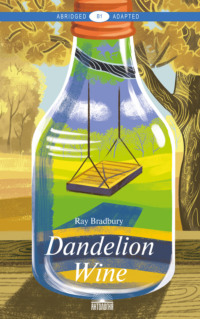
Kitobni o'qish: «Dandelion Wine / Вино из одуванчиков»
© Берестова А. И., адаптация, сокращение, словарь, 2023
© ООО «Издательство «Антология», 2023
* * *
JUST THIS SIDE OF BYZANTIUM1
An introduction
I must say that this book was a surprise. The nature of such surprises is that you begin your work around any word, or series of words that happens along in your head instead of trying to develop a made up idea. I call it a word-association process.
Thank God, I found this method quite early in my writing career. I would simply get out of bed each morning, walk to my desk, and put down some word. Then associations with that word would show me its meaning in my own life. An hour or two hours later, to my surprise, a new story would be finished and done. The surprise was total and lovely.
So, first I searched my mind for words that could describe my personal nightmares, fears of night from my childhood, and made stories from these.
Then I looked back at the green apple trees and the old house of my parents, and the house next door where my grandparents lived, and all the lawns of my childhood summers, and I began to try words for all that.
So in this book you have a gathering of dandelions from all those years. The wine metaphor which appears again and again in these pages is wonderfully appropriate. I was gathering images and impressions all of my life, and forgetting them. Words (like, for instance, dandelion wine) were catalysts that sent me back and opened the memories out, and helped me see what those memories had to offer.
From the age of twenty-four to thirty-six, it was my nearly every day game: to walk myself across a recollection of my grandparents’ northern Illinois grass in order to see how much I could remember about dandelions themselves or about picking wild grapes with my father and brother, and, perhaps, remember a fragment of a letter written to myself in some young year hoping to contact the older person I became to remind him of his past, his life, his people, his joys, and his sorrows.
I also wanted to see the ravine, especially on those nights when walking home late after seeing The Phantom of the Opera, my brother Skip would run ahead and hide under the ravine-creek bridge like the Lonely One and jump out and seize me, yelling, so that I ran, fell, and ran again, babbling all the way home. That was great stuff.
Through word-association in my game I came upon old and true friendships. I borrowed my friend John Huff from my childhood in Arizona and shipped him East to Green Town so that I could say good-bye to him properly.
In my recollections, I sat me down to breakfasts, lunches, and dinners with the long dead and much loved, for I was a boy who did indeed love his parents and grandparents and his brother, even when that brother “dumped” him.
Or I found myself on the front porch Independence night helping my Uncle Bion fire his home-made brass cannon.
When I learned to go back and back again to those times, I had plenty of memories and impressions to play with, not work with, no, play with. Dandelion Wine is just the boy-hid-in-the-man playing in the fields of the Lord on the emerald-green grass of other Augusts while starting to grow up, grow old, and feel darkness waiting under the trees to spill the blood.
A critical article analyzing Dandelion Wine amused and somewhat surprised me a few years ago. The author wrote about the ugliness of the harbor and how depressing the coal docks and railroad-yards were down below the town of Waukegan (which I named Green Town in my novel), and wondered why I, who had been born and grown up there, hadn’t noticed all that.
Naturally, I had noticed them but, being a genetic magician, I was fascinated by their beauty. Trains and boxcars and the smell of coal and fire are not ugly to children. Counting box-cars is a usual activity of boys. Their elders get annoyed at the train that blocks their way, but boys happily stand and count, and cry the names of the cars as they pass from far places.
As to that so-called ugly railroad-yard, it was where carnivals and circuses arrived with elephants that washed the brick pavements with mighty steaming acid waters at five in the dark morning.
As for the coal from the docks, I went down in my cellar every autumn to wait for the arrival of the truck and its metal chute, which shot down a ton of beautiful meteors that fell out of far space into my cellar and threatened to bury me beneath dark treasures.
In other words, if your boy is a poet, horse manure can only mean flowers to him and that, of course, is what horse manure has always been about.
In a poem of mine I tried to explain about the germination of all the summers of my life into one book.
I started the poem thus:
Byzantium, I come not from,
But from another time and place
Whose race was simple, tried and true;
As boy I dropped me forth in Illinois.
A name with neither love nor grace
Was Waukegan, there I came from
And not, good friends, Byzantium.
And yet in looking back I see
From topmost part of farthest tree
A land as bright, beloved and blue
As any Yeats 2 found to be true.
I mentioned Byzantium from the poem by Yeats because I wanted to show how old myths and legends became interwoven in the child’s imagination with the impressions and feelings of their real life.
I often visited Waukegan since my young years. It’s no more beautiful than any other small midwestern town. Much of it is green. The street in front of my old home is still paved with red bricks. Why then was the town special? Why, I was born there. It was my life. I had to write of it as I saw appropriate:
Not Illinois nor Waukegan
But blither sky and blither sun.
Though mediocre all our Fates
And Mayor not as bright as Yeats
Yet still we know ourselves. The sum?
Byzantium.
Byzantium.
Waukegan/Green Town/Byzantium.
So, Green Town did exist, and John Huff was the real name of a real boy. But he didn’t go away from me, I went away from him. And he is still alive, forty-two years later, and remembers our love.
There was also a Lonely One, and that was his name. And he moved around at night in my home town when I was six years old and he frightened everyone and was never caught.
And, of course, the big house itself, with Grandpa and Grandma and the boarders and uncles and aunts in it, existed.
The ravine, deep and dark at night, it was, and it is. I took my children there a few years ago. I can tell that the ravine is deeper, darker, and more mysterious than ever. I would not, even now, go home through there after seeing The Phantom of the Opera.
So that’s it. Waukegan was Green Town was Byzantium, with all the happiness that that means, with all the sadness that these names imply.
Here is my glorification, then, of both death and life, dark and light, old and young, bright and stupid combined, pure joy and complete horror written by a boy who once hung upside down in trees, and then fell out of the trees when he was twelve and went and took a notebook, and wrote his first “novel.”
And a final memory – fire balloons.
These days you don’t often see them, but in 1925 Illinois, we still had them. The last hour of a Fourth of July night many years ago is one of the last memories I have of my grandfather.Uncles and aunts and cousins and mothers and fathers were standing on the porch; Grandpa and I lit a small fire on the lawn and filled the pear-shaped red-white-and-blue-striped paper balloon with hot air. Then, very softly, we let that flickering thing go up on the summer air and away among the stars, as fragile, as wonderful, as vulnerable, as lovely as life itself.
I can still see my grandfather there looking up at that flickering drifting light, thinking his own quiet thoughts. And I see me, with eyes filled with tears, because it was all over, and I knew there would never be another night like this.
We all just looked up at the sky and thought the same things, but nobody said anything. Someone finally had to say. And that one is me.
The dandelion wine still stands in the cellars below.
My beloved family still sits on the porch in the dark.
The fire balloon still drifts and burns in the night sky of an as yet unburied summer.
Why and how?
Because I say it is so.
Ray BradburySummer, 1974
DANDELION WINE
It was still dark, and the town was still sleeping. Summer was felt in the warm early morning air. You had only to get up, go to the window, breath in and know that this indeed was the first real time of freedom and living, this was the first morning of summer.
Douglas Spaulding, twelve years of age, awoke in his third-story cupola bedroom. He let himself idle a little on this first early morning of a long summer ahead. Lying in bed in the grandest tower in town, he felt the tall power it gave him, riding high in the June wind. Now a familiar task awaited him.
One night each week he was allowed to leave his father, his mother, and his younger brother Tom in their small house next door and run here, up the dark spiral stairs to his grandparents’ cupola, and sleep in this magician’s tower with thunders and visions, then wake before the crystal tinkle of milk bottles and perform his ritual magic.
He went to the open window in the dark, deeply breathed in, and exhaled.
At once, the street lights went out. He exhaled again and again, and the stars began to disappear.
Douglas smiled. He started to point a finger in various directions, and yellow house lights began to wink in the darkness.
“Everyone yawn. Everyone up.”
The great house awoke below.
“Grandpa, get your teeth from the water glass!”
He waited some time. “Grandma and Great-grandma, fry hot cakes!”
The warm smell of frying cakes drifted through the house and stirred the boarders, the aunts, the uncles, the visiting cousins, in their rooms.
“Street where all the Old People live, wake up! Miss Helen Loomis, Colonel Freeleigh, Miss Bentley! Cough, get up, take your pills, move around!”
“Mom, Dad, Tom, wake up.”
Clock alarms tinkled faintly. The courthouse clock boomed. Birds flew up from trees like a net thrown by his hand, singing. Douglas, conducting an orchestra, pointed to the eastern sky.
The sun began to rise.
He smiled a magician’s smile. Yes, sir, he thought, everyone jumps, everyone runs when I order. It’ll be a fine season. He gave the town a last snap of his fingers.
Doors opened; people stepped out.
Summer 1928 began.
Douglas Spaulding felt that this day was going to be different. His father’s words, as he was driving Douglas and his ten-year-old brother Tom out of town toward the country, also meant that the day would be different. His father said that some days were just a mixture of smells, nothing but the world blowing in one nostril and out the other. Other days, he went on, were days of hearing every sound and trill of the universe. Some days were good for tasting and some for touching. And there were days that were good for all the senses at once. This day now, he said, smelled as if a great orchard had grown up overnight beyond the hills and filled the whole land with its warm freshness. The air felt like rain, but there were no clouds. In a moment, a stranger might laugh in the woods, but there was silence…
Douglas watched the land along the road. He smelled no orchards and sensed no rain, for he knew that without apple trees or clouds they could not exist. And as for that stranger laughing in the woods…?
But nevertheless, Douglas knew – this, without reason, was a special day.
The car stopped at the very center of the quiet forest, and they got out.
“Look for bees,” said Father. “Bees hang around grapes like boys around kitchens.”
They walked through the forest, and soon, Father pointed and said that there was where the big summer- quiet winds lived and passed in the green depths, like ghost whales, unseen.
Douglas looked quickly, saw nothing, and felt tricked by his father who, like Grandpa, lived on riddles. But… But, still… Douglas paused and listened.
Yes, something’s going to happen, he thought, I know it! We’re surrounded! he thought. It’ll happen! Come out, wherever you are, whatever you are! he cried silently.
Tom and Dad walked on ahead.
Now, thought Douglas, here it comes! Running! I don’t see it! Running! Almost on me!
“Fox grapes!” said Father. “We’re in luck, look here!”
Don’t! Douglas gasped.
But Tom and Dad started to pick up wild berries. The spell was broken. Douglas didn’t feel the magic running force any more. He dropped to his knees and started to pick up wild grapes.
“Lunch time, boys!”
With buckets half full with fox grapes and wild strawberries, they went to sit on a log followed by bees. Father said the bees were the world humming under its breath.They sat on the log, eating sandwiches and trying to listen to the forest the same way Father did.
“Sandwich outdoors isn’t a sandwich anymore,” Father said, “tastes different than indoors, notice? Got more spice. Tastes like mint and pinesap. Does wonders for the appetite.”
Douglas chewed and didn’t feel any difference, it was just a sandwich.
Tom chewed and nodded. “I know just what you mean, Dad!”
Douglas thought about that strange feeling that something was running on him. Where is it now? Behind that bush! No, behind me! No here… almost here… He touched his stomach secretly.
He decided to wait; he knew it would come back. He also knew somehow that it wouldn’t hurt him. But what was it?
“You know how many baseball games we played this year, last year, year before?” asked Tom without any reason. Douglas watched Tom’s quickly moving lips.
“I wrote it down! One thousand five hundred sixty-eight games! How many times I brushed my teeth in ten years? Six thousand! Washing my hands: fifteen thousand. Ate six hundred peaches, eight hundred apples. Pears: two hundred. I don’t like pears very much. I’ve got statistics for everything! When I add up all things I’ve done in ten years, it will be billion millions.”
Douglas felt that unknown something coming close again. Why? Tom talking? But why Tom? Tom continued his statistics, enumerating books and matinees he had read and seen.
“During that time I think I’ve eaten four hundred lollipops, three hundred Tootsie Rolls, seven hundred icecreams…
Dad asked, “How many berries you’ve picked so far, Tom?”
“Two hundred fifty-six!” said Tom instantly.
Dad laughed and lunch was over and they started to pick up fox grapes and wild strawberries again. And again Douglas felt something was going to happen. He thought yes, it’s near again! Breathing on my neck, almost! Don’t look! Just work, fill up the bucket. If you look you’ll scare it off. Don’t lose it this time! But how do you bring it around here where you can see it, stare it right in the eye?
“Got a snowflake in a matchbox,” said Tom, smiling at his hand, red with berries juice.
Douglas wanted to yell at him, to stop him talking, but he thought the yell would scare the Thing away.
Then he noticed that the more Tom talked, the closer the great Thing came, it wasn’t scared of Tom. Tom attracted it with his breath, he was part of it!
Tom continued to explain how in February during a snowstorm he had let one snowflake fall in a matchbox and put the matchbox in the icebox.
The thing was close, very close. Douglas stared at Tom’s moving lips. He wanted to jump around, for he felt a huge wave lift up behind the forest. In an instant it would fall down, crush them forever…
“Yes, sir,” Tom said, picking grapes, “I’m the only guy in all Illinois who’s got a snowflake in summer. Precious as diamonds. Tomorrow I’ll open it. Doug, you can look, too…”
Any other time Douglas might have laughed and denied it all. But now, when the great Thing was running near, falling down in the clear air above him, he could only nod, with his eyes shut.
As Tom didn’t get any reaction from his brother, he stopped picking berries and turned to him. Douglas, hunched over, was an ideal target. Tom jumped on him, yelling. They fell and rolled.
At first Douglas was afraid that the great Thing would be scared off, but no… it was all right! Their falling tumble had not scared off the tidal wave that crashed now, rolling them along the grass. Knuckles struck his mouth. He tasted warm blood, clutched Tom, held him tight, and so in silence they lay, breathing hard. Then, slowly, afraid he would find nothing, Douglas opened one eye.
And everything, absolutely everything, was there.
The world, like a gigantic eye, which has also just opened and stretched out to embrace everything, stared back at him.
And suddenly he understood what had jumped on him and it would not run away now.
I’m alive, he thought.
He let go of Tom and lay on his back holding his hand up and looking at his fingers through which the sun rays streamed making them look like a red flag.
The grass whispered under his body. The wind sighed over his ears. Ten thousand individual hairs grew a millionth of an inch on his head. He heard the twin hearts beating in each ear, the third heart beating in his throat, the two hearts pulsating in his wrists, the real heart throbbing in his chest. The million pores on his body opened.
I’m really alive! he thought. I never knew it before, or if I did I don’t remember!
He yelled it loudly but silently, a dozen times! Twelve years old and only now discovering this rare timepiece, this gold-bright clock and guaranteed to run three-score and ten, left under a tree and found while wrestling.
“Doug, you okay?” asked Tom.
Douglas yelled, grabbed Tom, and rolled.
They rolled downhill, laughing till they cried.
“Doug, you’re not mad?”
“No, no!”Douglas said excitedly and then asked quietly, “Tom… does everyone in the world… know he’s alive?”
“Sure. Heck, yes!”
“I hope they do,” whispered Douglas. “Oh, I sure hope they know.”
Douglas looked at his father, who was standing high above him there in the green-leaved sky, laughing. Their eyes met. Douglas understood. Dad knows, he thought. It was all planned. He brought us here on purpose, so this could happen to me! He knows it all. And now he knows that I know.
Dad helped him to his feet. He swayed a little, still puzzled and awed. Then he looked at Dad and Tom.
“I’ll carry all the buckets,” he said. “This once, let me haul everything.”
They handed over their buckets with quizzical smiles.
He stood swaying slightly under the heavy weight of the buckets full ofjuicy forest riches. I want to feel all there is to feel, he thought. Let me feel tired, now. I mustn’t forget, I’m alive, I know I’m alive, I mustn’t forget it tonight or tomorrow or the day after that.
The bees followed and the smell of fox grapes and yellow summer followed as he walked through the forest toward that incredible highway which would take them back to the town. His brother and his quiet father followed behind.
Later in the day there was another harvest.
Grandfather stood on the wide front porch questioning the wind and the high sky and the lawn on which stood Douglas and Tom to question only him.
“Grandpa, are they ready? Now?”
Grandfather pinched his chin. “Five hundred, a thousand, two thousand easily. Yes, yes, a good supply. Pick ’em easy, pick ’em all. A dime for every sack delivered to the press!”
The boys smiled and started to pick the golden flowers. The flowers that flooded the world, dripped off lawns onto brick streets, tapped softly at crystal cellar windows and agitated themselves so that on all sides lay the dazzle and glitter of molten sun.
“Every year,” said Grandfather. “They run amok; I let them. Pride of lions in the yard. A common flower, a weed that no one sees, yes. But for us, a noble thing, the dandelion.”
So, the dandelions in sacks were carried into the cellar, and its darkness glowed with their arrival. Grandfather operated the wine-press, and the golden tide, the essence of this fine fair month ranfrom the spout below. Then it was to be bottled in clean ketchup shakers and put in sparkling rows in cellar gloom.
Dandelion wine.
The words were summer on the tongue. The wine was summer caught and sealed. Douglas was glad that now when he really knew he was alive, some of his new knowledge, some of this special vintage day would be sealed away and could be opened on a January day. The snow would be falling fast and there would be no sun for weeks, or months, and perhaps some of the miracle would be by then forgotten and in need of renewal. Since this was going to be a summer of unexpected wonders, he wanted it all saved and labeled so that any time he wished, he might go to the cellar, and there the rows of the dandelion wine would stand, with the soft gleam of flowers opened at morning, with the light of this June sun glowing through a light layer of dust on the bottles. Look through it at the wintryday – the snow melted to grass, the trees were in green leaf and blossoms again, and the sky turned from iron to blue.
Hold summer in your hand, pour summer in a glass, change the season in your veins by raising glass to lip and tilting summer in.
Even Grandma, one cold windy day in February, would vanish to the cellar.
Above, in the vast house, there would be coughings, sneezings, and groans, childish fevers, sore throats, red noses, the stealthy microbe everywhere.
Then, rising from the cellar like a June goddess, Grandma would come, something hidden but obvious under her shawl. This, carried to every miserable room, would be poured into neat glasses and swigged neatly. The medicines of another time, the balm of sun and idle August afternoons, the sounds of ice wagons passing on brick avenues, and of lawn mowers moving through ant countries, all these, all these in a glass.
Dandelion wine. Dandelion wine. Dandelion wine.
These fine and golden words would be repeated every winter for all the white winters in time. Saying them over and over on the lips, like a smile, like a sudden patch of sunlight in the dark.
The boys of summer were running. The grass sprang up again behind them. They passed like cloud shadows downhill.
Douglas, left behind, stopped at the edge of the ravine. This ravine divided the town in halves. Here civilization ceased. Here was only growing earth, and here were the paths, made or yet unmade, that told of the need of boys traveling, always traveling, to be men.
Douglas turned. This winding path led to the icehouse where winter lived on the yellow days. This path ran to the hot sands of the lake shore in July. This to trees where boys might grow like sour and still-green crab apples, hidden among leaves. This to peach orchard, grape arbor, watermelons lying like tortoise-shell cats sleeping in the sun. That path, now deserted, to school! This, straight as an arrow, to Saturday cowboy matinees. And this, by the creek waters, to wilderness beyond town…
Who could say where town or wilderness began? There was always and forever some indefinable place where the two struggled for possession of a certain avenue, a tree, a bush. Each night the wilderness, the meadows, the far country flowed down-creek through ravine and flowed up in town with a smell of grass and water, and the town was gone back to earth. And each morning a little more of the ravine inched up into town, threatening to sink garages like leaking rowboats, swallow ancient cars which had been left to the mercies of rain and therefore rust.
“Hey! Hey!” John Huff and Charlie Woodman ran through the mystery of ravine and town and time. “Hey!”
Douglas went slowly down the path. The ravine was indeed the place where you came to look at the two things of life, the ways of man and the ways of the natural world. The town was, after all, only a large ship filled with constantly moving survivors, cutting the grass, chipping away the rust. Now and again a lifeboat, a shanty, related to the mother ship, lost out to the quiet storm of seasons, sank down in silent waves of termite and ant into swallowing ravine, and finally, in avalanche of shingle and tar, collapse into a bonfire, which thunderstorms ignited with blue lightning, while flash-photographing the triumph of the wilderness.
This mystery of man seizing from the land and the land seizing back, year after year, attracted Douglas. The towns never really won, they merely existed in calm danger, fully equipped with lawn mower, bug spray and hedge shears, swimming steadily as long as civilization said to swim, but each house ready to sink in green tides, buried forever, when the last man passed away and his equipment turned to flakes of rust.
The town. The wilderness. The houses. The ravine. Douglas looked around. But how to relate the two, make sense of the interchange when…
“Doug… come on… Doug…” The running boys vanished.
The first ritual of summer, the dandelion picking, the starting of the wine, was over. Now the second ritual waited for him to make the motions, but he stood very still.
“I’m alive,” thought Douglas. “But they’re more alive than me. How come?” He looked at his motionless feet and knew the answer…
That evening, on his way home from the show with his mother and father and his brother Tom, Douglas saw the tennis shoes in the bright store window. He looked quickly away, but his feet felt as if he was rushing, and the shop awnings flapped their canvas wings overhead because of the wind made by his body running. His mother and father and brother walked quietly on both sides of him.
“It was a nice movie,” said Mother.
Douglas murmured, “It was…”
It was June and long past time for buying the special shoes that were quiet as a summer rain falling on the walks. June and the earth full of life and everything everywhere in motion. The grass was still pouring in from the country, surrounding the sidewalks and the houses. Any moment the town would go down and leave not a stir in the clover and weeds. And here Douglas stood on the dead cement and the red-brick streets, hardly able to move.
“Dad! Back there in that window, those Cream-Sponge Para Litefoot Shoes…”
His father didn’t even turn. “Can you tell me why you need a new pair of sneakers?”
“Well…”
It was because they felt the way it feels every summer when you take off your shoes for the first time and run in the grass.
“Dad,” said Douglas, “it’s hard to explain.”
Somehow the people who made tennis shoes knew what boys needed and wanted. Whatever it was, it was in the shoes, and it was summer.
Douglas tried to get all this in words.
“Yes,” said Father, “but what’s wrong with last year’s sneakers?”
Douglas felt sorry for boys who lived in California where they wore tennis shoes all year and never knew what it was to get winter off your feet, take off the leather shoes all full of snow and rain and run barefoot for a day and then lace on the first new tennis shoes of the season, which was better than barefoot. The magic was always in the new pair of shoes. The magic might die by the first of September, but late June was still full of magic, and shoes like these could jump you over trees and rivers and houses. And if you wanted, they could jump you over fences and sidewalks and dogs.
“Don’t you see?” said Douglas. “I just can’t use last year’s pair.”
For last year’s pair were dead inside. They had been fine last year when he had started to wear them. But by the end of summer, every year, you always knew, you couldn’t really jump over rivers and trees and houses in them, and they were dead. But this was a new summer, and he felt that with this new pair of shoes, he could do anything, anything at all.
“Save your money,” said Dad. “In five or six weeks —”
“Summer’ll be over!”
That night Douglas lay watching his feet in the moonlight, free of the heavy winter shoes, the big lumps of winter fallen away from them.
“Reasons. I’ve got to think of reasons for the shoes.”
Well, first of all, the hills around town were full of friends. They were frightening away cows, playing barometer to the atmospheric changes, taking sun from dawn to sunset. To catch those friends, you must run much faster than foxes or squirrels. As for the town, it was full of enemies who got irritable with heat and remembered every winter argument and insult. Find friends, dump enemies! That was the Cream-Sponge Para Litefoot motto. Does the world run too fast? Want to catch up? Want to be agile, stay agile? Litefoot, then! Litefoot!”
He shook his coin bank and heard the faint small tinkling, the light weight of money there.
Whatever you want, he thought, you got to make your own way. During the night now, let’s find that path through the forest…
Downtown, the store lights went out. In his dreams he heard a rabbit running in the deep warm grass.
Old Mr. Sanderson moved through his shoe store as the owner of a pet shop must move through his shop touching each animal in passing. Mr. Sanderson brushed his hands over the shoes in the window, and some of them were like cats to him and some were like dogs; he touched each pair with care, adjusting laces, fixing tongues. Then he stopped in the center of the carpet and looked around, nodding.
There was a sound of growing thunder.
One moment, the door to Sanderson’s Shoe Emporium was empty. The next, Douglas Spaulding stood there, staring down at his leather shoes as if these heavy things could not be pulled up out of the cement. The thunder had stopped when his shoes stopped. Then, looking only at the money in his cupped hand, Douglas moved out of the bright sunlight of Saturday noon. He started to put nickels, dimes, and quarters on the counter and worried if the next move carried him out into sun or deep into shadow. “Don’t say a word!” said Mr. Sanderson.
Douglas froze.
“First, I know just what you want to buy,” said Mr. Sanderson. “Second, I see you every afternoon at my window; you think I don’t see? You’re wrong. Third, to give it its full name, you want the Royal Crown Cream-Sponge Para Litefoot Tennis Shoes: ‘LIKE MENTHOL ON YOUR FEET!’ Fourth, you want credit.”
“No!” cried Douglas. He was breathing hard, as if he’d run all night in his dreams. “I got something better than credit to offer!” Then he asked Mr. Sanderson when he himself had worn a pair of Litefoot sneakers.
Mr. Sanderson’s face darkened. “Oh, ten, twenty, say, thirty years ago. Why..?”
“Mr. Sanderson, don’t you think you owe it to your customers, sir, to at least try the tennis shoes you sell, for just one minute, so you know how they feel? People forget if they don’t keep testing things. United Cigar Store man smokes cigars, doesn’t he? Candy-store man tastes his own stuff, I think. So…”
“You can see,” said the old man, “I’m wearing shoes.”
“But not sneakers, sir! How are you going to sell sneakers if you cannot praise them and how are you going to praise them if you don’t know them?”
“Well…,” said Mr. Sanderson.
“Mr. Sanderson,” said Douglas, “you sell me something and I’ll sell you something just as valuable.”
The old man sighed but agreed to put on a pair of the sneakers.
“How do they feel?” asked the boy when Mr. Sanderson stood up.
“They feel fine.” He started to sit down.
“Please!” Douglas held out his hand. “Mr. Sanderson, now could you kind of rock back and forth a little, bounce kind of, while I tell you the rest? It’s this: I give you my money, you give me the shoes, I owe you a dollar. But, Mr. Sanderson, as soon as I get those shoes on, you know what happens?”
“What?”
“Bang! I deliver your packages, pick up packages, bring you coffee, dump your trash, run to the post office, telegraph office, library! You’ll see me in and out, in and out, every minute. Feel those shoes, Mr. Sanderson, feel how fast they’d take me? Feel all the running inside? Feel how they don’t like you just standing there? Feel how quickly I’ll be doing all those things for you? You stay in the nice cool store while I’m jumping all around town! But it’s not me really, it’s the shoes. They’re going like mad down alleys, cutting corners, and back!”
The flow of the words carried Mr. Sanderson, and he began to sink deep in the shoes, to flex his toes, test his ankles. He rocked softly, secretly, back and forth in a small breeze from the open door. The tennis shoes silently sank themselves deep in the carpet, as in a jungle grass. Emotions ran over his face as if many colored lights had been switched on and off. Slowly he rocked himself to a halt, and the boy stopped talking, and they stood there looking at each other in a wonderful and natural silence.
“Boy,” said the old man at last, “in five years, how would you like a job selling shoes in this Emporium?”
“Gosh, thanks, Mr. Sanderson, but I don’t know what I’m going to be yet.”
“Anything you want to be, son,” said the old man, “you’ll be. No one will ever stop you.”
The old man walked lightly across the store to the wall of shoe boxes, came back with the tennis shoes for the boy, and wrote up a list on some paper while the boy was lacing the shoes on his feet and then standing there, waiting.
The old man gave him his list. “A dozen things you got to do for me this afternoon. Finish them, we’re even, and you’re fired.”
“Thanks, Mr. Sanderson!” Douglas jumped away.
“Stop!” cried the old man.
Douglas stopped and turned.
“How do they feel?” Mr. Sanderson asked.
The boy looked down at his feet deep in the rivers, in the fields of wheat, in the wind that already was rushing him out of the town. He looked up at the old man.His eyes were burning, but no sound came out of his mouth.
“Antelopes?” said the old man, looking from the boy’s face to his shoes. “Gazelles?”
The boy thought about it and nodded a quick nod. Almost immediately he vanished. The door stood empty. The sound of the tennis shoes faded in the jungle heat.
Mr. Sanderson stood in the sun-lit up door, listening. From a long time ago, when he dreamed as a boy, he remembered the sound. Beautiful creatures leaping under the sky, gone through bushes, under trees, away, and only the soft echo of their running left behind.
“Antelopes,” said Mr. Sanderson. “Gazelles.”
He picked up the boy’s winter shoes, left behind, heavy with forgotten rains and long-melted snows. Moving out of the hot sun, walking softly, lightly, slowly, he turned back toward civilization…
Tom’s statistics gave Douglas a fresh idea. He decided to write down all the things they usually did every summer in one part of his yellow nickel notebook, under the title RITES AND CEREMONIES, and in the other part he was going to register things they did for the first time. The title of that part was DISCOVERIES AND REVELATIONS.
“Like eating olives?” Tom asked.
“More important than that. Like finding out maybe that Grandpa and Dad don’t know everything in the world.”
“They know every dam’ thing there is to know, and don’t you forget it!”
“Tom, don’t argue, I’ve already written it down under Discoveries and Revelations. They don’t know everything. But it’s no crime. That I discovered, too.”
“What other new crazy stuff you got in there?”
“I’m alive.”
“Heck, that’s old!”
“Thinking about it, noticing it, is new. You do things and don’t watch. Then all of a sudden you look and see what you’re doing and it’s the first time, really. In other words, you do an old familiar thing, like bottling dandelion wine, and you put that under RITES AND CEREMONIES. And then you think about it, and what you think, crazy or not, you put under DISCOVERIES AND REVELATIONS. Here’s what I got on the wine: Every time you bottle it, you got a whole lump of 1928 put away, safe. How do you like that, Tom?”
“Can’t say I got it at all.”
“Well, here’s another. Under CEREMONIES I got: First argument and licking of Summer 1928 by Dad, morning of June 24th. Under REVELATIONS I got: The reason why grown-ups and kids fight is because they belong to separate races. Look at them, different from us. Look at us, different from them. Separate races, and never the two shall meet.”
“Doug, you hit it, you hit it! That’s right! That’s exactly why we don’t get along with Mom or Dad. Trouble, trouble, from sunrise to supper! Boy, you’re a genius!”
“So, when you see something done over and over, tell me. Think about it, and tell me that.”
“I got a statistic for you right now. Take your pencil, Doug. There are five billion trees in the world. I looked it up. Under every tree is a shadow, right? So, then, what makes night? I’ll tell you: shadows crawling out from under five billion trees! If only we could find a way to keep those dam five billion shadows under those trees, we could stay up half the night, Doug, because there’d be no night! There you are; something old, something new.”
“That’s old and new, all right.” Douglas licked his favorite yellow pencil. “Say it again.”
“Shadows are under five billion trees…”
Summer was full of rituals, each with its natural time and place. The ritual of lemonade or ice-tea making, the ritual of wine, shoes, or no shoes, and at last, the ritual of the front-porch swing.
On the third day of summer in the late afternoon Grandfather came out from the front door and looked at the two empty rings in the ceiling of the porch. He moved to the geranium-pot-lined rail, wet his finger to test the wind, and took off his jacket to see how it felt in shirt sleeves in the evening. He answered the salutes of other captains on yet other flowered porches, out themselves to see if it was warm enough, deaf to their wives chattering behind black porch screens.
“All right, Douglas, let’s set it up.”
They found the swing chair in the garage, dusted it, brought it to the porch, and Grandpa chained it to the porch-ceiling rings. The swing was, in fact, the most important thing for the quiet summer-night festivals.
Douglas, being lighter, was first to sit in the swing. Then, after a moment, Grandfather cautiously settled his pontifical weight beside the boy. Thus they sat, smiling at each other, nodding, as they swung silently back and forth, back and forth.
Ten minutes later Grandma appeared with water buckets and brooms to wash down and sweep off the porch. Other chairs, rockers and straight-backs, were brought from the house.
“Always like to start sitting early in the season,” said Grandpa, “before the mosquitoes thicken.”
About seven o’clock various sounds could be heard from the house: the chairs scraping back from the tables, someone experimenting with a yellow-toothed piano, matches being struck, the first dishes bubbling in the suds and tinkling on the wall racks, somewhere, faintly, a phonograph playing. And then at house after house on the twilight streets, under the huge oaks and elms, on shady porches, people would begin to appear.
Uncle Bert, perhaps Grandfather, then Father, and some of the cousins – the men all would come out first into the warm evening, blowing smoke, leaving the women’s voices behind, in the kitchen, to set their universe in order. Then the first male voices would be heard under the porch roof, their feet up, the boys sat on the worn steps or wooden rails where sometime during the evening something, a boy or a geranium pot, would fall off.
At last, Grandma, Great-grandma, and Mother would appear, and the men would move, and offer seats. The women carried folded newspapers, bamboo whisks, or perfumed kerchiefs, to fan their faces with, as they talked.
Sitting on the summer-night porch was so good, so easy and so reassuring. These were rituals that were right and lasting; the lighting of pipes, the pale hands that moved knitting needles in the dimness, the eating of ice cream, the coming and going of all the people. For at some time or other during the evening, everyone visited here: the neighbors down the street or across the street; Miss Fern and Miss Roberta would drive by in their electric green machine, give Tom or Douglas a ride around the block and then come up and sit down and fan away the fever in their cheeks; or Mr. Jonas, the junkman, would leave his horse and wagon in the alley and come up the steps looking as fresh as if his talk had never been said before, and somehow it never had. And last of all, the children, who had been off playing a last hide-and-seek or kick-the-can, breathing hard, glowing, would sickle quietly back like boomerangs along the soundless lawn, to sink beneath the talking talking talking of the porch voices which would weigh and gentle them down…
Douglas loved to lie there quietly, listening to those voices weaving the dark together. The grown-ups had forgotten he was there, so still, so quietly he lay, noting the plans they were making for his and their own futures. And the voices drifted in moonlit clouds of cigarette smoke while the moths, like late apple-blossoms came alive, tapped lightly about the far street lights, and the voices moved on into the coming years…
In front of the United Cigar Store this evening the men gathered and talked about the destruction that threatened human kind through all modern machines and inventions.Their sepulchral speeches distressed Leo Auffmann, the town jeweler, who, widening his large liquid-dark eyes, at last threw up his childlike hands and cried out in dismay.
“Stop! In God’s name, stop this funereal talk!”
“Lee, how right you are,” said Grandfather Spaulding, passing on his nightly stroll with his grandsons Douglas and Tom. “But, Lee, only you can shut these doom-talkers up. Invent something that will make the future brighter, more comforting and joyful. You’ve invented bicycles, repaired the penny slot-machines in the playing arcade, been our town movie projectionist, haven’t you?”
“Sure,” said Douglas. “Invent us a happiness machine!”
The men laughed.
“Don’t laugh,” said Leo Auffmann. “How have we used machines so far? To make people cry! Yes! Every time man and the machine look like they will get on all right – boom! Someone adds a cog, and airplanes drop bombs on us, cars run us off cliffs. So is the boy wrong to ask? No! No…”
He went to the curb to his bicycle and touched it as if it were an animal.
“What can I lose?” he murmured. “A little skin off my fingers, a few pounds of metal, some sleep? I’ll do it!”
“Lee,” said Grandfather, “we didn’t mean —”
But Leo Auffmann was gone, pedaling off through the warm summer evening, his voice drifting back. “…I’ll do it…”
“You know,” said Tom, in awe, “I bet he will.”
When seeing him riding along the brick streets of evening, you understood that Leo Auffmann enjoyed everything around him: the rustle of the hot grass when the wind blew like a furnace, or the singing of the electric power lines in the wind.
Now, pedaling along, he thought about the shocks of life – what were they? Getting born, growing up, growing old, dying. Not much to do about the first. But – the other three?
In his head now, golden spokes of the spinning wheels of his Happiness Machine sparkled. A machine, now, to help boys grow brave and strong, girls change from an ugly duckling to a white swan. And in the late years of your life, as you lie abed at nights, and your heartbeat is increasing to a billion, his invention must let a man take the autumn of his life easy.
When he arrived home, his six children, Saul, Marshall, Joseph, Rebecca, Ruth, Naomi, all ages from five to fifteen, rushed across the lawn to take his bike. They hugged him all at once.
“We waited. We got ice cream!”
Moving toward the porch, he could feel his wife’s smile there in the dark.
Five minutes the family ate ice cream in comfortable silence, then he said, “Lena? What would you think if I tried to invent a Happiness Machine?”
“Is something wrong?” she asked quickly.
Before Grandfather and the boys could reach home, Charlie Woodman and John Huff and some other boys rushed by like meteors. Their gravity was so huge they pulled Douglas away from Grandfather and Tom and took him off toward the ravine.
“Don’t get lost, son!”
“I won’t… I won’t…”
The boys disappeared into darkness.
Tom and Grandfather walked the rest of the way in silence, except when they turned in at home and Tom said, “boy, a Happiness Machine – wow!”
The courthouse clock struck eight.
The courthouse clock struck nine and it was really night on this small street in a small town in a big state on a large continent on a planet earth hurtling down the pit of space toward nowhere or somewhere, and Tom was feeling every mile of the long drop. He sat by the front-door screen looking out at that rushing blackness that looked very innocent as if it was holding still. Only when you closed your eyes and lay down could you feel the world spinning under your bed.
There was a smell of rain. Mother was ironing and sprinkling water from a corked ketchup bottle over the crackling dry clothes behind Tom.
One store was still open about a block away – Mrs. Singer’s.
Finally, just before it was time for Mrs. Singer to close her store, Mother relented and told Tom to run to Mrs. Singer’s and buy a pint of ice cream.
He took the money and ran barefooted over the warm evening pavement. He crossed the street and found Mrs. Singer moving about her store, singing Yiddish melodies.
“Pint ice cream?” she said. “Chocolate on top? Yes!”
He gave the money, received the chill, icy pack, and rubbing it across his brow and cheek, laughing, rushed homeward. Behind him the lights of the lonely little store went out and there was only a street light on the corner, and the whole city seemed to be going to sleep.
Mother was still ironing when he opened the screen door. She looked hot and irritated but she smiled just the same.
“When will Dad be home from his meeting?” he asked.
“About eleven or eleven-thirty,” Mother said. She took the ice cream to the kitchen and put two portions away, for Douglas and Father when they come.
They sat enjoying the ice cream. The deep quiet summer night was around them, all around their small house on the small street. Mother sat in the armchair by the phonograph, eating her dessert and saying, “It was a hot day. Earth soaks up all the heat and lets it out at night. It’ll be soggy sleeping.”
They both sat listening to the night. The silence was complete because the radio needed a new battery, and they had played all the records on the phonograph to exhaustion. So Tom just sat on the floor and looked out into the darkness, pressing his nose against the screen.
“I wonder where Doug is. It’s almost nine-thirty.”
“He’ll be here,” Tom said, knowing very well that Douglas would be.
Mother went to the kitchen to wash the dishes, and he followed her. Then, silently, they went to the living room, removed the couch cushions and, together, opened it and extended it down into the double bed it secretly was. Mother made the bed, plumping up pillows for their heads. But she stopped him when he started unbuttoning his shirt saying, “Wait awhile, Tom.”
“Why?”
“Because I say so.”
“You look funny, Mom.”
Mom went to the door and called, “Douglas, Douglas, oh Doug! Douglasssssss!” over and over. There was no answer. She stepped out into the night, walked under the lilac bush, and called again.
Silence.
She called twice more. Tom sat in the room. Any moment now, Douglas would answer from down the long narrow street, “All right, Mom! All right, Mother! Hey!”
But he didn’t answer. Mother came back and said, “Come on, Tom. We’ll take a walk.”
“Where to?”
“Just down the block. Come on.”
They walked down the dark street. The crickets were sounding louder against the darkening dark. They reached a corner, turned, and walked toward the West Ravine.
There was such a complete lack of life, light, and activity. Here and there, in the distance, dim squares of light glowed where people were still up. But most of the houses, darkened, were sleeping already, and there were a few darkhouses where the occupants still sat talking low night talk on their front porches.
“I wish your father was home,” said Mother. Her large hand squeezed around his small one. “Just wait till I get that boy. The Lonely One’s around again. Killing people. No one’s safe anymore. You never know when the Lonely One’ll turn up or where. So help me, when Doug gets home I’ll give him a sound thrashing.”
Now they had walked another block and were standing by the black silhouette of the German Baptist Church. In back of the church, a hundred yards away, the ravine began. He could smell it. It had a dark-sewer, rotten-foliage odor. The wide ravine cut and twisted across town – a jungle by day, a place to let alone at night, Mother often declared.
He was only ten years old. He knew little of death, fear, or dread. Death was the waxen figure in the coffin when he was six and Great-grandfather died, silent, withdrawn, no more to tell him how to be a good boy, no more to comment briefly on politics. Death was his little sister one morning when he awoke at the age of seven, looked into her crib, and saw her staring up at him with a blind, blue, fixed and frozen stare until the men came with a small wicker basket to take her away. Death was when he stood by her high chair four weeks later and suddenly understood that she’d never be in it again, laughing and crying and making him jealous of her because she was born. That was death. And Death was the Lonely One, unseen, walking and standing behind trees, coming from the country, once or twice a year, to this town, to these streets, to these many places where there was little light, to kill one, two, three women in the past three years. That was Death…
But this was more than Death. This dark, dark summer night was all things you would ever feel or see or hear in your life, drowning you all at once.
They walked along a weed-fringed path while the crickets’ chorus rose in a loud full drumming. He followed obediently behind brave, fine, tall Mother – defender of the universe. Together, they reached and paused at the very end of civilization.
The Ravine.
Here and now, down in that pit of black jungle were suddenly all the things he would never know or understand; all the things without names lived in the deep tree shadow, in the odor of decay.
He and his mother were alone.
Her hand trembled. He realized his mother was frightened. It was a shock for him. So, she, too, felt that nameless threat from that darkness, that malignancy down below. Was there, then, no strength in growing up? No consolation in being an adult? No worldly citadel strong enough to stand up to the dreadful attack of midnights? Doubts flooded him. He was suddenly cold as a wind out of December.
He realized that all men were like this; that each person was to himself one alone. A unit in a society, but always afraid. Like here, standing. If he should scream for help, would it matter?
Blackness could come and swallow quickly; in one freezing moment all would be finished. Long before dawn, long before police with flashlights might come, long before worried men could rustle down the pebbles to his help. Even if they were within five hundred yards of him now, and help certainly was, in three seconds a dark wave could rise to take all ten years from him and —
The shock of life’s loneliness crushed his beginning-to- tremble body. Mother was alone, too. She could not look to the sanctity of marriage, the protection of her family’s love, she could not look to the United States Constitution or the City Police, she could not look anywhere, in this very moment, except into her heart, and there she would only find uncontrollable disgust and fear. In this moment it was an individual problem looking for an individual solution. He must accept being alone and work on from there.
He clung to his mother. Oh, Lord, don’t let her die, please, he thought. Don’t do anything to us. Father will be coming home from his meeting in an hour and if the house is empty —
Mother went down the path into the primeval jungle. His voice trembled. “Mom, Doug’s all right. He’s all right!”
Mother’s voice was strained, high. “He always comes through here. I tell him not to, but those kids, they come through here anyway. Some night he’ll come through and never come out again —”
Never come out again. That could mean death!
Alone in the universe.
There were a million small towns like this all over the world, with no lights, but many shadows. Oh, the vast loneliness of them. The secret damp ravines of them. Life was a horror lived in them at night, when at all sides sanity, marriage, children, happiness, were threatened by an ogre called Death.
Mother raised her voice into the dark. “Doug! Douglas!”
Suddenly both of them felt something was wrong.
The crickets’ chorus had stopped. Silence was absolutely complete.
Why should the crickets stop? Why? What reason? They’d never stopped before. Not ever.
Something was going to happen.
The silence was growing, growing; the tenseness was growing, growing. Oh, it was so dark, so far away from everything!
And then, a way off across the ravine:
“Okay, Mom! Coming, Mother!”
And again: “Hi, Mom! Coming, Mom!”
And then the sound of tennis shoes running down through the pit of the ravine as three kids came racing, giggling. His brother Douglas, Chuck Woodman, and John Huff.
The crickets sang!
The darkness pulled back, frightened, shocked, furious. Pulled back, losing its appetite at being so rudely interrupted as it prepared to feed. As the dark retreated like a wave on the shore, three children ran out of it, laughing.
“Hi, Mom! Hi, Tom! Hey!”
“Young man, you’re going to get a thrashing,” declared Mother. She put away her fear instantly. Tom knew she would never tell anyone of it. It would be in her heart, though, for all time, as it was in his heart for all time.
They walked home to bed in the late summer night. He was glad Douglas was alive. Very glad.
“Only two things I know for sure, Doug,” Tom whispered, lying in bed beside Douglas.
“What?”
“Nighttime is awfully dark – is one.”
“What’s the other?”
“The ravine at night doesn’t belong in Mr. Auffmann’s Happiness Machine, if he ever builds it.”
Late at night on the front porch Leo Auffmann wrote a list of components for his Happiness Machine. His wife joined him and sat down next to him on the swing. Theirs was a very happy family.
“That machine,” she said, “…we don’t need it.”
“No,” he said, “but sometimes you have to build for others. I’ve been thinking what to put in. Motion pictures? Radios? Stereoscopic viewers? All those in one place so any man can run his hand over it and smile and say, ‘Yes, sir, that’s happiness’.”
Yes, he thought, to make a mechanism that in spite of wet feet, various troubles, rumpled beds, and those three-in-the-morning hours when monsters ate your soul, would manufacture happiness, like that magic salt mill that, thrown in the ocean, made salt forever and turned the sea to brine. Who wouldn’t put all his soul into inventing a machine like that? he asked the world, he asked the town, he asked his wife!
In the porch swing beside him, Lena’s uneasy silence was an opinion.
Silent now, too, head back, he listened to the elm leaves above rustling in the wind.
Don’t forget, he told himself, that sound, too, must be in the machine.
Grandfather smiled in his sleep.
He awoke and lay quietly listening, and the smile was explained: he heard a sound which was far more important than birds, or the rustle of new leaves. This sound meant that summer had officially begun. A cool soft fountain of sweet summer grass leaped up from the chattering mower. Grandfather imagined it tickling his legs, spraying his warm face, filling his nostrils with the timeless scent of a new season begun, with the promise that, yes, we’ll all live another twelve months.
God bless the lawn-mower, he thought. What fool made January first New Year’s Day? No, they should set a man to watch the grasses across a million Illinois, Ohio, and Iowa lawns, and on that morning when it was long enough for cutting, instead of rockets and hymns and yelling, there should be a great symphony of lawn-mowers reaping fresh grass upon the prairie lands. Instead of confetti and serpentine, people should throw grass spray at each other on the one day each year that really represents Beginning!
He went to the window and looked out into the sunshine, and sure enough, there was a boarder, a young newspaperman named Forrester, just finishing a row.
“Morning, Mr. Spaulding!”
“Give ’em hell, Bill!” cried Grandpa heartily, and went downstairs to eat Grandma’s breakfast, with the window open so the buzz of the lawn-mower accompanied his eating.
“It gives you confidence,” Grandpa said. “That lawnmower. Listen to it!”
“Won’t be using the lawn-mower much longer,” Grandma said. “Bill Forrester’s putting in a new kind of grass that never needs cutting.”
Grandpa stared at the woman. “You’re finding a poor way to joke with me.”
“Go look for yourself,” said Grandma, “it was Bill Forrester’s idea. The new grass is waiting in little trays by the side of the house. You just dig small holes here and there and put the new grass in spots. By the end of the year the new grass kills off the old, and you sell your lawn-mower.”
Grandpa was up from his chair, through the hall, and out the front door in ten seconds.
“That’s right,” Bill Forrester said. “Bought the grass yesterday. Thought, while I’m on vacation I’d just plant it for you.”
“Why wasn’t I consulted about this? It’s my lawn!” cried Grandfather.
“Thought you’d appreciate it, Mr. Spaulding.”
“Well, I don’t think I do appreciate it.”
Grandpa looked at the new grass suspiciously. “Looks like plain old grass to me. You sure some horse trader didn’t catch you early in the morning when you weren’t fully awake?”
“I’ve seen the stuff growing in California. Only so high and no higher. If it survives our climate, next year we won’t have to cut it once a week.”
“That’s the trouble with your generation,” said Grandpa. “Bill, I’m ashamed ofyou, you a newspaperman. All the things in life that were put here to savor, you eliminate. Save time, save work, you say.” He nudged the grass trays disrespectfully. “Bill, when you’re my age, you’ll find out it’s the little savors and little things that count more than big ones. A walk on a spring morning is better than an eighty-mile ride in a car, you know why? Because it’s full of flavors, full of a lot of things growing. You’ve time to seek and find. I know – you’re after the bigjobs now, and I suppose that’s fit and proper. But for a young man working on a newspaper, you got to look for grapes as well as watermelons. If you had your way you’d pass a law to abolish all the little jobs, the little things. But then you’d leave yourselves nothing to do between the big jobs and you’d have a devil of a time thinking up things to do so you wouldn’t go crazy. Instead of that, why not let nature show you a few things? Cutting grass and pulling weeds can be a way of life, son.”
Bill Forrester was smiling quietly at him.
“I know,” said Grandpa, “I talk too much.”
“There’s no one I’d rather hear.”
“Lecture continued, then. Lilacs on a bush are better than orchids. And dandelions are better! Why? Because they bend you over and turn you away from all the people and the town for a little while and get you down where you remember you got a nose again. And when you’re all to yourself that way, you’re really yourself for a little while; you get to thinking things through, alone. Gardening is a very helpful excuse for being a philosopher. Nobody guesses, nobody accuses, nobody knows, but there you are, Plato in the peonies, Socrates force-growing his own hemlock. A man carrying a sack of manure across his lawn is kin to Atlas letting the world spin easy on his shoulder. As Samuel Spaulding, Esquire, once said, ‘Dig in the earth, look into the soul.’ Spin those mower blades, Bill, and walk in the spray of the Fountain of Youth. End of lecture.”
“About this grass now. I didn’t finish telling,” said Bill. “It grows so close it’s sure to kill off clover and dandelions —”
“Great God in heaven! That means no dandelion wine next year! That means no bees crossing our lawn! You’re out of your mind, son! Look here, how much did all this cost you?”
“A dollar a tray. I bought ten trays as a surprise.”
Grandpa took his old purse from his pocket and removed from it three five-dollar bills. “Bill, you’ve just made a great profit of five dollars on this deal. I want you to deliver this unromantic grass into the ravine, the garbage dump – anywhere – but I ask you in a civil and humble voice not to plant it in my yard. Your motives are above reproach, but my motives, I feel, because I’m approaching my tenderest years, must be considered first.”
Bepul matn qismi tugad.