Kitobni o'qish: «Spiritual Practice School», sahifa 4
Levels of Achievement
● Hatha Yoga – purification of the right, left and central channels. Awakening of Kundalini.
● Raja Yoga – ability to transcend the grasp of the three gunas, and in particular the energy of tamas. Tamas in a person manifests itself as laziness. That is why the first thing any practitioner should get rid of is tamas. Therefore, when a practitioner overcomes his tamas, a very high willpower awakens in him.
● Kundalini Yoga – ability to steadily enter samadhi. Holiness.
● Arhat – entering the state of nirvana. Solitary awakening. Solitary liberation and enlightenment ("enlightenment" is the mental side of liberation). A soul worthy of sacrifice. Mahamudra Yoga.
● Bodhisattva – savior. Mahayana Yoga.
● Bodhisattva in astral – savior in the astral plane. Astral Mahayana Yoga.
● Bodhisattva in Causal – savior in the causal plane. Causal Mahayana Yoga.
● Buddha – attainment of mahanirvana. Great Awakening to the Truth. Great Liberation. The spiritual level of a buddha surpasses the spiritual level of any god, with the exception of Shiva.
● Winner in Truth – attainment of Mahanirvana independently, without teachers.
● The Departure of the Conqueror in Truth into Mahaparinirvana – attainment of the Absolute. Adi-Buddha. The spiritual level of Adi-Buddha surpasses the spiritual level of any god, including the spiritual level of Shiva.
Awakened Bodies – Buddha Bodies
Yogis, in the course of meditative practice and the mastery of ever deeper boundaries in it, awaken the sleeping bodies within. Awakening the body of another dimension and a controlled exit in this other body is also called the formation of this other body.
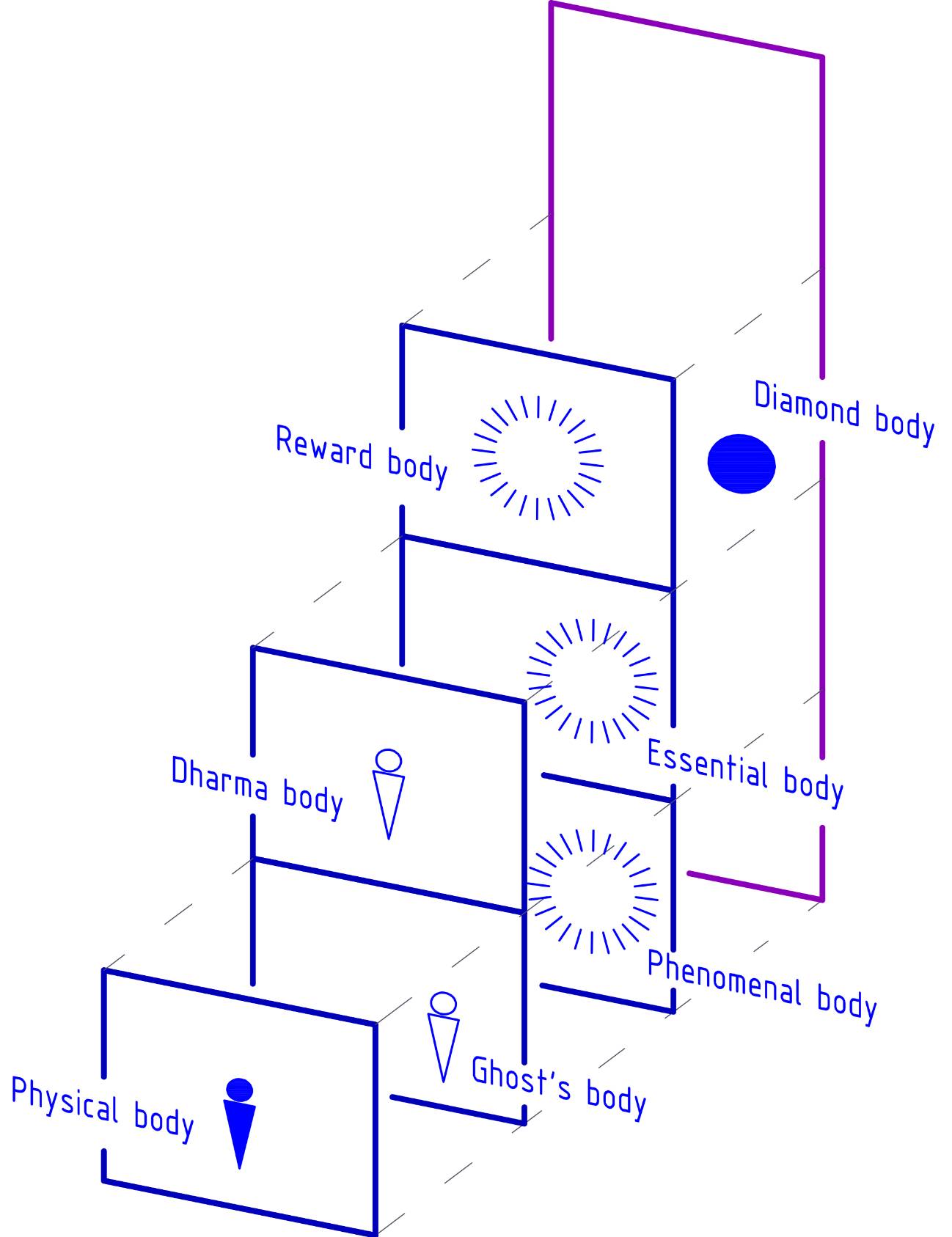
● Physical body – associated with the muladhara chakra. Operates in the world of phenomena. To exit the physical body into another body, the yogi must bring the physical body into an altered state. For example, relax extremely or enter a semi-sleep state (meditative state), or fall asleep, or enter a state of artificial suspended animation (samadhi).
● Ghost's body – associated with the svadisthana chakra. Operates in the lower astral plane.
● Phenomenal body (nirmanakaya) – associated with the manipura chakra. Operates in the lower causal. Can manifest itself in the world of phenomena as precognition, separated from the real physical body.
● Dharma body (dharmakaya) – associated with the anahata chakra. Operates in the upper astral plane.
● Essential body (svabavikakaya) – associated with the vishudha chakra. Operates in the middle causal.
● Reward body (sambhogakaya) – associated with the ajna chakra. Operates in the upper causal.
● Diamond Body (vajrakaya) – associated with the sahasrara chakra. True Ego. Atman. Resides in the state of nirvana.
Six Yogas of Naropa. During the Six Yogas of Naropa, the yogis pass sequentially from bottom to top through the mentioned chakras and work with the awakened bodies corresponding to these chakras. The six yogas of Naropa in order: tumo yoga, bardo yoga, dream yoga, illusory body yoga, light yoga, and transference yoga.
Four Yanas
Yana. The path to attaining various spiritual levels is through spiritual practice (sadhana). Many different interests are realized through spiritual practice. This could be simply love or attachment to the Supreme Being, a saint, or a specific deity (or even just a form of one). It could also be a pull toward samsara. It could also be material interest. Spiritual practice includes specific techniques, such as asanas, special physical exercises, walking (standing or running), and pranayama. In Christianity, standing is a very important gymnastic component of spiritual practice (but its significance is little understood; for this reason, churchmen who call officials who hold candles at ceremonies for show "candlesticks" are incorrect). Spiritual practice also includes mental exercises, such as meditation, mantras, prayers, and reading sutras. Spiritual practice also includes lifestyle changes. Spiritual practice also includes cleansing techniques and various ascetic abstinences, such as intermittent dry fasting. Spiritual practice also includes various rituals and ceremonies. Spiritual practice also includes various forms of donation, whether to oneself, one's actions, or one's values. Spiritual practice is conducted either independently or under the guidance of various mentors. Spiritual practice is conducted individually or by joining like-minded groups. The many schools, approaches, paths, and methods of spiritual exploration are commonly systematized, divided, and correlated with the four yanas. Each subsequent yana encompasses all the preceding ones.
● Hinayana (literally "lesser vehicle") is the path of individual, personal liberation. It is also known as Theravada. This path entails the adherent leaving home, joining a monastic community, and becoming a monk by taking the appropriate monastic vows and precepts. Within this yana, the practice of retreat is also practiced, where the adherent renounces worldly life but lives outside the monastic community. Sometimes, retreat occurs outside the community, but under its supervision. If the rate of spiritual growth is compared with that without a community, then progress within the community is significantly faster. Laypeople should strive to become monks. If this is not possible, then they should structure their lives so that they are as similar and close as possible to the monastic life. Among the recommended donations that laypeople can make are donations to the monastic community. Through such a donation, a layperson accumulates karmic data so that in the next life they will no longer face obstacles to monasticism. A prominent characteristic of Hinayana is social isolation, autism, and egocentricity. Any interaction, any social openness of the adept, throws their state back to the initial, mundane level; in this case, the adept is filled with data they receive from another person, and this foreign data, as a rule, becomes overwhelming, and, as a result, they fall to the mundane level. The goal of Hinayana is lesser nirvana. One who has achieved lesser nirvana is called an arhat. After personal achievement, becoming an arhat, the adept can choose what to do next: discard life and enter lesser parinirvana, or embark on the path of Mahayana.
● Mahayana (literally "great vehicle") – in its strict, original sense, is the continuation of the path of spiritual growth after attaining the level of arhat. This is the path of the bodhisattva. Bodhisattvayana. The main task of the bodhisattva is to bring all souls to spiritual awakening. The goal of Mahayana is mahanirvana. One who ultimately achieves mahanirvana is called a buddha.
However, there is another, broader meaning of the word Mahayana. It turns out that Mahayana can be practiced even at the Hinayana stage. Moreover, it turns out that if a person has not yet reached the level of bodhisattva, but nevertheless practices what a bodhisattva must do, then their speed of spiritual advancement increases significantly. Therefore
Mahayana, in its broadest sense, is the path to the salvation of all souls. Mahayana adherents initially strive for attainment for the sake of saving all souls. This approach is based on the development of bodhichitta. Bodhichitta (literally, "enlightened consciousness") is the conscious choice and determination of the adherent, whether already an arhat or not, to dedicate themselves entirely to the salvation of all souls. Mahayana, in this broad sense, encompasses all other paths. Mahayana is practiced by both monks and laypeople. Within Mahayana schools, there is a common misconception that mahanirvana differs from lesser nirvana in that lesser nirvana is attained individually, while mahanirvana is attained collectively. This is not true. Both are attained individually (cases of simultaneous collective awakening are virtually nonexistent). The difference between the two lies in the spiritual level. The practice of the Six Yogas of Naropa and the Six Bodies of Buddha are also included in the Mahayana.
● Tantrayana (literally "secret vehicle", tantra translates as "connection, thread, sequence") is a secret esoteric vehicle. Tantrayana is part of both Mahayana and Vajrayana. In Tantrayana, non-trivial means are used to achieve goals. Magic. Borderline states (of life and death). Psychotechnics. Social engineering. Tantra is understood as the practice of achieving the final result ("fruit") the state of buddhahood by any possible means. "The word 'tantra' is understood as the inseparability of the cause (base), skillful methods (path), and fruit". Tantra practices rituals, mudras, meditations, and yantras. All tantric practices are secret. They cannot be disclosed to anyone. Otherwise, the practice will be ineffective. An important detail of tantra is the bodhisattva vow. That is, an adept, whether an arhat or not, must necessarily take a vow to save all living beings. Another essential requirement of tantra is the vow to attain buddhahood, with the goal of subsequently saving all, or as many, souls as possible. Tantra is considered the shortest and, at the same time, the most dangerous path. It is crucial for a tantric adept to find a good teacher, who must also be thoroughly vetted.
Tantra transforms the adept into a divine being. Identification with the deity(ies) occurs through mantras, mandalas, meditations, and rituals. Signs and symbols, particularly words written in Sanskrit, acquire special significance in the practice (which resonates with Orthodox arguments about the need to read prayers in Old Church Slavonic; this inevitably creates a unique existential perception; although it is more than obvious that the lag between church language and modern language is a normal, natural phenomenon). Tantra is characterized by an expanded list of practices, departing from traditional Buddhist meditation and rituals, and borrowing from other religions, such as yoga, Christianity, Sufism, paganism, and Taoism. Physiology is studied as a means of transforming the body. Techniques for activating sexual energy are used. A rule for the mind is introduced, stating that there are no failures in practice; that is, any failure is not a failure, but, on the contrary, a stroke of good fortune, an event necessary for development, a lesson, and should be studied to avoid repeating the mistake. A repentant sinner is spiritually superior to a righteous person. Moral and ethical standards are being reconsidered.
It is especially important to note the significant difference between true Tantra and what amateurs mistakenly perceive it to be. The large number of so-called Tantrics who have appeared recently (at the beginning of the 21st century), practicing in the tradition of Rajneesh or Andrei Lapin, in fact, have no connection to true Tantra. They simply engage in highly sophisticated group sex, employing esoteric, magical, and energetic techniques. They practice all of this for the sake of achieving increasingly sophisticated pleasure. As a rule, at these orgies there is no talk whatsoever of any understanding of what spiritual growth is.
● Vajrayana (literally "diamond chariot") is the path to developing an indestructible consciousness. The main aspect of Vajrayana is unwavering commitment to the guru. "Diamond consciousness cannot be formed, it can only be copied". Vajrayana places very high demands on the spiritual level of the guru. In Vajrayana, the guru must be at least a Buddha or a Bodhisattva, very close to the highest awakening. Vajrayana is considered the highest chariot. It is easy to see that Christianity is also a diamond chariot, since the most important aspect in Christianity is proclaimed to be faith in Christ and complete, uncritical obedience to him (servitude to God). As in Tantra, of the three types of action, the most important action is the action of the mind. Thoughts must be pure or none at all.
Commandments
The commandments are indications of what a person embarking on the path of spiritual awakening should not do. The higher a person's spiritual level, the fewer mistakes they make on their own, and the fewer commandments they must observe. A spiritually perfect person, such as a buddha, for example, has no need of commandments. The lower a person's spiritual level, the more mistakes they involuntarily make throughout their life, and the more commandments they must observe to keep themselves from falling. Almost all commandments are formulated negatively: don't do this, don't do that. Therefore, a commandment such as "I am God", which exists in Christianity and Judaism, by definition of what a commandment is, falls outside the definition of a true commandment (unless one considers the clarifying subtext of "You shall have no other gods", which, in fact, also falls outside the definition, as it is more manipulation than a commandment, since there is no specific criterion by which this particular "God" is distinguished from any other "god").
Commandments work best if the list of commandments is free of serious omissions, if, as far as possible, everything that could destroy a person is foreseen. To cover as many options as possible, Buddhists took into account that a person can perform three types of actions: actions of the body, actions of words, and actions of the mind (actions of the mind here also include actions of the soul, such as feelings, emotions, and states). Sages of various religions also noted that a person is prone to fall under the influence of one of the three universal energies: the three gunas (satva, tamas, or rajas). These three obsessions became known in Buddhism as the three poisons. This means that virtually any wrongdoing can be seen as a consequence of being obsessed with one of these three poisons. When we consider the division into the three poisons and the three types of actions, we arrive at the following: Rajas at the level of the body is murder. Tamas at the level of the body is adultery. Satva at the level of the body is theft. Rajas at the level of words is backbiting. Tamas at the level of words is lying. Satva at the level of words is slander. Rajas at the level of the mind is hatred. Tamas at the level of the mind is ignorance. Satva at the level of the mind is greed. It is believed that the actions of the mind are more important, that all other misdeeds arise from the actions of the mind. Therefore, these three greed, hatred, and ignorance were called the three root poisons. They were blamed for all the suffering a person faces in life. That is, the cause of all suffering lies in the three root poisons: greed, hatred, and ignorance. If a person eradicates these three poisons, they will achieve liberation from all suffering and attain true spiritual liberation.
Three poisons multiplied by three types of actions equals nine. This gives us nine fundamental commandments. Adding one more commandment for speech results in ten fundamental commandments. These ten commandments, with slight modifications, are preached in all religions.
What is crucial to keep in mind here? It is important to understand that each of the ten commandments must be understood in both a narrow and a broad sense.
For example, the commandment "thou shalt not kill". Christians generally believe that to observe this commandment, it is sufficient to refrain from killing another person. This is a mistake. One should not treat the sacred scriptures so superficially. It is naive to think that simply by not killing one's own kind, one will avoid falling into the world of hell. No, it is not so. By not killing people, one will avoid accumulating only the heaviest, most dangerous karma. However, to avoid accumulating the karma of hell altogether, one must observe the commandment "thou shalt not kill" not in a narrow, but in a broad sense. And what does this mean? This means the following: do not cause physical pain to anyone, do not kick, push, hit, swing, scare, kill people, animals, fish and insects, do not engage in terrorist activities, do not commit terrorist acts, do not threaten terrorist acts, do not kill or beat anyone who does not agree with you, do not kill or beat anyone who has a different worldview, do not kill or beat anyone who has a different religion, since the production of almost any food is associated with the killing of living beings, therefore, do not eat not only fish or meat, but also try to eat as little as possible of any other food products, and also try not to feed other people or other living beings (unless this is done to save life), do not eat or damage seeds, do not damage plants, do not dig the ground, do not mow, lend a helping hand in trouble, do not cause offense, do not take revenge, do not mock, do not Do not oppress, do not be intrusive, do not perform an abortion, do not assist in performing an abortion.
The commandment "Thou shalt not steal" in a broad sense means the following: do not steal, do not commit robbery, do not appropriate by force, do not appropriate secretly, do not travel without pay, keep a minimum of belongings, do not borrow, do not lend, do not allow default on debts, do not delay repayment of debts, do not take someone else's property without permission, do not use someone else's things without permission, if possible, do not use someone else's things, do not appropriate someone else's items or items of common use, do not appropriate alms intended for others, do not take anything that is not properly laid around, do not throw away any food, including uneaten food, do not throw away anything that is fit for food, do not indulge in reckless behavior, do not live in luxury, do not indulge in debauchery, do not lead a dissolute life, beg, be simple, do not withhold from a worker the wages he deserves, do not appropriate surplus value, do not appropriate someone else's labor, do not live on the results of someone else's labor, do not engage in commerce (an activity the purpose of which is to obtain income), do not appropriate income, spend on yourself (or loved ones) from the income received only a share equal to the invested efforts, do not appropriate someone else's property, do not appropriate public property, do not appropriate income from the sale of public property, do not gamble on the stock exchange, in bets, in casinos and the like, do not gamble, do not play lotteries, do not use insurance, do not speculate, do not abuse a deficit obtained due to a deficit Invest any excess income entirely into a business that eliminates this deficit, do not attend corporate events, do not pocket unearned money, do not receive a salary that exceeds the efforts you have put into this business, make donations, do not own more than one home, do not accept unearned bonuses or prizes, abstain from excessive consumption of food and drink, and practice intermittent dry fasting.
The commandment “You shall not commit adultery” in a broad sense means the following: to abstain from any sexual activity, not to waste sexual energy in any way, not to have lovers, to have intercourse only for the sake of having children, not to cheat on the father (mother) of your child, not to divorce the father (mother) of your child, to remain faithful to the father (mother) of your child even if you are widowed, not to touch people or other living creatures, not to have animals at home, not to entertain yourself with dancing, music or visiting other entertainment events, not to play computer games, not to play other games and not to entertain yourself in any other way, not to use intoxicants, not to smoke, not to use drugs, not to use perfume, cosmetics or other jewelry, not to arrange feasts, not to use a luxurious, large or soft bed, not to communicate with the opposite sex (for the sake of communication), not to seduce persons of the opposite sex, not to conduct seductive conversations, not to look at persons of the opposite sex, do not sleep in the same room with the opposite sex, do not swim, do not shower, do not take a bath or steam room with the opposite sex, do not lie on your stomach, maintain good posture, do not have fun, do not enjoy, do not be captivated by taste, sight, smell, hearing, touch, sensation of movement, delicacies, gluttony, be satisfied with Lenten food, do not watch romance films, do not read depraved books, do not read fiction, do not read vain and soulless books, do not look at shameful images, do not watch erotica or pornography, refrain from seeking impressions, refrain from contemplating anything interesting, do not show curiosity, do not admire, do not do empty, meaningless things.
The commandment “not to speak evil” in a broad sense means the following: not a drop of cold, sharp, evil, not to swear, not to use foul language, not to swear, not to engage in negative conversations, not to be indignant, not to scold, not to shout, not to argue, not to speak in a raised voice, not to reprimand, not to reprimand, not to condemn, not to mention evil spirits, not to insult, not to contradict, not to say abusive, cruel or caustic words, to refrain from blasphemous statements, not to threaten, to speak with honor and respect, silence in front of those who offend, to stop enmity and discord in the family (and not only), not to speak ill of others, not to scold in their faces, not to scold behind their backs, not to curse, not to blame other people or circumstances for your failures or your problems, to listen to another person when he shares his problems with you, not to shut another person’s mouth, to give speak up, give someone the opportunity to speak out, do not block anyone on forums or other social networks and do not delete other people's messages (except in cases where these people themselves violate the commandment "not to speak ill of others"), be accountable for deleting other people's messages, be accountable for blocking on networks to everyone who asks about it, be responsible for your words, be responsible for your actions, be responsible.
The commandment "not to slander" in a broad sense means the following: to refrain from criticizing anyone (unless absolutely necessary), to keep other people's secrets, not to disclose personal information about others without permission, not to suspect, not to ridicule, not to make fun, not to speak mockingly, not to exalt oneself above others, not to assert oneself, not to be arrogant, not to defend oneself in words, not to speak arrogantly, not to talk about loving oneself, not to speak on the basis of loving oneself, to be modest, to be impartial, not to seek glory, not to seek honors, not to boast, to defend the innocent and the righteous.
The commandment "thou shalt not lie" broadly means the following: do not lie, do not deceive, do not cheat, do not speak frankly, do not engage in idle chatter, do not flatter, avoid jokes, speak only to the point, silence is golden, do not engage in seductive conversations, do not mislead others, and keep promises.
Care should be taken not to violate the commandments regarding speech, either in writing or electronically. The commandment “root out anger” in a broad sense means the following: not to allow thoughts based on hatred or anger, not to violate the commandment “not to slander” in thoughts, not to think about breaking the commandment “do not kill”, not to allow yourself to be especially manic with anger, not to get angry, not to allow negative thoughts, to suppress thoughts of revenge, to tolerate insults, to restrain the heart from anger, to avoid the indignation of the heart with anger, to forgive insults, to love offenders, to love enemies, to re-educate innate egoism and love for oneself into altruism. Rejection of the cult of self-love, not wishing evil, eradicating coldness and indifference, not being afraid to die, not killing love, love for one's neighbors that is brotherly, pure, equal to all, impartial, joyful, flaming equally towards friends and enemies, the desire to crucify oneself like Christ, not to explode, not to allow the mind to be clouded by malice, suppress bitterness, suppress irritability, suppress obstinacy, suppress suspicion, suppress suspicion of evil intent, suppress suspicion of violation of norms, suppress suspicion of a bad quality in another person.
The commandment “eradicate greed” in a broad sense means the following: do not allow thoughts based on greed, do not violate the commandment “do not slander” in thoughts, do not think about breaking the commandment “do not steal”, do not especially allow yourself manic greed, do not envy, do not love money, do not want to get rich, do not think about the means to enrichment, do not dream about wealth, do not consider income as your property, do not be selfish, do not be stingy, do not love things, do not have a desire to receive gifts, do not be attached to property, to real estate, to money, to savings, do not have thoughts of ownership of anything in your mind, even to personal belongings, clothes and your own body, eradicate the desire to have a good thing, eradicate the desire to appropriate someone else's thing, eradicate the desire to appropriate a thing that “lies badly” (easily accessible for theft, or is lost), hatred of luxury, not to engage in science and art for the sake of earthly glory, not to despise one's neighbor, not to prefer oneself to everyone, to eradicate pride, to eradicate the desire to support one's own life, to dedicate oneself entirely to the Absolute.
The commandment “root out ignorance” in a broad sense means the following: not to allow thoughts based on ignorance, not to break the commandment “do not lie” in thoughts, not to think about breaking the commandment “do not commit adultery”, not to especially allow yourself manic lust, reject hedonism, not to have fun, not to enjoy, not to have tender feelings (to your activities, to conversations, to communication, to being in company, to rest, to clean water, to tasty food, to food, to good weather, to pleasant experiences, to a change of scenery, to travel, to tourism, to experiences, to the beautiful and the wonderful, to music and songs, to news, to new things), not to show interest in animals, not to have a greed for sleep, don't sleep in complete darkness, not to do anything for the sake of appearance, for the sake of beauty, not to touch the altar or other sacred objects without the appropriate ceremony, refrain from ceremonies and actions with the altar or sacred objects, performed only with the left hand, do not damage or throw away icons and mandalas, sacred objects, portraits of saints, venerate saints from any religion, do not succumb to ignorance (for example, "it's okay if you're a little lazy", or, for example, "it's okay if you relax a little", or, for example, "it's okay if you break the commandment", or "it's okay if you lie around a little", or, for example", it's okay if the child doesn't live with both of its biological parents", or "it's okay if the child lives and is raised in a state institution", or "it's okay to have an abortion", or "it's better to have an abortion than to then abandon your child", or, for example, "it's okay to go for a walk a little", or "it's okay to dream about the sensations and desires of the body, soul and heart", or "there's nothing wrong with enjoying prodigal thoughts"), to observe chastity in thoughts, not to put a loved one above the Absolute, not to put an agreement with a person above an agreement with the Almighty, not to put an agreement above the Truth, not to put any reasons above the Truth, not to put any knowledge above the Truth, not to show laziness (the energy of tamas), not to succumb to tamas, not to allow agnosticism (thoughts that deny the possibility of scientific knowledge). Absolute, God, Holy Spirit, nirvana and other similar spiritual foundations), not to deny the existence of the law of karma and reincarnation, not to allow thoughts that deny the Truth (the need to eradicate worldly desires, the need and benefit of spiritual practice, other foundations of spiritual practice), inactivity of the bodily senses, silence of the mind, repentance, awareness of the fall, a feeling of poverty of soul and spirit, the desire for prayer, solitude, obedience, humility, confession of one's sins, careful observation of all deeds, words, thoughts and feelings, distrust of one's own mind, fear of the Almighty, humility, constant accusation and reproach of oneself, rejection and oblivion of false customs, rejection of erroneous traditions, rejection of erroneous vows and rules, recognition of one's feeblemindedness. To suppress: sadness, despondency, grief, melancholy, cutting off hope for one's spiritual growth, doubt in promises, ingratitude to heaven for everything that happens, faint-heartedness, impatience, lack of self-reproach, grumbling, renunciation of the feat of a difficult spiritual life, the desire to leave one's field, evading the burden of the cross – the struggle with passions and sinfulness, laziness in any good deed, especially spiritual, abandoning the religious or prayer rule, loss of memory of the Absolute, abandoning unceasing prayer (mantra) and soul-profiting reading, inattention, haste, negligence, idleness, carelessness, revelry, drinking, soothing the flesh with sleep, lying down and all kinds of bliss, seeking easy salvation, moving from place to place in order to avoid hardships and deprivations, frequent walks and visiting friends, abandoning bows and other spiritual feats, forgetting one's sins, forgetting the commandments, negligence, self-justification through captivity to passions, absent-mindedness, failure to fulfill promises, despair, fickleness of character, indulgence in passions, lack of conscience, becoming like demons in character and life, lack of diligence, neglect of the spiritual education of children, self-love, self-will, hardening of the heart from successes in spiritual growth, trust in God's long-suffering, hypocritical or deceitful repentance, sinful life.