Kitobni o'qish: «CASE ANALYSIS OF CHINA AFFECTED BY INTERNATIONAL TRADE BARRIERS»
The U.S. imposes additional steel tariffs on China
1. Import and export status of Chinese steel products to the United States
Figure 1 shows the import and export status of China's steel products to the United States from 2000 to 2017. It can be seen from the figure that since 2000, China’s steel exports to the United States have increased in a wave-like manner. After China’s accession to the WTO in 2001, the trade between China and the United States has developed. U.S. exports grew rapidly and reached a maximum of 2.63 billion U.S. dollars in 2008. However, after the financial crisis, Chinese steel products exports to the
U.S. were hit, and they dropped directly from 2.63 billion U.S. dollars to 430 million
U.S. dollars. In 2014, China's export quota of steel products to the United States returned to the level before the financial crisis. After 2014, China’s exports of steel products to the United States have fallen year after year. In 2017, China’s exports of steel products to the United States were only 590 million U.S. dollars. At this stage, the decline in export quotas is consistent with China’s facing the United States.
The increase in various trade frictions is not unrelated. The trade volume of steel products imported by China from the United States has also risen in waves since 2000, reaching a maximum of US$2.04 billion in 2009. After 2009, the import quota continued to decline. In 2017, China's trade in steel products imported from the United States was only 370 million U.S. dollars.

[Source]: United Nations International Trade Statistics Database
Table 1 shows the export situation of China's steel products in 2017. In 2017, China’s total export of steel was approximately US$43 billion, most of which were exported to Asian countries, of which the total export of steel products to the United States was US$598 million, accounting for 1.39%, an increase of 11.3% compared to 2016: Steel The export volume of China has increased by approximately US$61 million. In 2016, China’s total steel exports were approximately US$43.2 billion, and exports to the United States totaled US$537 million. It can be seen that China's steel exports to the United States account for only a small part of China's total steel exports.
In 2017, China’s total merchandise sales to the United States totaled 430 billion
dollars, and China’s steel exports to the United States accounted for 0.139% of total merchandise exports. Compared with 2016, the share of steel in China's total exports to the United States has remained basically unchanged. In 2016, China’s cumulative exports of all commodities to the United States were US$385 billion, and steel products accounted for 0.139% of the total. In Sino-US trade, steel products also account for only a small part of China's total export merchandise trade volume with the United States.

2. The impact of increased steel tariffs imposed by the United States on China's economy
А. Explanation of the GTAP model
GTAP (Global Trade Analysis Project) is a computable general equilibrium analysis tool developed by Purdue University. In addition to considering the problems of traditional CGE model research, the GTAP model can also analyze various possible effects of international trade policy shocks.
The GTAP model is mainly composed of two parts, one is the model main program, and the other is the database. The main program of the model is based on the relevant equations set by the neoclassical economic theory, and the model calculates the data through these equations.
The database provides support for the operation of the main program in the model, and mainly contains the main data of the economic operation of the country or region in the model and foreign trade data. The main program starts with production, sets input- output functions for each country and analyzes them according to the functions. Government departments, private sectors, and producers in different countries have their own production functions or demand functions, and the balance of funds is determined by investment And deposit decision.
The model has an independent model, supporting software and database. When using the GTAP model to simulate the impact of one or more Policy Shocks, the change value of the policy is reset under the initial equilibrium state of the market, and the internal equilibrium of the model is reached again after calculation. By analyzing the data changes of the endogenous variables in the initial state and the new equilibrium state, we can get what kind of impact the economic policy changes have on economic activities.
As a comparatively static model, GTAP has two premises, one is a perfectly competitive market, and the other is that the return to scale of production remains unchanged. Under this premise, producers seek to minimize production costs and consumers seek to maximize consumption utility. Product markets and factor markets must be cleared. In equilibrium, the value of the model's endogenous variables is determined by total demand and total supply.
The model also has the following assumptions:
1. There are five production factors in the model: land, capital, natural resources, skilled labor, and unskilled labor; three subjects: private households, government, and manufacturers;
2. The production function is a fixed elasticity substitution function (CES), and the consumption function is a fixed elasticity of difference (CDE) function;
3. Land cannot move between departments, and labor can move freely within the country;
4. Obeying the Armington hypothesis, imported goods and domestic goods cannot be completely replaced, and links between various countries are established through commodity trade and capital flows. Setting of simulation conditions
After the United States imposes an undifferentiated 25% tariff on imported steel products, it will affect the interests of US trading partners and will be resisted. For example, after the United States imposed tariffs on steel, the European Union also followed up in order to prevent the occurrence of re-export trade. A 25% tariff is imposed on steel products indiscriminately.
Mexico has also imposed tariffs on American agricultural products in retaliation for the increase in taxes by the United States, while Canada has imposed additional tariffs on American steel products. China subsequently announced additional tariffs on American agricultural products. Therefore, when setting the simulation conditions, the reaction of other countries after the United States imposed a 25% tariff on steel products will be considered, and the impact of different policy changes on the Chinese economy will be explored, which can be divided into the following three situations:
Scenario 1: The United States imposes a 25% tariff on steel products, of which Canada and Mexico are exempted;
Scenario 2: After the expiration of the exemption period in Canada and Mexico, the United States imposes a 25% tariff on steel products from all countries. The European Union follows the United States and also imposes a 25% tariff on steel products. Canada and Mexico retaliate after the exemption period expires. , Canada imposes a 25% tariff on American steel products, and Mexico imposes a 20% tariff on American agricultural products;
Scenario 3: The United States and the European Union impose 25% tariffs on steel products, Canada imposes 25% tariffs on American steel products, and Mexico and China both impose 20% tariffs on American agricultural products.
В. The impact of the US's additional steel tariffs on China's macro economy
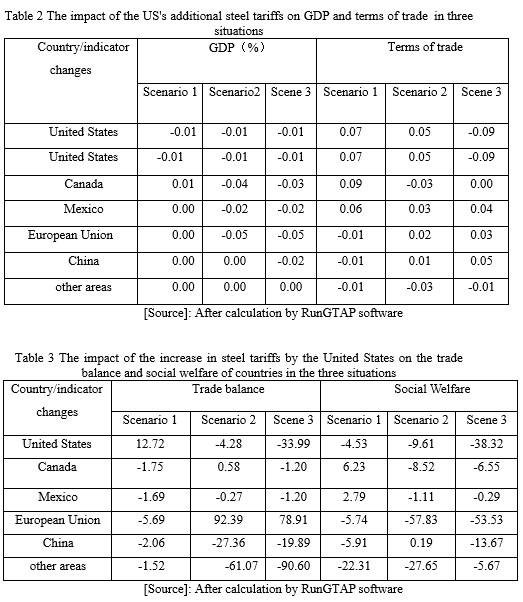
It can be seen from Table 2 and Table 3 that in the simulation results, scenario 1 is that the United States imposes 25% tariffs on imported steel products and Canada and Mexico are exempted: the United States’ GDP decreases by 0.01%, and Canada’s GDP level increases by 0.01 %, the GDP of other countries has not changed significantly; in terms of trade terms, the United States has improved, an increase of 0.07%, Canada and Mexico have been exempted, and their terms of trade have also improved, increasing by 0.09% and 0.06%, respectively.
After China suffered a 25% impact on steel tariffs, its terms of trade deteriorated by 0.01%. In terms of trade balance, after the United States imposed tariff barriers, the trade balance turned into a surplus of US$1.272 billion. Other countries have It has become a deficit. The largest change is the EU, with an amount of -569 million U.S. dollars, and China’s trade deficit of 206 million U.S. dollars. In terms of social welfare, although the United States has achieved a trade balance surplus, social welfare has lost. The social welfare of Canada and Mexico increased by US$623 million and US$279 million, respectively, due to the exemption rights, while the social welfare of China and the European Union suffered losses. China’s social welfare losses were the largest at US$591 million.
In Scenario 2, that is, after the expiration of Canada and Mexico’s exemptions, retaliation occurs against the United States, and the EU also imposes a 25% steel tariff: in terms of GDP levels, Canada, Mexico, and the EU are different from those in Scenario 1. In terms of trade terms, compared with scenario 1, only China and the European Union have improved, with an increase of 0.03% respectively. %, 0.02%, the United States, Canada, and Mexico have reduced to varying degrees. Among them, Canada has the largest decrease, with a decrease of 0.12%. In terms of trade balance, after the countermeasures implemented by Canada, Mexico, and the European Union, the trade balance has As a result, the EU experienced the largest increase from its original trade deficit of US$569 million to a surplus of US$9.239 billion, an increase of US$9.808 billion.
After the United States was countered, the trade balance changed from the original surplus of US$1.272 billion to a deficit. 428 million U.S. dollars. In the trade war that other countries sanctioned each other, China’s trade balance continued to decline, and the deficit became larger and larger, reaching 2.736 billion U.S. dollars. In terms of social welfare, China has gained social welfare because it did not participate in the trade war. The slight improvement has changed from a loss of US$574 million to US$19 million in social welfare.
Bepul matn qismi tugad.