Kitobni o'qish: «Analysis of Present Situation of Residential Real Estate Market in China»
An overview of international and china’s housing structure
As the housing problem has become worldwide, more and more attentions had put on to it. Governments across the world are also trying to solve this difficult problem. Governments have accumulated a lot of experience by proposing more effective policy measures based on their own realities. They actively advocate the government-led development and construction of public housing and believe that the government's housing market is essential for pre-regulation and regulation. The main representative scholars are Dennis and Richard (1996), who pointed out that government intervention in the housing market can change the unsatisfied role of the market economy and put forward the housing scheme of government intervention. Pasquale studied the relationship between local government and the real estate industry and put forward the necessity of government intervention and regulation on housing supply. It is no exaggeration to say that all countries are striving for the realization of "home ownership".
For example, Singapore's group housing, adhere to the small-family, low-price principle of France's low-cost housing policy, the Indian government in conjunction with real estate developers for low- and middle-income people to build affordable housing and a series of initiatives. Both are worthy of our reference to seek further development. After many years of adjustment, these countries are becoming more mature housing structure, understand their current situation in government regulation, housing security and so on, we can adjust measures to local conditions and look forward to our future more clearly.
With the deepening of China's urban housing system reform, many scholars have emerged in China to study the housing system and housing supply regulation. Chen Wei (2007) studied the development and regulation of the real estate market and proposed to establish a supply system and solve the housing problem through multiple channels.
Wang Yue (2002) studied the housing supply structure and demand in Jiaxing City. He pointed out that to establish a housing supply system suitable for the operation mechanism of socialist market economy, we must optimize the housing supply structure, so that the scale and structure of housing development and construction can adapt to the housing demand structure. In 2004, the paper studies the market structure of China's housing industry in 2004 economic forum, analyzes the construction of the housing demand and the spatial competition model of the housing market. It points out that to promote the competition, the government should increase the housing supply to alleviate the situation of short supply and weaken the monopoly power of the developers. Fudan University Housing Research Center (2010) studies the housing policy of Shanghai from the macro and theoretical perspective: Professor Lang Xiaoping pointed out that the housing supply system should match the national conditions. The Chinese government is not an interest group. It should balance the interests of all parties, ensure the healthy development of the real estate industry, stabilize the local land revenue, and make the people live and work in peace and contentment.
By 2006, most cities have issued the "11th Five Year Plan" for housing construction according to the central requirements, which basically tend to position the "70% of the commercial housing with the building area of less than 90 square meters" as the total control rather than the project control. Some scholars pointed out that whether the housing structure adjustment can be solved depends on the executive power of local government. The research group on macro policy trends of the Ministry of economic forecast of the State Information Center believes that how to implement the policy of "90 square meters and 70%" and how to ensure the development of "limited house type and house price" commercial housing, and how to improve the housing security system with economic applicable housing and low rent housing as the main body is still a puzzle in front of the government.
In the 2010 NPC and CPPCC sessions, some representatives put forward suggestions on reforming the land supply mode, carrying out the second housing reform and establishing the three-system housing system. After the promulgation of the national low rent housing security plan 2009-2011, the affordable housing system is gradually ensuring the basic living conditions of low-income families. The commercial housing system meets the housing needs of high-income families but cannot meet the housing needs of middle-income families. Therefore, the representatives suggested that the state should carry out the second housing reform as soon as possible and establish a third public housing system (including public rental housing system) that can meet the housing needs of middle-income families, that is, an affordable market housing system.
2. Main trends of housing structure in China
Housing problem is no longer a simple social and economic problem, but a political one. Taking China as an example, in recent years, to solve the problem of small housing and difficult to buy, the state has issued many preferential policies. At present, there are low rent housing and affordable housing for low-income people. In the proposal of the two sessions in 2010, more scholars proposed to provide public housing and public rental housing system for middle-income families. Although the government has been formulating various policies in recent years to effectively solve the housing problem and ensure "home ownership", the contradiction of unreasonable housing supply structure is still prominent.
2.1 Overview of the relevant concepts of housing supply structure in China
1. The meaning and difference between commercial housing and indemnificatory housing affordable housing, office building, high-end apartment, commercial business housing, etc. This paper mainly studies the housing supply structure for housing. According to the use of real estate, it mainly includes commercial housing
2. At present, the housing supply structure in China is mainly divided into two categories, one is affordable housing, the other is commercial housing. As shown in Picture 1
.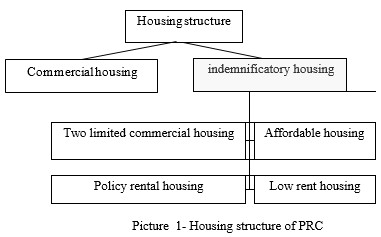
Indemnificatory housing refers to the housing with social security nature, which is provided by the government in the process of classified security for low- income families, including limited supply object, construction standard, sales price or rent standard. It includes two limited commercial housing, affordable housing, policy rental housing and low rent housing.
Commercial housing originally refers to the real estate development and operation enterprises, approved for sale in the market and the construction of housing known as commercial housing. Commercial housing can be divided into domestic commercial housing and export commercial housing.
Commercial housing and indemnificatory housing are different, mainly in the following aspects (policy indemnificatory housing is affordable housing, the following is the main difference between commercial housing and affordable housing):
First, there are different ways to acquire land. The land for the construction of affordable housing is allocated by administration and free of land transfer fee; the
land transfer fee is required for the commercial housing.
Second, leasing policies are different. Affordable housing is only for sale but not for rent, and commercial housing is not restricted. The conditions and objects of purchase are different. Affordable housing can enjoy preferential treatment from the government. Because of the implementation of the application approval system, the objects of purchase are specific, that is, they are only supplied to urban low-income families, while the objects and conditions of commercial housing purchase are not limited.
Third, the price policy is different. The selling price of affordable housing is guided by the government. Developers cannot increase the selling price by themselves, but the selling price of commercial housing is completely determined by the market. The property right of housing is divided into four parts: the right to use, the right to dispose, the right to occupy and the right to gain. The property right of affordable housing purchased by individual residents belongs to individuals, while the right to gain of commercial housing is different from that of affordable housing. After the commercial housing is sold on the market, all the income belongs to individuals.
3. Classification of residential consumption demand structure
The basic meaning of consumption demand structure of housing market refers to the composition of various levels of housing consumption demand in the total demand of housing market according to people's actual needs and their different ability to pay.
Housing demand structure can be classified from different perspectives. First, according to the housing price structure, it can be divided into high price housing, medium and high price housing, medium and low-price housing, etc. Second, according to the quality structure of the house itself, it can be divided into high- grade house, medium and high-grade house, medium and low-grade house, etc. Third, according to the area structure of each house, it can be divided into large, medium, and small houses. In the quality grade structure of housing, high-end housing is bound to have a high price, while low-end housing is bound to have a low price. In the area structure of housing, the total price of each set of large area is bound to be high, and the total price of each set of small area is relatively low. In the regional structure of housing, due to the difference of land location and land price, the price of housing in the central area is bound to be high, while that in the suburbs is relatively low.
Bepul matn qismi tugad.