Kitobni o'qish: «A History of North American Birds, Land Birds. Volume 2»
NORTH AMERICAN BIRDS
Family FRINGILLIDÆ.—The Finches. (Continued.)
Genus SPIZELLA, Bonap
Spizella, Bonap. Geog. and Comp. List, 1838. (Type, Fringilla canadensis, Lath.)
Spinites, Cabanis, Mus. Hein. 1851, 133. (Type, Fringilla socialis, Wils.)

Spizella monticola.
871 ♂
Gen. Char. Bill conical, the outlines slightly curved; the lower mandible decidedly larger than the upper; the commissure gently sinuated; the roof of the mouth not knobbed. Feet slender; tarsus rather longer than the middle toe; the hinder toe a little longer than the outer lateral, which slightly exceeds the inner; the outer claw reaching the base of the middle one, and half as long as its toe. Claws moderately curved. Tertiaries and secondaries nearly equal; wing somewhat pointed, reaching not quite to the middle of the tail. First quill a little shorter than the second and equal to the fifth; third longest. Tail rather long, moderately forked, and divaricated at the tip; the feathers rather narrow. Back streaked; rump and beneath immaculate. Young streaked beneath.
This genus differs from Zonotrichia principally in the smaller size and longer and forked, instead of rounded tail.
Birds of the year of this genus are very difficult to distinguish, even by size, except in monticola. The more immature birds are also very closely related. In these the entire absence of streaks on a plumbeous head point to atrigularis; the same character in a reddish cap, and a reddish upper mandible to pusilla; a dusky loral spot with dark streaks and generally a rufous shade on top of head, to socialis. S. breweri, with a streaked head, lacks the dusky lore and chestnut shade of feathers. S. pallida generally has a median light stripe in the cap, and a dusky mandibular line.
Common Characters. Interscapular region with black streaks. Rump and lower parts without streaks (except in young). Wing with two narrow light bands (indistinct in atrigularis).
A. Crown different from the sides of the head, a plain light superciliary stripe. Young with crown and breast streaked.
a. Crown rufous and plain in adult; in young, grayish and with streaks.
I. Streak behind eye, and tinge on side of breast, rufous. Egg pale blue, or bluish-white, blotched with pale brown, or sprinkled with reddish
1. S. monticola. Crown bright rufous, undivided medially; a dusky spot on lore; wing-bands sharply defined, pure white. A black spot on breast; jugulum tinged with ashy. Bill black above, yellow below. Length, 6.25; wing, 3.00. Hab. Whole of North America; north of the United States only, in summer.
2. S. pusilla. Crown dull rufous, indistinctly divided medially; lores entirely whitish; wing-bands not sharply defined, pale brown. No black spot on breast; jugulum tinged with buff. Bill entirely light brownish-red.
Wing, 2.70; tail, 2.80; bill, from forehead, .37. Hab. Eastern Province United States … var. pusilla.
“Similar, but colors clearer, and bill more robust.” Hab. Peten, Guatemala … var. pinetorum.1
II. Streak behind the eye blackish. No rufous tinge on side of breast. Egg deep blue, with black dots and streaks round larger end
3. S. socialis. Crown bright rufous, not distinctly divided, generally plain. Forehead black, divided medially with white. Streak of black on lore and behind eye. Rump pure bluish-ash. Bill blackish, lower mandible paler.
Auriculars deep ash, in strong contrast with pure white of the superciliary stripe and throat; breast without ashy tinge. Dorsal streaks broad. Wing, 2.80; tail, 2.30. Hab. Eastern Province of United States … var. socialis.
Auriculars lighter ash, less strongly contrasted with the white above and below; breast strongly tinged with ash. Dorsal streaks narrow. Wing, 3.00; tail, 2.90. Hab. Western Province of United States, and table-lands of Mexico … var. arizonæ.
b. Crown light grayish-brown, with distinct black streaks; young differing in streaked. Egg deep blue, with black streaks and dots (precisely as in socialis).
4. S. pallida.
Crown divided medially by a distinct pale stripe; whitish superciliary stripe, and blackish post-ocular streak sharply defined. A dusky sub-maxillary streak. Nape ashy in contrast with the crown and back. Wing, 2.50; tail, 2.40. Hab. Plains of United States, from the Saskatchewan southward … var. pallida.
Crown without a distinct median stripe. Markings on side of head not sharply defined. No dusky sub-maxillary stripe, and nape scarcely different from crown and back. Wing, 2.50; tail, 2.60. Hab. Middle and western Provinces … var. breweri.
B. Crown not different from the sides of head; no light superciliary stripe.
5. S. atrigularis. Head and neck all round, and rump, uniform dark ash, gradually fading into white on the abdomen; wing-bands indistinct; bill light brownish-red. Ad. Lores, chin, and upper part of throat black. Juv. without black about the head. (Eggs unknown.) Hab. Adjacent portions of Mexico and southern Middle Province of United States (Fort Whipple, Arizona, Coues; Cape St. Lucas, Xantus).
Spizella monticola, Baird
TREE SPARROW
Fringilla monticola, Gm. Syst. Nat. I, 1788, 912. Zonotrichia monticola, Gray, Genera. Spinites monticolus, Cabanis, Mus. Hein. 1851, 134. Spizella monticola, Baird, Birds N. Am. 1858, 472.—Coues, P. A. N. S. 1861, 224 (Labrador).—Cooper & Suckley, 203 (Washington Ter.).—Dall & Bannister, Tr. Ch. Ac. I, 1869, 285.—Cooper, Orn. Cal. 1, 206.—Samuels, 317. Passer canadensis, Brisson, Orn. III, 1760, 102. Fringilla canadensis, Lath. Index, I, 1790, 434.—Aud. Orn. Biog. II, 1834, 511; V, 504, pl. clxxxviii.—Max. Cab. Jour. VI, 1858, 280. Emberiza canadensis, Sw. F. B. Am. II, 1831, 252.—Aud. Syn. 1839.—Ib. Birds Am. III, 1841, 83, pl. clxvi. Spizella canadensis, Bon. List, 1838.—Ib. Conspectus, 1850, 480. Fringilla arborea, Wils. Am. Orn. II, 1810, 12, pl. xii, f. 3. Moineau du Canada, Buffon, Pl. Enl. 223, f. 2. “Mountain Finch,” Lath. Syn. II, I, 265.

Spizella monticola.
Sp. Char. Middle of back with the feathers dark brown centrally, then rufous, and edged with pale fulvous (sometimes with whitish). Hood and upper part of nape continuous chestnut; a line of the same from behind the eye, as well as a short maxillary stripe. Sides of head and neck ashy. A broad light superciliary band. Beneath whitish, tinged with fulvous; the throat with ashy; a small circular blotch of brownish in the middle of the upper part of the breast; the sides chestnut. Edges of tail-feathers, primary quills, and two bands across the tips of the secondaries, white. Tertiaries nearly black; edged externally with rufous, turning to white near the tips. Lower jaw yellow; upper black. Young bird streaked on throat and breast, as well as on crown. Length, 6.25 inches; wing, 3.00.
Hab. Eastern North America to the Missouri, north to Arctic Ocean; also on Pole Creek and Little Colorado River, New Mexico; Western Nevada.
This species varies in the amount of whitish edging to the quills and tail.
Habits. Essentially a northern bird, the Tree Sparrow breeds in high Arctic regions, only appearing in winter within the United States. It is then common as far south as Pennsylvania. A few winter in South Carolina.
It arrives on the Saskatchewan in the latter part of April, where it only makes a short halt, proceeding farther north to breed. Bischoff obtained a specimen at Sitka. Mr. Kennicott found its nest and eggs on the Yukon, and Mr. Dall obtained it at Nulato, and more sparingly below that point. Mr. MacFarlane met with it breeding in large numbers at Fort Anderson. The nests were in various situations, the larger proportion on the ground, a few in bushes near the ground, and only one is mentioned as having been several feet above it. One was in the cleft of a low willow on the edge of a small lake; another, in a bush, was nearly four feet from the ground; and a third was in a clump of willows and fourteen inches above the ground. Nearly all the other nests mentioned were built directly upon the ground.
The nests were constructed of dry bark and grasses, loosely put together, and very warmly lined with feathers. On the ground they were usually concealed in a tuft of grass. In all instances the female alone was found on the nests, the male being very rarely seen in their vicinity. The usual number of eggs in a nest was four or five, occasionally six, and even seven.
Dr. Suckley obtained a single specimen at Fort Dalles, and Dr. Cooper saw a flock in September, 1863, and again in 1864 at the mouth of the Columbia. Lieutenant Bryan met with them among the Rocky Mountains in latitude 39°, in August. Mr. Ridgway found them very common during the winter in the interior.
Dr. Coues found this Sparrow common in all the wooded districts of Labrador. It was very tame and unsuspicious, showing no fear even when closely approached. I have never met with any, in summer, in any part of New Brunswick or Nova Scotia.
This Sparrow is occasionally abundant in Massachusetts early in October, but rarely appears in full numbers until November. Some remain in the gardens in and about Boston during the winter, and during November the marshes of Fresh Pond are filled with them, when their wailing autumnal chant is in marked contrast with the sweet and sprightly song with which they enliven the spring, just before they are about to depart for their summer homes. They remain until the latter part of April, and Mr. Allen has observed them at Springfield till about the first of May.
In regard to their song, Mr. William Brewster informs me that they usually commence singing about the 25th of March. Their song is a loud, clear, and powerful chant, starting with two high notes, then falling rapidly, and ending with a low, sweet warble. He has heard a few singing with their full vigor in November and December, but this is rare.
Dr. Coues found them not common in South Carolina, but Dr. Kennerly states that they were quite abundant in December on the Little Colorado, in New Mexico, feeding on the fruit of the wild grape and upon seeds.
During the love-season the Tree Sparrow is quite a fine musician, its song resembling that of the Canary, but finer, sweeter, and not so loud. In their migrations, Mr. Audubon states, a flock of twenty or more will perch upon the same tree, and join in a delightful chorus. Their flight is elevated and graceful, and in waving undulations. On opening the stomachs of those he shot at the Magdeleine Islands, Mr. Audubon found them containing minute shell-fish, coleopterous insects, hard seeds, berries, and grains of sand.
Nests obtained near Fort Anderson confirm the descriptions given by Mr. Hutchins, as observed in the settlement at Hudson’s Bay. The eggs, which are much larger than those of the other species of Spizella, measure .85 by .65 of an inch. Their ground-color is a light green, over which the eggs are very generally freckled with minute markings of a foxy brown. These markings are distributed with great regularity, but so sparsely as to leave the ground distinctly visible.
Spizella pusilla, Bonap
FIELD SPARROW
Fringilla pusilla, Wilson, Am. Orn. II, 1810, 121, pl. xvi, f. 2.—Licht. Verzeich. Doubl. 1823, No. 252.—Aud. Orn. Biog. II, 1834, 299, pl. cxxxix. Spizella pusilla, Bonap. List, 1838.—Ib. Conspectus, 1850, 480.—Baird, Birds N. Am. 1858, 473.—Samuels, 319. Emberiza pusilla, Aud. Syn. 1839, 104.—Ib. Birds Am. III, 1841, 77, pl. clxiv. Spinites pusillus, Cab. Mus. Hein. 1851, 133. Fringilla juncorum, Nutt. Man. I, 1832, 499 (2d ed.,) 1840, 577 (supposed by him to be Motacilla juncorum, Gmelin, I, 952; Sylvia juncorum, Latham, Ind. II, 511; Little Brown Sparrow, Catesby, Car. I, 35).
Sp. Char. Bill red. Crown continuous rufous-red, with a faint indication of an ashy central stripe, and ashy nuchal collar. Back somewhat similar, with shaft-streaks of blackish. Sides of head and neck (including a superciliary stripe) ashy. Ear-coverts rufous. Beneath white, tinged with yellowish anteriorly. Tail-feathers and quills faintly edged with white. Two whitish bands across the wing-coverts. Autumnal specimens more rufous. Length about 5.75; wing, 2.34.
Hab. Eastern North America to the Missouri River; San Antonio, Texas in winter (Dresser, Ibis, 1865, 489).
This species is about the size of S. socialis, but is more rufous above; lacks the black forehead and eye stripe; has chestnut ears, instead of ash; has the bill red, instead of black; lacks the clear ash of the rump; has a longer tail, etc. It is more like monticola, but is much smaller; lacks the spot on the breast, and the predominance of white on the wings, etc. The young have the breast and sides streaked, and the crown slightly so.
Habits. The common Field Sparrow occupies a well-defined and somewhat compact area, being resident within the United States, and in its migrations not removing far from its summer abode. In the summer it breeds from Virginia to Maine, as far as the central and western portions. It is not found near Calais, but occurs and breeds near Norway, Oxford County. In the interior it is found still farther north, in Canada, Iowa, and Wisconsin, to the Red River settlements, where it was found breeding by Donald Gunn. At Hamilton, Ontario, Mr. McIlwraith states it to be a rather rare summer resident. It breeds in Southern Wisconsin and in Iowa, but is not abundant. It does not appear to have been found west of the Missouri Valley.
This Sparrow arrives in Massachusetts early in April, and is found almost exclusively in open pastures, old fields, and in clearings remote from villages. It is a shy, retiring bird, and seems to avoid the near presence of man. Wilson states that it has no song, nothing but a kind of chirruping, not much superior to the chirping of a cricket. But this is quite a mistake, as it is in reality a very varied and fine singer. Its notes are not very powerful, and cannot be heard any distance, but they are very pleasing, although little known or appreciated. It continues in full song until into July, when the second brood is about hatching, when its notes relax, but do not cease until just before its departure in September or early October.
Mr. D. D. Hughes, of Grand Rapids, Mich., in an interesting paper on the habits of this species, speaks of its beautiful tinkling song as one of its most marked features. To his ear it resembles the ringing of a tiny bell more nearly than anything else. In the early morning and at evening the fields ring with their plaintive and tender peals. It sings at all hours of the day, during the nesting-season, even in the noonday heat of summer, when most other birds are silent.
In Virginia these birds may be found throughout the year, though probably not the same birds in the same localities, some retiring farther south and others coming to take their places from the north. In winter they are found, in the greatest abundance in South Carolina and Georgia, occurring in large loose flocks, found chiefly along the roadsides and in old fields and pastures in the rural districts.
The Field Sparrow nests both on the ground and in low bushes, or among tangled clusters of vines. I have found their nests in all these situations, and have no doubt the nature of the surface may have something to do with the position. In high dry pastures, in sheltered situations, I have always found their nests on the ground. In the wet meadows and fields subject to a rise of water, as about the Potomac, near Washington, where these birds are very abundant, they almost invariably nest in bushes at a height of two or three feet.
Mr. Audubon says that during the winter these birds are quite common throughout Louisiana, and the country about the Mississippi, as far as Kentucky. They begin to depart from the South early in March, and move slowly northward as the season advances. He states that they begin to nest in May, and raise three broods in a season. This is not the case in New England, where they do not often have more than a single brood.

PLATE XXVII.

1. Spizella socialis, Ad., Pa., 10150.

2. Spizella pusilla. ♀ Pa., 1378.

3. Spizella pallida. Ad.

4. Spizella breweri. Ad., Rocky Mts., 2890.

5. Spizella monticola.

6. Melospiza melodia,. Pa., 2637.

7. Melospiza samuelis. Cal., 7098.

8. Melospiza insignis. Kodiak, 52477.

9. Melospiza heermanni. ♂ Sierra Nevada, 53529.

10. Melospiza fallax. ♀ Nevada, 53537.

11. Melospiza rufina. Sitka, 46007.

12. Melospiza guttata. Washington Ter.

13. Melospiza lincolni. Pa., 937.
Their nests are constructed in a manner very similar to those of the Chipping Sparrow, loosely made of a few stems of vegetables, grasses, and sedges, and lined with hair or fine rootlets. Those placed on the ground are larger and more bulky, and those wrought into the twigs of a bush are made with more care and neatness of interweaving. The eggs are usually five in number, of an oblong-oval shape. The ground is a whitish clay-color, marked more or less fully with blotches of a ferruginous-brown. In some these markings are few, and arranged only about the larger end. In others they are generally diffused, and impart a deep ferruginous color to the whole egg, and disguise or conceal the ground. They vary also in size,—in length from .70 to .63 of an inch, and in breadth from .52 to .50. Their usual size is .70 by .52.
Two nests of this bird taken in Lynn, Mass., by Mr. George O. Welch, are characteristic of their usual style in architecture. One of these has a diameter of four and a height of two and a half inches. Its base, as well as the great mass of its periphery, is made of a very loose intertwining of minute stems of vegetables and dry grasses. The ends of these project from the exterior of the nest at the upper rim, and present a very peculiar appearance, as of an enclosure of palisades. The interior is lined with horsehair. The other is made of similar materials, of a less rigid character and closer texture. Its rim presents the same peculiarities of projecting ends, arranged like a fence above the nest itself. Its dimensions also are about the same. It is, however, much more compactly constructed, with thicker walls and a less open network of dry grasses, and stiff wiry stems of dried plants intermixed with a few pine leaves. The whole is very carefully and warmly lined with horsehair and the softer fur of small quadrupeds. These nests contained, one three, and the other four eggs.
Spizella socialis, Bonap
CHIPPING SPARROW; CHIPPY
Fringilla socialis, Wilson, Am. Orn. II, 1810, 127, pl. xvi, f. 5.—Aud. Orn. Biog. II, 1834, 21; V, 517, pl. civ. Spizella socialis, Bon. List, 1838.—Ib. Conspectus, 1850, 480.—Baird, Birds N. Am. 1858, 473.—Cooper & Suckley, 203.—Samuels, 320. Emberiza socialis, Aud. Syn. 1839.—Ib. Birds Am. III, 1841, 80, pl. clxv. Spinites socialis, Cabanis, Mus. Hein. 1851, 133.
Sp. Char. Rump, back of neck, and sides of neck and head, ashy. Interscapular region with black streaks, margined with pale rufous. Crown continuous and uniform chestnut. Forehead black, separated in the middle by white. A white streak over the eye to nape, and a black one from the base of the bill through and behind the eye. Lores dusky. Under parts unspotted whitish, tinged with ashy on the sides and across the upper breast. Tail-feathers and primaries edged with paler, not white. Two narrow white bands across the wing-coverts. Bill black. Length, 5.75; wing, nearly 3.00; tail, 2.50 (or less).
Young. Immature birds and frequently the adult females with the cap streaked with blackish lines, the chestnut nearly or sometimes quite wanting. Birds of the year streaked beneath and on rump.
The color of bill varies; sometimes entirely black throughout, sometimes very light (but never reddish as in S. pusilla), with all intermediate stages. There is usually, however, a dusky tinge in the upper bill, wanting in pusilla, and the lores are almost always more or less dusky in all stages of plumage.
Hab. Eastern Province of North America; north to Great Slave Lake, and south to Orizaba, Eastern Mexico, where it is resident. Oaxaca (perhaps var. arizonæ), Jan. (Scl. 858, 304); Xalapa (Scl. 1859, 365); Cordova (Scl. 1856, 305); Cuba (Lawr. 1860, VII., 1269).
Habits. The common Chipping Sparrow, so familiar to all in the eastern portion of the United States, is not only one of the most abundant, but one of the most widely distributed of our North American birds. It is found from the Atlantic to the Pacific in its two races, and breeds from Georgia to the Arctic Circle. At different seasons of the year it is found in all portions of North America to Mexico. Along the Atlantic coast it nests at least as far north as New Brunswick and Nova Scotia; in the extreme northern portion of the latter Province I found it one of the most abundant birds.
The late Mr. Robert Kennicott met with them in considerable numbers at Fort Resolution, on Great Slave Lake, and there he obtained quite a number of their nests, all of which were in trees or bushes, from two to three feet above the ground. These were all met with between the 1st and the 26th of June. Mr. B. R Ross also met with these birds in considerable numbers at Fort Simpson and at Fort Rae.
On the Pacific coast the Chipping Sparrow is stated by Dr. Cooper to be quite as abundant in the northern parts of California, and in Oregon and Washington Territory, as on the Atlantic coast. He found them wintering in the Colorado Valley in large numbers, but met with none about San Diego. They spend their summers in the northern part of California, building their nests, as with us, in the shrubbery of the gardens, and coming familiarly about the doorsteps to pick up crumbs. In autumn they collect in large flocks, and frequent the open fields and pastures. Dr. Cooper found them in flocks on Catalina Island in June, but could discover no nests. They were all old birds, and the conclusion was that they had delayed their more northern migrations.
Dr. Suckley found this species extremely abundant in the open districts on the Columbia River, as well as upon the gravelly prairies of the Puget Sound district. It is not named as having been met with by Mr. Dall or any of the Russian Telegraph party in Alaska.
It was found in abundance during the summer by Mr. Ridgway in all the wooded portions of the country of the Great Basin. He did not meet with any among the cottonwoods of the river-valleys, its favorite haunts appearing to be the cedars and the nut-pines of the mountains. In July and August, in such localities, on the East Humboldt Mountains, it was not only the most numerous species, but also very abundant, nesting in the trees. About the middle of August they congregated in large numbers, preparing for their departure.
At Sacramento it was also very abundant among the groves of small oaks. He could not observe the slightest difference in habits or notes between the eastern and the western specimens of this form. He found them breeding at Salt Lake City, June 19, the nest being in a scrub-oak, six feet from the ground.
In Arizona, Dr. Coues found the Chippy a very abundant summer resident, arriving the third week of March and remaining until the latter part of November. A few may spend the winter there. As described, it seems more gregarious than it is with us, arriving in the spring, and remaining for a month or more in large flocks of fifty or upwards. In New England they always come in pairs, and only assemble in flocks just on the eve of their departure. Mr. Dresser met with these Sparrows, and obtained specimens of them, near San Antonio, on the 10th of April. Dr. Heermann, in his Report upon the birds observed in Lieutenant Williamson’s route between the 32d and 35th parallels, speaks of finding this species abundant.
Dr. Gerhardt found this Sparrow not uncommon in the northern portions of Georgia, where it is resident throughout the year, and where a few remain in the summer to breed. Dr. Coues also states that a limited number summer in the vicinity of Columbia, S. C., but that their number is insignificant compared with those wintering there between October and April. They collect in large flocks on their arrival, and remain in companies of hundreds or more.
Mr. Sumichrast states that it is a resident bird in the temperate region of Vera Cruz, Mexico, where it remains throughout the year, and breeds as freely and commonly as it does within the United States.
Although found throughout the country in greater or less numbers, they are noticeably not common in the more recent settlements of the West, as on the unsettled prairies of Illinois and Iowa. Mr. Allen found them quite rare in both States, excepting only about the older settlements. As early as the first week in April, 1868, I noticed these birds very common and familiar in the streets of St. Louis, especially so in the business part of that city, along the wharves and near the grain-stores, seeking their food on the ground with a confidence and fearlessness quite unusual to it in such situations.
The tameness and sociability of this bird surpass that of any of the birds I have ever met with in New England, and are only equalled by similar traits manifested by the Snowbird (J. hyemalis) in Pictou. Those that live about our dwellings in rural situations, and have been treated kindly, visit our doorsteps, and even enter the houses, with the greatest familiarity and trust. They will learn to distinguish their friends, alight at their feet, call for their accustomed food, and pick it up when thrown to them, without the slightest signs of fear. One pair which, summer after summer, had built their nest in a fir-tree near my door, became so accustomed to be fed that they would clamor for their food if they were any morning forgotten. One of these birds, the female, from coming down to the ground to be fed with crumbs, soon learned to take them on the flat branch of the fir near her nest, and at last to feed from my hand, and afterwards from that of other members of the family. Her mate, all the while, was comparatively shy and distrustful, and could not be induced to receive his food from us or to eat in our presence.
This Sparrow is also quite social, keeping on good terms and delighting to associate with other species. Since the introduction of the European House Sparrow into Boston, I have repeatedly noticed it associating with them in the most friendly relations, feeding with them, flying up with them when disturbed, and imitating all their movements.
The Chipping Sparrow has very slight claims to be regarded as one of our song-birds. Its note of complaint or uneasiness is a simple chip, and its song, at its best, is but a monotonous repetition of a single note, sounding like the rapid striking together of two small pebbles. In the bright days of June this unpretending ditty is kept up incessantly, hours at a time, with only rare intermissions.
The nest of this bird is always in trees or bushes. I have in no instance known of its being built on the ground. Even at the Arctic regions, where so many of our tree-builders vary from this custom to nest on the ground, no exceptional cases are reported in regard to it, all its nests being upon trees or in bushes. These are somewhat rudely built, often so loosely that they may readily be seen through. Externally they are made of coarse stems of grasses and vegetable branches, and lined with the hair of the larger animals.
These birds are devoted parents, and express great solicitude whenever their nests are approached or meddled with. They feed their young almost exclusively with the larvæ of insects, especially with young caterpillars. When in neighborhoods infested with the destructive canker-worm, they will feed their young with this pest in incredible numbers, and seek them from a considerable distance. Living in a district exempt from this scourge, yet but shortly removed from them, in the summer of 1869, I noticed one of these Sparrows with its mouth filled with something which inconvenienced it to carry. It alighted on the gravel walk to adjust its load, and passed on to its nest, leaving two canker-worms behind it, which, if not thus detected, would have introduced this nuisance into an orchard that had previously escaped, showing that though friends to those afflicted they are dangerous to their neighbors. This Sparrow is also the frequent nurse of the Cow Blackbird, rearing its young to the destruction of its own, and tending them with exemplary fidelity.
Their eggs, five in number, are of an oblong-oval shape, and vary greatly in size. They are of a bluish-green color, and are sparingly spotted about the larger end with markings of umber, purple, and dark blackish-brown, intermingled with lighter shadings of faint purple. The largest specimen I have ever noticed of this egg, found in the Capitol Grounds, Washington, measures .80 by .58 of an inch; and the smallest, from Varrell’s Station, Ga., measures .60 by .50. Their average measurement is about .70 by .54. They are all much pointed at the smaller end.
Spizella socialis, var. arizonæ, Coues
WESTERN CHIPPING SPARROW
Spizella socialis, var. arizonæ, Coues, P. A. N. S. 1866.—Cooper, Orn. Cal. 1, 207.
Sp. Char. Similar to socialis, but tail and wing longer, the bill narrower, and colors paler and grayer. Rufous of the crown lighter and less purplish, generally (always in specimens from southern Rocky Mountains) with fine black streaks on the posterior part. Ash of the cheeks paler, throwing the white of the superciliary stripe and throat into less contrast. Black streaks of the back narrower, and without the rufous along their edges, merely streaking a plain light brownish-gray ground-color. A strong ashy shade over the breast, not seen in socialis; wing-bands more purely white. Wing, 3.00; tail, 2.80; bill, .36 from forehead, by .18 deep. (40,813 ♂, April 24, Fort Whipple, Ariz., Dr. Coues.)
Hab. Western United States from Rocky Mountains to the Pacific; south in winter into Middle and Western Mexico.
The proportions of the present race differ more from those of æstivalis than do the colors, the bill being more slender, and the wings and tail considerably longer.
The resemblance to P. botterii (= æstivalis, var. botterii) of Sclater, from Middle Mexico (Orizaba, Colima, etc.), is very close; the difference being greater in the proportions than in the colors, the latter having a shorter wing and tail, with thicker bill, as in var. æstivalis. In botterii there is rather a predominance of the black over the rufous in the streaks above.
Habits. This, in its general habits, nesting, eggs, etc., probably resembles the variety æstivalis.
Peucæa cassini, Baird
CASSIN’S SPARROW
Zonotrichia cassini, Woodhouse, Pr. A. N. Sc. Ph. VI, April, 1852, 60 (San Antonio). Passerculus cassini, Woodhouse, Sitgreaves’s Rep. Zuñi and Colorado, 1853, 85; Birds, pl. iv. Peucæa cassini, Baird, Birds N. Am. 1858, 485, pl. iv, f. 2.—Heermann, X, c, p. 12, pl. iv, f. 2.—Cooper, Orn. Cal. 1, 219 (not from Cal.).
Sp. Char. (6,329 ♂, Texas; compared with type of species.) Ground-color of upper parts grayish-ash; the middle portion of each feather dull brown, in the form of a blotch, and with a black shaft-streak, the latter becoming modified on scapulars, rump, and upper tail-coverts, into transverse spots, those on the upper tail-coverts being large and conspicuous, and in the form of crescentic spots, the terminal margin of the feathers being lighter ashy in sharp contrast. Middle tail-feathers clear ashy, with a sharply defined shaft-streak of blackish, throwing off obsolete, narrow, transverse bars toward the edge; rest of tail clear dusky-brown, the lateral feather with whole outer web, and margin of the inner, dull white, all, except the intermediate, with a large, abruptly defined, terminal space of dilute brown (decreasing in size from the outer), the margin whitish. Upper secondaries broadly and sharply margined along both edges with dull ashy-white, the enclosed portion being clear dusky brown, intensified where adjoining the whitish. A very obsolete superciliary stripe of ashy, becoming whitish over the lore; auriculars more dingy, but without distinct stripe along upper edge. An uninterrupted but indistinct “bridle” along sides of throat. Lower parts dull white, without any ochraceous, but with a very faint ashy tinge ever the jugulum; flanks with broad, somewhat blended streaks of mixed brownish and dusky. Bend of wing edged with light yellow. Wing, 2.55; tail, 2.80; bill, .28 from nostril and .23 deep; tarsus, .68; middle toe, .55.
Young. (45,277, Laredo, Texas, June 28.) Very similar, but with a few drop-shaped streaks of dark brown on the jugulum and along sides. The feathers above have a more appreciable terminal border of buff.
Hab. Rio Grande region of Southern Middle Province; Kansas, breeding (Allen). San Antonio, Texas, summer (Dresser, Ibis, 1865, 489; eggs); ? Orizaba, temp. reg. (Sum. M. B. S. I, 551).
In the Birds of North America, the specimen characterized on p. 637 of the present work as æstivalis, var. arizonæ, was referred to P. cassini, those specimens which are here retained as such being considered as in quite immature plumage. A more recent examination of additional material, however, has compelled us to change our view. In consequence of the similarity of the specimen in question to æstivalis, as noted in the article referred to above, the general acceptation of the name cassini has been that of a term designating a variety of the common species; but we have as the result of the investigation in question found it necessary to retain under the head of “cassini” only the typical specimens from the Rio Grande region, and refer the supposed aberrant specimen to æstivalis. In this Los Nogales specimen we find existing such differences in proportions and colors as are sufficient to warrant our bestowing upon it a new name, and establishing it as the Middle Province race of æstivalis, in this way connecting the South Atlantic and Mexican races (var. æstivalis and var. botterii) by a more similar form than the P. cassini, which must be set apart as an independent form,—in all probability a good species. Several facts are favorable to this view. First, we have of the P. cassini specimens which are beyond question in perfect adult plumage, and others which are undoubtedly immature; they differ from each other only in such respects as would be expected, and agree substantially in other characters, by which they are distinguished from the different styles of æstivalis. Secondly, the region to be filled by a peculiar race of æstivalis is represented by the var. arizonæ, which is undoubtedly referable to that species; thus we have in one province these two different forms, which therefore are probably distinct.
The present bird is hardly less distinct from the races of æstivalis than is ruficeps; and we would be as willing to consider all the definable forms presented in the synopsis as varieties of a single species, as to refer the present bird to æstivalis.
Habits. This Finch, in its general appearance, as well as in respect to habits, nesting, and eggs, is quite similar to Bachman’s Finch. It was first met with by Dr. Woodhouse, in the expedition to the Zuñi River, when he found it in Western Texas. He shot it on the prairies near San Antonio, on the 25th of April, 1851, mistaking it for Passerculus savanna, which, in its habits, it seemed to him very much to resemble, but upon examination it was found to be totally distinct.
Dr. Heermann afterwards, being at Comanche Springs in Texas, had his attention attracted by the new note of a bird unfamiliar to him. It was found, after some observation, to proceed from this species. He describes it as rising with a tremulous motion of its wings some twenty feet or more, and then descending again, in the same manner, to within a few yards of the spot whence it started, and as accompanying its entire flight with a lengthened and pleasing song. The country in that neighborhood is very barren, covered with low stunted bushes, in which the bird takes refuge on being alarmed, gliding rapidly through the grass and shrubbery, and very adroitly and effectually evading its pursuer. He observed them during four or five days of the journey of his party, and after that saw no more of them. They seemed, at the time, to be migrating, though their continued and oft-repeated song also showed that they were not far from readiness for the duties of incubation.
The Peucæa cassini is said, by Mr. Sumichrast, to be a resident species in the valley of Orizaba, in the State of Vera Cruz, Mexico, and to be generally distributed throughout the temperate region of that district. It is very probable, however, that he has in view the Mexican race of P. æstivalis (var. botterii), and not the present species.
Mr. J. A. Allen, who considers this bird only a western form of P. æstivalis, mentions (Am. Naturalist, May, 1872) finding it quite frequently near the streams in Western Kansas, where its sweetly modulated song greets the ear with the first break of dawn, and is again heard at night till the last trace of twilight has disappeared. Mr. Allen also states, in a letter, that this bird was “tolerably common along the streams near Fort Hays, but very retiring, singing mostly after nightfall and before sunrise, during the morning twilight. When singing, it had the habit of rising into the air. I shot three one morning thus singing, when it was so dark I could not find the birds. The one I obtained does not differ appreciably from specimens from Mr. Cassin’s collection, labelled by him Peucæa cassini, collected in Texas.”
Mr. Ridgway regards this record of the manners of this bird, while singing, as indicating a specific difference from P. æstivalis. The latter, in Southern Illinois, has never been heard by him to sing at night, or in the morning, nor even on the wing; but in broad midday, in the hottest days of June, July, and August, he often heard them singing vigorously and sweetly, as they perched upon a fence or a dead tree in a field, exactly after the manner of our common Spizella pusilla.
Among Dr. Heermann’s notes, quoted by Mr. Dresser, is one containing the statement that he found this species not rare on the prairies near the Medina River, in Texas, where it breeds. Mr. Dresser also states that when at Howard’s Ranche, early in May, he found this bird by no means uncommon. He confirms Dr. Heermann’s account, that it is easily distinguished as it rises in the air, from a bush, with a peculiar fluttering motion of the wings, at the same time singing, and then suddenly dropping into the bushes again. He adds that, in his absence, Dr. Heermann procured the eggs of this species on the Medina, and while he was himself travelling in July towards Loredo, he found a nest which he was fully confident belonged to this bird. It was placed in a low bush not above a foot from the ground, and in its construction resembled that of the Poospiza bilineata. The eggs were three in number, pure white, closely agreeing with those taken by Dr. Heermann, and larger and more elongated than those of the bilineata.
An egg of this species, taken in Texas by Dr. H. R. Storer, the identification of which, however, was incomplete, is more oblong than the eggs of P. æstivalis, and smaller, measuring .72 by .58 of an inch. It is pure white also.
Peucæa ruficeps, Baird
RUFOUS-CROWNED SPARROW
Ammodromus ruficeps, Cassin, Pr. A. N. Sc. VI, Oct. 1852, 184 (California).– Ib. Illust. I, V, 1854, 135, pl. xx. Peucæa ruficeps, Baird, Birds N. Am. 1858, 486.—Cooper, Orn. Cal. 1, 1870, 218.
Sp. Char. Above brownish-ashy. The crown and nape uniform brownish-chestnut, the interscapular region and neck with the feathers of this color, except around the margins. A superciliary ashy stripe, whiter at the base of the bill. Beneath pale yellowish-brown, or brownish-yellow, darker and more ashy across the breast and on the sides of body; middle of belly and chin lighter; the latter with a well-marked line of black on each side. Edge of wing white. Under tail-coverts more rufous. Legs yellow. Length, 5.50; wing, 2.35; tail, 2.85.
Hab. Coast of California, to Mexico; ? Oaxaca, March (Scl. 1859, 380); ? Vera Cruz, temperate region; resident (Sum. M. B. S. I, 552).
This plainly colored species has the bill rather slender; tail rather long, and considerably rounded; the outer feathers .40 of an inch shorter than the middle; the feathers soft, and rounded at the tip. The wing is short; the primaries not much longer than the tertials; the second, third, fourth, and fifth nearly equal; the first scarcely longer than the secondaries.
There is a blackish tinge on the forehead, separated by a short central line of white, as in Spizella socialis. The eyelids are whitish, and there is a short black line immediately over the upper lid. There is a faint chestnut streak back of the eye. The chestnut of the nape is somewhat interrupted by pale edgings. The blotches on the back melt almost insensibly into the colors of the margins of the feathers. The outer edges of the secondaries and tertials, and the outer surface of the tail, are yellowish-rusty.
This bird is similar in general appearance to the P. æstivalis, but has the head above more continuous chestnut; the black cheek-stripe more distinct, and the edge of wing whitish, not yellow, the bill more slender. A Mexican specimen has a stouter bill.
The P. boucardi of Sclater (= ruficeps, var. boucardi; see table, p. 634), from Mexico, is exceedingly similar, it being very difficult to present the differences in a diagnosis. This trouble is partly the result of the insufficient series at our command, for there are such different combinations of colors, according to the season, that it is almost impossible to select the average characters of two definable forms.
Habits. This species was first described, in 1852, by Mr. Cassin, from a specimen obtained in California by Dr. Heermann. Very little is known as to its history, and it appears to have been generally overlooked by naturalists who have studied the ornithology of that State. The extent of its distribution or of its numbers remains unknown,—a circumstance due undoubtedly to the nature of the country which it frequents.
Dr. Heermann states that in the fall of 1851 he shot on the Cosumnes River a single specimen of this bird from among a large flock of Sparrows of various kinds. In the spring of the following year, among the mountains, near the Calaveras River, he found it quite abundant. It was then flying in pairs, engaged in picking grass-seed from the ground, and when started it never extended its flight beyond a few yards. Its notes, in their character, reminded him of the ditty of our common little Chipping Sparrow (Spizella socialis). He obtained several specimens. Its flight seemed feeble, and when raised from the ground, from which it would not start until almost trodden on, it would fly but a short distance, and almost immediately drop again into the grass.
Dr. Cooper has only met with this species on Catalina Island, in June, where a few kept about the low bushes, feeding on the ground. They were very difficult even to get a sight of. He heard them sing a few musical notes, that reminded him of those of the Cyanospizæ. They flew only a short distance, and in their habits reminded him of the Melospizæ. Their favorite places of resort he supposes to be pine woods, as in the eastern species.
The fact that this species has been found by Mr. Sumichrast to be a permanent resident throughout all the temperate regions of Vera Cruz is a very interesting one, and is suggestive of different manners and habits from those supposed to belong to it as a bird allied with the Ammodrami. They are abundant, and breed there, as in the United States, but nothing is given throwing any positive light upon their general habits.
Genus EMBERNAGRA, Lesson
Embernagra, Lesson, Traité d’Ornith., 1831 (Agassiz). (Type, Saltator viridis, Vieillot.)
Gen. Char. Bill conical, elongated, compressed; the upper outline considerably curved, the lower straight; the commissure slightly concave, and faintly notched at the end. Tarsi lengthened; considerably longer than the middle toe. Outer toe a little longer than the inner, not reaching quite to the base of the middle claw. Hind toe about as long as the middle without its claw. Wings very short, and much rounded; the tertials nearly equal to the primaries; the secondaries a little shorter; the outer four primaries much graduated, even the second shorter than any other quill. The tail is moderate, about as long as the wings, much graduated; the feathers rather narrow, linear, and elliptically rounded at the end; the outer webs more than usually broad in proportion to the inner, being more than one third as wide. The upper parts are olive-green, the under whitish.
The position of this genus is a matter of considerable uncertainty. On some accounts it would be better placed among the Spizinæ.
There are numerous tropical species of this genus; none of them are nearly allied, however, to the single North American species.
Embernagra rufivirgata, Lawrence
TEXAS SPARROW
Embernagra rufivirgata, Lawrence, Ann. N. Y. Lyc. V, May, 1851, 112, pl. v, f. 2 (Texas).—Sclater, Pr. Zoöl. Soc. 1856, 306.—Baird, Birds N. Am. 1858, 487, pl. lv. f. 2.—Ib. Mex. Bound. II, Birds, 16, pl. xvii, f. 2. Zonotrichia plebeja, Licht. Bon. Comptes Rend. 43, 1856, 413.

Embernagra rufivirgata, Lawr.
29229 ♀
Sp. Char. Above uniform olivaceous-green. A stripe on each side of the head, and one behind the eye, dull brownish-rufous, an ashy superciliary stripe whiter anteriorly. Under parts brownish-white, tinged with yellowish posteriorly, and with olivaceous on the sides; white in the middle of the belly. Edge of wing, under coverts, and axillaries bright yellow. Young with the head-stripes obsolete. Length, 5.50; wing, 2.60; tail, 2.70.
Hab. Valley of the Rio Grande, and probably of Gila, southward; Mazatlan, Mexico. Oaxaca, April (Scl. 1859, 380); Cordova; Vera Cruz, temperate and hot regions, breeding (Sum. M. B. S. I, 551); Yucatan (Lawr. IX, 201).
In this species the bill is rather long; the wings are very short, and much rounded; the tertials equal to the primaries; the secondaries rather shorter; the first quill is .65 of an inch shorter than the seventh, which is longest. The tail is short; the lateral feathers much graduated; the outer half an inch shorter than the middle.
All the Mexican specimens before us have the bill stouter than those from the Rio Grande of Texas, the stripes on the head apparently better defined. The back is darker olive; the flanks brighter olive-green, not olive-gray, the wings are apparently shorter. The series is not sufficiently perfect to show other differences, if any exist.

Embernagra rufivirgata.
Habits. In regard to the habits and distribution of this species we are entirely without any information, other than that it has been met with in the valley of the Rio Grande, and at various places in Mexico. Specimens were obtained at New Leon, Mexico, by Lieutenant Couch, and at Ringgold Barracks, in Texas, by Mr. J. H. Clark. The season when these birds were met with is not indicated by him.
It is stated by Mr. Sumichrast that this species is found throughout both the temperate and the hot districts of the State of Vera Cruz, Mexico. He also mentions that he has found this bird in localities quite remote from each other, and belonging both to the hot and to the temperate regions. In the latter it is found to the height of at least four thousand feet.
This species was met with by Mr. Boucard, during the winter months, at Plaza Vicente, in the hot lowlands of the State of Oaxaca, Mexico.
Subfamily PASSERELLINÆ
Char. Toes and claws very stout; the lateral claws reaching beyond the middle of the middle one; all very slightly curved.

Passerella iliaca.
846
Bill conical, the outlines straight; both mandibles equal; wings long, longer than the even tail or slightly rounded, reaching nearly to the middle of its exposed portion. Hind claw longer than its digit; the toe nearly as long as the middle toe; tarsus longer than the middle toe. Brown above, either uniformly so or faintly streaked; triangular spots below.
This section embraces a single North American genus, chiefly characterized by the remarkable elongation of the lateral claws, as well as by the peculiar shape and large size of all the claws; the lateral, especially, are so much lengthened as to extend nearly as far as the middle. The only approach to this, as far as I recollect, among United States Conirostres, is in Pipilo megalonyx, and Xanthocephalus icterocephalus.
Genus PASSERELLA, Swainson
Passerella, Swainson, Class. Birds, II, 1837, 288. (Type, Fringilla iliaca, Merrem.)
Gen. Char. Body stout. Bill conical, not notched, the outlines straight; the two jaws of equal depth; roof of upper mandible deeply excavated, and vaulted; not knobbed. Tarsus scarcely longer than the middle toe; outer toe little longer than the inner, its claw reaching to the middle of the central one. Hind toe about equal to the inner lateral; the claws all long, and moderately curved only; the posterior rather longer than the middle, and equal to its toe. Wings long, pointed, reaching to the middle of the tail; the tertials scarcely longer than secondaries; second and third quills longest; first equal to the fifth. Tail very nearly even, scarcely longer than the wing. Inner claw contained scarcely one and a half times in its toe proper.
Color. Rufous or slaty; obsoletely streaked or uniform above; thickly spotted with triangular blotches beneath.
Species and Varieties
Common Characters. Ground-color above, slaty-ash, or sepia; wings, upper tail-coverts, and tail more rufescent. Beneath, pure white, with numerous triangular spots over breast and throat, streaks along sides, and a triangular blotch on side of throat, of the same color as the wings. The pectoral spots aggregated on the middle of the breast.
A. Hind claw not longer than its digit. Back with broad streaks of dark rufous.
1. P. iliaca. Ground-color above ash (more or less overlaid in winter with a rufous wash); wings, dorsal spots, upper tail-coverts, tail, auriculars, and markings of lower parts, bright reddish-rufous. Wing, 3.50; tail, 2.90; tarsus, .87; middle toe, without claw, .67; hind claw, .35. Hab. Eastern Province of North America.
B. Hind claw much longer than its digit. Back without streaks.
2. P. townsendi.
Head and neck above with back, scapulars, and rump, rich sepia-brown, almost uniform with wings and tail. Belly thickly spotted; tibiæ deep brown; supraloral space not whitish. Wing, 3.05; tail, 2.85; tarsus, .80; middle toe, .62; hind claw, .43. Hab. Pacific Province of North America, from Kodiak south to Fort Tejon, Cal. (in winter) … var. townsendi.
Head and neck above, with back, scapulars, and rump, slaty-ash, in strong contrast with the rufescent-brown of wings and tail. Belly with only minute specks, or immaculate; tibiæ grayish; supraloral space distinctly white. Spots beneath clove-brown.
Bill, .34 from nostril, by .25 deep at base; wing, 3.30; tail, 3.50; tarsus, .85; middle toe, .60; hind claw, .45. Hab. Middle Province of United States … var. schistacea.
Bill, .35 from nostril and .47 deep; wing, 3.30; tail, 3.50; tarsus, .83; middle toe, .63; hind claw, .50. Hab. Sierra Nevada, from Fort Tejon, north to Carson City, Nev … var. megarhynchus.
No great violence would be done by considering all the above forms as races of one species, the characters separating iliaca from the rest being of no great importance. However, in the large series examined, there is no specimen of iliaca at all aberrant, and none approach in the slightest degree to any of the other forms. There can be no doubt whatever of the specific identity of the three forms presented under section “B,” as is plainly shown by specimens of intermediate characters. These western forms are parallels of the western race of Melospiza; schistacea representing M. fallax, megarhynchus the M. heermanni, and townsendi the M. guttata or rufina.
Passerella iliaca, Swainson
FOX-COLORED SPARROW
Fringilla iliaca, Merrem. “Beitr. zur besond. Gesch. der Vögel, II, 1786-87, 40, pl. x.”—Gm. Syst. Nat. I, 1788, 923.—Aud. Orn. Biog. II, 1834, 58; V, 512, pl. cviii.—Ib. Syn. 1839.—Ib. Birds Am. III, 1841, 139, pl. clxxxvi. Passerella iliaca, Sw. Birds, II, 1837, 288.—Bon. List, 1838.—Ib. Conspectus, 1850, 477.—Baird, Birds N. Am. 1858, 488.—Dall & Bannister, Tr. Ch. Ac. I, 1869, 285.—Samuels, 325. Fringilla rufa, Wilson, Am. Orn. III, 1811, 53, pl. xxiv, f. 4.—Licht. Verz. 1823, No. 248. Fringilla ferruginea, Wilson, Catalogue, VI, 1812.—Hall’s ed. Wilson, II, 255. “Emberiza pratensis, Vieill.,” Gray.
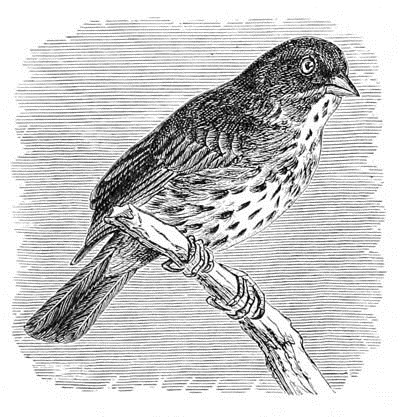
Passerella townsendi.
Sp. Char. General aspect of upper parts foxy-red, the ground-color and the sides of neck being ashy; the interscapular feathers each with a large blotch of fox-red; this color glossing the top of head and nape; sometimes faintly, sometimes more distinctly; the rump unmarked; the upper coverts and surface of the tail continuous fox-red. Two narrow white bands on the wing. Beneath, with under tail-coverts and axillars, clear white, the sides of head and of throat, the jugulum, breast, and sides of body, conspicuously and sharply blotched with fox-red; more triangular across breast, more linear and darker on sides. Sometimes the entire head above is continuously reddish. First quill rather less than fifth. Hind toe about equal to its claw. Length, 7.50; wing, 3.50; tail, 2.90; tarsus, .87; middle toe, without claw, .67; hind claw, .35.
Hab. Eastern North America to the Mississippi, to the north along valley of the Mackenzie, almost or quite to the Arctic coast, and down the valley of the Yukon to the Pacific. Breeds throughout the interior of British America.
In summer, the ash is more predominant above; in winter, it is overlaid more or less by a wash of rufous, as described above.
The young plumage we have not seen. The P. obscura, Verrill,9 may be referrible to it.
Habits. The Fox-colored Sparrow, in its seasons of migrations, is a very common bird throughout the United States east of the Mississippi River. It has not been ascertained to breed in any part of the United States, though it may do so in Northeastern Maine. Mr. Boardman has not met with it near Calais, nor did I see nor could I hear of it in any part of Nova Scotia or New Brunswick that I visited. In passing north, these birds begin their northern movements in the middle of March, and from that time to the last of April they are gradually approaching their summer quarters. Their first appearance near Boston is about the 15th of March, and they linger in that vicinity, or successive parties appear, until about the 20th of April. The last comers are usually in song. On their return, the middle or last of October, they pass rapidly, and usually make no stay. In Southwestern Texas these birds were not observed by Mr. Dresser, nor in Arizona by Dr. Coues, but in the Indian Territory Dr. Woodhouse found them very abundant on the approach of winter. Dr. Coues speaks of them as common in South Carolina from November to April, but less numerous than most of the Sparrows.
In the vicinity of Washington this bird is found from October to April. I have met with small groups of them through all the winter months among the fallen leaves in retired corners of the Capitol grounds, where they were busily engaged, in the manner of a Pipilo, in scratching in the earth for their food. At those periods when the ground was open, their habits were eminently similar to those of the gallinaceous birds. In March and April they were in company with the White-throated Sparrows, but passed north at least a month earlier.
During their stay in the United States these birds keep in small distinctive flocks, never mingling, though often in the same places, with other species. They are found in the edges of thickets and in moist woods. They are usually silent, and only occasionally utter a call-note, low and soft. In the spring the male becomes quite musical, and is one of our sweetest and most remarkable singers. His voice is loud, clear, and melodious; his notes full, rich, and varied; and his song is unequalled by any of this family that I have ever heard. They soon become reconciled to confinement and quite tame, and sing a good part of the year if care is taken in regard to their food. If allowed to eat to excess, they become very fat and heavy, and lose their song.
Dr. Coues did not meet with these birds in Labrador, but Mr. Audubon found them there and in Newfoundland in large numbers; and, according to the observations of Sir John Richardson, they breed in the wooded districts of the fur countries, up to the 68th parallel of latitude.
These birds were also found abundantly at Fort Simpson and Great Slave Lake by Mr. Robert Kennicott and Mr. B. R. Ross; at Fort Anderson, Anderson River, Swan River, and in various journeys, by Mr. R. MacFarlane; at Fort Resolution, Fort Good Hope, La Pierre House, and Fort Yukon, by Mr. Lockhart; at Peel’s River, by Mr. J. Flett; at St. Michael’s, by Mr. H. M. Bannister; and at Nulato, by Mr. W. H. Dall. They were observed at Fort Simpson as early as May 17, and by Mr. Kennicott as late as September 17. Mr. Dall states that at Nulato he found this Sparrow in abundance. It arrived there from the 10th to the 15th of May. It breeds there, and its eggs were obtained on the Yukon River. In the month of August in 1867 and of July in 1868 it was abundant at the mouth of the Yukon and at St. Michael’s. One was also shot at Unalaklik. The birds seemed to prefer thickets to the more open country. Mr. Bannister did not find it abundant. He shot only one specimen during the season, in an alder thicket near the fort; and Mr. Pease, who was familiar with the species, only saw a single individual.
According to the reports of both Mr. MacFarlane and Mr. Kennicott, the nest of this species was found both on the ground and in trees. In one instance it was in a tree about eight feet from the ground, and in its structure was said to be similar to the nests of Turdus aliciæ. They were nearly all found after the middle of June, a few as early as the 7th. One was found on the ground at the foot of a tuft of dwarf willows, which helped to conceal it from view. This was composed of coarse hay, lined with some of a finer quality, a few deer-hairs, and a small quantity of fresh and growing moss, intermingled together. In speaking of this nest Mr. MacFarlane states that all the nests of this Sparrow he had previously met with had been built in the midst of branches of pine or spruce trees, and had been similar to those of the T. aliciæ, which, in this instance, it did not resemble. He adds that this species, though not numerous, extended quite to the borders of the wooded country, to the north and northwest of Fort Anderson. Afterwards he observed several other nests on the ground, all of which were similar to the last, and it is by no means impossible that in certain instances these birds may have occupied old nests of the T. aliciæ, and used them for purposes of incubation. Richardson states that its nests are constructed in a low bush, and are made of dry grass, hair, and feathers. He states that the eggs are five in number, of a pale mountain-green tint, and marbled with irregular spots of brown.
Mr. Audubon, who found several of the nests of this bird in Labrador, near the coast, describes them as large for the size of the bird, and as usually placed on the ground among moss or tall grass near the stem of a creeping fir, the branches of which usually conceal it from view. Its exterior is loosely formed of dry grasses and moss, with a carefully disposed inner layer of fine grasses, circularly arranged. The lining consists of very delicate fibrous roots, with feathers of different kinds of water-fowl. In one instance he noted the down of the eider-duck. He found their eggs from the middle of June to the 5th of July. When their nest was approached, the female affected lameness, and employed all the usual arts to decoy the intruder away. They raised but one brood in a season, and about the first of September left Labrador for the south in small flocks, made up of members of one family.
Their eggs measure from .92 to an inch in length, and .70 in breadth. They are oblong in shape. Their ground-color is a light bluish-white, thickly spotted with a rusty-brown, often so fully as to conceal the ground.
Passerella townsendi, Nuttall
TOWNSEND’S SPARROW
? Emberiza unalaschkensis, Gmel. II, 1788, 875 (based on Aonalaschka Bunting, Lath. II, 202, 48; Unalaschka B., Pennant, 52). Passerella u. Finsch, Abh. Nat. III, 1872, 53 (Alaska). Fringilla townsendi, Aud. Orn. Biog. V, 1839, 236, pl. ccccxxiv, f. 7.—Ib. Syn. 1839.—Ib. Birds Am. III, 1841, 43, pl. clxxxvii. Fringilla (Passerella) townsendi, Nutt. Man. I, (2d ed.,) 1840, 533. Passerella townsendi, Bon. Conspectus, 1850, 477.—Baird, Birds N. Am. 1858, 489.—Cooper & Suckley, 204.—Dall & Bannister, Tr. Ch. Ac. I, 1869, 285. Fringilla meruloides, Vig. Zoöl. Blossom (Monterey, Cal.), 1839, 19. ? Emberiza (Zonotrichia) rufina, Kittlitz, Denkw. 1858, 200. (He compares it with P. iliaca, but says it is darker. Sitka.)
Sp. Char. Above very dark olive-brown, with a tinge of rufous, the color continuous and uniform throughout, without any trace of blotches or spots; the upper tail-coverts and outer edges of the wing and tail feathers rather lighter and brighter. The under parts white, but thickly covered with approximating triangular blotches colored like the back, sparsest on the middle of the body and on the throat; the spots on the belly smaller. Side almost continuously like the back; tibiæ and under tail-coverts similar, the latter edged with paler. Axillars brown; paler on edges. Claws all very large and long; the hinder claw longer than its toe. First and sixth quills about equal. Length, about 7 inches; wing, about 3.00.
Hab. Pacific coast of United States, as far south as Sacramento, and Fort Tejon? north to Kodiak (and Unalaschka?).

Passerella townsendi.
2874 ♀
This species differs a good deal in form from P. iliaca. The claws are much larger and stouter, the wing a good deal shorter and more rounded. The differences in color are very appreciable, the tints being dark sepia-brown instead of red, and perfectly uniform above, not spotted; the under parts much more thickly spotted.
Specimens from Alaska show a tendency to longer and perhaps more slender bills. Some are rather more rufous-brown than the type; others have a faint tinge of ashy anteriorly, although scarcely appreciable. This is especially noticeable in some skins from Fort Tejon, they being almost exactly intermediate between townsendi and schistacea, or megarhynchus.
Young birds are not materially different from the adult, except in having the white of under parts replaced by pale rusty; the back is rather duller in color, but without spots or stripes of any kind.
No. 46,620 from British Columbia has the bill much stouter than in the average.
It is by no means certain, however probable, that this bird is the E. unalaschkensis of Gmelin, an important objection being its absence so far in collections received by the Smithsonian Institution from that island. We therefore leave the question open for the present.
Habits. The history of this western analogue of the Fox-colored Sparrow is still quite imperfectly known. It was first obtained in Oregon by Mr. Townsend, on the 15th of February. He describes it as a very active and a very shy bird, keeping constantly among the low bushes of wormwood, and on the ground in their vicinity. It was partially gregarious, six or eight being usually seen together. Its call-note was a short, sharp, quick chirp, and it also had occasionally a low weak warble.
Dr. Gambel, referring probably to its occurrence in winter in California, speaks of this bird as an abundant resident in that State, which is not correct, it being only a winter visitant, and not abundant south of San Francisco. He describes its habits as very different from those of any other Sparrow, and more like those of a Thrush. It is said to keep in retired bushy places, or in underwood, and was scarcely ever seen except on the ground, and then would scarcely ever be discovered but for the noise it made in scratching among the leaves. It was silent and unsuspicious, and he rarely heard it utter even its occasional chirp.
Dr. Cooper states that he found this Sparrow only a winter resident in Washington Territory, where, in company with other Sparrows, it kept constantly on the ground, frequenting the thickets and scratching among the fallen leaves for its food. It was most common in the interior, but in very cold weather sought the coast, in company with the Snowbird and other species. He observed a few lingering about the Straits of Fuca until April. After that he saw no more of them until their return southward in October. During their winter residence Dr. Cooper never heard them sing. Dr. Suckley found them rather abundant near Fort Steilacoom, though not so common as the Melospiza rufina, which they greatly resembled in habits and in general appearance.
Dr. Heermann describes them as abundant and migratory in California, visiting that State only in winter. He speaks of them as of a solitary and quiet nature, resorting to the thickets and underwood for its food, turning over the leaves and scratching up the ground in the manner of the Brown Thrush, occasionally hopping backwards as if to ascertain the results of its labors.
Dr. Cooper, in his Report on the Birds of California, reaffirms that this bird is only a winter visitant to the lower country near the Columbia, but also conjectures that it spends the summer in the Cascade Mountains, between April and October. Specimens have been obtained near San Francisco in winter. It seemed to him to be both a shy and a silent bird, frequenting only woods or thick bushes, and while there constantly scratching among the fallen leaves, and feeding both on seeds and insects. He has seen either this bird or the P. megarhynchus as far south as San Diego in winter. He has also noticed its arrival near San Francisco as early as October 20.
On the Spokan Plains, in British Columbia, Mr. J. K. Lord first met with this species. They were there not uncommon in dark swampy places east of the Cascades. These birds he found remarkable for their singular habit of scratching dead leaves or decayed material of any sort with their feet, exactly as do barn-door fowls,—sending the dirt right, left, and behind. It picks up seeds, insects, larvæ, or anything eatable that it thus digs out, and then proceeds to scratch for more. The long and unusually strong claws with which this bird is provided seem particularly well adapted for these habits, so unusual in a Sparrow. At almost any time, by waiting a few moments, one may be pretty sure to hear the scratching of several of these birds from under the tangle of fallen timber.
Several specimens were obtained in Sitka by Bischoff and others, but without any record of their habits.
Passerella townsendi, var. schistacea, Baird
Passerella schistacea, Baird, Birds N. Am. 1858, 490, pl. lxix, f. 3.

11234 ♂
Sp. Char. Bill slender, the length being .34 from nostril, the depth .25; the upper mandible much swollen at the base; the under yellow. Above and on the sides uniform slate-gray; the upper surface of wings, tail-feathers, and upper coverts dark brownish-rufous; ear-coverts streaked with white. Beneath pure white, with broad triangular arrow-shaped and well-defined spots of slate-gray like the back everywhere, except along the middle of the belly; not numerous on the throat. A hoary spot at the base of the bill above the loral region; axillars nearly white. Length, 6.80; wing, 3.30; tail, 3.50.
Hab. Head-waters of Platte and middle region of United States to Fort Tejon and to Fort Crook, California.
This species is readily distinguished from P. iliaca by the slaty back and spots on the breast, the absence of streaks above, and the longer claws. From townsendi it differs in having the head, back, sides, and spots beneath slate-colored, instead of dark reddish-brown. The spotting beneath is much more sparse, the spots smaller, more triangular, and confined to the terminal portion of the feathers, instead of frequently involving the entire outer edge. The axillars are paler. The wings and tail are the same in both species.
The young bird is quite similar; but the spots beneath are badly defined, more numerous, and longitudinal rather than triangular.
There can be little doubt, however, that this bird is a geographical race of P. townsendi.
Habits. For all that we know in regard to the habits and general distribution of this species, we are indebted to the observations of Mr. Ridgway, who met with it while accompanying Mr. Clarence King’s geological survey. It was first obtained in July, 1856, by Lieutenant F. T. Bryan, on the Platte River, and others were afterwards collected at Fort Tejon by Mr. Xantus.
Mr. Ridgway found the Slate-colored Sparrow at Carson City, during its spring migrations northward, in the early part of March. At this time it was seen only among the willows along the Carson River, and was by no means common. It had the habit of scratching among the dead leaves, on the ground in the thickets, precisely after the manner of the eastern P. iliaca. In the following September he again found it among the thickets in the Upper Humboldt Valley. In Parley’s Park, among the Wahsatch Mountains, he found it a very plentiful species in June, nesting among the willows and other shrubbery along the streams. There it was always found in company with the M. fallax, which in song it greatly resembles, though its other notes are quite distinct, the ordinary one being a sharp chuck. The nest of the two species, he adds, were also so much alike in manner of construction and situation, and the eggs so similar, that it required a careful observation to identify a nest when one was found.
The eggs from one nest of the Passerella schistacea measure .90 by .70 of an inch, have a ground of a light mountain-green, and are profusely spotted with blotches of a rufous-brown, generally diffused over the entire egg.
Another nest of this species, obtained in Parley’s Park, in the Wahsatch Mountains, by Mr. Ridgway, June 23, 1869, was built in a clump of willows, about two feet from the ground. The nest is two inches in height, two and a half in diameter, cavity one and a half deep, with a diameter of two. It is composed externally of coarse decayed water-grass, is lined with fine hair and finer material like the outside. The eggs, four in number, are .80 by .67 of an inch, of a very rounded oval shape, the ground-color of a pale green, blotched and marked chiefly at the larger end with brown spots of a wine-colored hue.
Passerella townsendi, var. megarhynchus, Baird
THICK-BILLED SPARROW
Passerella schistacea, Baird, Birds N. Am. 1858, p. 490 (in part; Ft. Tejon specimens). Passerella megarhynchus, Baird, Birds N. Am. 1858, p. 925 (Appendix).—Cooper, Orn. Cal. I, 222. Passerella schistacea, var. megarhynchus, Ridgway, Rept. Geol. Expl. 40th Par.

13757 ♂
Sp. Char. Similar to var. schistacea in colors, size, and general proportions; but bill enormously thick, its depth being very much greater than the distance from nostril to tip, instead of much less; color of lower mandible rosy milk-white, instead of maize-yellow. Bill, .35 from nostril, .47 deep; wing, 3.30; tail, 3.50; tarsus, .83; middle toe without claw, .63; hind claw, .50.
Hab. Sierra Nevada, from Fort Tejon north to 40° latitude (Carson City, Nevada, breeding, Ridgway).
This very remarkable variety of P. townsendi is quite local in its distribution, having been observed only in the Sierra Nevada region, as above indicated. The first specimens were brought from Fort Tejon by Mr. J. Xantus, but at what season they were found there is not indicated on the labels. Recently, specimens were procured by Mr. Ridgway at Carson City, Nev., in April, they having arrived there about the 20th of April, frequenting the ravines of the Sierra near the snow. At the same place the var. schistacea was found earlier in the spring, but among the willows along the streams in the valleys, and not met with in the mountains; and all the individuals had passed northward before those of megarhynchus arrived.
In this restricted distribution the present bird is a companion of the Melospiza melodia, var. heermanni, and the characteristics of form are the same in both as compared with their Middle Province and Northern representatives; while they both differ from the latter (townsendi of Passerella, and rufina of Melospiza) in purer, lighter, and less brown colors.
Habits. Dr. Cooper met with several individuals of this bird towards the summits of the Sierra Nevada, in September, 1863, but was unable to preserve any of them. So far as he was able to observe them, they had no song, and their habits were generally similar to those of the P. townsendi.
The Thick-billed Sparrow was found by Mr. Ridgway as a very common bird among the alder swamps in the ravines of the eastern slope of the Sierra Nevada during the summer. Near Carson City, April 25, in a swampy thicket near the streams in the level slopes, he heard, for the first time, its beautiful song, and killed a specimen in the midst of its utterance of what, he adds, was one of the most exquisitely rich utterances he ever heard. This song, he states, resembles, in richness and volume, that of the Louisiana Water Thrush (Seiurus ludovicianus), qualities in which that bird is hardly equalled by any other North American bird. They were singing in all parts of that swampy thicket, and up the ravines as far as the snow. From the nature of the place and the character of their song, they were at first supposed to be the Water Thrush, until specimens of these exquisite songsters were secured. He regards this bird as second to none of our singers belonging to this family and though in variety, sprightliness, and continuity, and also in passionate emotional character, its song is not equal to that of the Chondestes grammaca, yet it is far superior in power and richness of tone. Mr. Ridgway regards this bird as easily distinguishable from the P. schistacea, of which, however, it is only a variety. There is a total discrepancy in its notes, and while neither species is resident in the latitude of Carson City, through which both kinds pass in their migrations, the P. schistacea lingers in the spring only a short time, soon passing to the northward, while the P. megarhynchus arrives later and remains through the summer. The former makes its temporary abode among the willows along the river, while the latter breeds in the shrubbery of the mountain ravines.
Subfamily SPIZINÆ
Char. Bill variable, always large, much arched, and with the culmen considerably curved; sometimes of enormous size, and with a greater development backward of the lower jaw, which is always appreciably, sometimes considerably, broader behind than the upper jaw at its base; nostrils exposed. Tail rather variable. Bill generally black, light blue, or red. Wings shorter than in the first group. Gape almost always much more strongly bristled. Few of the species sparrow-like or plain in their appearance; usually blue, red, or black and white; except in one or two instances the sexes very different in color.
The preceding diagnosis is intended to embrace the brightly colored passerine birds of North America, different in general appearance from the common Sparrows. It is difficult to draw the line with perfect strictness, so as to separate the species from those of the preceding group, but the bill is always more curved, as well as larger, and the colors are brighter. They resemble quite closely, at a superficial glance, the Coccothraustinæ, but may be readily distinguished by absence of the projecting tufts surrounding the base of the upper mandible, shorter, more rounded wings, and longer tarsi.
The genera may be most conveniently arranged as follows:—
A. Wings decidedly longer than the tail. Eggs plain blue or white, unspotted.
a. Feet very stout, reaching nearly to the end of the tail. Species terrestrial.
Calamospiza. Bill moderate, the commissure with a deep angle posteriorly and prominent lobe behind it; anteriorly nearly straight; commissure of lower mandible with a prominent angle. Outer toe longer than the inner, both nearly as long as the posterior. Outer four primaries about equal, and abruptly longer than the rest. Tertials nearly equal to primaries. Tail-feathers broad at tips. Color: black with white spot on wing in ♂, brownish streaks in ♀. Nest on or near ground; eggs plain pale blue.
Euspiza. Bill weaker, the commissure with a more shallow angle, and much less prominent sinuation behind it; anteriorly distinctly sinuated. Outer toe shorter than inner, both much shorter than the posterior one. First primary longest, the rest successively shorter. Tertials but little longer than secondaries. Tail-feathers attenuated at tips. Color: back brown streaked with black; throat white; jugulum yellow or ashy; with or without black spot on fore neck. A yellow or white superciliary stripe. Nest on or near ground; eggs plain pale blue.
b. Feet weaker, scarcely reaching beyond lower tail-coverts; species arboreal.
a. Size large (wing more than 3.50 inches)
Hedymeles. Upper mandible much swollen laterally. Colors: no blue; upper parts conspicuously different from the lower. Wings and tail with white patches; axillars and lining of wing yellow or red. Female streaked. Nest in a tree or bush; eggs greenish, thickly spotted.
Guiraca. Upper mandible flat laterally. Colors: ♂ deep blue, with two rufous bands on wings; no white patches on wings or tail; axillars and lining of wing blue; ♀ olive-brown without streaks. Nest in a bush; eggs plain bluish-white.
b. Size very small (wing less than 3.00 inches)
Cyanospiza. Similar in form to Guiraca, but culmen more curved, mandible more shallow, the angle and sinuations of the commissure less conspicuous. Color: ♂ more or less blue, without any bands on wing (except in C. amæna in which they are white); ♀ olive-brown. Nest in a bush; eggs plain bluish-white (except in C. ciris, in which they have reddish spots).
B. Wing and tail about equal. The smallest of American Conirostres. Nest in bushes. Eggs white, spotted.
Spermophila. Bill very short and broad, scarcely longer than high, not compressed; culmen greatly curved. Color: chiefly black and white, or brown and gray.
Phonipara. Bill more triangular, decidedly longer than deep, much compressed; culmen only slightly curved, or perfectly straight. Colors: dull olive-green and blackish, with or without yellow about the head.
C. Wing much shorter than the tail.
a. Head crested. Prevailing color red. Bill red or whitish.
Pyrrhuloxia. Bill pyrrhuline, very short, and with the culmen greatly convex; shorter than high. Hind claw less than its digit; not much larger than the middle anterior one. Tarsus equal to the middle toe. Nest in bush or low tree; eggs white, spotted with lilac and olive.
Cardinalis. Bill coccothraustine, very large; culmen very slightly convex. Wings more rounded. Feet as in the last, except that the tarsus is longer than the middle toe. Nest in bush or low tree; eggs white, spotted with lilac and olive.
b. Head not crested. Colors black, brown, or olive, without red. Bill dusky, or bluish.
Pipilo. Bill moderate; culmen and commissure curved. Hind claw very large and strong; longer than its digit. Tarsus less than the middle toe. Nest on ground or in low bush; eggs white sprinkled with red, or pale blue with black dots and lines round larger end.
Genus CALAMOSPIZA, Bonap
Calamospiza, Bonap. List, 1838. (Type, Fringilla bicolor, Towns.)
Corydalina, Audubon, Synopsis, 1839. (Same type.)

Calamospiza bicolor.
5720 ♂
Gen. Char. Bill rather large, much swollen at the base; the culmen broad, gently but decidedly curved; the gonys nearly straight; the commissure much angulated near the base, then slightly sinuated; lower mandible nearly as deep as the upper, the margins much inflected, and shutting under the upper mandible. Nostrils small, strictly basal. Rictus quite stiffly bristly. Legs large and stout. Tarsi a little longer than the middle toe; outer toe rather longer than the inner, and reaching to the concealed base of the middle claw; hind toe reaching to the base of the middle claw; hind claw about as long as its toe. Claws all strong, compressed, and considerably curved. Wings long and pointed; the first four nearly equal, and abruptly longest; the tertials much elongated, as long as the primaries. Tail a little shorter than the wings, slightly graduated; the feathers rather narrow and obliquely oval, rounded at the end.
Color. Male, black, with white on the wings. Female, brown above, beneath white, with streaks.

PLATE XXIX.

1. Poocætes gramineus. D. C., 10147.

2. Calamospiza bicolor. ♂ Neb., 5720.

3. Calamospiza bicolor. ♀ N. Mex., 6306.

4. Guiraca cærulea. ♂ Philada., 6480.

5. Guiraca cærulea. ♀ Cal.

6. Cyanospiza parellina. ♂ N. Leon, Mex., 4074.

7. Cyanospiza ciris. ♂ Texas, 6271.

8. Cyanospiza ciris. ♀.

9. Cyanospiza versicolor. ♂ N. Leon, Mex., 4075.

10. Cyanospiza versicolor. ♀ C. St. Lucas, 12984.

11. Cyanospiza amœna. ♂ Ft. Union, Dak., 1898.

12. Cyanospiza amœna. ♀ Nevada, 53551.

13. Cyanospiza cyanea. ♂ Pa., 2645.

14. Cyanospiza cyanea. ♀ Ga., 32426.

15. Phonipara zena. ♂ Bahamas.

16. Phonipara zena. ♀ Bahamas.

17. Spermophila moreleti. ♂ Costa Rica, 30524.
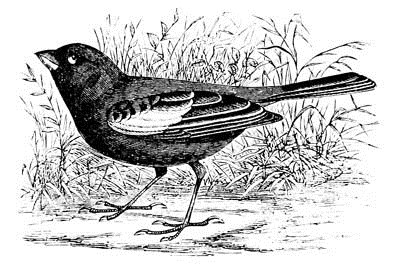
Calamospiza bicolor.
This genus is well characterized by the large swollen bill, with its curved culmen; the large strong feet and claws; the long wings, a little longer than the tail, and with the tertials as long as the primaries; the first four quills about equal, and abruptly longest; the tail short and graduated.
The only group of North American Spizellinæ, with the tertials equal to the primaries in the closed wing, is Passerculus. This, however, has a differently formed bill, weaker feet, the inner primaries longer and more regularly graduated, the tail-feathers more acute and shorter, and the plumage streaked brownish and white instead of black.
Calamospiza bicolor, Bonap
LARK BUNTING; WHITE-WINGED BLACKBIRD
Fringilla bicolor, Townsend, J. A. N. Sc. Ph. VII, 1837, 189.—Ib. Narrative, 1839, 346.—Aud. Orn. Biog. V, 1839, 19, pl. cccxc. Calamospiza bicolor, Bonap. List, 1838.—Ib. Conspectus, 1850, 475.—Baird, Birds N. Am. 1858, 492.—Heerm. X, c, 15. Corydalina bicolor, Aud. Synopsis, 1839, 130.—Ib. Birds Am. III, 1841, 195, pl. cci.—Max. Cab. J. VI, 1858, 347.—Cooper, Orn. Cal. 1, 225. Dolichonyx bicolor, Nuttall, Manual, I, (2d ed.,) 1840, 203.
Sp. Char. Male entirely black; a broad band on the wing (covering the whole of the greater coverts), with the outer edges of the quills and tail-feathers, white. Length, about 6.50; wing, 3.50; tail, 3.20; tarsus, 1.00; bill above, .60.
Female pale brown, streaked with darker above; beneath white, spotted and streaked rather sparsely with black on the breast and sides. Throat nearly immaculate. A maxillary stripe of black, bordered above by white. Region around the eye, a faint stripe above it, and an obscure crescent back of the ear-coverts, whitish. A broad fulvous white band across the ends of the greater wing-coverts; edge of wing white. Tail-feathers with a white spot at the end of the inner web.
Young. Similar to the female; a faint buff tinge prevalent beneath, where the streaks are narrower; dark streaks above broader, the feathers bordered with buffy-white.
Hab. High Central Plains to the Rocky Mountains; southwesterly to Valley of Mimbres and Sonora; San Antonio, Texas, winter (Dresser, Ibis, 1865, 490). Fort Whipple, Arizona (Coues, P. A. N. S. 1866, 84). Parley’s Park, Utah (Ridgway).
Habits. This peculiar species, known by some writers as the Lark Bunting, and by others as the White-winged Blackbird, was first described by Townsend in 1837. He met with it when, in company with Mr. Nuttall, he made his western tour across the continent, on the 24th of May, soon after crossing the north branch of the Platte River. The latter writer regarded it as closely allied to the Bobolink, and described it as a Dolichonyx. He describes the birds as gregarious, consorting with the Cowbirds, and, at the time he met with them, uttering most delightful songs. Towards evening they sometimes saw these birds in all directions around them, on the hilly grounds, rising at intervals to some height, hovering and flapping their wings, and, at the same time, giving forth a song which Mr. Nuttall describes as being something like weet-weet-wt-wt-wt, notes that were between the hurried warble of the Bobolink and the melody of a Skylark. It is, he says, one of the sweetest songsters of the prairies, is tame and unsuspicious, and the whole employment of the little band seemed to be an ardent emulation of song.
It feeds on the ground, and, as stated by Mr. Townsend, may be seen in flocks of from sixty to a hundred together. It was, so far as their observations went, found inhabiting exclusively the wide grassy plains of the Platte. They did not see it to the west of the Black Hills, or the first range of the Rocky Mountains.
To Mr. Nuttall’s account Mr. Townsend adds that this bird is strictly gregarious, that it feeds on the ground, around which it runs in the manner of the Grass Finch, to which, in its habits, it seems to be somewhat allied. Mr. Townsend adds that, as their caravan moved along, large flocks of these birds, sometimes to the number of sixty or a hundred individuals, were started from the ground, and the piebald appearance of the males and females promiscuously intermingled presented a very striking and by no means unpleasing effect. While the flock was engaged in feeding, some of the males were observed to rise suddenly to considerable height in the air, and, poising themselves over their companions with their wings in constant and rapid motion, continued nearly stationary. In this situation they poured forth a number of very lively and sweetly modulated notes, and, at the expiration of about a minute, descended to the ground and moved about as before. Mr. Townsend also states that he met with none of these birds west of the Black Hills.
Mr. Ridgway also mentions that though he found these birds very abundant on the plains east of the Black Hills, he met with only a single specimen to the westward of that range. This was at Parley’s Park, among the Wahsatch Mountains.
Dr. Gambel, in his paper on the Birds of California, states that he met with small flocks of this handsome species in the bushy plains, and along the margins of streams, during the winter months. And Dr. Heermann states that he also found this species numerous in California, New Mexico, and Texas. Arriving in the last-named State in May, he found this species there already mated, and about to commence the duties of incubation.
Mr. Dresser found these birds common near San Antonio during the winter. In December he noticed several flocks near Eagle Pass. They frequented the roads, seeking the horse-dung. They were quite shy, and when disturbed the whole flock would go off together, uttering a low and melodious whistle. In May and June several were still about near Howard’s Rancho, and on his return from Houston, in June, he succeeded in shooting one in its full summer plumage, when its specific name is peculiarly appropriate. He does not, however, think that, as a general thing, any of them remain about San Antonio to breed.
They breed in great numbers on the plains of Wyoming Territory, and probably also in Colorado, Montana, and Dakota. The Smithsonian collection embraces specimens obtained in July from the Yellowstone, from Platte River, Pole Creek, the Black Hills, and Bridger’s Pass, indicating that they breed in these localities; also specimens from Texas, New Mexico, Sonora, and Espia, in Mexico, but none from California.
Dr. Kennerly, who met with these birds both in Sonora and at Espia, on the Mexican Boundary Survey, states that he observed them in the valley of the river early in the morning, in very large flocks. During the greater part of the day they feed on the hills among the bushes. When on the wing they keep very close together, so that a single discharge of shot would sometimes bring down twenty or thirty. Mr. J. H. Clark, on the same survey, also states that he sometimes found them occurring in flocks of hundreds. The greatest numbers were seen near Presidio del Norte. Great varieties of plumage were observed in the same flock. The food seemed to be seeds almost exclusively. They were very simultaneous in all their movements. Stragglers were never observed remaining behind after the flock had started. They are, he states, the most absolutely gregarious birds he has ever met with.
Dr. Coues, who regarded this bird as one highly characteristic of the prairie fauna, writes me that he met with it in great numbers in Kansas, soon after leaving Fort Riley, and saw it every day until he reached the Raton Mountains in New Mexico. “For two or three days, in fact, from Fort Larned to the mountains,” he writes, “I scarcely saw anything else. This was the first week in June, and most of the birds seemed to be paired and nesting, though occasionally a dozen or more were seen together, flocking like the Blackbirds that they strongly recall. They were in full song, and proved delightful vocalists. Sometimes they warble from some spray or low bush offering a stand a little above the level flower-beds of the prairie, but oftener they mount straight up, hovering high in the air on tremulous wings, pouring forth their melodious strains until, seemingly exhausted, they sink back to the ground. At such times it is interesting to watch two rival males, each straining every nerve to mount higher than the other, and sing more acceptably to its mate hidden in the verdure below. This habit of rising on the wing to sing, so famed in the case of the Skylark, seems not confined to particular species, but to be a forced practice of a number of different birds residing in open level regions, that do not afford the elevated perches usually chosen by woodland songsters for their performances. The ordinary flight of this species is altogether of a different character, being a low gliding motion, overtopping the weeds and bushes. That the birds were nesting at this time is rendered still more probable by the fact that the males noticed as we passed along were out of all proportion, in numbers, to the females seen. They were very heedless of approach, and any number could have been readily destroyed. I never saw any at Fort Whipple, or elsewhere in Arizona, though Dr. Heermann says that they are abundant in the southern portions of the Territory, and specimens are recorded from Lower California.”
A nest with eggs, procured at Fort Mohave by Dr. Cooper, is in the Smithsonian Collection (No. 7,276). The egg measures .93 by .70 of an inch, is obovate in shape, being much rounded at the smaller end. Its ground-color is a dull white, without any perceptible tinge of blue,—though possibly bluish when fresh,—with heavy dots and occasional delicate, hair-like, zigzag markings of black. These markings are wholly confined to the larger end. One of the eggs has these markings much finer, consisting of minute dots, more dense, and upon the apex of the larger end. The nest is loosely built and very bulky. Its external diameter is about six inches, and its depth three. The cavity is three inches wide and two deep. It is constructed almost entirely of strips of inner bark, the coarser, ribbon-like pieces being used on the outer portion, and the finer shreds composing the lining. Externally are also a few sticks about one quarter of an inch in diameter.
SECTION IV
Crown rufous; body above, olive-green
Pipilo chlorurus, Baird
GREEN-TAILED BUNTING; BLANDING’S FINCH
Fringilla chlorura, (Townsend,) Aud. Orn. Biog. V, 1839, 336 (Young). Zonotrichia chlorura, Gambel, J. A. N. Sc. Ph. 2d Series, I, 1847, 51. Embernagra chlorura, Bonap. Conspectus, 1850, 483. Fringilla blandingiana, Gambel, Pr. A. N. Sc. Ph. I, April, 1843, 260. Embernagra blandingiana, Cassin, Illus. I, III, 1853, 70, pl. xii. Pipilo rufipileus, Lafresnaye, Rev. Zoöl. XI, June, 1848, 176.—Bp. Conspectus, 1850, 487. Kieneria rufipileus, Bon. Comptes Rendus, XL, 1855, 356. Pipilo chlorura, Baird, Birds N. Am., 1858, 519.—Heerm. X, c, 15.—Cooper, Orn. Cal. 1, 248.
Sp. Char. Above dull grayish olive-green. Crown uniform chestnut. Forehead with superciliary stripe, and sides of the head and neck, the upper part of the breast and sides of the body, bluish-ash. Chin and upper part of throat abruptly defined white, the former margined by dusky, above which is a short white maxillary stripe. Under tail-coverts and sides of body behind brownish-yellow. Tail-feathers generally, and exterior of wings, bright olive-green, the edge and under surface of the wings bright greenish-yellow; edge of first primary white. First quill longer than eighth, fourth longest. Length, about 7 inches; wing, 3.20; tail, 3.65.
Hab. Whole of the Middle Province, including the Rocky Mountains and eastern slope of the Sierra Nevada; north to beyond the 40th parallel; south to Mexico.
In this species the wing is considerably rounded, the tertials considerably shorter than the primaries, and not exceeding the secondaries; the fourth quill longest, the first shorter than the sixth, the second and fifth quills considerably longer than the rest. The tail is long and considerably graduated, the outer feather half an inch shortest; the feathers broad and obtusely pointed, the corners rounded.

Pipilo chlorurus.
38493
The extent of the chestnut of the crown varies somewhat; more extended probably in the males. The region on the side of the head, adjoining the nostrils, is whitish; the small feathers under the eye are spotted with the same. The posterior outline of the ash of the breast is much less sharply defined than the anterior.
Specimens vary in the brightness of the olive above, which is never as pure as that of the wings and tail. The olive of the tail, too, is darker than that of the wings.

Pipilo chlorurus.
A very young bird (1,896) has the whole under parts dull white, streaked and spotted on the sides of the throat and on the breast with dark brown. The crown and back are also thickly spotted. In 5,734 the ash of the breast has made its appearance; the middle of the belly is white, spotted; the chin white, encircled by spots. The spots above are restricted to near the head, and there is a small central patch of chestnut on the crown.
No. 1,896 is the original “Green-tailed Sparrow” killed July 12, 1834, by Townsend, and described in an extract of a letter to Mr. Audubon, published page 336 of Vol. V. of the Ornithological Biography.
Habits. Dr. Kennerly, who procured a specimen of this bird at San Elizario, Tex., December 16, states that it was obtained with some difficulty. For several successive days it was found in the same place, occupying a small clump of very thick weeds. When aroused, which was only accomplished with some effort, its flight was short, rapid, and decidedly irregular. Its motions on the ground were very awkward. This species was found by Mr. Ridgway very generally distributed throughout the fertile mountain portions of the interior. It was not seen by him in California, and was first met with in the ravines at the base of the eastern slope of the Sierra Nevada. On the high mountain-ranges it was a characteristic and the best-known singer, as well as one of the most abundant of the Fringillidæ, being found in all bushy places, from the bases to the summits of the mountains. It is exclusively a summer species, arriving at Carson City about the middle of April. He describes the usual note of this bird as very peculiar, and, as nearly as can be described, a sweet laughing utterance of the syllables keek-keek´, a little resembling the tweet of a Canary, but very musical. This curious note was generally uttered when anything unusual attracted its attention, such as the approach of an intruder. Then, with elevated tail and its very conspicuous red cap raised, it would hop familiarly and unsuspiciously about. He adds that it is a songster of high merit, in power and variety ranking very little below the song of the Chondestes grammaca. The song varies in the modulations greatly with the individual, but the same general style is preserved. At times it seemed to have a slight resemblance to the song of Bewick’s Wren, and at others to that of a Cyanospiza, and more rarely, to be the reproduction of a passage from the song of the Chondestes.
In the early part of July, near Austin, in the cañons of the mountains, he found these birds breeding in the greatest abundance, and later in the same month a few of its nests were found on the East Humboldt Mountains. All of its nests, with hardly an exception, were placed from eighteen inches to two feet above the ground, among the thick bushes of a species of Symphoricarpus, or “snow-berry,” which grows in great abundance upon the sides of the cañons of those mountains. The maximum number of eggs was four. It was also quite a common bird in the Wahsatch Mountains, though less abundant than the P. megalonyx.
Mr. Allen found this Finch quite numerous in Colorado Territory, and speaks of its song as very peculiar and very pleasing. It is said to resemble in no respect the eastern Towhee Finch, with which it is classed, but much more closely the group of Sparrows, so familiarly represented at the east by the White-throated, being like them in habits, song, and general aspect. It was more common among the foot-hills than on the plains. In Utah, according to Mr. Allen, this Finch begins to appear in numbers about September 20, from its breeding-haunts in the mountains.
Dr. Coues met with this species in Arizona, but only as a spring and autumn migrant. None remained there in summer to breed, and none were found there in the winter. In its migrations it passed rapidly by Fort Whipple, being found there only during the latter part of April and the beginning of May, and during the month of September. At those seasons it appeared to him the most silent and retiring of all the Pipilos. He found it very difficult to either observe its habits or to capture it. It winters sparingly at Fort Mohave.
Specimens of this bird were taken near Lookout Mountain by C. S. McCarthy, and at Gilmer, in Wyoming Territory, by Mr. Durkee.
Dr. Heermann, in his Report on the birds observed on the 32d. parallel, under Lieutenant Parke, mentions first meeting with this species near Tucson. They were frequenting, in numbers, the thick undergrowth, and were seeking seeds and insects on the ground. They seemed inclined to shun observation, and always kept in the most retired situations. They were sociable among themselves, going about singly or in pairs, associated with the Poospiza bilineata and two or three other kinds of Finch. When started they fly low, diving into the bushes, and soon disappear from sight. Occasionally, until reaching El Paso, Texas, birds of this species were met with, mingling with the flocks of migrating Fringillidæ. He there procured a pair apparently just entering upon incubation.
Instead of being suited by color, like most of the other Pipilos, to inhabit dark thickets and among dry leaves, this species is clad in a gayer livery, and seems well adapted for concealment in its summer resorts, and also among the growing vegetation of the lower country during the rainy season. Dr. Heermann found a few wintering in the Colorado Valley, and yet more at San Diego, but they left both places in March. He found them silent and shy, hiding very closely in the bushes, and feeding altogether on the ground. The only note he heard, resembled the crowing note of the California Quail.
Among the memoranda of Mr. Xantus, made near Fort Tejon, are the two following: “4,839, nest and two eggs (of Pipilo chlorurus) found in a dry hedge in Mr. Ritchie’s garden; 5,083, nest and eggs found in a dark garden-hedge.”
The eggs of the chlorurus are like those of no other Pipilo that I have met with. They are peculiar in shape, being nearly of an exact oval, neither end being apparently much more rounded than the other. Their ground-color is white with a bluish tint, over which is profusely diffused a cloud of fine dottings of a pinkish-drab. These markings are occasionally so fine and so thickly distributed as to give to the egg the appearance of a uniform color, or as an unspotted pinkish drab-colored egg. Occasionally the dots are deeper and larger, and more sparsely diffused.
In considering the eggs of the Pipilos in general we find certain variations which deserve more than a passing notice. Those of erythrophthalmus, oregonus, arcticus, and megalonyx are all fringilline in their characters, and have a marked affinity to eggs of Melospiza, Zonotrichia, and many other genera of this order. The eggs of aberti, fuscus, mesoleucus, and albigula are also all closely alike, and exhibit a very close resemblance to those of the Agelaii, and even of the Icteri, while the eggs of P. chlorurus, though of a fringilline character, are unlike either style.
Family ALAUDIDÆ.—The Larks
Char. First primary very short or wanting. Tarsi scutellate anteriorly and posteriorly, with the plates nearly of corresponding position and number. Hind claw very long and nearly straight. Bill short, conical, frontal feathers extending along side of the bill; the nostrils concealed by a tuft of bristly feathers directed forward. Tertials greatly elongate beyond the secondaries.
Subfamilies and Genera
Alaudinæ. Bill stout, short, and conical; nasal fossæ transverse and completely filled by the thick tuft of bristly feathers, and perforated anteriorly by a circular nasal opening. (Old and New World.)
Crown with a depressed soft crest of feathers, of normal structure; a spurious primary; tail deeply emarginate … Alauda.
Crown without a crest, but occiput with an erectile tuft of narrow elongated feathers on each side. No spurious primary; tail square, or slightly rounded … Eremophila.
Calandritinæ. Bill broader, more depressed, and straighter at the base; nasal fossæ longitudinal, large, elongated, the nasal opening rather linear. (Old World.)
Of the Alaudidæ only the two genera diagnosed above belong to the American continent; and one of them is properly only a wanderer from the Old World, while the other is cosmopolitan.
The most characteristic feature of the Larks among other oscine families is seen in the scutellation of the tarsus. The anterior half of this is covered by divided scales lapping round on the sides, but instead of the two plates which go one on each side of the posterior half and unite ultimately behind as an acute ridge, there is but one which laps round on the sides, and is divided into scales like the anterior ones, but alternating with them. The posterior edge of the tarsus is as obtuse as the anterior, instead of being very acute. There is a deep separating groove on the inner side of the tarsus; and there may be really but one plate divided transversely, the edges meeting at this place.
In the elongated hind claw and lengthened tertials, general style of coloration, mode of life, and manner of nesting, there is a decided approximation in the Alaudidæ to the Anthinæ, of the family Motacillidæ; but in these the posterior edge of the tarsus is sharp and undivided transversely, the toes more deeply cleft, the bill more slender, etc.,—their relations being rather nearer to the Sylvicolidæ than to the present family.
Genus ALAUDA, Linn
Alauda, Linn. S. N. 1735
Gen. Char. Bill very small, less than half the length of the head, conical; nostrils exposed; rictal bristles quite strong; commissure without notch; tarsus much longer than middle toe; lateral toes equal; posterior toe about as long as the middle, its claw longer than the digit, and nearly straight; claws of anterior toe very small. Wing long, pointed, the third and fourth (apparently second and third) quills longest, the second and fifth successively, a little shorter; the first so small as to be almost concealed; tertials much elongated, reaching about half-way from end of secondaries to tip of primaries; their ends emarginated; tail rather deeply emarginated, and a little more than half the length of the wing.
Species
A. arvensis. Above grayish-brown, beneath whitish, with a buffy tinge across jugulum and along sides; every feather above with a medial streak of dusky; sides of throat, sides, and across jugulum streaked with dusky; the outer tail-feathers partly white. Wing, 4.90; tail, 2.80; culmen, .40; tarsus, .80; hind claw, .50. Hab. Europe; accidental in Greenland and the Bermudas.
Alauda arvensis, Linn
THE SKYLARK
Alauda arvensis, Linn., Faun. Sue. p. 76. Alauda vulgaris, Leach, Syst. Cat. Mamm. and Birds in B. M. p. 21. Alauda cœlipeta, Pall. Zoögr. I, 524. Alauda segetum, Brehm, Vög. Deutschl. 318. Alauda montana, Brehm, Vög. Deutschl. 319, t. 20, f. 1. Alauda agrestis, Brehm, Vög. Deutschl. 320. Alauda italica, Gmel. S. N. I, 793.
Sp. Char. Adult. Above grayish umber-brown, beneath white, tinged across the breast with soft light ochraceous. Every feather above with a medial dusky streak, the shaft black; wing-feathers and upper tail-coverts bordered with white. Outer tail-feather mostly white, the next one edged with the same. A plain, light superciliary stripe; auriculars nearly uniform light brownish; sides of the throat, jugulum, and sides with short streaks of dusky brown.
Male. Wing, 4.90; tail, 2.80; culmen, .40; tarsus, .80; middle toe, .55; hind claw, .50.
Young. Above more yellowish-fulvous, the feathers with central spots, instead of medial stripes of dusky, and bordered terminally with whitish; jugulum washed strongly with ochraceous, and marked with dusky spots.
Hab. Europe; accidental in Greenland and the Bermudas; Aleutian Islands.
Habits. The famed Skylark of the Old World can rest a twofold claim to be included in a complete list of North American birds. One of these is their occasional occurrence in the Bermudas, and in Greenland. The other is their probably successful introduction near New York.
A few years since an attempt was made to introduce these birds, for which purpose several individuals were set at liberty on Long Island. For a short time they did well, and succeeded in raising one or more broods, but, owing probably to the constant persecution of all small birds by the foreign population of the neighborhood, the experiment nearly failed, and none were noticed in that vicinity. Within the last year or two, however, several pairs of these birds have been observed in Westchester County, and also on Long Island, by parties competent to recognize them, and hopes are now entertained that these desirable birds have obtained a foothold in this country.
According to Messrs. Dresser and Sharpe, the Skylark is found throughout the polar Arctic regions, from the British Islands eastward to Siberia and Northern China. A smaller subspecies is met with in Southeastern Europe, which does not present any character by which it can be separated from it. In Eastern Europe the Lark has been found as far north as the Faroe Islands, but has not been observed in Iceland. It reaches Christiania in March, and leaves in October. It has been found breeding in Lapland as far north as latitude 65°, and is a common summer visitant in Finland. Pallas found it abundant throughout Russia and Siberia, and Steller found it not only in Kamtschatka, but equally in the Kurile Islands and in those between Asia and America, so that its occurrence in our Alaskan territories may be regarded as a not improbable event.
The same writers also state that the Skylark has been twice recorded as occurring in Greenland and in America; and in another place they state that “the Skylark occasionally visits Greenland, and has been met with in the Bermudas.” In the latter place a storm-tried waif was taken by Mr. J. M. Jones after an easterly gale.
The Lark is a universal favorite in the Old World, and as a vocalist enjoys a reputation hardly second even to the far-famed Nightingale. It is an inhabitant of all the countries of Europe, and is said to be most abundant in the cultivated districts.
We only know of its song from caged specimens and from the testimony of European writers. Yarrell speaks of its notes as cheerful and exhilarating, fresh as the season of spring, and the admiration of all hearers. Its voice is described as powerful to an extraordinary degree, and its song wild and joyous. They sing while they fly, rising, with quivering wings almost perpendicularly, until they gain so great an elevation that they can no longer be distinguished; yet, while thus no longer visible, their wild music continues to be heard as that of some unseen spirits of the air. It is said that one familiar with their song can readily determine, by their notes, whether the singer is ascending, stationary, or descending. Occasionally, when at this great elevation, the Lark will close its wings and drop to the earth with the rapidity of a stone. At times it will sing while on the ground, but its most lively strains are poured forth during these flights. And though this bird will sing while in confinement, and is a favorite cage-bird, yet in singing they are said to flutter their wings, as if this motion were almost a necessary accompaniment to their song.
In regard to the song and its peculiarities writers are not quite in agreement. The general opinion seems to be that, while in the quality of its tone it is surpassed by the song of the Nightingale, the Bulfinch, and the Black-cap, it is unequalled in quantity, sprightliness, variety, and power. The Lark is in song eight months of the year, and during the summer months it sings from two in the morning, with very little intermission, until after sunset.
Mr. Macgillivray gives an excellent and graphic description of the habits of this bird, from which we extract a portion descriptive of its song. “It has been alleged,” he writes, “that the Lark ascends in a spiral manner, but my observation does not corroborate the statement. In rising it often passes directly upward, but with the body always horizontal, or nearly so, then moves in a curve, and continues thus alternately, but without a continued spiral motion. At first, the motion of the wings is uniformly fluttering; but afterwards it shoots them out two or three times successively at intervals, and when at its greatest height exhibits this action more remarkably. When it descends, the song is not intermitted, but is continued until it approaches the ground, when it usually darts down headlong, and alights abruptly. Frequently it resumes its song after alighting, and continues it for a short time, but more commonly it stops when it has reached the ground. Often a Lark may be seen hovering over a field, in full song, for a considerable time, at a small height. On the 4th of May, 1837, I observed a Lark perched on a half-burnt whin branch, where it remained singing a long time. I have often seen it perch on a wall, and several times on a hawthorn bush in a hedge; but it never, I believe, alights on tall trees.
“The song of the Lark is certainly not musical, for its notes are not finely modulated, nor its tones mellow; but it is cheerful and cheering in the highest degree, and protracted beyond all comparison. In a sunny day in April or May, when the grass-fields have begun to resume their verdure, it is pleasant to listen to the merry songster that makes the welkin ring with its sprightly notes; in the sultry month of July, still more pleasant is it to hear its matin hymn while the dew is yet on the corn; and in winter, should you chance to hear the well-known voice on high, it reminds you of the bright days that have gone, and fills you with anticipation of those that are to come. No doubt much of the pleasure derived from the Lark’s song depends upon association, but independently of circumstances and associations the song of the Lark imparts an elasticity to the mind, elevates the spirits, and suspends for a time the gnawing of corroding care. The carol of the Lark, like the lively fife, excites pure cheerfulness. In confinement this bird sings every whit as well as when at large, and when rapidly perambulating the square bit of faded turf in its cage, it enacts its part with apparently as much delight as when mounting toward heaven’s gate.”
This bird succeeds well in cages, and lives to a great age, Yarrell mentioning one that lived nearly twenty years in confinement. Its natural food is grain, the seeds of grasses, worms, and various kinds of insects. They begin to mate in April, and have two broods in a season. Their nest is always placed on the ground, often sheltered by a tuft of grass, or some other protection. The nests are woven of coarse grasses and stems of plants, and are lined with finer materials of the same. The eggs are five in number, have a grayish-white ground, occasionally a greenish-white, very generally sprinkled and blotched with markings of dark-gray and an ashy-brown, so profusely as to conceal the ground. They are oval in shape, slightly more pointed at one end, and measure .93 of an inch in length by .70 in breadth.
According to Selby, the young of the first brood are fully fledged by the end of June, and the second in August. The Lark evinces a very strong attachment to its young, and many interesting accounts are given by European writers of its intelligent endeavors to conceal and to protect its nest,—in one instance constructing an artificial dome of dry grass, where the natural protection had been cut away by mowers, and in another attempting to remove the young to a place of greater safety.
The Lark has, in several instances, been successfully induced to mate and rear her young in an aviary; and Mr. W. P. Foster, of Hackney, is quoted by Mr. Yarrell as authority for the statement, that, during the period of producing the eggs, the female has been heard to sing with a power and a variety of tone equal to the voice of her mate.
While his mate is sitting on her eggs, the male Lark, apparently timid at all other times, is remarkably bold, and drives away other birds that venture too near their nest. He not only watches over her and seeks to protect her, but assiduously supplies her with food.
Genus EREMOPHILA, Boie
Eremophila, Boie, Isis, 1828, 322. (Type, Alauda alpestris. Sufficiently distinct from Eremophilus, Humboldt, [Fishes,] 1805.)
Phileremos, Brehm, Deutschl. Vögel, 1831.
Otocoris, Bonaparte, 1839. (Type, Alauda alpestris, Gray.) (We are unable to find where the genus is named.)
Gen. Char. First primary wanting; bill scarcely higher than broad; nostrils circular, concealed by a dense tuft of feathers; the nasal fossæ oblique. A pectoral crescent and cheek-patches of black.

♂ Eremophila alpestris.
This genus differs from Melanocorypha in having no spurious first primary, although the other characters are somewhat similar. Calandritis of Cabanis, with the same lack of first primary, has a much stouter bill. The spurious primary, more depressed bill, and differently constituted nostrils and nasal fossæ of Alauda are readily distinctive.

Eremophila alpestris.
The type of this genus is the Alauda alpestris, Linn., a well-known cosmopolitan species, though the birds of the New World have been distinguished under distinctive names, as cornuta, chrysolæma, peregrina, etc. The examination and critical comparison of more than a hundred specimens from all parts of North America, however, has convinced us of the identity with alpestris of the several forms mentioned above, though it may be advisable to retain one or more of them as geographical races.
Species and Varieties
E. alpestris. Adult. Above pinkish-gray, varying to cinnamon, the pinkish deepest on nape and lesser wing-coverts; tail black (except two middle feathers), the outer feather edged with white. Beneath white, the sides pinkish or grayish. A frontal band and superciliary stripe, the middle of auriculars, chin, and throat varying from white to deep Naples-yellow; forepart of crown, and “ear-tufts,” a patch on lores and cheeks, and a broad crescent across the jugulum, deep black; end of auriculars ashy. Female and autumnal males, with the pattern less sharply defined, and the colors more suffused. Young. Brownish-black above, more or less mixed with clay-color, and sprinkled with whitish dots; wing-feathers all bordered with whitish. Beneath white. Markings on head and jugulum just merely indicated by dusky cloudings.
Wing (of adult male), 4.20 to 4.60; tail, 2.90 to 3.16; culmen, .60 to .65.
White frontal band, .25 to .30, wide; the black prefrontal patch, .26 to .35 wide. The pinkish above of an ashy-lilac shade.
Throat and forehead white, with only a very faint tinge of yellow; pinkish tinge above more rufous. Hab. Interior Northern Plains of the United States … var. occidentalis.
Throat and forehead pale straw-yellow, or strongly tinged with it; pinkish tinge above varying from ashy-lilacous to purplish-rufous. Hab. Northern regions of Old and New Worlds … var. alpestris.
Wing (adult male), 3.80 to 4.10; tail, 2.75 to 2.90; culmen, .53 to .62.
White frontal band, .13 to .16 wide; the black prefrontal patch, .35 to .50 wide. Pinkish above of a deep cinnamon shade. Hab. Desert plains of South Middle Province of United States, and table-lands of Mexico, south to Bogota … var. chrysolæma.

PLATE XXXII.

1. Eremophila cornuta. ♂ Nev., 53470.

2. Eremophila cornuta. Juv., Wisc., 4330.

3. Alauda arvensis. Europe.

4. ♂ Pa., 977.

5. Dolichonyx oryzivorus. ♀ Kansas, 13069.

6. Molothrus pecoris. ♀ Ga., 32446.

7. Molothrus pecoris. ♀

8. Molothrus pecoris. var. obscurus. ♂ Manzanillo, Mex., 30165.

9. Xanthocephalus icterocephalus. ♂ Utah, 58624.
Eremophila alpestris, Boie
THE SHORE LARK
Sp. Char. Adult male; spring. A frontal crescent, curving backward in a broad, sharply defined, superciliary stripe to the occiput; chin, throat and foreneck, and a crescent across middle of ear-coverts, whitish, either more or less tinged with yellow, or pure white. Lower parts, except laterally, white. A broad crescentic patch behind the frontal whitish crescent, running back on each side of the crown and terminating in an erectile tuft of narrow elongated feathers on each side of occiput, a patch covering the lores, nasal tufts, passing beneath the eye, and forming a broad “mustache” on the cheeks, with a convex outline behind and concave anteriorly, and a broad crescentic patch across the jugulum, deep black. A crescentic spot of grayish-drab across the ends of the auriculars. Posterior portion of the crown enclosed laterally between the “ear-tufts,” occiput, nape, lateral lower parts, lesser and middle wing-coverts, and upper tail-coverts, pinkish-brown; the sides and flanks with obsolete dusky streaks. Back, scapulars, rump, wings, and two middle tail-feathers, ashy-drab, the feathers darker centrally, forming rather conspicuous broad streaks on lower part of back; middle and secondary coverts, secondaries and primaries bordered terminally, quite conspicuously, with white. Tail (except the intermediæ) black; outer web of lateral feather almost entirely white, that of the next edged with the same.
Adult female; spring. Similar, but markings rather less sharply defined; a tendency to streaking of nape and crown; these streaks often displacing the continuous black of the anterior portion of crown. The “ear-tufts” less developed.
Winter adult. Similar to the spring dress, but the black areas obscured, more or less, by whitish borders to the feathers; the frontal whitish band less sharply defined. Breast with numerous more or less distinct deltoid specks of plumbeous, and the pinkish of the sides much tinged with the same. The dusky streaks above are broader and more conspicuous.
Young. First plumage, entirely different from the adult. Above dusky, variegated with whitish dots, sprinkled over the whole surface; these specks terminal on each feather, and of a deltoid form, becoming more transverse and crescentic on the scapulars and rump; each feather of the wings broadly bordered with pale brownish, approaching white on the coverts. The blackish areas are but faintly indicated by a dusky suffusion, generally very indistinct, across the breast, and over the cheeks; and variegated with badly defined, more dusky spots; lower parts, including post-ocular stripe, dull white; sides spotted with dusky.
The E. alpestris, as restricted, is represented in the collection by three perfect specimens, in the several stages of plumage described; while there is also a fine specimen from Astrachan, representing a white-throated race (“var. bei” on MS. label) of Central Asia. The series of American specimens is all that could possibly be desired, there being numerous examples from nearly the whole northern continent, from the Arctic regions to as far south as Bogota, and from coast to coast.
The common Shore Lark of the northern parts of North America appears to be absolutely identical with the European bird, each of the specimens of the latter being easily matched from the American series. It therefore becomes necessary to reduce the name “cornuta” to a synonyme of alpestris, the former not affording characters to distinguish it as even a variety. To alpestris may also be referred the form known as “occidentalis, McCall,” those specimens from the interior regions which are destitute of any yellow tinge on the throat. Were this feature a constant one in specimens from the region which it characterizes, it would be, of course, right to retain the name in the form of alpestris var. occidentalis. As it is, however, quite a large percentage of the specimens from every locality where occidentalis is found have more or less yellow throats, but it is possible that this mixture of the two may be the result of irregular migrations, those yellow-throated individuals being stragglers from their breeding habitat,—more to the eastward and northward. In its white instead of straw-yellow throat, and more lilaceous than vinaceous upper parts, this form bears a close resemblance to a race of the deserts of Western (and Central?) Asia,—the “bei”26; the latter, however, has these features more exaggerated than in the one of the central plains of North America. Breeding throughout the table-lands of Mexico, and in the Western Province of the United States, north to about the 40th parallel, is a more strongly marked race, maintaining also more constancy in its peculiar features; this race is the E. chrysolæma, Wagl., of which name rufa, Aud., and minor, Giraud, are synonymes. This race, which we propose to call E. alpestris var. chrysolæma, differs from both the northern styles in smaller size and longer bill, and in coloration is the opposite extreme from occidentalis, having the vinaceous tints deeper and browner, instead of paler and less brown, than in cornuta (i. e. typical alpestris). The black markings are also more extended, in proportion to the other colors, reducing the white on the forehead to a very narrow band, instead of a broad spot equalling, or exceeding, the black in width. Specimens from Bogota—about the southern limit of the genus on this continent—are, perhaps, referrible to chrysolæma, or at least not very different from it, though described by Sclater as distinct, under the name peregrinus.27
In fewer words, the variations, with the region, are about as follows. Starting with North America, north of the United States, we begin with a style absolutely undistinguishable from that of Europe; this, to which the name cornuta belongs, visits the Eastern States only in winter, but breeds over the prairie region of Wisconsin, Illinois, and westward. West of the Rocky Mountains, especially south of about 40°, specimens referrible to this style are most numerous in winter, and in a large series a great percentage of the specimens entirely lack any yellow on the throat, while the pinkish-brown tints are lighter and less reddish; this style represents, in these peculiar features, the “var. bei” of Western Asia (Astrachan), and has been distinguished by the name occidentalis, McCall, though it is doubtful whether McCall’s description is of a specimen of this style or of one of chrysolæma, being taken from a young or immature bird. Breeding south of about 40°, from the Rocky Mountains to the Pacific coast, and throughout the table-lands of Mexico,—in winter sometimes resident at the northern limit assigned, and there mixed with northern-bred individuals,—is a kind which is smaller, and, generally, with a larger bill; the throat is deeper yellow than in the northern form, the pinkish tints deepened into cinnamon, and the frontal band narrower, caused by an encroachment of the black, which, in its several areas, is extended more in proportion to the other colors. This is the E. chrysolæma of Wagl., and of which minor, Giraud, and rufa, Aud., are synonymes, as already stated.
Along the coast of Oregon and Washington Territory is a very peculiar race, represented in the collection by several specimens. These differ essentially in having the dark streaks above very sharply defined, broad and clear blackish-brown,28 while the lower parts are strongly tinged with yellow, even as deeply so as the throat. Additional specimens from the northwest coast may establish the existence of a race as distinct as any of those named above.
Var. alpestris
Alauda alpestris, Linn. S. N. I, 289.—Forst. Phil. Trans. LXII, 1772, 383.—Wilson,—Aud.—Jard.—Maynard, B. E. Mass. 1870, 121. Otocorys a. Finsch, Abh. Nat. 1870, 341 (synonomy and remarks). Alauda cornuta, Wils. Am. Orn. I, 1808, 85.—Rich. F. B. A. II. Eremophila c. Boie, Isis, 1828, 322.—Baird, Birds N. Am. 1858, 403.—Lord, P. R. A. Inst. IV, 118 (British Col.).—Cooper & Suckley, XII, 195.—Dall & Bannister, Tr. Ch. Ac. I, 1869, 218 (Alaska).—Cooper, Orn. Cal. I, 1870, 251.—Samuels, 280. Phileremos c. Bonap. List, 1838. Otocoris c. Auct. Otocoris occidentalis, McCall, Pr. A. N. Sc. V, June, 1851, 218 (Santa Fé).—Baird, Stansbury’s Rep., 1852, 318.
Char. Adult. Frontal whitish crescent more than half as broad as the black patch behind it. Throat and forehead either tinged, more or less strongly, with yellow, or perfectly white. Pinkish tint above, a soft ashy-vinaceous.
Measurements. (56,583 ♂, North Europe,) wing, 4.40; tail, 2.90; culmen, .60; width of white frontal crescent, .25; of black, .30. (3,780 ♂, Wisconsin,) wing, 4.20; tail, 3.00; culmen, .60; width of white frontal crescent, .30; of black, .26. (16,768 ♂, Hudson’s Bay Ter.,) wing, 4.55; tail, 3.10; culmen, .65; width of white frontal crescent, .35; of black, .36. (8,491 ♂, Fort Massachusetts,) wing, 4.35; tail, 3.15; culmen, .61; width of white frontal crescent, .27; of black, 27. (The three perfectly identical in colors.)
Young. On the upper parts the blackish greatly in excess of the whitish markings. Spots across jugulum distinct.
Hab. Northern Hemisphere; in North America, breeding in the Arctic regions and the open plains of the interior regions, from Illinois, Wisconsin, etc., to the Pacific, north of about 38°.
Var. chrysolæma
Alauda chrysolæma, Wagl. Isis, 1831, 350.—Bonap. P. Z. S. 1837, 111. Otocorys ch. Finsch, Abh. Nat. 1870, 341. Alauda minor, Giraud, 16 Sp. Tex. B. 1841. Alauda rufa, Aud. Birds Am. VII, 1843, 353, pl. ccccxcvii. Otocoris r., Heerm. X. s, 45. ? Otocorys peregrina, Scl. P. Z. S. 1855, 110, pl. cii. Eremophila p., Scl. Cat. Am. B. 1860, 127.
Char. Adult. Frontal crescent less than half as wide as the black. Throat and forehead deep straw-yellow; pinkish tints above deep cinnamon.
a. Specimens from California and Mexico, streaks on back, etc., very obsolete; darker central stripe to middle tail-feathers scarcely observable; white beneath.

b. Specimens from coast of Oregon and Washington Territory. Streaks on back, etc., very conspicuous; dark central stripe of tail-feathers distinct; yellow beneath.
Measurements. (8,734 ♂, Fort Steilacoom,) wing, 3.75; tail, 2.60; bill, .61—.15—.40.
Hab. Middle America, from the desert regions of the southern Middle Province of North America, south to Bogota.
Habits. Assuming the Shore Lark of the Labrador coast and the rufous Lark of the Western prairies to be one and the same species, but slightly modified by differences of locality, climate, or food, we have for this species, at all times, a wide range, and, during the breeding-season, a very unusual peculiarity,—their abundant distribution through two widely distant and essentially different regions.
During a large portion of the year, or from October to April, these birds may be found in all parts of the United States. Dr. Woodhouse found them very common throughout Texas, the Indian Territory, New Mexico, and California. Mr. Dresser states that he found the western variety—which he thinks essentially different in several respects from the eastern—in great numbers, from October to the end of March, in the prairies around San Antonio. Afterwards, at Galveston, in May and June, 1864, he noticed and shot several specimens. Although he did not succeed in finding any nests, he was very sure that they were breeding there. It is common, during winter, on the Atlantic coast, from Massachusetts to South Carolina. In Maine it is comparatively rare. In Arizona, Dr. Coues speaks of the western form as a permanent resident in all situations adapted to its wants. The same writer, who also had an opportunity of observing the eastern variety in Labrador, where he found it very abundant on all the moss-covered islands around the coast, could notice nothing in their voice, flight, or general manners, different from their usual habits in their southern migrations, except that during the breeding-season they do not associate in flocks.
Richardson states that this Lark arrives in the fur countries in company with the Lapland Bunting, with which it associates, and, being a shyer bird, would act as sentinel and give the alarm on the approach of danger. As Mr. Dall only obtained a single skin on the Yukon, it probably is not common there. Dr. Suckley states it to be a very abundant summer resident on the gravelly prairies near Fort Steilacoom, in Washington Territory. He describes it as a tame, unsuspicious bird, allowing a man to approach within a few feet of it. It is essentially a ground bird, rarely alighting on bushes or shrubs.
Dr. Cooper adds to this that the Shore Lark is common in the interior, but he only noticed one on the coast border. In ordinary seasons they seem to be permanent residents, and in winter to be both more gregarious and more common. He met with one as late as July 1, on a gravelly plain near Olympia, scratching out a hollow for its nest under a tussock of grass.
Dr. Cooper also found these birds around Fort Mohave in considerable flocks about the end of February, but all had left the valley by the end of March. About May 29 he found numbers of them towards the summits of the Providence range of mountains, west of the valley, and not far from four thousand feet above it, where they probably had nests. They were also common in July on the cooler plains towards the ocean, so that they doubtless breed in many of the southern portions of California, as well as at Puget Sound and on the Great Plains. Dr. Cooper states that in May or June the males rise almost perpendicularly into the air, until almost out of sight, and fly around in an irregular circle, singing a sweet and varied song for several minutes, when they descend nearly to the spot from which they started. Their nests were usually found in a small depression of the ground, often under a tuft of grass or a bush. Mr. Nuttall started a Shore Lark from her nest, on the plains, near the banks of the Platte. It was in a small depression on the ground, and was made of bent grass, and lined with coarse bison-hair. The eggs were olive-white, minutely spotted all over with a darker tinge.
According to Audubon, these Larks breed abundantly on the high and desolate granite tracts that abound along the coast of Labrador. These rocks are covered with large patches of mosses and lichens. In the midst of these this bird places her nest, disposed with so much care, and the moss so much resembling the bird in hue, that the nests are not readily noticed. When flushed from her nest, she flutters away, feigning lameness so cunningly as to deceive almost any one not on his guard. The male at once joins her, and both utter the most soft and plaintive notes of woe. The nest is embedded in the moss to its edges, and is composed of fine grasses, circularly disposed and forming a bed about two inches thick. It is lined with the feathers of the grouse and of other birds. The eggs, deposited early in July, are four or five in number, and are described by Mr. Audubon as marked with bluish as well as brown spots.
About a week before they can fly, the young leave the nest, and follow their parents over these beds of mosses to be fed. They run nimbly, and squat closely at the first approach of danger. If observed and pursued, they open their wings and flutter off with great celerity.
These birds reach Labrador early in June, when the male birds are very pugnacious, and engage frequently in very singular fights, in which often several others besides the first parties join, fluttering, biting, and tumbling over in the manner of the European House Sparrow. The male is described as singing sweetly while on the wing, but its song is comparatively short. It will also sing while on the ground, but less frequently, and with less fulness. Its call-note is quite mellow, and is at times so altered, in a ventriloquial manner, as to seem like that of another bird. As soon as the young are hatched their song ceases. It is said to feed on grass-seeds, the blossoms of small plants, and insects, often catching the latter on the wing, and following them to a considerable distance. It also gathers minute crustaceans on the sea-shore.
Mr. Ridgway found this species abundant over the arid wastes of the interior, and, in many localities, it was almost the only bird to be found. In its habits he could observe no differences between this bird and the alpestris. He met with their nests and eggs in the Truckee Reservation, June 3. The nest was embedded in the hard, grassy ground, beneath a small scraggy sage-bush, on the mesa, between the river and the mountains.
Mr. J. K. Lord mentions that, having encamped at Cedar Springs on the Great Plains of the Columbia, where the small stream was the only water within a long distance, he became interested in watching the movements of these Larks. As evening approached they came boldly in among the mules and men, intense thirst overcoming all sense of fear. He found these handsome little birds very plentiful throughout British Columbia. They were nesting very early on those sandy plains, even before the snow had left the ground. He saw young fledglings early in May.
A single specimen of this species was taken at Godhaab, Greenland, in October, 1835.
Eggs from Labrador are much larger in size than those from Wisconsin. Two eggs from the first, one obtained by Mr. Thienemann, the other by Mr. George Peck, of Burlington, Vt., measure .93 and .94 of an inch in length by .71 in breadth; while some from the West are only .83 in length and .63 in breadth, their greatest length being .90, and their largest breadth .69 of an inch. In their ground-color and markings, eggs from both localities vary about alike. The ground-color varies from a purplish-white to a dark gray, while the spots are in some a brownish-lavender, in others a brown, and, quite frequently, an olive-brown. In some they are in larger, scattered blotches; while in others they are in very fine minute dots so thickly and so uniformly diffused as almost to conceal the ground.
Family ICTERIDÆ.—The Orioles
Char. Primaries nine. Tarsi scutellate anteriorly; plated behind. Bill long, generally equal to the head or longer, straight or gently curved, conical, without any notch, the commissure bending downwards at an obtuse angle at the base. Gonys generally more than half the culmen, no bristles about the base of bill. Basal joint of the middle toe free on the inner side; united half-way on the outer. Tail rather long, rounded. Legs stout.
This family is strictly confined to the New World, and is closely related in many of its members to the Fringillidæ. Both have the angulated commissure and the nine primaries; the bill is, however, usually much longer; the rictus is completely without bristles, and the tip of the bill without notch.
The affinities of some of the genera are still closer to the family of Sturnidæ or Starlings, of which the Sturnus vulgaris may be taken as the type. The latter family, is, however, exclusively Old World, except for the occurrence of a species in Greenland, and readily distinguished by the constant presence of a rudimentary outer primary, making ten in all.
There are three subfamilies of the Icteridæ,—the Agelainæ, the Icterinæ, and the Quiscalinæ,29 which may be diagnosed as follows, although it is difficult to define them with precision:—
Agelainæ. Bill shorter than, or about equal to, the head; thick, conical, both mandibles about equal in depth; the outlines all more or less straight, the bill not decurved at tip. Tail rather short, nearly even or slightly rounded. Legs longer than the head, adapted for walking; claws moderately curved.
Icterinæ. Bill rather slender, about as long as the head; either straight or decurved. Lower mandible less thick than the upper; the commissure not sinuated. Tarsi not longer than the head, nor than middle toe; legs adapted for perching. Claws much curved.
Quiscalinæ. Tail lengthened, considerably or excessively graduated. Bill as long as,or longer than, the head; the culmen curved towards the end, the tip bent down, the cutting edges inflexed, the commissure sinuated. Legs longer than the head, fitted for walking.
Subfamily AGELAINÆ
Char. Bill stout, conical, and acutely pointed, not longer than the head; the outlines nearly straight, the tip not decurved. Legs adapted for walking, longer than the head. Claws not much curved. Tail moderate, shorter than the wings; nearly even.
The Agelainæ, through Molothrus and Dolichonyx, present a close relation to the Fringillidæ in the comparative shortness and conical shape of the bill, and, in fact, it is very difficult to express in brief words the distinctions which evidently exist. Dolichonyx may be set aside as readily determinate by the character of the feet and tail. The peculiar subfamily characteristics of Molothrus will be found under the generic remarks respecting it.
The following diagnosis will serve to define the genera:—
A. Bill shorter than the head. Feathers of head and nostrils as in B.
Dolichonyx. Tail-feathers with rigid stiffened acuminate points. Middle toe very long, exceeding the head.
Molothrus. Tail with the feathers simple; middle toe shorter than the tarsus or head.
B. Bill as long as the head. Feathers of crown soft. Nostrils covered by a scale which is directed more or less downwards.
Agelaius. First quill shorter than the second and third. Outer lateral claws scarcely reaching to the base of middle; claws moderate.
Xanthocephalus. First quill longest. Outer lateral claw reaching nearly to the tip of the middle. Toes and claws all much elongated.
C. Bill as long as, or longer than, the head. Feathers of crown with the shafts prolonged into stiffened bristles. Nostrils covered by a scale which stands out more or less horizontally.
Sturnella. Tail-feathers acute. Middle toe equal to the tarsus.
Trupialis. Tail-feathers rounded. Middle toe shorter than the tarsus.
Genus DOLICHONYX, Swainson
Dolichonyx, Swainson, Zoöl. Journ. III, 1827, 351. (Type, Emberiza oryzivora, L.)

Dolichonyx oryzivorus.
977
Gen. Char. Bill short, stout, conical, little more than half the head; the commissure slightly sinuated; the culmen nearly straight. Middle toe considerably longer than the tarsus (which is about as long as the head); the inner lateral toe longest, but not reaching the base of the middle claw. Wings long, first quill longest. Tail-feathers acuminately pointed at the tip, with the shaft stiffened and rigid, as in the Woodpeckers.
The peculiar characteristic of this genus is found in the rigid scansorial tail and the very long middle toe, by means of which it is enabled to grasp the vertical stems of reeds or other slender plants. The color of the single species is black, varied with whitish patches on the upper parts.
Dolichonyx oryzivorus, Swainson
BOBOLINK; REEDBIRD; RICEBIRD
Emberiza oryzivora, Linn. Syst. Nat. I, 1766, 311.—Gm. I, 1788, 850.—Wilson, Am. Orn. II, 1810, 48, pl. xii, f. 1, 2. Passerina oryzivora, Vieillot, Nouv. Dict. XXV, 1817, 3. Dolichonyx oryzivora, Swainson, Zoöl. Jour. III, 1827, 351.—Ib. F. Bor.-Am. II, 1831, 278.—Bon. List, 1838.—Ib. Conspectus, 1850, 437.—Aud. Syn. 1839, 139.—Ib. Birds Am. IV, 1842, 10, pl. ccxi.—Gosse, Birds Jam. 1847, 229.—Baird, Birds N. Am. 1858, 522.—Max. Cab. J. VI, 1858, 266.—Cooper, Orn. Cal. I, 1870, 255.—Samuels, 335. Icterus agripennis, Bonap. Obs. Wils. 1824, No. 87. Aud. Orn. Biog. I, 1831, 283; V, 1839, 486, pl. liv.—Nutt. Man. I, 1832, 185. Icterus (Emberizoides) agripennis, Bon. Syn. 1828, 53. Dolichonyx agripennis, Rich. List, 1837. Psarocolius caudacutus, Wagler, Syst. Av. 1827, 32.

Dolichonyx oryzivorus.
Sp. Char. General color of male in spring, black; the nape brownish cream-color; a patch on the side of the breast, the scapulars, and rump, white, shading into light ash on the upper tail-coverts and the back below the interscapular region. The outer primaries sharply margined with yellowish-white; the tertials less abruptly; the tail-feathers margined at the tips with pale brownish-ash. In autumn totally different, resembling the female.
Female, yellowish beneath; two stripes on the top of the head, and the upper parts throughout, except the back of the neck and rump, and including all the wing-feathers generally, dark brown, all edged with brownish-yellow, which becomes whiter near the tips of the quills. The sides sparsely streaked with dark brown, and a similar stripe behind the eye. There is a superciliary and a median band of yellow on the head. Length of male, 7.70; wing, 3.83; tail, 3.15.
Hab. Eastern United States to the high Central Plains. North to Selkirk Settlement, and Ottawa, Canada; and west to Salt Lake Valley, Utah, and Ruby Valley, Nevada (Ridgway); Cuba, winter (Caban.); Bahamas (Bryant); Jamaica (Gosse, Scl., Oct.; March, Oct., and in spring); James Island, Galapagos, Oct. (Gould); Sombrero, W. I. (Lawrence); Brazil (Pelzeln); Yucatan.
A female bird from Paraguay (Dec., 1859) is undistinguishable from the average of northern ones, except by the smaller size. Specimens from the western plains differ from those taken near the Atlantic Coast in having the light areas above paler, and less obscured by the grayish wash so prevalent in the latter; the ochraceous of the nape being very pale, and at the same time pure.
Habits. The well-known and familiar Bobolink of North America has, at different seasons of the year, a remarkably extended distribution. In its migrations it traverses all of the United States east of the high central plains to the Atlantic as far to the north as the 54th parallel, which is believed to be its most northern limit, and which it reaches in June. In the winter it reaches, in its wandering, the West Indies, Central America, the northern and even the central portions of South America. Von Pelzeln obtained Brazilian specimens from Matogrosso and Rio Madeira in November, and from Marabitanas, April 4th and 13th. Those procured in April were in their summer or breeding plumage, suggesting the possibility of their breeding in the high grounds of South America. Sclater received specimens from Santa Marta and from Bolivia. Other specimens have been reported as coming from Rio Negro, Rio Napo, in Brazil, Cuba, Jamaica, Porto Rico, Paraguay, Buenos Ayres, etc.
In North America it breeds from the 42d to the 54th parallel, and in some parts of the country it is very abundant at this season. The most southern breeding locality hitherto recorded is the forks of the Susquehanna River, along the west branch of which, especially in the Wyoming Valley, it was formerly very abundant.
Mr. Ridgway also observed this bird in Ruby Valley where, among the wheat-fields, small companies were occasionally seen in August. He was informed that, near Salt Lake City, these birds are seen in May, and again late in the summer, when the grain is ripe.
Of all our unimitative and natural songsters the Bobolink is by far the most popular and attractive. Always original and peculiarly natural, its song is exquisitely musical. In the variety of its notes, in the rapidity with which they are uttered, and in the touching pathos, beauty, and melody of their tone and expression, its notes are not equalled by those of any other North American bird. We know of none, among our native feathered songsters, whose song resembles, or can be compared with it.
In the earliest approaches of spring, in Louisiana, when small flocks of male Bobolinks make their first appearance, they are said, by Mr. Audubon, to sing in concert; and their song thus given is at once exceedingly novel, interesting, and striking. Uttered with a volubility that even borders upon the burlesque and the ludicrous, the whole effect is greatly heightened by the singular and striking manner in which first one singer and then another, one following the other until all have joined their voices, take up the note and strike in, after the leader has set the example and given the signal. In this manner sometimes a party of thirty or forty Bobolinks will begin, one after the other, until the whole unite in producing an extraordinary medley, to which no pen can do justice, but which is described as very pleasant to listen to. All at once the music ceases with a suddenness not less striking and extraordinary. These concerts are repeated from time to time, usually as often as the flock alight. This performance may also be witnessed early in April, in the vicinity of Washington, the Smithsonian grounds being a favorite place of resort.
By the time these birds have reached, in their spring migrations, the 40th parallel of latitude, they no longer move in large flocks, but have begun to separate into small parties, and finally into pairs. In New England the Bobolink treats us to no such concerts as those described by Audubon, where many voices join in creating their peculiar jingling melody. When they first appear, usually after the middle of May, they are in small parties, composed of either sex, absorbed in their courtships and overflowing with song. When two or three male Bobolinks, decked out in their gayest spring apparel, are paying their attentions to the same drab-colored female, contrasting so strikingly in her sober brown dress, their performances are quite entertaining, each male endeavoring to outsing the other. The female appears coy and retiring, keeping closely to the ground, but always attended by the several aspirants for her affection. After a contest, often quite exciting, the rivalries are adjusted, the rejected suitors are driven off by their more fortunate competitor, and the happy pair begin to put in order a new home. It is in these love-quarrels that their song appears to the greatest advantage. They pour out incessantly their strains of quaint but charming music, now on the ground, now on the wing, now on the top of a fence, a low bush, or the swaying stalk of a plant that bends with their weight. The great length of their song, the immense number of short and variable notes of which it is composed, the volubility and confused rapidity with which they are poured forth, the eccentric breaks, in the midst of which we detect the words “bob-o-link” so distinctly enunciated, unite to form a general result to which we can find no parallel in any of the musical performances of our other song-birds. It is at once a unique and a charming production. Nuttall speaks of their song as monotonous, which is neither true nor consistent with his own description of it. To other ears they seem ever wonderfully full of variety, pathos, and beauty.
When their contests are ended, and the mated pair take possession of their selected meadow, and prepare to construct their nest and rear their family, then we may find the male bird hovering in the air over the spot where his homely partner is brooding over her charge. All this while he is warbling forth his incessant and happy love-song; or else he is swinging on some slender stalk or weed that bends under him, ever overflowing with song and eloquent with melody. As domestic cares and parental responsibilities increase, his song becomes less and less frequent. After a while it has degenerated into a few short notes, and at length ceases altogether. The young in due time assume the development of mature birds, and all wear the sober plumage of the mother. And now there also appears a surprising change in the appearance of our gayly attired musician. His showy plumage of contrasting white and black, so conspicuous and striking, changes with almost instant rapidity into brown and drab, until he is no longer distinguishable, either by plumage or note, from his mate or young.
At the north, where the Bobolinks breed, they are not known to molest the crops, confining their food almost entirely to insects, or the seeds of valueless weeds, in the consumption of which they confer benefit, rather than harm. At the south they are accused of injuring the young wheat as they pass northward in their spring migrations, and of plundering the rice plantations on their return. About the middle of August they appear in almost innumerable flocks among the marshes of the Delaware River. There they are known as Reedbirds. Two weeks later they begin to swarm among the rice plantations of South Carolina. There they take the name of Ricebirds. In October they again pass on southward, and make another halt among the West India Islands. There they feed upon the seeds of the Guinea-grass, upon which they become exceedingly fat. In Jamaica they receive a new appellation, and are called Butterbirds. They are everywhere sought after by sportsmen, and are shot in immense numbers for the table of the epicure. More recently it has been ascertained that these birds feed greedily upon the larvæ of the destructive cotton-worm, and in so doing render an immense service to the cultivators of Sea Island cotton.
Dr. Bryant, in his visit to the Bahamas, was eye-witness to the migrations northward of these birds, as they passed through those islands. He first noted them on the 6th of May, towards sunset. A number of flocks—he counted nine—were flying to the westward. On the following day the country was filled with these birds, and men and boys turned out in large numbers to shoot them. He examined a quantity of them, and all were males in full plumage. Numerous flocks continued to arrive that day and the following, which was Sunday. On Monday, among those that were shot were many females. On Tuesday but few were to be seen, and on Wednesday they had entirely disappeared.
The markings of the upper plumage of the young or even winter birds are different in pattern from those of the adult; the tendency being toward the peculiar features of the adult neglecta; the various species in these stages being readily distinguishable, however, by the general characters assigned. Mexicana and neglecta are both in proportions and colors the most widely different in the whole series; hippocrepis and neglecta the most similar. The relation of the several races to each other is about as follows:—
A. Yellow of throat confined within maxillæ.
Crown with black streaks predominating.
Smallest species, with reddish tints, and maximum amount of black.
Largest bill … meridionalis.
Smallest bill; largest feet … mexicana.
Next largest species, with less reddish tints, and smaller amount of black. Bill and feet the standard of comparison … magna
Crown with the light streaks predominating.
Narrowest pectoral crescent … hippocrepis
B. Yellow of throat covering maxillæ.
Crown with black and light streaks about equal.
Largest species, with grayish tints, and minimum amount of black.
Smallest feet … neglecta.
Sturnella magna, Swainson
MEADOW LARK; OLD FIELD LARK
Alauda magna, Linn. Syst. Nat. I, 1758, 167, ed. 10 (based on Alauda magna, Catesby, tab. 33).—Ib., (12th ed.,) 1766, 289.—Gm. I, 1788, 801.—Wilson, Am. Orn. III, 1811, 20, pl. xix.—Doughty, Cab. I, 1830, 85, pl. V. Sturnella magna, Swainson, Phil. Mag. I, 1827, 436.—Baird, Birds N. Am. 1858, 535.—Samuels, 343. Sturnus ludovicianus, Linnæus, Syst. Nat. I, 1766, 290.—Gm. I, 802.—Lath. Ind. I, 1790, 323.—Bon. Obs. Wils. 1825, 130.—Licht. Verz. 1823, No. 165.—Aud. Orn. Biog. II, 1834, 216; V, 1839, 492, pl. cxxxvi. Sturnella ludoviciana, Swainson, F. Bor.-Am. II, 1831, 282.—Nuttall, Man. I, 1832, 147.—Bon. List, 1838.—Ib. Conspectus, 1850, 429.—Aud. Syn. 1839, 148.—Ib. Birds Am. IV, 1842, 70, pl. ccxxiii.—Cabanis, Mus. Hein. 1851, 192.—Allen, B. E. Fla. 288. Sturnella collaris, Vieill. Analyse, 1816.—Ib. Galerie des Ois. I, 1824, 134, pl. xc. Sturnus collaris, Wagler, Syst. Av. 1827, 1.—Ib. Isis, 1831, 527. “Cacicus alaudarius, Daudin,” Cabanis.
Sp. Char. The feathers above dark brown, margined with brownish-white, and with a terminal blotch of pale reddish-brown. Exposed portions of wings and tail with dark brown bars, which on the middle tail-feathers are confluent along the shaft. Beneath yellow, with a black pectoral crescent, the yellow not extending on the side of the maxilla; sides, crissum, and tibiæ pale reddish-brown, streaked with blackish. A light median and superciliary stripe, the latter yellow anterior to the eye; a black line behind. Female smaller and duller. Young with pectoral crescent replaced by streaks; the yellow of under surface replaced more or less by ochraceous or pale fulvous. Length, 10.60; wing, 5.00; tail, 3.70; bill above, 1.35.
Hab. Eastern United States to the high Central Plains, north to Southern British Provinces. England (Sclater, Ibis, III, 176).
Habits. The eastern form of the Meadow Lark is found in all the eastern portions of the United States, from Florida to Texas at the south, and from Nova Scotia to the Missouri at the north. Richardson met with it on the Saskatchewan, where it arrives about the first of May. In a large portion of the United States it is resident, or only partially migratory.
In Maine this species is not abundant. A few are found in Southern Maine, even as far to the east as Calais, where it is very rare. It was not found in Oxford County by Mr. Verrill. In New Hampshire and Vermont, especially in the southern portions, it is much more abundant. Throughout Massachusetts it is a common summer visitant, a few remaining all winter, the greater number coming in March and leaving again in November, at which time they seem to be somewhat, though only partially, gregarious. South of Massachusetts it becomes more generally resident, and is only very partially migratory, where the depth of snow compels them to seek food elsewhere. Wilson states that he met a few of these birds in the month of February, during a deep snow, among the heights of the Alleghanies, near Somerset, Penn.
The favorite resorts of this species are old fields, pasture-lands, and meadows, localities in which they can best procure the insects, largely coleopterous, and the seeds on which they feed. They are not found in woods or thickets, or only in very exceptional cases.
In New England they are shy, retiring birds, and are rarely seen in the neighborhood of houses; but in Georgia and South Carolina, Wilson found them swarming among the rice plantations, and running about in the yards and the out-buildings, in company with the Killdeer Plovers, with little or no appearance of fear, and as if domesticated.
In Alabama and West Florida, Mr. Nuttall states, the birds abound during the winter months, and may be seen in considerable numbers in the salt marshes, seeking their food and the shelter of the sea-coast. They are then in loose flocks of from ten to thirty. At this season many are shot and brought to market. By some their flesh is said to be sweet and good; but this is denied by Audubon, who states it to be tough and of unpleasant flavor.
Mr. Sclater records the occurrence of one or more individuals of this species in England.
The song of the eastern Meadow Lark is chiefly distinguished for its sweetness more than any other excellence. When, in spring, at the height of their love-season, they alight on the post of a fence, a bush, or tree, or any other high object, they will give utterance to notes that, in sweetness and tenderness of expression, are surpassed by very few of our birds. But they are wanting in variety and power, and are frequently varied, but not improved, by the substitution of chattering call-notes, which are much inferior in quality. It is noticeable that at the West there is a very great improvement in the song of this bird as compared with that of their more eastern kindred, though still very far from equalling, either in volume, variety, or power, the remarkable song of the neglecta.
In the fall of the year these birds collect in small companies, and feed together in the same localities, but keeping, individually, somewhat apart.
In New England these birds mate during the latter part of April, and construct their nests in May. They always place their nest on the ground, usually in the shelter of a thick tuft of grass, and build a covered passage to their hidden nest. This entrance is usually formed of withered grass, and so well conceals the nest that it can only be detected by flushing the female from it, or by the anxiety of her mate, who will frequently fly round the spot in so narrow a circuit as to betray its location.
The eggs of the Meadow Lark vary greatly in size and also in their markings, though the general character of the latter is the same. The smallest, from Florida, measure .95 by .68 of an inch. The largest, from Massachusetts, measure 1.20 inches by .90. They have a white ground, marked and dotted with irregular reddish-brown spots. Generally these are equally distributed, but occasionally are chiefly about the larger end. Their shape is oval, nearly equally rounded at either end.
The diversity in the characteristics of the eggs of this species has not unfrequently occasioned remarks, and even suggested conjectures as to specific differences. They are all, however, reconcilable with differences in the age of the parents, and are, to some extent, affected by the circumstances under which they are deposited. The eggs of old, mature birds, deposited in the early summer, or the first brood, are usually sub-globular or obtusely pointed at either end, large in size, and irregularly sprinkled over with fine bright red dots. Younger birds, breeding for the first time, birds that have been robbed of their eggs, or those depositing a third set, have smaller eggs, sometimes two thirds of the maximum size, more oblong and more pointed at one end, and are marked, at the larger end only, with plashes of dark purplish-brown.
Sturnella magna, var. neglecta, Aud
WESTERN LARK
Sturnella neglecta, Or. Route; Rep. P. R. R. Surv. VI, IV, 1857, 86.—Baird, Birds N. Am. 1858, 537.—Heerm. X, S, 54.—Cooper & Suckley, 208.—Cooper, Orn. Cal. I, 1870, 270. ? Sturnella hippocrepis, (Wagler,) Heermann, J. A. N. Sc. Ph. 2d series, II, 1853, 269, Suisun.
Sp. Char. Feathers above dark brown, margined with brownish-white, with a terminal blotch of pale reddish-brown. Exposed portion of wings and tail with transverse bands, which, in the latter, are completely isolated from each other, narrow and linear. Beneath yellow, with a black pectoral crescent. The yellow of the throat extending on the sides of the maxilla. Sides, crissum, and tibiæ very pale reddish-brown, or nearly white, streaked with blackish. Head with a light median and superciliary stripe, the latter yellow in front of the eye; a blackish line behind it. The transverse bars on the feathers above (less so on the tail) with a tendency to become confluent near the exterior margin. Length, 10 inches; wing, 5.25; tail, 3.25; bill, 1.25.
Hab. Western America from high Central Plains to the Pacific; east to Pembina, and perhaps to Wisconsin, on the north (Iowa, Allen), and Texas on the south; western Mexico, south to Colima.

PLATE XXXIV.

1. Sturnella neglecta. ♂ Nevada, 53592.

2. Sturnella magna. ♂ Pa., 1303.

3. Icterus bullocki. ♂ Ft. Bridger, 11282.

4. Icterus spurius. ♂ La., 4286.

5. Icterus spurius. ♂ juv. Pa., 1437.

6. Icterus spurius. ♀ Pa., 150.

7. Icterus bullocki. ♀ Cal., 3900.
Habits. The differences of plumage between this species and our eastern Meadow Lark are so slight that we might hesitate to allow the existence of any specific distinctness between the two forms, were it not for the very strongly marked differences between them in other respects. Whether we regard them as races or as different species, their history diverges as we cross the Missouri River, though both are found on either bank.
The existence of this variety was first made known by Messrs. Lewis and Clark, in their memorable expedition to the Rocky Mountains. They refer especially to the difference, in the notes, between this bird and the old Field Lark of the east. It remained unnoticed by our ornithologists until 1844, when Mr. Audubon included it in the appendix to his seventh volume. He met with it in his voyage to the Yellowstone, and it would have escaped his notice had not the attention of his party been called to its curious notes. In its flight, manners on the ground, or general habits, he could perceive no difference between it and the common species. None of its nests that he found were covered over, in the manner of the magna, and the eggs were differently marked.
Mr. J. A. Allen, in his interesting paper on the birds observed in Western Iowa, while he does not admit any specific difference between these two forms, presents with impartial exactness the very striking dissimilarity between them, both in habits and in song. In regard to the diversity in habits we quote his words:—
“At the little village of Denison, where I first noticed it in song, it was particularly common, and half domestic in its habits, preferring the streets and grassy lanes, and the immediate vicinity of the village, to the remoter prairie. Here, wholly unmolested and unsuspicious, it collected its food; and the males, from their accustomed perches on the housetops, daily warbled their wild songs for hours together.” These traits of familiarity, so totally different from anything ever observed in our eastern birds, he does not concede, however, as establishing necessarily specific difference. Yet he does admit that its song was so new to him that he did not at first have the slightest suspicion that its utterer was the western Meadow Lark, as he found it to be. He adds: “It differs from that of the Meadow Lark in the Eastern States, in the notes being louder and wilder, and at the same time more liquid, mellower, and far sweeter. They have a pensiveness and a general character remarkably in harmony with the half-dreamy wildness of the primitive prairie, as though the bird had received from its surroundings their peculiar impress. It differs, too, in the less frequency of the harsh, complaining chatter so conspicuous in the eastern bird.”
The value of these marked differences, both in song and character, between the eastern and western birds, we will not argue, but will only add that they are none too strikingly presented by Mr. Allen. During the writer’s brief visit to the Plains he was strongly impressed by the natural, confiding trustfulness of this species and its wonderful beauty of song, both in such remarkable contrast with the habits of our eastern birds. At Antelope Station a pair of these birds had built their nest under the window of the office, and seemed to enjoy the society of the family, while the depot-master, familiar with the song and habits of our eastern birds, appreciated the great differences between the two forms, and called my attention to them.
Mr. Allen also found this Lark everywhere abundant in Colorado, but its notes appeared to him quite different from those of the representatives of this species living to the eastward, in the prairie States, being less varied and ringing, and more guttural.
Dr. Cooper says this bird is abundant in California, and resident nearly throughout the entire State, breeding in the Colorado Valley and in all other districts not quite waterless. Their songs are lively, sweet, and varied. They sing at all seasons, early and late, from the ground, from the tree-top, or in the air, and when unmolested are so tame as to make the house-top their favorite perch. Even the female has considerable musical power, and cheers her mate by singing to him while he relieves her by sitting on the eggs. She also has a harsh, petulant chirp, frequently repeated as if in anger. He states that they build their nest in a slight depression under a bunch of grass, and usually more or less arched over and artfully concealed. The female, when flushed, usually skulks off some distance before she flies. The eggs he describes as white, with a few large purplish-brown blotches and dots towards the larger end, and measuring 1.15 inches by .85. They are very obtuse in shape.
They feed chiefly on insects, seeds, and grain, do no damage to the crops, and destroy a vast number of noxious insects.
Dr. Suckley found this bird common everywhere in Oregon and Washington Territory, some remaining throughout every winter. In 1855 a few were seen at Fort Dalles as early as March 5. On the 7th he found them quite abundant on the ploughed fields near Fort Vancouver. Some of these had probably remained all the winter. In February, 1856, he found them quite abundant at Fort Steilacoom. At Fort Dalles, by the 2d of May, he obtained young birds nearly fledged.
Mr. Dresser found it very common during winter near San Antonio, where a few remain to breed.
In Arizona, according to Dr. Coues, it is resident, but quite rare.
Lieutenant Couch found these birds from the Rio Grande to the high bottoms of the Lower Bolson de Mapimi. Its notes he speaks of as highly musical, contending even with the Mocking Bird for a supremacy in song.
Mr. Ridgway found the western Meadow Lark one of the most abundant and characteristic birds of California and all fertile portions of the interior as far east as the Missouri, and remarks that, although closely resembling the eastern bird in appearance, its song is totally different, not a note uttered by it having more than a very distant resemblance to any of the well-known magna of the eastern meadows. In the depth of its tone and the charms of its articulation its song is hardly excelled, resembling very nearly the song of the Wood Thrush. Mr. Ridgway describes its modulations as expressed by the syllables tung-tung-tungah-til’lah-til’lah-tung, each note powerful and distinct. The difference between the other notes of the two birds is still greater than in their song, and even in character these are not alike. In the neglecta the call-note of watchfulness or alarm is a loud, deep-toned tuck, similar to the chuck of the Blackbird, but much louder and more metallic. That of sympathy for the young, or anxiety when the nest is approached, is a loud, liquid tyur, slightly resembling the complaining note of the eastern Bluebird, and also of the Orchard Oriole. All of its notes are of a power corresponding to the size of the bird.
Mr. Ridgway also notices important differences in their flight. That of the eastern species is carried on by an occasional spasmodic beat or jerk of the wings, which are then extended, the bird sailing a short distance. The flight of the western Lark is much more irregular, the bird flitting along by a trembling flutter of the wings, never assuming these peculiar features.
An egg of this species, collected by Dr. Cooper in Washington Territory, June 19, 1856, measures 1.20 inches in length and .86 in breadth. It is of an oblong-oval shape, obtuse; the ground white, sparingly spotted with a very dark purple, most of the markings being at the larger end. Three eggs from Arizona, collected by Dr. Palmer, measure 1.10 inches by .80. The markings are of much lighter shades of lilac, purple, and purplish and reddish-brown. The markings are more generally diffused, but predominate at the larger end. An egg from the Yellowstone, collected by Mr. Audubon, is unusually pointed at one end, measures 1.13 inches by .82. The spots are a dark purplish-brown, intermingled with smaller and lighter dottings of reddish-brown. Eggs from California do not vary essentially in their markings from those of Arizona, and have an average measurement of 1.10 inches by .85. As a general rule, the mottling of the eggs of the western bird is finer than that of the eastern.
Subfamily ICTERINÆ
Genus ICTERUS, Auct
Icterus, Brisson, R. A. 1760.—Gray, Genera.
Xanthornus, Cuvier, Leç. Anat. Comp. 1800.—Gray, Genera.
Pendulinus, Vieillot, Analyse, 1816.
Yphantes, Vieillot, Analyse, 1816.—Gray, Genera.
Gen. Char. Bill slender, elongated, as long as the head, generally a little decurved, and very acute. Tarsi not longer than the middle toe, nor than the head; claws short, much curved; outer lateral toe a little longer than the inner, reaching a little beyond base of middle toe. Feet adapted for perching. Tail rounded or graduated. Prevailing colors yellow or orange, and black.
The species of this subfamily are all as strikingly characterized by diversity and brilliancy of plumage as the others are (with few exceptions) for their uniform sombre black, scarcely relieved by other colors. Of the four genera of this subfamily, recognized by Gray, all but Cacicus are well represented in the United States. This differs from all the rest in having the culmen widened and much depressed towards the base, where it advances in a crescent on the forehead, separating the frontal plumes. In the other genera the culmen advances somewhat on the forehead, but it is in a narrow acute point, and not dilated.

Icterus bullocki.
6721
In studying the North American Orioles we have found it exceedingly difficult to arrange them in any sharply defined sections, as whatever characters be taken as the basis of classification, the other features will not correspond. Thus, species with the bill of the same proportions and amount of curvature differ in the shape and graduation of the tail, while tails of the same form are accompanied by entirely dissimilar bills and wings. The bill is sometimes much attenuated and decurved, as in I. cucullatus, while in melanocephalus and baltimore it is stouter and straighter. The tail is usually much graduated; in I. baltimore and bullocki it is only moderately rounded. These last-mentioned species constitute the genus Hyphantes. Many of the species have a naked space round the eye, very evident in I. vulgaris, less so in melanocephalus. I. vulgaris is peculiar in having the feathers of the throat pointed and lanceolate, as in the ravens.

Icterus bullocki.
In view of the difficulties attendant upon the definition of subordinate groups among the United States Icterinæ, we propose to consider them all under the single genus Icterus, leaving it for some one with more ingenuity to establish satisfactory divisions into sub-genera.34
The colors of the Orioles are chiefly black and yellow, or orange, the wing sometimes marked with white. The females are generally much duller in plumage, and the young male usually remains in immature dress till the third year. In all the North American species the rump is of the same color with the belly; the chin, throat, and tail, black.
In the North American Orioles the baltimore and bullocki have the tail but little graduated; spurius, more so; the others very decidedly graduated. The bills of the two first mentioned are stout and nearly straight; that of I. melanocephalus quite similar. I. parisorum has the bill more attenuated, but scarcely more decurved; in spurius it is attenuated and decurved, much as in wagleri; this character is strongest in I. cucullatus. The much graduated tail is combined with a slender decurved bill in I. cucullatus and wagleri; with a straighter one in parisorum; with a thick, nearly straight, one in melanocephalus. The arrangement, according to the graduation of the tail, would be baltimore, bullocki, spurius, parisorum, wagleri, melanocephalus, and cucullatus. According to stoutness and curvature of bill, it would be baltimore, melanocephalus, bullocki,parisorum, spurius wagleri, and cucullatus.
All the species have the rump and under parts yellow or orange. All have the head entirely black, except bullocki, in which its sides are orange, and cucullatus, which has an orange crown. All have black on the throat. In the species with black head and neck, all have the tails black towards the end, except bullocki and baltimore.
The females and young males are so entirely different in colors from the adult males, and so similar in the different species, that they can best be distinguished by the details of form and size. The I. prosthemelas and I. melanocephalus are placed, according to the above arrangement, in different subgenera, yet the young male of the former and the adult male of the latter are so perfectly similar in colors as to be undistinguishable in this respect, and require careful examination of points of external structure to be separated (see description of I. melanocephalus, p. 782).
The following synopsis may help to distinguish the North American Orioles and their nearest allies, as far as color is concerned.
Species and Varieties
ICTERUS. Head all round deep black, sharply defined against the yellow of the nape; wings black, with or without white markings. Body generally, including lesser wing-coverts, deep greenish-yellow (intense orange-red in some South American species).
I. vulgaris. Feathers of the throat elongated and lanceolate. Bill longer than head. Back and scapulars black; greater coverts and tertials with much white on outer webs; middle wing-coverts white. Rest of plumage, including lesser coverts, chrome-yellow. Sexes alike. Hab. Northern South America. Jamaica? Accidental in southeastern United States? ? Several races.
I. melanocephalus. Feathers of the throat not elongate and lanceolate, but soft and normal; bill shorter than head. Back and scapulars greenish-yellow. Rest of plumage, including lesser wing-coverts, gamboge-yellow. Sexes alike.
Wings without any white. Wing, 4.00; tail, 4.00; culmen, .95; tarsus, .96. Hab. Southern Mexico … var. melanocephalus.
Wings with white edgings to greater coverts, secondaries and tertials. Wing, 4.25; tail, 4.40; culmen, 1.10; tarsus, 1.10. Hab. Northern Mexico and Rio Grande Valley of United States … var. auduboni.
XANTHORNUS. Back, scapulars, wings, tail, and throat, black; wings and tail with, or without, white. Rest of plumage greenish-yellow, gamboge-yellow, orange, orange-red, or chestnut-rufous.
A. Head and neck, all round, deep black.
a. Tail-feathers wholly black.
I. dominicensis. Head, neck, back, scapulars, wings, tail, and jugulum, deep black; lesser and middle wing-coverts, lining of the wing, anal region, tibiæ, and rump, deep gamboge-yellow. No white on wings or tail. Sexes similar (in all the races?).
Abdomen and sides yellow
Tail-coverts partially or wholly yellow. Wing, 3.25 to 3.50; Tail, 3.75 to 4.00; culmen, .80; tarsus, .85. Hab. South Mexico to Costa Rica … var. prosthemelas.35
Tail-coverts uniform black. Wing, 3.75; tail, 4.50; culmen, .80; tarsus, .90. Hab. Mexico and Guatemala … var. wagleri.
Abdomen and sides black
Flanks and crissum yellow; upper tail-coverts yellow. Wing, 3.50; tail, 3.50; culmen, .80; tarsus, .85. Hab. Hayti … var. dominicensis.36
Flanks black; crissum mostly yellow; upper tail-coverts black. Wing, 3.75; tail, 4.00; culmen, .93; tarsus, .85. Hab. Porto Rico … var. portoricensis.37
Flanks black; crissum mostly black; upper tail-coverts black. Wing, 3.75; tail, 3.90; culmen, .80; tarsus, 86. Hab. Cuba … var. hypomelas.38
I. spurius. Head, neck, back, scapulars, wings, and tail, deep black; other portions, including lesser and middle wing-coverts, lining of wing, and the tail-coverts, above and below, chestnut-rufous; greater coverts and secondaries edged with dull white, and tail-feathers margined terminally with the same. Female greenish-yellow, darker above. Young male in second year similar, but with a black patch covering face and throat. Wing, 3.20; tail, 3.20, its graduation, .45; culmen, .73; tarsus, .92. Hab. Eastern Province of United States; south throughout Middle America, to New Granada.
b. Tail-feathers (except the two middle ones) with their basal half yellow.
I. parisorum. Head, neck, jugulum, back, scapulars, wings, and terminal half of tail, deep black; rest of plumage, including lesser and middle wing-coverts, bright lemon-yellow, approaching white on the middle coverts; greater coverts tipped with white, and tertials edged with the same; tail-feathers margined terminally with the same. Sexes very different. Hab. Mexico; Rio Grande Valley and Cape St. Lucas.
B. Crown, occiput, nape, and auriculars, orange; frontlet, lores, cheeks, chin, throat, and jugulum, deep black.
I. cucullatus. Back, scapulars, wings, and tail, and patch covering jugulum and throat, extending up over lores, around eyes and across frontlet, deep black. Other portions orange. Sexes very different.
Lesser coverts black; middle coverts white; greater coverts tipped with white, and secondaries, primaries, and tertials edged with the same; tail-feathers with narrow white tips. Wing, 3.30; tail, 4.00; culmen, .80; tarsus, .90. Sexes very unlike. Hab. Southern border of Western United States (San Bernardino, California, Camp Grant, Arizona and Rio Grande of Texas), south through Mexico to Guatemala; Cape St. Lucas … var. cucullatus.
Lesser coverts gamboge-yellow; middle coverts yellow; no white on wings or tail. Wing, 3.50; tail, 3.90; culmen, .85; tarsus, .90. Hab. New Granada, Venezuela, and Trinidad … var. auricapillus.39
HYPHANTES. Crown, back, scapulars, wings, and part of tail, deep black; wing with much white. Other portions orange or yellow. Sexes very different.
I. baltimore. Head entirely deep black; tail orange, the feathers black at base; greater coverts broadly tipped with white; secondaries and primaries skirted with the same. Other portions rich, mellow orange, the rump as intense as the breast. Wing, about 3.75; tail, 3.50; culmen, .80; tarsus, .97.
(Specimens from Eastern United States and Middle America with middle coverts deep orange.)
(Specimens from the Plains of Kansas, Nebraska, etc., with middle coverts pure white. Some eastern specimens similar.)
I. bullocki. Head mainly black, with an orange or yellow superciliary stripe, and a broader one beneath the eye, cutting off the black of the throat into a narrow strip; tail orange or yellow, the feathers with black at ends; greater coverts with outer webs wholly white, and middle coverts entirely white, producing a large conspicuous longitudinal patch on the wing; tertials and secondaries broadly edged with white, and primaries more narrowly skirted with the same. Other portions rich orange or yellow.
Rump grayish-orange; sides and flanks deep orange; forehead and auriculars orange; a broad supraloral stripe of the same. Xanthic tints deep orange, with a reddish tinge on the breast. Wings, 4.00; tail, 3.50; culmen, .80; tarsus, .90. Hab. Western Province of United States … var. bullocki.
Rump black; sides and flanks black; forehead and auriculars black; no yellow or orange supraloral stripes. Xanthic tint a very intense gamboge, without any shade of orange. Wing, 4.00; tail, 3.50; culmen, .75; tarsus, .85. Hab. Mexico … var. abeillei.40
Icterus vulgaris, Daudin
TROUPIAL
Oriolus icterus, Linn. Syst. Nat. I, 1766, 161. Icterus vulgaris, “Daudin.”—Aud. Birds Am. VII, 1844, 357, pl. ccccxcix.—Bp. Conspectus Av. 1850, 434.—Baird, Birds N. Am. 1858, 542.—Cass. P. A. N. S. 1867, 46. Le troupiale vulgaire, Buffon, Pl. enl. “532” (535, Bp.).
Sp. Char. Bill curved. Throat and chin with narrow pointed feathers. A naked space around and behind the eye. Tail-feathers graduated. Head and upper part of neck all round, and beneath from tail to upper part of breast, interscapular region of back, wings, and tail, black. Rest of under parts, a collar on the lower hind neck, rump, and upper tail-coverts, yellow-orange. A broad band on the wing and outer edges of secondaries, white. Length, 10 inches; wing, 4.50; tail, 4.50; bill above, 1.35.
Hab. Northern South America and West Indies? Accidental on the southern coast of the United States?
This is the largest Oriole said to be found in the United States, and differs from the rest in its longer bill, and pointed, elongated feathers on the throat. The bill is attenuated, and somewhat decurved. The third quill is longest, the first quill almost the shortest of all the primaries. The outer tail-feather is about .60 of an inch less than the middle.
A young bird is soft, dull orange beneath, palest on the throat, and tinged along the sides with olive; above olive, with an orange cast on the rump and tail, the latter being without any black; centres of dorsal feathers blackish; wings blackish, with two broad white bands across coverts, and broad edges of white to the tertials.
Specimens collected in Western Kansas, by Mr. J. A. Allen, have the middle wing-coverts pure white instead of deep orange, and, according to that naturalist, have more slender bills than Eastern birds. Mr. Allen thinks they form a race peculiar to the plains; but in examining the series of specimens in the museum of the Smithsonian Institution, we have failed to discover any constancy in this respect. A male (5,356, Farm Isl., May 30) from Nebraska has the middle wing-coverts pure white,—the lesser, clear orange; the black throat-stripe is almost separated from the black of the cheeks by the extension forward of the orange on each side of it, only the tips of the feathers being black.
No. 61,192 ♂, Mount Carmel, Ill. (August 12), has the throat-stripe even more isolated, being connected anteriorly for only about a quarter of an inch with the black of the jaw; there is also a distinct indication of an orange superciliary stripe, mostly concealed, however, by the black tips of the feathers. The middle coverts, like the lesser, are pure plain orange.
A male from Cape May, N. J. (59,458, May), has the middle coverts white, and the lesser wholly uniform black. The head, however, is as in typical specimens.
In a series of twenty adult spring males from Carlisle, Penn., seven have the middle coverts more or less white. But it is noticed that all these specimens with white middle coverts have invariably less intense colors than those with orange shoulders, while in the Kansas specimens the other colors are of the brightest character.
A male from Washington (12,317, May 6) is exactly similar.
Habits. The familiar Baltimore Oriole, the Golden Robin of the New England States, is found throughout eastern North America, at various seasons, from Texas to the British Possessions, and from the Atlantic to the plains. It is, however, for the most part, not common beyond the Mississippi River. It has been traced as far to the north as the 55th parallel of latitude, and probably breeds more or less abundantly in every State east of the Mississippi River. It is rare in Florida, and is not given by Mr. Allen as known to that State, but I have received its nest and eggs from Monticello in West Florida. The Smithsonian Museum embraces specimens from as far west as Powder River and the Yellowstone.
Mr. J. A. Allen (Am. Naturalist, June, 1872) mentions finding this species at the base of the Rocky Mountains, in Colorado, which he regards as its extreme western limit. In Kansas he found this species, as well as the Orchard Oriole, abundant, the Baltimore indulging in a dialect so different from that of its northern relatives as often to puzzle him to make out to what bird its strange notes belonged. Its colors were also unusually bright in all the specimens he examined.
Mr. Boardman gives it as very rare at Calais, but Professor Verrill thinks it common in Western Maine. It is abundant throughout the southern and central portions of Vermont, and New Hampshire, and in all New York. It is a common summer resident at Hamilton, Ontario, where it arrives the second week in May. It was found on the plains of the Saskatchewan by Captain Blakiston.
Mr. Dresser states it to have been abundant at Matamoras, where it was breeding, though he was too late for its eggs. He saw none at San Antonio, but Mr. J. H. Clark was more fortunate. Numbers of them, he states, were seen nesting in the mesquite-trees on the prairies, at which time they were very musical, having sometimes as many as three nests in the same tree. These were all built of fine grass, among the top branches, and interwoven with the leaves. Dr. Woodhouse found it quite common in the Indian Territory and in Eastern Texas. Specimens of this species were taken by Mr. James M. Leannan, at Panama, which is presumed to be the most southern locality on record for this bird.
The Baltimore Oriole is one of the most common birds nearly throughout New England. Gay and brilliant in plumage, interesting and lively in manners and habits, and a vocalist of rare power, with pathos, beauty, and variety in his notes, this bird has been, and would still be, a great favorite, but for its transgressions among the pea-vines of our gardens. He makes his appearance with exemplary punctuality, seeming regardless of the prematureness or tardiness of the season. Rarely does the 10th of May pass without the sound of his welcome notes, and rarely, if ever, does he come sooner.
Their period of song is not a long one, but soon terminates, as family cares increase and the tender broods require an undivided attention. Early in July this Oriole ceases to favor the world with those remarkable notes that seldom fail to attract attention by their peculiarity, and to excite admiration by their rich and full-toned melody.
When the male Baltimores first arrive, they come unaccompanied by their mates. At this time their notes are unusually loud, and their voices seem shrill. Their song appears to partake somewhat of the nature of tender lamentations and complaining. At this period they are very active and restless, moving rapidly through the branches of the trees, just opening into leaf and blossom, searching busily for the insects which then form their principal food. When, a few days after their arrival, they are joined by the females, the whole character of their song changes, which becomes a lower-toned, richer, and more pleasing refrain. During their love-season their resonant and peculiarly mellow whistle resounds in every garden and orchard, along the highways of our villages, and in the parks and public squares of our cities.
Nuttall, generally very felicitous in expressing by verbal equivalents the notes of various species of our song-birds, describes the notes of its song as running thus, Tshippe-tshayia-too-too-tshippe-tshippe-too-too, with several other very similar modifications and variations. But these characters give a very inadequate idea of their song. It must be heard to be appreciated, and no description can do justice to its beauties. The notes are of an almost endless variety, and each individual has his own special variations. The female, too, has her own peculiar and very pretty notes, which she incessantly warbles as she weaves her curiously elaborate nest.
To agriculturists this Oriole renders immense service in the destruction of vast numbers of highly injurious insects; among the most noteworthy of these are the common canker-worm and the tent caterpillars, both great pests to orchards. These benefits far more than compensate for its annoying attacks on the pods of esculent peas, the only sin that can rightfully be brought against it, except, perhaps, the acts of theft committed against other birds, in seizing upon and appropriating to it materials collected by smaller birds for their nests.
The Baltimore Orioles are devoted, faithful, and courageous parents, resolutely defending their young when in danger, and exposing themselves fearlessly to danger and to death rather than forsake them. If their young are taken and caged, the parents follow them, and, if permitted, will continue to feed them.
Mr. Ridgway mentions an instance where the female entered her nest while he was in the act of severing the limb from which it was suspended, and persisted in remaining there until the nest had been cut off and taken into the house. One of these birds, reared from the nest by a family in Worcester, Mass., became perfectly domesticated, was allowed full liberty, and even when taken by the married daughter of its mistress, perched on her finger, through the open grounds to her own house, made no attempt to escape. It delighted in occasional acts of mischief, especially in putting its pointed bill through the meshes of the lace curtains, and then opening its beak, seeming to enjoy the sound produced by tearing the threads.
In the construction of its nest the Oriole displays great skill and ingenuity. This structure is a pendulous and nearly cylindrical pouch, suspended from the extremity of some hanging branch. It is constructed by means of the interweaving of the natural filaments of several flaxlike plants into a homogeneous fabric of great strength, and admirably adapted to its purpose. A nest of this species from West Florida, as well as the one figured by Audubon, was made entirely of the long moss (Tillandsia usneoides) so abundant in Southern forests.
The young birds, before they can fly, climb to the edge of the nest, and are liable, in sudden tempests, to be thrown out. If uninjured, they are good climbers, and by means of wings, bill, and claws, are often able to reach places of safety. In one instance a fledgling, which had broken both legs, and was placed in a basket to be fed by its parents, managed, by wings and bill, to raise itself to the rim, and in a few days took its departure.
The parents feed their young chiefly with caterpillars, which they apparently swallow and then disgorge for this purpose. In confinement they feed readily on soaked bread and fruit, and are especially fond of figs. They are soon reconciled to confinement, become very docile and even playful, sing readily, and will even come at a given signal and alight on the finger of their master.
The eggs of the Baltimore are usually five and rarely six in number. They are of an oblong-oval shape, pointed at one end, and measure .91 of an inch in length by .60 in breadth. Their ground-color is white, with a slight roseate tinge when fresh, fading into a bluish shade in time. They are all variously marked, dotted, and marbled, with spots, blotches, and irregular waving lines of purplish-brown. These markings are of greatly varying shades, from a light purple to almost complete blackness, only perceptibly purplish in a strong light.
Icterus bullocki, Bon
BULLOCK’S ORIOLE
Xanthornus bullocki, Sw. Syn. Mex. Birds, Taylor’s Phil. Mag. I, 1827, 436. Agelaius bullocki, Rich. Rep. Brit. Assoc. 1837. Icterus bullocki, Bon. List, 1838.—Aud. Orn. Biog. V, 1839, 9, pls. ccclxxxviii and ccccxxxiii.—Ib. Birds Am. IV, 1842, 43, pl. ccxviii.—Newberry, Rep. P. R. R. VI, IV, 1857, 87.—Baird, Birds N. Am. 1858, 549.—Max. Caban. J. VI, 1858, 259.—Lord, Pr. R. A. Inst. IV, 121.—Cooper & Suckley, 209.—Sclater & Salvin, Ex. Orn. I, 1869, 188 (diagnosis).—Cooper, Orn. Cal. I, 1870, 273. Psarocolius auricollis, Maxim. Reise Nordam. I, 1839, 367 (Fort Pierre, Neb.). Hyphantes b., Cass. Pr. A. N. S. 1867, 62.—Heerm. X, S, 52 (nest).
Sp. Char. Tail very slightly graduated. Upper part of the head and neck, back, wings, two central tail-feathers, line from base of bill through the eye to the black of the nape, and a line from the base of the bill running to a point on the throat, black. Under parts generally, sides of head and neck, forehead and line over the eye, rest of tail-feathers, rump, and upper tail-coverts, yellow-orange. A broad band on the wings, involving the greater and middle coverts, and the outer edges of the quills, white. Young male with the black replaced by greenish-yellow, that on the throat persistent; female without this. The first plumage of the young differs from that of baltimore in being more whitish beneath; lighter olive above, and without dark spots on back; white of middle and greater coverts connected by white edges of the latter. Length, about 7.50 inches; wing, 3.80.
Hab. High Central Plains to the Pacific; rare on Upper Missouri; south into Mexico. City of Mexico (Scl. & Salv. 1869, 362).
A closely allied Mexican species is I. abeillei of Lesson, differing principally in having the sides and rump black.
Habits. Bullock’s Oriole, the western counterpart of the eastern Baltimore, is found throughout the Pacific shore, from the great Central Plains to the ocean, and from Washington Territory to Mexico. It is not given by Sumichrast as occurring in Vera Cruz, where its place is taken, as a migrant, by the Baltimore. It was not noticed by Mr. Dresser on the Rio Grande, but in Arizona it was found by Dr. Coues to be a common summer resident. It was there seen to frequent, almost exclusively, the willows and cottonwoods of the creek-bottoms. To the small twigs of these trees its pensile nests were usually attached. It is said to arrive in Arizona late in April, and to remain there nearly through September.
In the survey of the Mexican boundary Dr. Kennerly met with this species in passing through Guadaloupe cañon, where it was often seen, but it was observed at no other point on the route. It seemed to prefer the low bushes on the hillside to the large trees. In its motions it was quick and restless, passing rapidly from bush to bush.
In Washington Territory this species is stated by Dr. Suckley to be more abundant in the sparsely wooded districts of the eastern base of the Cascade Mountains than in the Coast Range. He found it exceedingly abundant at Fort Dalles and along the eastern base of Mt. Adams. They arrive about the 15th of May, and were very common among the low oaks of that region. He speaks of its song as very pleasant, and especially melodious early in the morning, when the bird is generally perched on the sunny side or top of an oak.
At Puget Sound, according to Dr. Cooper, these birds do not arrive until the beginning of June, and are at no time very common there. He describes their habits as similar to those of the spurius, they being shy and difficult to discover among the foliage. Their song is more like that of the Baltimore, loud, clear, and varied.
In his Report on the birds of California, Dr. Cooper states that these birds arrive at San Diego, from the south, about March 1; but at Fort Mohave, one hundred and sixty miles farther north, he saw none until a month later. Like the Baltimore Oriole, they resort to the open roads, gardens, and orchards, putting themselves under the protection of man, and repaying him both by their sweet melody and their usefulness in destroying insects. They keep chiefly in the trees and rarely descend to the ground, except to collect materials for their nests. These are suspended from the end of a branch, and are constructed of fibrous grasses, horse-hairs, strings, bits of rags, wool, hempen fibres of plants, etc. At times only a single material is used, such as horse-hair. These nests are neatly and closely interwoven in the form of a deep bag or purse, and are suspended by the edges from the forks of a branch, near its end. They have usually a depth of about four or five inches, and a diameter of about three or three and a half. In most cases they are largely made of the flaxen fibres of wild hempen plants, and by strings of this are firmly bound around the ends of the twigs to which they are suspended. They are lined within with fine, soft vegetable down. In some nests the inner bark of the silkweed largely predominates.
Dr. Cooper states that the eggs of Bullock’s Oriole are, in number, from four to six. He describes them as bluish-white, with scattered, winding streaks and hair-lines of black and reddish-brown near the larger end, measuring .98 by .60 of an inch. In the southern half of California they are laid in the first or second week of May. At Santa Cruz, in 1866, he did not observe any of this species until April 3.
Mr. Allen did not meet with this species in Western Kansas, and it is not included in his list of birds observed by him near Fort Hays. At Ogden and Salt Lake City, in Utah, which he reached the first of September, Bullock’s Oriole had already migrated southward.
In all the fertile portions of the country west of the plains, Mr. Ridgway found Bullock’s Oriole—the western representative of the Baltimore—extremely abundant. In May, when the valley of the Truckee, near Pyramid Lake, was visited, he observed great numbers feeding upon the buds of the grease-wood, in company with the Louisiana Tanager and the Black-headed Grosbeaks. In certain localities there was scarcely a tree that did not contain one or more nests of these birds, and as many as five have been found in a single tree. Although constructed in a manner almost precisely similar to those of the common eastern species, its nest is less frequently pendulous, being in many cases fixed between the upright twigs near the top of the tree. It is, however, not unfrequently suspended, like that of the Baltimore, from the extremity of a drooping branch, though very rarely in so beautiful a manner. The notes of this Oriole, which are similar to those of the Baltimore, are neither so distinct, so mellow, nor so strong, and their effect is quite different from that produced by the splendid mellow whistling of the eastern species; and the mellow, rolling chatter so characteristic of the latter is not so full in the western species, and generally ends in a sharp chow, much like the curious mewing of an Icteria. He regards Bullock’s Oriole as altogether a less attractive species.
Mr. Lord found this bird by no means an abundant species in British Columbia. Those that were seen seemed to prefer the localities where the scrub-oaks grew, to the pine regions. He found their long, pendulous nests suspended from points of oak branches, without any attempt at concealment. He never met with any of these birds north of Fraser’s River, and very rarely east of the Cascades. A few stragglers visited his quarters at Colville, arriving late in May and leaving early in September, the males usually preceding the females three or four days.
On the Shasta Plains Mr. Lord noticed, in the nesting of this bird, a singular instance of the readiness with which birds alter their habits under difficulties. A solitary oak stood by a little patch of water, both removed by many miles from other objects of the kind. Every available branch and spray of this tree had one of the woven nests of this brilliant bird hanging from it, though hardly known to colonize elsewhere in this manner.
Dr. Coues, in an interesting paper on the habits of this species in the Naturalist for November, 1871, states that its nests, though having a general resemblance in their style of architecture, differ greatly from one another, usually for obvious reasons, such as their situation, the time taken for their construction, and even the taste and skill of the builders. He describes one nest, built in a pine-tree, in which, in a very ingenious manner, these birds bent down the long, straight, needle-like leaves of the stiff, terminal branchlets, and, tying their ends together, made them serve as the upper portion of the nest, and a means of attachment. This nest was nine inches long and four in diameter.
Another nest, described by the same writer, was suspended from the forked twig of an oak, and draped with its leaves, almost to concealment. It had an unusual peculiarity of being arched over and roofed in at the top, with a dome of the same material as the rest of the nest, and a small round hole on one side, just large enough to admit the birds.
The eggs of this Oriole are slightly larger than those of the Baltimore, and their ground-color is more of a creamy-white, yet occasionally with a distinctly bluish tinge. They are marbled and marked with irregular lines and tracings of dark umber-brown, deepening almost into black, but never so deep as in the eggs of the eastern species. These marblings vary constantly and in a remarkable degree; in some they are almost entirely wanting. They measure .90 of an inch in length by .65 in breadth.
Subfamily QUISCALINÆ

Scolecophagus ferrugineus.
16775
Char. Bill rather attenuated, as long as or longer than the head. The culmen curved, the tip much bent down. The cutting edges inflected so as to impart a somewhat tubular appearance to each mandible. The commissure sinuated. Tail longer than the wings, usually much graduated. Legs longer than the head, fitted for walking. Color of males entirely black with lustrous reflections.
The bill of the Quiscalinæ is very different from that of the other Icteridæ, and is readily recognized by the tendency to a rounding inward along the cutting edges, rendering the width in a cross section of the bill considerably less along the commissure than above or below. The culmen is more curved than in the Agelainæ. All the North American species have the iris white.
The only genera in the United States are as follows:—
Scolecophagus. Tail shorter than the wings; nearly even. Bill shorter than the head.
Quiscalus. Tail longer than the wings; much graduated. Bill as long as or longer than the head.
Genus SCOLECOPHAGUS, Swainson
Scolecophagus, Swainson, F. Bor.-Am. II, 1831. (Type, Oriolus ferrugineus, Gmelin.)
Gen. Char. Bill shorter than the head, rather slender, the edges inflexed as in Quiscalus, which it otherwise greatly resembles; the commissure sinuated. Culmen rounded, but not flattened. Tarsi longer than the middle toe. Tail even, or slightly rounded.
The above characteristics will readily distinguish the genus from its allies. The form is much like that of Agelaius. The bill, however, is more attenuated, the culmen curved and slightly sinuated. The bend at the base of the commissure is shorter. The culmen is angular at the base posterior to the nostrils, instead of being much flattened, and does not extend so far behind. The two North American species may be distinguished as follows:—
Synopsis of Species
S. ferrugineus. Bill slender; height at base not .4 the total length. Color of male black, with faint purple reflection over whole body; wings, tail, and abdomen glossed slightly with green. Autumnal specimens with feathers broadly edged with castaneous rusty. Female brownish dusky slate, without gloss; no trace of light superciliary stripe.
S. cyanocephalus. Bill stout; height at base nearly .5 the total length. Color black, with green reflections over whole body. Head only glossed with purple. Autumnal specimens, feathers edged very indistinctly with umber-brown. Female dusky-brown, with a soft gloss; a decided light superciliary stripe.
Cuba possesses a species referred to this genus (S. atroviolaceus), though it is not strictly congeneric with the two North American ones. It differs in lacking any distinct membrane above the nostril, and in having the bill not compressed laterally, as well as in being much stouter. The plumage has a soft silky lustre; the general color black, with rich purple or violet lustre. The female similarly colored to the male.
Scolecophagus ferrugineus, Swainson
RUSTY BLACKBIRD
Oriolus ferrugineus, Gmelin, Syst. Nat. I, 393, No. 43.—Lath. Ind. I, 1790, 176. Gracula ferruginea, Wilson, Am. Orn. III, 1811, 41, pl. xxi, f. 3. Quiscalus ferrugineus, Bon. Obs. Wils. 1824, No. 46.—Nuttall, Man. I, 1832, 199.—Aud. Orn. Biog. II, 1834, 315; V, 1839, 483, pl. cxlvii.—Ib. Synopsis, 1839, 146.—Ib. Birds Am. IV, 1842, 65, pl. ccxxii.—Max. Caban. J. VI, 1858, 204. Scolecophagus ferrugineus, Swainson, F. Bor.-Am. II, 1831, 286.—Bon. List, 1838.—Baird, Birds N. Am. 1858, 551.—Coues, P. A. N. S. 1861, 225.—Cass. P. A. N. S. 1866, 412.—Dall & Bannister, Tr. Ch. Ac. I, 1869, 285 (Alaska). ? ? Oriolus niger, Gmelin, I, 1788, 393, Nos. 4, 5 (perhaps Quiscalus).—Samuels, 350.—Allen, B. E. Fla. 291. Scolecophagus niger, Bonap. Consp. 1850, 423.—Cabanis, Mus. Hein. 1851, 195. ? ? Oriolus fuscus, Gmelin, Syst. I, 1788, 393, No. 44 (perhaps Molothrus). Turdus hudsonius, Gmelin, Syst. Nat. I, 1788, 818.—Lath. Ind. Turdus noveboracensis, Gmelin, I, 1788, 818. Turdus labradorius, Gmelin, Syst. Nat. I, 1788, 832.—Lath. Ind. I, 1790, 342 (labradorus). “Pendulinus ater, Vieillot, Nouv. Dict.” Chalcophanes virescens, Wagler, Syst. Av. (Appendix, Oriolus 9). ? Turdus No. 22 from Severn River, Forster Phil. Trans. LXII, 1772, 400.
Sp. Char. Bill slender; shorter than the head; about equal to the hind toe; its height not quite two fifths the total length. Wing nearly an inch longer than the tail; second quill longest; first a little shorter than the fourth. Tail slightly graduated; the lateral feathers about a quarter of an inch shortest. General color black, with purple reflections; the wings, under tail-coverts, and hinder part of the belly, glossed with green. In autumn the feathers largely edged with ferruginous or brownish, so as to change the appearance entirely. Spring female dull, opaque plumbeous or ashy-black; the wings and tail sometimes with a green lustre. Young like autumnal birds. Length of male, 9.50; wing, 4.75; tail, 4.00. Female smaller.
Hab. From Atlantic coast to the Missouri. North to Arctic regions. In Alaska on the Yukon, at Fort Kenai, and Nulato.

Scolecophagus ferrugineus.
Habits. The Rusty Blackbird is an eastern species, found from the Atlantic to the Missouri River, and from Louisiana and Florida to the Arctic regions. In a large portion of the United States it is only known as a migratory species, passing rapidly through in early spring, and hardly making a longer stay in the fall. Richardson states that the summer range of this bird extends to the 68th parallel, or as far as the woods extend. It arrives at the Saskatchewan in the end of April, and at Great Bear Lake, latitude 65°, by the 3d of May. They come in pairs, and for a time frequent the sandy beaches of secluded lakes, feeding on coleopterous insects. Later in the season they are said to make depredations upon the grain-fields.
They pass through Massachusetts from the 8th of March to the first of April, in irregular companies, none of which make any stay, but move hurriedly on. They begin to return early in October, and are found irregularly throughout that month. They are unsuspicious and easily approached, and frequent the streams and edges of ponds during their stay.
Mr. Boardman states that these birds are common near Calais, Me., arriving there in March, some remaining to breed. In Western Massachusetts, according to Mr. Allen, they are rather rare, being seen only occasionally in spring and fall as stragglers, or in small flocks. Mr. Allen gives as their arrival the last of September, and has seen them as late as November 24. They also were abundant in Nova Scotia. Dr. Coues states that in South Carolina they winter from November until March.
These birds are said to sing during pairing-time, and become nearly silent while rearing their young, but in the fall resume their song. Nuttall has heard them sing until the approach of winter. He thinks their notes are quite agreeable and musical, and much more melodious than those of the other species.
During their stay in the vicinity of Boston, they assemble in large numbers, to roost in the reed marshes on the edges of ponds, and especially in those of Fresh Pond, Cambridge. They feed during the day chiefly on grasshoppers and berries, and rarely molest the grain.
According to Wilson, they reach Pennsylvania early in October, and at this period make Indian corn their principal food. They leave about the middle of November. In South Carolina he found them numerous around the rice plantations, feeding about the hog-pens and wherever they could procure corn. They are easily domesticated, becoming very familiar in a few days, and readily reconciled to confinement.
In the District of Columbia, Dr. Coues found the Rusty Grakle an abundant and strictly gregarious winter resident, arriving there the third week in October and remaining until April, and found chiefly in swampy localities, but occasionally also in ploughed fields.
Mr. Audubon found these birds during the winter months, as far south as Florida and Lower Louisiana, arriving there in small flocks, coming in company with the Redwings and Cowbirds, and remaining associated with them until the spring. At this season they are also found in nearly all the Southern and Western States. They appear fond of the company of cattle, and are to be seen with them, both in the pasture and in the farm-yard. They seem less shy than the other species. They also frequent moist places, where they feed upon aquatic insects and small snails, for which they search among the reeds and sedges, climbing them with great agility.
In their habits they are said to resemble the Redwings, and, being equally fond of the vicinity of water, they construct their nests in low trees and bushes in moist places. Their nests are said to be similarly constructed, but smaller than those of the Redwings. In Labrador Mr. Audubon found them lined with mosses instead of grasses. In Maine they begin to lay about the first of June, and in Labrador about the 20th, and raise only one brood in a season.
The young, when first able to fly, are of a nearly uniform brown color. Their nests, according to Audubon, are also occasionally found in marshes of tall reeds of the Typha, to the stalks of which they are firmly attached by interweaving the leaves of the plant with grasses and fine strips of bark. A friend of the same writer, residing in New Orleans, found one of these birds, in full plumage and slightly wounded, near the city. He took it home, and put it in a cage with some Painted Buntings. It made no attempt to molest his companions, and they soon became good friends. It sang during its confinement, but the notes were less sonorous than when at liberty. It was fed entirely on rice.
The memoranda of Mr. MacFarlane show that these birds are by no means uncommon near Fort Anderson. A nest, found June 12, on the branch of a spruce, next to the trunk, was eight feet from the ground. Another nest, containing one egg and a young bird, was in the midst of a branch of a pine, five feet from the ground. The parents endeavored to draw him from their nest, and to turn his attention to themselves. A third, found June 22, contained four eggs, and was similarly situated. The eggs contained large embryos. Mr. MacFarlane states that whenever a nest of this species is approached, both parents evince great uneasiness, and do all in their power, by flying from tree to tree in its vicinity, to attract one from the spot. They are spoken of as moderately abundant at Fort Anderson, and as having been met with as far east as the Horton River. He was also informed by the Eskimos that they extend along the banks of the Lower Anderson to the very borders of the woods.
“Size somewhat smaller than that of P. iliaca. Legs and wings a little shorter in proportion. Claws less elongated. Bill somewhat shorter, thicker, and less acute. Color above rufous-brown, becoming bright rufous on the rump and exposed portion of the tail, but a shade darker than in P. iliaca; head uniform brown, with a slight tinge of ash; feathers of the back centred with a streak of darker brown. Wings nearly the same color as the back, with no white bands; outer webs of the quills rufous, inner webs dark brown; secondary coverts rufous, with dark brown centres; primary coverts uniform brown. Beneath dull white, with the throat and breast thickly covered with elongated triangular spots and streaks of dark reddish-brown; sides streaked with rufous-brown; middle of abdomen with a few small triangular spots of dark brown; under tail-coverts brownish-white, with a few small spots of bright rufous; tibiæ dark brown. The auriculars are tinged with reddish-brown. Bristles at the base of the bill are numerous, extending over the nostrils. Tail rather long, broad, and nearly even. Third quill longest; second and fourth equal, and but slightly shorter; first intermediate between the fifth and sixth, and one fourth of an inch shorter than the third.
“Length, 6.75; extent of wings, 10.75; wing, 3.35; tarsus, 1 inch.
“This species differs greatly in color from P. iliaca. It is darker in all parts; the feathers of the back are rufous-brown, centred with darker, instead of ash centred with brownish-red; the two white bands on the wing are wanting; the breast and throat are thickly streaked with elongated spots of dark reddish-brown, while in P. iliaca the spots are less numerous, shorter and broader, and bright rufous, and the central part of the throat is nearly free from spots; the under tail-coverts are brownish-white, with rufous spots, instead of nearly pure white.”
There are some features in this bird, as described by Mr. Verrill, which seem to characterize it as different from P. iliaca, although it is barely possible that it is this bird in immature dress. The streaked back at once separates it from all our species excepting iliaca. Nothing is said of its habits. One specimen was killed in Anticosti, July 1; the other, August 8. The true iliaca was found on the island, which fact renders it still more probable that this is its young.
Icterus, bill stout, conical, the culmen and gonys nearly straight. Tail graduated. Species: vulgaris, auduboni, melanocephalus.
Xanthornus, bill slender, slightly decurved. Tail graduated. Species: wagleri, parisorum, spurius, cucullatus.
Hyphantes, bill stout, conical; the culmen and gonys straight. Tail slightly rounded. Species: baltimore, bullocki, abeillei.
We do not find, however, that these subgenera are very tangible, excepting Hyphantes, which is rather well marked by square tail and straight outlines of the bill, as indicated above. The differences are really so minute, and the characters so variable with the species, that it seems entirely unnecessary to subdivide the genus.
There seems to be no reason for not referring all the above forms to one species, the differences being merely in the relative amount of black and yellow. The greater predominance of the former color we should expect in specimens from the West Indies, where in this family the melanistic tendency is so marked.
The only essential difference from I. bullocki is in the greater amount of black, it being merely more extended, while the pattern is the same.