Kitobni o'qish: «Royal Edinburgh: Her Saints, Kings, Prophets and Poets»


QUEEN MARGARET'S CHAPEL, EDINBURGH CASTLE.
PART I
MARGARET OF SCOTLAND, ATHELING—QUEEN AND SAINT
It is strange yet scarcely difficult to the imagination to realise the first embodiment of what is now Edinburgh in the far distance of the early ages. Neither Pict nor Scot has left any record of what was going on so far south in the days when the king's daughters, primitive princesses with their rude surroundings, were placed for safety in the castrum puellarum, the maiden castle, a title in after days proudly (but perhaps not very justly) adapted to the supposed invulnerability of the fortress perched upon its rock. Very nearly invulnerable, however, it must have been in the days before artillery; too much so at least for one shut-up princess, who complained of her lofty prison as a place without verdure. If we may believe, notwithstanding the protest of that much-deceived antiquary the Laird of Monkbarns, that these fair and forlorn ladies were the first royal inhabitants of the Castle of Edinburgh, we may imagine that they watched from their battlements more wistfully than fearfully, over all the wide plain, what dust might rise or spears might gleam, or whether any galley might be visible of reiver or rescuer from the north. A little collection of huts or rude forts here and there would be all that broke the sweeping line of Lothian to the east or west, and all that width of landscape would lie under the eyes of the watchers, giving long notice of the approach of any enemies. "Out over the Forth I look to the north," the maidens might sing, looking across to Dunfermline, where already there was some royal state, or towards the faint lines of mountains in the distance, over the soft swelling heights of the Lomonds. No doubt Edinburgh, Edwinesburgh, or whatever the antiquaries imagine it to have been, must have been sadly dull if safe, suspended high upon the rock, nearer heaven than earth. It is curious to hear that it was "without verdure"; but perhaps the young ladies took no account of the trees that clothed the precipices below them, or the greenness that edged the Nor' Loch deep at their feet, but sighed for the gardens and luxuriance of Dunfermline, where all was green about their windows and the winding pathways of the dell of Pittendreich would be pleasant to wander in. This first romantic aspect of the Castle of Edinburgh is, however, merely traditional, and the first real and authentic appearance of the old fortress and city in history is in the record, at once a sacred legend and a valuable historical chronicle, of the life of Margaret the Atheling, the first of several Queen Margarets, the woman saint and blessed patroness of Scotland, who has bequeathed not only many benefits and foundations of after good to her adopted country, but her name—perhaps among Scotswomen still the most common of all Christian names.
No more moving and delightful story was ever written or invented than the history of this saint and Queen. She was the daughter of Edward, called the Outlaw, and of his wife a princess of Hungary, of the race which afterwards produced St. Elizabeth: and the sister of Edgar Atheling, the feeble but rightful heir of the Saxon line, and consequently of the English throne. The family, however, was more foreign than English, having been brought up at the Court of their grandfather, the King of Hungary, one of the most pious and one of the richest Courts in Christendom; and it was not unnatural that when convinced of the fact that the most legitimate of aspirants had no chance against the force of William, they should prefer to return to the country of their education and birth. It was no doubt a somewhat forlorn party that set out upon this journey, for to lose a throne is seldom a misfortune accepted with equanimity, and several of the beaten and despondent Saxons had joined the royal exiles. Their voyage, however, was an unprosperous one, and after much beating about by winds and storms they were at last driven up the Firth of Forth, where their ship found shelter in the little bay at the narrowing of the Firth, which has since borne the name of St. Margaret's Hope.
Lying here in shelter from all the winds behind the protecting promontory, with perhaps already some humble shrine or hermit's cell upon Inchgarvie or Inchcolm to give them promise of Christian kindness, with the lonely rock of Edinburgh in the distance on one side, and the soft slopes of the Fife coast rising towards the King's palace at Dunfermline on the other, the travellers must have awaited with some anxiety, yet probably much hope, the notice of the barbaric people who came to the beach to stare at their weather-beaten ships, and hurried off to carry the news inland of such unwonted visitors. It is the very spot which is now disturbed and changed by the monstrous cobwebs of iron which bear the weight of the Forth Bridge and make an end for ever of the Queen's Ferry, which Margaret must have crossed so often, and by which a personage more familiar, Mr. Jonathan Oldbuck, once, as we all know, made his way to the North; but these are modern reflections such as have nothing to do with that primitive morning, fresh no doubt as to-day with sun and dew, when Malcolm's messengers came hurrying down to see what were these intruders, and what their purpose, and whether anything was to be apprehended from a visit apparently so unusual. The eager and curious emissaries had apparently no warrant to board the strangers, but gazed and wondered at the big ship and all its equipments, so unlike their own rude galleys; then hastened back again with an excited and exciting description of the greatness of the passengers on board and all their splendid array. Malcolm, cautious yet excited too, sent forth, as we are told in the Scotichronicon, "his wisest councillors" to make further inquiries. They too were astonished by the splendour of all they saw, and especially by the mien of a certain lady among these strangers, "whom, by her incomparable beauty, and the pleasantness of her jocund speech, I imagined to be the chief of the family," said the spokesman; "nor was it wonderful," adds the chronicler, "that they should believe her to be the chief who was destined to be Queen of Scotland and also heir of England." Perhaps it was the after light of these events that conveyed that high appreciation of Margaret's qualities into the story, for she must have been quite young, and it is very unlikely that in presence of her mother, and the brother whom they all considered as the King of England, a young girl, however gifted, would have taken upon her the chief place.

PILLAR IN NAVE, DUNFERMLINE ABBEY
The report he received, however, had so much effect upon King Malcolm that he went himself to visit the strangers in their ship. He was not a mere barbaric prince, to be dazzled by the sight of these great persons, but no doubt had many a lingering recollection in his mind of Siward's great house in Northumberland, where he had taken refuge after his father's murder. It is curious and bewildering to go back in that dawn of national life to familiar Shaksperian regions, and to think that this primitive King who had so much in him of the savage, along with all his love and gentleness, was the son of that gracious Duncan who addressed his hostess like a kingly gentleman though her hospitality was to be so fatal. King Malcolm came down, no doubt with such state as he could muster, to see the wandering foreign princes. He was not unlearned, but knew Latin and the English tongue, though he could not read, as we are afterwards told. He had already reigned for fourteen years, after about as long a period of exile, so that he could not now be in his first youth, although he was still unmarried. He came down with his suite to the shore amid all the stir of the inquiring country folk, gathered about to see this strange thing—the ship with its unusual equipments, and the group of noble persons in their fine clothes who were to be seen upon the deck. The Athelings were carrying back with them to Hungary all the gifts with which the Emperor, Henry III, had loaded their father when he went to England, and had jewels and vessels of gold and many fine things unknown to the Scots. And Margaret, even though not so prominent as the chroniclers say, was evidently by the consent of all a most gracious and courteous young lady, with unusual grace and vivacity of speech. The grave middle-aged King, with his recollections of a society more advanced than his own, which probably had made him long for something better than his rude courtiers could supply, would seem at once to have fallen under the spell of the wandering princess. She was such a mate as a poor Scots King, badgered by turbulent clans, could scarcely have hoped to find—rich and fair and young, and of the best blood in Christendom. Whether the wooing was as short as the record we have no means of knowing, but in the same year, 1070, Margaret was brought with great rejoicing to Dunfermline, and there married to her King, amid the general joy.

DUNFERMLINE ABBEY
The royal house at Dunfermline, according to the chronicle, was surrounded by a dense forest and guarded by immense cliffs. The latter particular, however, it is difficult to accept, for the dell in which the ruins of the mediæval palace (a building much more recent, it is needless to say, than that of Malcolm) still stand, though picturesque in its acclivities and precipices, is as far as possible from including any cliffs that could be called immense. The young Queen made a great change in the internal arrangements of what was no doubt a grim stronghold enough, soft as was the country around. Probably the absence of decoration and ornament struck her painfully, accustomed as she was to palaces of a very different kind—for almost the first thing we hear in the contemporary history written by her confessor Theodoric, afterwards a monk at Durham, is of the workshops and rooms for embroidery and all the arts which were established in Dunfermline, presumably in the palace itself under Margaret's own eye, for the beautifying of the great church which she founded there, and also no doubt for her own house. Certain women of good birth were judged worthy to share the Queen's work, and lived with her, it would seem, in a kind of seclusion, seeing only such chosen visitors as Margaret brought with her to cheer their labours, and forswearing all idle talk and frivolity. The Queen had such austerity mingled with her graciousness and such grace with her severity, says her monkish biographer, loving an antithesis, that all feared and respected her presence. "Her life was full of moderation and gentleness, her speech contained the very salt of wisdom; even her silence was full of good thoughts."
This biographer—according to the conscientious and painstaking investigations of the Bollandist Fathers, who examine in their careful way all the guarantees and traditions of the manuscript with a jealousy worthy of the most enlightened historians—is not Turgot, who is usually credited with it, but Theodoric, a monk of Durham, who must have shared with Turgot, at some period of his life, the office of spiritual director and confidant to the Queen. It is curious that both these writers should have passed from the northern Court to the community at Durham, of which Turgot was prior and Theodoric a simple brother; yet not so strange either, for Durham was largely patronised and enriched by Margaret and her husband, their kingdom at this period reaching as far south. Of Turgot's Life, which was presumably written in the vernacular, there seems nothing existing; but that of Theodoric is very full, and contains many details which set before us the life of the simple Court, with its many labours and charities: the King full of reverence and tender surprise and admiration of all his wife's perfections; the young saint herself, sweet and bright in modest gravity amid a tumultuous world little respectful of women, full of the excessive charity of the age and of her race, and of those impulses of decoration and embellishment which were slow to develop among the ruder difficulties of the north. Theodoric himself must have been more or less of an artist, for in speaking of the "golden vases" and ornaments for the altars of her new church which Margaret devised, "I myself carried out the work," he says. These must have been busy days in Malcolm's primitive palace while the workmen were busy with the great cathedral close by, the mason with his mallet, the homely sculptor with his chisel, carving those interlaced and embossed arches which still stand, worn and gray, but little injured, in the wonderful permanency of stone, in the nave of the old Abbey of Dunfermline: while the Queen's rooms opened into the hall where her ladies sat over their embroidery, among all the primitive dyes that art had caught from herbs and traditional mixtures, on one hand—and on the other into noisier workshops, where workmen with skilful delicate hammers were beating out the shining gold and silver into sacred vessels and symbols of piety. Margaret along with her stores of more vulgar wealth, and the ingots which were consecrated to the manufacture of crucifix and chalice, had brought many holy relics: and no doubt the cases and shrines in which these were enclosed afforded models for the new, over which Father Theodoric, with his monkish cape and cowl laid aside, and his shaven crown shining in the glow of the furnace, was so busy. What a pleasant stir of occupation and progress, the best and most trustworthy evidences of growing civilisation, must have arisen within the shelter of the woods which framed that centre of development and new life: the new abbey rising day by day, a white and splendid reality in the clearing among the trees; the bells, symbols of peace and pleasantness, sounding out over the half-savage country; the chants and songs of divine worship swelling upward to the skies. Margaret's royal manufactory of beautiful things, her tapestries and metal work, her adaptation of all the possibilities of ornament latent in every primitive community, with the conviction, always ennobling to art, that by these means of sacred adornment she and her assistants and coadjutors were serving and pleasing God, no doubt consoled her ardent and active spirit for the loss of many comforts and graces with which she must have been familiar. At the same time her new sphere of influence was boundless, and the means in her hand of leavening and moulding her new country almost unlimited—a thing above all others delightful to a woman, to whom the noiseless and gradual operation of influence is the chief weapon in the world.
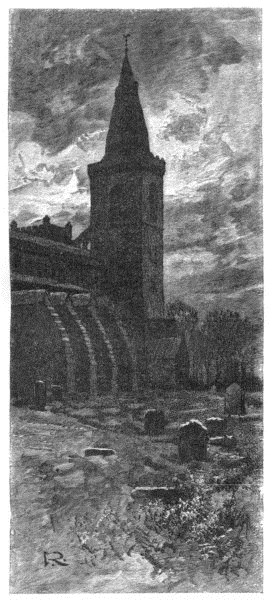
WEST TOWER, DUNFERMLINE ABBEY
There is nothing, however, in this history more charming than the description of the relations between the royal pair. King Malcolm had probably known few graces in life except those, a step or two in advance of his own, which were to be found in Northumberland in the house of Earl Siward; and after the long practical struggle of his reign between the Scots and Celts, who had already so far settled down together as to constitute something which could be called a kingdom, he had no doubt fallen even from that higher plane of civilisation. Such rude state as the presence of a queen even in those primitive days might have procured had been wanting, and all his faculties were probably absorbed in keeping peace between the unruly chieftains, and fostering perhaps here and there the first rising of a little community of burghers, strong enough by union to defend themselves. Uneasy, there can be little doubt, was often the head which bore the circlet of troubled supremacy among all those half-subdued tribes; and his dwelling in the heart of the "dense forest," amid all the noisy retainers in the hall and jealous nobles in the council chamber, would leave little room for beauty or sweetness of any kind. When the stranger princess suddenly came in like an enchantment, with her lovely looks and "jocund eloquence"—full of smiles and pleasant speech, yet with a dignity which overawed every rude beholder—into these rude and noisy halls, with so many graceful ways and beautiful garments and sparkling jewels, transforming the very chambers with embroidered hangings and all the rare embellishments of a lady's bower, with which no doubt the ship had been provided, and which mediæval princesses, like modern fine ladies, carried about with them—the middle-aged man of war was evidently altogether subdued and enraptured. To see her absorbed in prayer—an exercise which Malcolm had perhaps felt to be the occupation of monks and hermits only—to see her bending over her beautiful book with all its pictures, reading the sacred story there, filled him with awe and a kind of adoration. He could not himself read, which made the wonder all the more; but though incapable of mastering what was within, he loved to handle and turn over the book from which his beautiful wife derived her wisdom, touching it with his rude hands with caressing touches, and kissing the pages she loved. When he found one manuscript which she particularly esteemed, he "sent for his goldsmith" and had the vellum encased in gold and ornamented with jewels; then carried it back to her with such fond pleasure as may be easily imagined. Margaret on her part did what she could to secure to her King some of the punctilios of reverential respect due in her knowledge to a monarch. She suggested the formation of a royal guard to protect the King's person and surround him with honour and observance. She filled the palace with her wealth, adorning it in every way, providing fine clothes for the retainers and so enriching the house that the table was served with dishes of gold and silver. And it would seem that the reputation of a new and splendid Court thus suddenly evolved among the northern mists got abroad, and brought merchants with their wares up the Firth, and quickened, if it did not altogether originate, the first feeble current of trade which was the precursor and origin of all our after wealth in Scotland.

THE NAVE, DUNFERMLINE ABBEY—LOOKING WEST

QUEEN MARGARET'S CAVE
This was not all, however, that Margaret did for the commonwealth. If we may trust her biographer, it was she who established that great principle of reform so important in all states, and generally one of the later fruits of civilisation, that the soldiers should be prevented from exacting or putting under requisition the peaceful people about, and that all they had should be honestly paid for, which was the last thing likely to be thought of by a mediæval prince. Altogether Margaret's influence was exerted for the best purposes to induce her husband "to relinquish his barbarous manners and live honestly and civilly," as the chronicler says. It was perhaps not so good an exercise of her power when she opened arguments, apparently through Malcolm as interpreter, with the native clergy of Scotland, the hermits and ecclesiastics of Columba's strain, and the mysterious Culdees of whom we know so little. The one certain fact fully established concerning them being, that they kept Easter at a different date from that appointed by Rome. The King, though no scholar, would seem to have been a linguist in his way, since he spoke both languages, that is the Saxon, and the Celtic or Pictish, again a most difficult question to determine—with a smattering of Latin; and was thus able to act as Margaret's mouthpiece in her arguments. She found fault with the Celts not only for the date of their Easter, but for their habit of not communicating at that festival. It is very curious to note in their answer the very same reason which has prevailed in later days among all the changes of faith and ceremonial, and is still put forth in Highland parishes as an excuse for the small number of communicants. The Celtic priests and bishops defended their flocks by producing the words of St. Paul, in which that Apostle says that those who eat and drink unworthily eat and drink condemnation to themselves. So, according to Theodoric, the Celtic party in the Church answered Margaret, and so would their descendants, the "Men" of the Highlands, answer at this day. The integrity of the tradition is very remarkable. On the other hand, they offended the devout Queen by their neglect of Sunday, a reproach which cannot be addressed to their descendants.

WEST DOORWAY, DUNFERMLINE ABBEY
These theological discussions between the fair and learned Queen and the Highland ecclesiastics and anchorites, carried on by means of her chief convert the warrior King, whom love for her had taught to respect and share in her devotion, must have afforded many picturesque and striking scenes, though unfortunately there was no modern observer there to be interested and amused, but only Theodoric standing by, himself very hot upon the atrocity of a miscalculated Easter, and perhaps helping his royal mistress here and there with an argument. Naturally his story is especially full upon the religious side of Margaret's life—her much prayer, her humility and reverence during the services of the Church, an intent and silent listener to all teachings, only a little disposed to rebel now and then when her confessor passed too lightly over her faults. As for her charities, they were boundless. It was not for nothing that the blood of St. Ursula, and that which was to give life to still another saint, Elizabeth of Hungary, was in her veins. It is needless to say that nobody in those days had discovered the evil of indiscriminate almsgiving, which was, on the contrary, considered one of the first of Christian virtues. Margaret was the providence of all the poor around her. Her biographer tells us naïvely, with no sense that the result was not one to be proud of, that the fame of her bounty and kindness brought the poor in crowds to every place where she was. When she went out they crowded round her like children round their mother. When she had distributed everything she had of her own she took garments and other things from her courtiers and attendants to give away, a spoliation to which they consented willingly, knowing that the value of everything thus appropriated would be returned to them—an excellent reason for acquiescence. This "rapine of piety" was so strong in her that she sometimes even appropriated to her poor certain of the gold pieces which it was the King's custom to offer at Easter to the Church—a pious robbery which Malcolm pretended not to perceive until he caught her in the act, when he accused her with a laugh of tender amusement for her rapacity. In all the touches by which the sympathetic priest delineates the union of this pair there is something at once humorous and pathetic in the figure of the King, the rough old warrior, always following with his eyes the angelic saintly figure by his side, all believing, half adoring, and yet not without that gleam of amusement at the woman's absolute unhesitating enthusiasm—an amusement mingled with admiration and respect, but still a smile—a delighted surprise at all her amazing ways, and wonder what she will do next, though everything in his eyes was perfect that she did—such as may still be seen in the eyes of many a world-worn husband looking on at the movements of that directer, more simple, yet more subtle being, and the quick absolutism and certainty of the bright spirit at his side. The grey-bearded old soldier, leader of many a raid and victor in many a struggle, with this new revelation of beauty and purity bursting upon his later life, becomes to us a recognisable and friendly human soul in these glimpses we have of him, unintentional and by the way. Theodoric himself must have liked Malcolm, half-barbarian as he was, and even admired the look of ardent supplication which would come into the King's face, "a great intentness and emotion," such as seemed to him extraordinary in a secular person, and which his wife's beautiful example and the contagion of her piety alone could have developed.
Among Margaret's many duties there was one which throws a very strange light upon the time. Just before her arrival in Scotland, King Malcolm had been carrying fire and sword through Northumberland in one of the many raids over the Border which were the commonplace of the time—if indeed we may speak of the Border at such an unsettled and shifting period when the limits of the kingdoms were so little certain. The issue of this raid was that Scotland, probably meaning for the most part Lothian, the southern portion of the country, was filled with English captives, apportioned as slaves, or servants at least, through the entire population, so that scarcely a house was without one, either male or female. The Queen interested herself particularly in these captives, as was natural; sometimes paying the ransom exacted for them, and in all cases defending and protecting them. Her emissaries went about among them inquiring into their condition and how they were treated, visiting them from house to house: and all that Margaret could do to mitigate the evils of their captivity was done. Nothing can be more strange than to realise a time when Northumbrian prisoners of war could be house slaves in Lothian. No doubt what was true on one side was true on the other, and Scotch captives had their turn of similar bondage.
In those days the ancient county which her children love to call the Kingdom of Fife was far more than Edinburgh, then a mere fortress standing up on an invulnerable rock in the middle of a fertile plain, the centre of the national life. Not only was the King's residence at Dunfermline, but the great Cathedral of St. Andrews was the ecclesiastical capital, gradually working out that development of Roman supremacy and regularity which soon swept away all that was individual in the apostleship of St. Columba and the faith of his followers. That the King and Queen were frequently at Edinburgh is evident from the fact that Margaret had her oratory and chapel on the very apex of the rock, and had there established a centre of worship and spiritual life. St. Andrews, however, was the centre of influence, the shrine to which pilgrims flowed, and the pious Queen, in her care for every office of religion and eagerness to facilitate every exercise of piety, gave special thought to the task of making the way easy and safe towards that holy metropolis. The Canterbury of the north was divided from the other half of Malcolm's kingdom by that sea which in these later days, at much cost of beauty, money, and life, has been bridged over and shortened—"the sea which divides Lothian from Scotland" according to the chronicler, "the Scottish Sea" as it is called by others, the mighty Firth, which to the rude galleys of the little trading villages along its shores must have been a sea dangerous and troubled, full of risks and perils. The Queen, we are told, erected houses of shelter on either side of this angry strait, and established what we should call a line of passenger boats to take the pilgrims over at the expense of the State. One wonders how much or how little of State policy might mingle in this pious act, for no doubt the establishment of an easy and constant means of communication between the wealthy Lothians and the then centre of national life must have been of unspeakable use in consolidating a kingdom still so imperfectly knit together and divided by the formidable line of the great estuary. It is one drawback of a religious chronicler that no such motive, large and noble as it might be, is thought of, since even national advantage counted so much less than the cultivation of piety. And it is very likely that Margaret thought of nothing else, and reckoned a prayer at the shrine of the patron saint as far more important than the intercommunications thus established and the knowledge of each other thus acquired by the different parts of a kingdom which still retained the differences of separate nationalities. A mingled aim, a practical motive, might not have accomplished half so much; but no doubt among Malcolm's men, his greybeards pondering in council, or perhaps himself thinking of many things as he protected all his wife's schemes, there was a dawning perception, along with the undoubted advantages of piety, of a national use in the quickened intercourse and securely established communications. If so he would probably blame himself for a mixed motive by the side of Margaret's pure and absolute heavenly-mindedness, yet take pleasure in the secondary unacknowledged good all the same.
Thus their life went on for nearly a quarter of a century in a course of national development to which everything contributed, even the love of splendour which Margaret brought with her, and her artistic tastes, and the rage for decoration and beautiful surroundings which had then begun to be so strong an element in national progress. She had many children in the midst of all these labours and public interests, seven sons and two daughters, whom she brought up most carefully in all the perfection of her own faith. Three of these sons succeeded one after the other to the Scottish throne, and proved the efficacy of her teaching by piety as strong and as liberal as her own. It was in the year 1093 that Margaret's beautiful and touching life came to an end, in great sorrow yet triumph and pious victory over trouble. Before this time, but at a date not indicated in the narrative, she had parted with her friend and biographer Theodoric, probably not very long before her own death, as we are told that she was oppressed by forebodings, or rather premonitions of death and sorrow, of which she spoke to him with tears. When the moment of separation came both penitent and confessor so long united in the closest bonds of sympathy wept sore. "Farewell," said the Queen; "I shall not live long, but you will live long after me. Remember my soul in your prayers, and take care of my children; cease not to teach and admonish them, especially when they are raised to great estate." He made the promise with tears, not daring to contradict her by happier auguries, and in this way took his last farewell of the Queen, and never saw her more. He continues his story, however, taking it from the lips of a priest who remained with her during the rest of her life, probably also a Saxon, since he became a monk of St. Cuthbert's on Margaret's death.
PART II
THE STEWARDS OF SCOTLAND
CHAPTER I
JAMES I. POET AND LEGISLATOR
The growth of Edinburgh is difficult to trace through the mists and the tumults of the ages. The perpetual fighting which envelops the Scotland of those days as in the "great stour" or dust, which was Sir Walter Scott's conception of a battle, with gleams of swords and flashes of fire breaking through, offers few breaks through which we can see anything like the tranquil growth of that civic life which requires something of a steady and settled order and authority to give it being. The revolutions which took place in the country brought perpetual vicissitude to the Castle of Edinburgh, and no doubt destroyed and drove from their nests upon the eastern slopes of the rock the settlers who again and again essayed to keep their footing there. When the family of St. Margaret came to a conclusion, and the great historical struggle which succeeded ended in the establishment of Robert Bruce upon the throne, that great victor and statesman destroyed the Castle of Edinburgh with other strongholds, that it might not afford a point of vantage to the English invader or other enemies of the country's peace—a step which would seem to have been premature, though probably, in the great triumph and ascendency in Scotland which his noble character and work had gained, he might have hoped that at least the unanimity of the nation and its internal peace were secured, and that only an enemy would attempt to dominate the reconciled and united country. The Castle was, however, built up again and again, re-established and destroyed, a centre of endless fighting during the tumultuous reigns that followed, though it is only on the accession of a new race, a family so deeply connected with the modern history of Great Britain that no reader can be indifferent to its early appearances, that Edinburgh begins to become visible as the centre of government, the royal residence from whence laws were issued, and where the business of the nation was carried on. Following what seems to be one of the most wonderful rules of heredity—a peculiarity considerably opposed to the views which have been recently current on that subject—Robert Bruce was too great a man to have a son worthy of him: and after the trifling and treacherous David the inheritance of his kingdom came through his daughter to a family already holding a high place—the Stewards of Scotland, great hereditary officials, though scarcely so distinguished in character as in position. The tradition that their ancestor Banquo was the companion of Macbeth when the prophecy was made to him which had so great an effect upon that chieftain's career, and that to Banquo's descendants was adjudged the crown which Macbeth had no child to inherit, is far better known, thanks to Shakspeare, than any fact of their early history. It is probably another instance of that inventive ingenuity of the original chroniclers, which so cleverly imagined a whole line of fabulous kings, to give dignity and importance to the "ancient kingdom" thus carried back to inarticulate prehistoric ages. In this way the Stewarts, actually a branch of a well-known Norman family, were linked to a poetic and visionary past by their supposed identification with the children of Banquo, with all the circumstantial details of an elaborate pedigree. According to the legend, the dignity of Grand Steward of Scotland was conferred by Malcolm Canmore upon a descendant of the ancient thane, and the lineage of the family is traced through all the dim intervening ages with scrupulous minuteness. The title of Steward of Scotland was enough, it would seem, to make other lordships unnecessary, and gradually developed into that family surname with which we are now so familiar, which has wrought both Scotland and England so much woe, yet added so intense an interest to many chapters of national history. The early Stewards are present by name in all the great national events: but have left little characteristic trace upon the records, as of remarkable individuals. They took the cross in repeated crusades, carrying their official coat with its chequers, the brand of the Chief Servitor of the Scottish Court, through the wars of the Holy Land, till they came finally into the highest favour and splendour in the days of Bruce, whose cause, which was also the cause of the independence of Scotland, they maintained. Walter, who then held the office of Steward, was knighted on the field of Bannockburn. He was afterwards, as the story goes, sent to receive on the Border, after peace had been made, various prisoners who had been detained in England during the war, and among them Marjory Bruce, the daughter of the patriot-king. It would be easy to imagine the romance that followed: the young knight reverently escorting the young princess across the devastated country, which had not yet had time to recover its cruel wounds, but yet was all astir with satisfaction and hope: and how his account of what had happened in Scotland, and, above all, of that memorable field where he had won from the Bruce's own famous sword the touch of knighthood, would stir the maiden's heart. A brave young soldier with great hereditary possessions, and holding so illustrious an office, there was no reason why he should despair, however high-placed his affections might be. It takes a little from the romance to be obliged to acknowledge that he was already a widower; but marriages were early and oft-repeated in those days, and when Marjory Bruce died her husband was still only about twenty-three. It was thus that the crown came to the family of the Stewards of Scotland, the Stewarts of modern times: coming with a "lass" as her descendant said long afterwards, and likely to "go with a lass" when it was left to the infant Mary: though this last, with all her misfortunes, was the instrument not of destruction but transformation, and transferred that crown to a more splendid and enlarged dominion.
It was in the reign of Marjory's son, the grandson and namesake of the Bruce, and of his successors, that Edinburgh began to be of importance in the country, slowly becoming visible by means of charters and privileges, and soon by records of Parliaments, laws made, and public acts proceeding from the growing city. Robert Bruce, though he had destroyed the castle, granted certain liberties and aids to the burghers, both in repression and in favour pursuing the same idea, with an evident desire to substitute the peaceful progress of the town for the dangerous domination of the fortress. Between that period and the reign of the second Stewart, King Robert III, the castle had already been re-erected and re-destroyed more than once. Its occupation by the English seemed the chief thing dreaded by the Scots, and it was again and again by English hands that the fortifications were restored—such a stronghold and point of defence being evidently of the first importance to invaders, while much less valuable as a means of defence. In the year 1385 the walls must have encircled a large area upon the summit of the rock, the enceinte probably widening, as the arts of architecture and fortification progressed, from the strong and grim eyrie on the edge of the precipice to the wide and noble enclosure, with room for a palace as well as a fortress, into which the great castles of England were growing. The last erection of these often-cast-down walls was made by Edward III on his raid into Scotland, and probably the royal founder of Windsor Castle had given to the enclosure an amplitude unknown before. The Scots king most likely had neither the money nor the habits which made a great royal residence desirable, especially in a spot so easily isolated and so open to attack; but he gave a charter to his burghers of Edinburgh authorising them to build houses within the castle walls, and to pass in and out freely without toll or due—a curious privilege, which must have made the castle a sort of imperium in imperio, a town within a town. The little closets of rooms which in a much later and more luxurious age must have sufficed for the royal personages whom fate drove into Edinburgh Castle as a residence, are enough to show how limited were the requirements in point of space of the royal Scots. The room in which James VI of Scotland was born would scarcely be occupied, save under protest, by a housemaid in our days. But indeed the Castle of Edinburgh was neither adapted nor intended for a royal residence. The abbey in the valley, from which the King could retire on receipt of evil tidings, where the winds were hushed and the air less keen, and gardens and pleasant hillsides accessible, and all the splendour of religious ceremonies within reach, afforded more fit and secure surroundings even for a primitive court. The Parliament met, however, within the fortress, and the courts of justice would seem to have been held within reach of its shelter. And thither the burghers carried their wealth, and built among the remains of the low huts of an earlier age their straight steep houses, with high pitched roofs tiled with slabs of stone, rising gray and strong within the enceinte, almost as strong and apt to resist whatever missiles were possible as the walls themselves, standing out with straight defiant gables against the northern blue.
King Robert III was a feeble, sickly, and poor-spirited king, and he had a prodigal son of that gay, brilliant, attractive, and impracticable kind which is so well known in fiction and romance, and, alas! also so familiar in common life. David, Duke of Rothesay, was the first in the Scotch records who was ever raised to that rank—nothing above the degree of Earl having been known in the north before the son and brother of the King, the latter by the fatal title of Albany, brought a new degree into the roll of nobility. Young David, all unknowing of the tragic fate before him, was then a daring and reckless youth, held within bounds, as would appear, by the influence of a good and wise mother, and if an anxiety and trouble, at least as yet no disgrace to the throne. He was the contemporary of another madcap prince, far better known to us, of whose pranks we are all more than indulgent, and whose name has the attraction of youth and wit and freedom and boundless humour to the reader still. David of Scotland has had no one to celebrate his youthful adventures like him whose large and splendid touch has made Prince Hal1 so fine a representative of all that is careless and gay in prodigal youth, with its noble qualities but half in abeyance, and abounding spirit and humour and reckless fancy making its course of wild adventure comprehensible even to the gravest. Perhaps the licence of the Stewart blood carried the hapless northern prince into more dangerous adventures than the wild fun of Gadshill and Eastcheap. And Prince David's future had already been compromised by certain sordid treacheries about his marriage when he first appears in history, without the force of character which changed Prince Hal into a conquering leader and strong sovereign, but with all the chivalrous instincts of a young knight. He had been appointed at a very early age Lieutenant of the Kingdom to replace his father, it being "well seen and kenned that our lorde the Kyng for sickness of his person may not travail to govern the realm," with full provision of counsellors for his help and guidance; which argues a certain confidence in his powers. But the cares of internal government were at this point interrupted by the more urgent necessity of repelling an invasion, a danger not unusual, yet naturally of an exciting kind.
On this occasion the invader was Henry IV of England, the father of the other prodigal, whose object is somewhat perplexing, and differs much from the usual raid to which the Scots were so well accustomed. So far as appears from all the authorities, his invasion was a sort of promenade of defiance or bravado, though it seems unlike the character of that astute prince to have undertaken so gratuitous a demonstration. He penetrated as far as Leith, and lay there for some time threatening, or appearing to threaten, Edinburgh Castle; but all that he seems to have done was to make proclamation by his knights and heralds in every town they passed through, of the old, always renewed, claim of allegiance to the English crown which every generation of Scots had so strenuously and passionately resisted. The fact that he was allowed to penetrate so far unmolested is as remarkable as that the invasion was an entirely peaceful one and harmed nobody. When Henry pitched his camp at Leith, Albany was within reach with what is called a great army, but did not advance a step to meet the invader—in face of whom, however, young David of Rothesay, and with him many potent personages, retired into Edinburgh Castle with every appearance of expecting a siege there. But when no sign of any such intention appeared or warlike movement of any kind, nothing but the gleam of Henry's spears, stationary day by day in the same place, and a strange tranquillity, which must have encouraged every kind of wondering rumour and alarm, the young Prince launched forth a challenge to the English king and host to meet him in person with two or three hundred knights on each side, and so to settle the question between them and save the spilling of Christian blood. Henry, it is said, replied with something of the sarcasm of a grave and middle-aged man to the hasty youth, regretting that Prince David should consider noble blood as less than Christian since he desired the effusion of one and not the other. The position of the young man shut up within the walls of the fortress in enforced inactivity while the hated Leopards of England fluttered in the fresh breezes from the Firth, and Henry's multitudinous tents shone in the northern sun—an army too great to be encountered by his garrison and noble attendants alone—while dark treason and evil intent in the person of Albany kept the army of Scotland inactive though within reach, was one to justify any such outbreak of impatience. David must have felt that should the invader press, there was little help to be expected from his uncle, and that he and his faction would look on not without pleasure to see the castle fall and the heir of Scotland taken or slain. But King Henry's object or meaning is more difficult to divine. Save for his proclamations, and the quite futile summons to King Robert to do homage, he seems to have attempted nothing against the country through which he was thus permitted to march unmolested. The little party of knights with their attendant squires and heralds riding to every market-cross upon the way, proclaiming to the astonished burghers or angry village folk the invader's manifesto, scarcely staying long enough to hear the fierce murmurs that arose—a passing pageant, a momentary excitement and no more—was a sort of defiant embassage which might have pleased the fancy of a young adventurer, but scarcely of a king so wary and experienced; and his own stay in the midst of the startled country is still more inexplicable. When the monks of Holyrood sent a mission to him to beg his protection, lying undefended as they did in the plain, his answer to them was curiously apologetic. "Far be it from me," he said, "to be so inhuman as to harm any holy house, especially Holyrood in which my father found a safe refuge.... I am myself half Scotch by the blood of the Comyns," added the invader. The account which Boece gives of the expedition altogether is amusing, and strictly in accord with all that is said by other historians, though they may not take the same amiable view. I quote from the quaint translation of Bellenden.
"A schort time efter King Harry came in Scotland with an army. Howbeit he did small injury to the people thairof, for he desirit nowt but his banner to be erected on their walls. Alwayis he was ane plesand enneme, and did gret humaniteis to the people in all places of Scotland where he was lodgit. Finally he showed to the lords of Scotland that he come in their rialm more by counsel of his nobles than ony hatred that he bore to Scottes. Soon efter he returnit without any further injure in England."
It is very seldom that a Scotch historian is able to designate an English invader as "a pleasant enemy," and whether there was some scheme which came to nothing under this remarkable and harmless raid, or whether it was only the carrying out of Henry's own policy "to busy giddy minds with foreign quarrels"
"Lest rest and lying still might make them look
Too near unto my state,"
it is difficult to say. The nobles pent up in Edinburgh Castle with the hot-headed young Prince at their head did not know what to make of the pleasant enemy. The alarm he had caused, compelling their own withdrawal into the stronghold, wrath at the mere sight of him there in the heart of Scotland, the humiliating inaction in which they were kept by a foe which neither attacked nor withdrew, must have so chafed the Prince and his companions that the challenge thrown forth like a bugle from the heights to break this oppressive silence and bring about the lingering crisis one way or another must have been a relief to their excitement if nothing else. One of the bewildered reasons alleged for the invasion is that young David had written letters to France in which he called Bolingbroke a traitor—letters which had fallen into Henry's hands; but this is as unlikely to have brought about the invasion as any other frivolous cause, though no doubt it might make the young Prince still more eager to take upon himself the settling of the quarrel. We have no reason to suppose that any foreboding of his fate had crossed the mind of the youth at this period of his career, yet to watch the army of England lying below, and to know his uncle Albany close at hand, and to feel himself incapable—with nothing but a limited garrison at his command and no doubt the wise Douglas and the other great noblemen holding him back—of meeting the invader except by some such fantastic chivalrous expedient, must have been hard enough.
And how strange is the scene, little in accordance with the habits and traditions of either country: the English camp all quiet below, as if on a holiday expedition, the Scots looking on in uneasy expectation, not knowing what the next moment might bring. The excitement must have grown greater from day to day within and without, while all the inhabitants, both citizens and garrison, kept anxious watch to detect the first sign of the enemy's advance. Henry, we are told, was called away to oppose a rising in Wales; not indeed that rising which we all know so well in which Prince Hal, more fortunate than his brother prodigal, had the means of showing what was in him; but even the suggestion approaches once more strangely and suggestively the names of the two heirs whose fate was so different—the one almost within sight of a miserable ending, the other with glory and empire before him. Prince Henry did not apparently come with his father to Scotland, or there might perhaps have been a different ending to the tale, and it would not have needed Harry Hotspur to rouse his namesake from his folly. There was, alas! no such noble rival to excite David of Scotland to emulation, and no such happy turning-point before him. No one, not even a minstrel or romancer, has remembered it in his favour that he once defied the English host for the love of his country and the old never-abandoned cause of Scottish independence. Already it would seem a prodigal who was a Stewart had less chance than other men. Whether some feeble fibre in the race had already developed in this early representative of the name, or whether it was the persistent ill-fortune which has always pursued them, making life a continual struggle and death a violent ending, the fatal thread which has run through their history for so many generations comes here into the most tragic prominence, the beginning of a long series of tragedies. It adds a softening touch to the record of David's unhappy fate that the death of his mother is recorded as one of the great misfortunes of his life. In the same year in which these public incidents occurred the Queen died, carrying with her the chief influence which had restrained her unfortunate son. She was Annabella Drummond, a woman of character and note, much lamented by the people. And to add to this misfortune she was followed to the grave within a year by the great Earl of Angus, David's father-in-law, and the Bishop of St. Andrews, to whom, as the Primate of Scotland, the young Prince's early instruction had probably been committed, as his loss is noted along with the others as a special disaster.
Thus the rash and foolish youth was left to face the world and all its temptations with no longer any one whom he feared to grieve or whom he felt himself bound to obey. His father, a fretful invalid, had little claim upon his reverence, and his uncle Albany, the strong man of the family, was his most dangerous enemy, ever on the watch to clear out of his path those who stood between him and the throne: or such at least was the impression which he left upon the mind of his time. Thus deprived of all the guides who had power over him, and of the only parent whom he could respect, the young Duke of Rothesay, only twenty-three at most, plunged into all those indulgences which are so fatally easy to a prince. It is supposed that the marriage into which a false policy had driven him was not the marriage he desired. But this was a small particular in those days, as it has proved even in other times less rude. He ran into every kind of riot and dissipation, which the councillors appointed to aid him could not check. After no doubt many remonstrances and appeals this band of serious men relinquished the attempt, declaring themselves unable to persuade the Prince even to any regard for decency: and the ill-advised and feeble King committed to Albany, who had been standing by waiting for some such piece of good fortune, the reformation of his son. The catastrophe was not slow to follow. Rothesay was seized near St. Andrews on the pretence of stopping a mad enterprise in which he was engaged, and conveyed to Falkland, where he died in strict confinement, "of dysentery or others say of hunger" is the brief and terrible record—blaming no one—of the chroniclers, on Easter Eve 1401. It would be vain to attempt to add anything to the picture of the young unfortunate and his end which Sir Walter Scott has given. We can but rescue out of obscurity the brief moment in which that young life was at the turning-point and might have changed into something noble. Had his challenge been accepted, and had he died sword in hand outside the castle gates for Scotland and her independence, how touching and inspiring would have been the story! But fortune never favoured the Stewarts; they have had no luck, to use a more homely expression, such as falls to the lot of other races, and what might have been a legend of chivalry, the record of a young hero, drops to the horror of a miserable murder done upon a victim who foils even the pity he excites—a young debauchee almost as miserable and wretched as the means by which he died.
There was this relic of generosity and honour about the unfortunate Prince, even in his fallen state, that he refused to consent to the assassination of the uncle, who found no difficulty, it would appear, in assassinating him; thus showing that wayward strain of nobleness among many defects and miseries which through all their tragic career was to be found even in the least defensible of his race.
King Robert, who had for some time been retired from the troubles of the throne, a poor man, infirm in health and in purpose, virtually deposed in favour of the son who was Lieutenant or the brother who was Regent of the kingdom, and from whom all his domestic comfort had been taken as well as his power, was driven to desperation by this blow. He had lost his wife and his best counsellors; he had never been strong enough to restrain his son, nor resist his brother. David, his first-born and heir, the gay and handsome youth who was dazzling and delightful to his father's eyes even in his worst follies, had been, as no doubt he felt, delivered over to his worst enemy by that father's own tremulous hand; and the heart-broken old man in his bereavement and terror could only think of getting the one boy who remained to him safe and out of harm's way, perhaps with the feeling that Albany might once again persuade him to deliver over this last hope into his hands if he did not take a decisive step at once. The boy-prince was at St. Andrews, pursuing his studies, under the care of the bishop, when his brother was murdered; and from thence he was sent, when the preparations were complete, across the Firth to the Bass, there to await a ship which should take him to France. It was a forlorn beginning for the Prince of Scotland to be thus hastily taken from his books and the calm of a semi-monastic life and hurried off to that wild rock in the middle of the waves, probably with his brother's awful story thrilling in his ears and his terrible uncle within reach, pushing forward a mock inquiry in Parliament into the causes of Rothesay's death. How easy it would have been for that uncle with the supreme power in his hands to seize the boy who now stood alone between him and the throne; and with what burning at the heart, of impotent rage and fierce indignation, the little Prince, old enough to know and feel his father's helplessness, his own abandonment, and his brother's terrible end, must have been conveyed away to the sea stronghold among the bitter eastern blasts. James, the first of the name, was not one of the feeble ones of the family. With all the romance and poetry of his race he conjoined a great spirit and a noble intelligence, and even at twelve, in the precocious development of that age of blood, when even a royal stripling had to learn to defend himself and hold his own, he must have had some knowledge why it was that he had to be sent thus clandestinely out of his native country: he, the hope of Scotland, in terror for his life.
The little garrison on the rock and the governor to whom the Prince's safety was confided must have watched with many an anxious vigil among the trading vessels stumbling heavily down the Firth from Leith, for that sail which was to carry their charge, into safety as they thought. Whether there was any navy belonging to the Crown at this period, or whether the King himself possessed some galley that could venture on the voyage to France, we are not told. But no doubt the ship when it arrived bore some sign by which the Prince's guardians, and unfortunately others besides, could recognise it. It could not be in any way a cheerful embarkation. It was in the dark days of Lent, in March, when the north is most severe: and the grey skies and blighting wind would be appropriate to the feelings of the exiles as they put forth from their rock amid the wild beating of the surf, anxiously watched by the defenders of the place, who no doubt had at the same time to keep up a vigilant inspection landward, lest any band of spearmen from Albany should arrive upon the adjacent shore in time to stop the flight. The grey rock, the greyer leaden sea, the whirling flight of wild sea birds white against the dark horizon, the little boat, kept with difficulty from dashing against the cliffs and rocky boulders, the attendant ship, driven up and down by the waves, and distant Fife, with its low hills in tones of neutral tint upon the horizon—would all increase the sadness of the parting: but no doubt there was a long breath of relief breathed by everybody about when the vessel continued its course, and slowly disappeared down the Firth. Whatever might happen elsewhere, at least the heir was safe.

THE BASS ROCK
But this hope soon proved futile. Whether it was some traitorous indication from Albany, or information from another source, or pure hazard, which directed the English ships to this one vessel with its royal freight, it had but rounded the headland of Flamborough when it fell into the hands of the enemy. Palm Sunday 1405 was the date of this event, but it was not till the end of Lent 1423, almost exactly eighteen years after, that James came back. The calamity seemed overwhelming to the nation and to all who were not pledged to Albany throughout Scotland. It was the death-warrant of poor old King Robert in his retirement. He lingered out a weary year in sickness and sorrow, and when the anniversary of his son's loss came round again, died at Rothesay, in Bute, amid the lovely lakes and islets of western Scotland—a scene of natural peace and tranquillity, which, let us hope, shed some little balm upon the heart of the helpless superseded sovereign. Perhaps he loved the place because it had given his title to his murdered boy, the hapless David, so gallant and so gay. There is something more than ordinarily pathetic and touching in the misfortunes of the feeble in an age of iron. As civilisation advances they have means of protecting themselves, but not in a time which is all for the strongest. One son buried, like any peasant's son, ignobly in the Abbey of Lindores: the other in an English prison, at the mercy of the "auld enemy," whom Scotland had again and again resisted to the death: and his kingdom entirely gone from him, in the hands of his arrogant and imperious brother; there was nothing left for poor King Robert but to die.
Thus James became at thirteen, and in an English castle, the King of Scotland. His prison, however, proved a noble school instead of an ignoble confinement to his fine and elevated spirit. The name of Stewart has never been so splendidly illustrated as by this patriotic and chivalrous Prince. No doubt it is infinitely to the credit of the English kings, both Henrys, IV and V, that he received from them all the advantages of education that could have been given to a prince of their own blood—advantages by which he profited nobly, acquiring every art and cultivation that belonged to his rank, besides that divine art which no education can communicate, and which is bestowed by what would seem a caprice, were it not divine, upon prince or ploughman as it pleases God. For above all his knightly and kingly qualities, his studies in chivalry and statesmanship, which prepared him to fill the throne of Scotland as no man save his great ancestor Bruce had yet filled it, James Stewart was a poet of no mean rank, not unworthy to be named even in the presence of Chaucer, and well worthy of the place which he has kept in literature. We need not enter here into that part of his history which concerns another locality full of great and princely associations—the noble Castle of Windsor, where the royal youth first saw and sang the lady of his love, "the fairest and the sweeteste yonge flour," of whom he has left one of the most tender and beautiful descriptions that is to be found in all the course of poetry. It is more to our present purpose to tell how, amid all the charms of that courtly residence, so far superior to anything which primitive Scotland could offer in the way of dignity or luxury, the boy-king remained faithful to his country, and maintained the independence for which she had so long struggled. It is said that the one advantage taken of his captivity and youth was to press the old oft-repeated arguments concerning the supposed supremacy of England, and the homage due from the kings of Scotland, upon the boy who bore that title sadly amid the luxury and splendour of what was still a prison, however gracious and kind his jailers might be. No circumstances could have been better suited to impress upon James's mind the conviction that submission was inevitable: and it would have been almost more than mortal virtue on the part of his captors had they not attempted to bring about so advantageous a conviction. King Henry V, under whom it is said the attempt was made, had been most generously liberal to and careful of the boy. He was a man so brilliant in reputation and success that a generous youth might well have been led by enthusiasm into any homage that was suggested, too happy to feel himself thus linked to so great a king; and James was very young, distant from his own country and all native advisers, his very life as well as his liberty in the power of those who asked this submission from him, and the force of circumstances so great that even his own people might have forgiven, and Holy Church could scarcely have hesitated to dispense him from keeping, an obligation entered into under such pressure. But the royal youth stood fast, and was not to be moved by any argument. Boece, whose authority is unfortunately not much to be depended upon, has a still more distinct and graphic story of judgment and firmness on the part of the young captive. He had been, according to this account, taken to France in the train of King Henry, who after the defeat the English had sustained near Orleans, chiefly through the valour of the Scots who had joined the French army, sent for James, and desired him "to pass to the Scots, and to command them to return to Scotland. King Harry promised, gif the said James brought this matter to good effect, not only to remit his ransom but to send him to Scotland with great riches and honour." James answered courteously, with expressions of goodwill and gratitude for the humanity shown towards him, but "I marvel not little," he said, "that thou considerest not how I have no power above the Scots so long as I am ane private man and holden in captivity." The chronicler adds: "Then said King Henry, 'Maist happy people shall they be that happens to get yon noble man to their prince.'" It is a pity that we have no more trustworthy proof of this charming story.
The narrative of the death struggle, and the distracted attempts to find a place of concealment for the victim, are too heartrending to be repeated here. James fell, it is said, with sixteen wounds in him, hacked almost to pieces, yet facing his murderers so desperately that some of them bore the marks of his dying grip when they were brought to the scaffold to be killed in their turn with every circumstance of horror conceivable some time later. The execution of these miserable traitors, one of them the King's own uncle Athole, took place at Edinburgh for the greater solemnity and terror of the punishment, which was accomplished by every kind of torture. The Queen, too, after the horrible scene of which she had been a witness, and almost more than a witness—for she had thrown herself before her husband and had been wounded in the terrible struggle—gathered her children and fled to Edinburgh Castle to put the little heir of the kingdom, now James II, in security. The hapless child was sadly crowned at Holyrood at six years old, with a hastily adapted ceremonial, the first of many such disastrous rites to come.
The time of James's reign had been one of rising prosperity throughout the realm. Law and order had been established in recognised courts and tribunals, the titles of property had been ascertained and secured, not without loss, no doubt, to many arrogant lords who had seized upon stray land without any lawful title, or on whom it had been illegally bestowed during the Albany reign—but to the general confidence and safety. And the condition of the people had no doubt improved in consequence. It is difficult to form any estimate of what this condition was. All foreign witnesses give testimony of an unpleasing kind, and represent the country as wretched, squalid, and uncivilised: but on the other hand nothing can be more unlike this report than the most valuable and unintentional evidence furnished by King James's own poems, with their tale of village merry-makings and frays which convey no impression of abject poverty, nor even of that rudest level of life where material wants are so pressing as to exclude all lighter thoughts. "On Mayday," says King James, "when everybody is bound to Peblis to the play,"
"At Beltane quhan ilke bodie bownis
To Peblis to the play,
To heir the singing and sweit soundis,
The solace suth to say.
Be firth and forest furth they found,
They graythit them full gay;
God wot that wald they do that stound,
For it was thair feist day
They said
Of Peblis to the Play."
All the lasses of the west, he goes on to tell us, were up at cockcrow, and no men might rest for the chatter and the noise of their preparations. One cried that her curch was not starched enough, another that a hood was best, another bewailed herself as "so evil sunburnt" that she was not fit to be seen. The young folk stream along "full bold" with the bagpipes blowing, and every village adding its contingent, "he before and she before to see which was most gay."
"Some said that they were mercat folk,
Some said the Quene of May
Was cumit
Of Peblis to the Play."
When they arrive at the "taverne hous" they give orders that the board be served, and to see that the napery is white, "for we will dyn and daunce." At "Christis Kirk on the Green" there is a similar description, the lasses coming out as before, "weshen clean," in their new grey kirtles "well prest with many plaits," with their gloves of doeskin and morocco shoes. All these incidental traits, and the atmosphere of the merry ballads, though both end in a fray, contradict with vigour the cold and wretched picture given by outsiders of a country where the people warmed themselves by burning sulphureous stones dug out of the ground, where the houses had a cow's hide stretched for a door, and all was squalid misery and nakedness. There was plenty of fighting going on it is evident—not a lowland fair without its broken heads (a habit that, according to Sir Walter Scott, no mean authority, lasted into the nineteenth century)—and much oppression, the great lords reigning like absolute tyrants in the midst of subjects without resource or protection; but the case of the peasantry notwithstanding all these evils does not seem to have been a bad one. A certain vigorous capacity of revival, which history shows us continually as existing on the broad level of the soil, must have brought them back to rough ease and comfort, and the freedom of the natural healthful atmosphere which makes itself apparent in transcripts of life so little likely to be forced or optimistic. In all times and circumstances there can be little doubt that the amount of simple enjoyment to be got out of life, especially by the young, who form at least the half of every community, far exceeds the elements of wellbeing which outsiders see in it. And the protection of the Church, the comparative quiet to be enjoyed on church lands, the charities and succour of the cloister, must have made an incalculable addition to the possibilities of existence. Everything in James's reign was calculated to increase the stability and good order which are the best guarantees of national life; even his severities cultivating a sense of security in the weak and a wholesome consciousness of the necessity of self-restraint in the strong. For the first time for many generations the nobles were kept within bounds, and exceptional cruelties became if not impossible, yet of so certain discovery and punishment that lesser tyrants at least must have trembled. The law that might makes right fell into temporary disuse, and a better law, that of the courts that sat periodically over all the kingdom, and—appealing still more strongly to the imagination—a king that shut his ears to no petition and interfered with a strong hand to right the wronged, began a new era for the commonalty of Scotland. Even the unfavourable description so often quoted of Eneas Silvius, reports the common people as having "abundance of flesh and fish," no small ingredient of wellbeing, and records rather a complete absence of luxuries than that want which reduces the vital strength of a nation. The same authority tells of exportations of "hides, wool, salt fish, and pearls," the latter a curious item, although there were as yet no manufactures, and even such necessaries as horse-shoes and every kind of harness had to be imported from Flanders. But the Scots in their farmhouses and cottages made the cloth with which they were clothed, and their "blew caps," the well-known blue bonnet which has lasted to our own days. And they retained the right which, according to her monkish chronicler, St. Margaret had been the first to secure for them—of immunity from all military requisitions, and even, which is a curious contradiction of the supposed tyrannies of the nobles, held an absolute property in their own goods which out of the island of Great Britain no peasantry in the world possessed. The French allies who were in Scotland in the end of the fourteenth century were struck with angry consternation to hear themselves hailed by a set of clodhoppers, and bidden to keep the paths and not trample down the growing corn, and to find that, however willing the Scots men-at-arms might be to harry England when occasion offered, not the greatest lord in the French contingent could carry off a cow or a brace of pullets without compensation. We cannot but think that the country in which the peasant's barnyard was thus defended was at least as forward in the best elements of civilisation as those in which there were hangings of arras and trenches of silver, but no security for anything in homesteads or workshop which might be coveted by the seigneur.

HOLYROOD
Edinburgh, as has been said, never seems to have been a favourite habitation of this enlightened and accomplished Prince. Perhaps Queen Jane found the east winds too keen on the heights, or the Abbey of the Holy Rood too low in the valley. The heir was born there it is true, and we have note of various Parliaments and visits, but no settled residence in the capital. One incident is mentioned by the chroniclers which must have afforded a picturesque scene, when the King himself presided, before the gates of Edinburgh Castle, at a duel between a knight called Henry Knokkis or Knox (curious precursor in the dimness of distance of another of his name!), who had been accused by an Edinburgh burgess of treasonable speeches against the King—and his accuser. But who this accuser was, and by what privilege he was allowed to meet a gentleman and knight in single combat we have no information. Perhaps he was himself of noble blood, a younger son, a man before his time, seeking the peaceful profits of trade instead of those of the marauder, as it has become the fashion of a later age to do. It is almost impossible not to fancy that there must have been a touch of the burlesque in this combat, which James himself interfered to stop, separating the combatants. He was very careless it would seem of treasonable speeches, apt to treat them lightly and very probably smiled a little at the zeal of the citizen who was more jealous of his honour than he was himself. The platform before the gates would still make a splendid area for any feat of arms, if the winds did not interfere before the King and blow the combatants away: and the old-world crowd with their many colours, the jerkins slashed and embroidered with the blazon of all the great families in Scotland, the plumed caps and dazzling helmets of courtier and knight, the border of blue bonnets outside, and all the shining array of fair ladies around and behind the throne, would present a more striking picture than the best we could do nowadays. Let us hope the sun shone and warmed the keen clear air, and threw into high relief the towers and bastions against the northern blue.
Edinburgh by this time had grown into the proportions of a town. The houses which the citizens had the privilege of building within the castle precincts would appear to have been low, to secure the protection of the walls; and by certain precautionary regulations for their preservation from fire it would seem that many of them were still thatched. The King's residence there, judging from the straitened accommodation, which was all that existed in a much more advanced period, must have been small and poor, though there already existed a Parliament Hall, in which probably other great assemblies were held. The city walls were continued along the crest of the ridge in narrow lines, deflecting a little only on the south side, where the limits were broken by several wealthy and well-cultivated enclosures where brotherhoods were established—White and Black Friars, sons of Augustine and Dominic, with their great detached houses, their gardens always an example of husbandry, and chapels filling the air with pleasant sound of bells. King James had himself endowed, besides many existing foundations, a monastery for the Franciscans or Grey Friars, which has always continued to be one of the chief ecclesiastic centres of Edinburgh. It was so fine a building, as the story goes, that the humble-minded Minors declined at first to take possession of it as being too magnificent for an Order vowed to poverty; though as their superior was a monk from Cologne, sent for by the King on account of his learning and sanctity, and accustomed to the great convents of the Continent, such an objection is curious. On the south side of the town, at some distance outside the walls, on the platform afterwards occupied by the buildings of the old High School, stood amid its blossoming gardens the Church of St. Mary in the Field, afterwards so fatally known as the Kirk of Field, a great house so extensive and stately that it had already served on several occasions as a royal lodging. St. Giles's, one of the oldest foundations of all, stood among its graves, at the foot of the Castle Hill in the centre of the life of ancient Edinburgh, as it does still. These clusters of sacred buildings, encircled by their orchards and gardens, made a fringe of verdure, of charity and peace, sanctuaries for the living and resting-places for the dead, round the strong and dark fortifications of the little royal town, which hitherto had held for its life upon that ridge of rock, a dangerous eminence lying full in every invader's way.
CHAPTER II
JAMES II: WITH THE FIERY FACE
It is clear that the public opinion of Scotland, so far as there was such a thing in existence, had no sympathy whatever with the murderers of James. The instruments of that murder were in the first place Highland caterans, with whom no terms were ever held and against whom every man's hand was armed. And the leaders who had taken advantage of these wild allies against their natural monarch and kindred were by the very act put beyond the pale of sympathy. They were executed ferociously and horribly, according to the custom of the time, the burghers of Perth rising at once in pursuit of them, and the burghers of Edinburgh looking on with stern satisfaction at their tortures—these towns feeling profoundly, more perhaps than any other section of the community, the extraordinary loss they had in the able and vigorous King, already, like his descendant and successor, the King of the commons, their stay and encouragement. If there was among the nobility less lamentation over a ruler who spared none of them on account of his race, and was sternly bent on repressing all abuse of power, it was silent in the immense and universal horror with which the event filled Scotland. It would seem probable that the little heir, only six years old, the only son of King James, was not with his parents in their Christmas rejoicings at Perth, but had been left behind at Holyrood, for we are told that the day after his father's death the poor little wondering child was solemnly but hastily crowned there, the dreadful news having flown to the centre of government. He was "crownd by the nobilitie," says Pitscottie, the great nobles who were nearest and within reach having no doubt rushed to the spot where the heir was, to guard and also to retain in their own hands the future King. He was proclaimed at once, and the crown, or such substitute for it as could be laid sudden hands upon, put on his infant head. The scene is one which recurred again and again in the history of his race, yet nothing can take from it its touching features. At six years old even the intimation of a father's death, especially when taking place at a distance, would make but a transitory impression upon the mind; yet we may well imagine the child taken from his toys, wrapped from head to foot in some royal mantle, with a man's crown held over his baby head, receiving with large eyes of wonder and fright easily translated into tears, the sacred oil, the sceptre which his little fingers could scarcely enclose. Alas for the luckless Stewarts! again and again this affecting ceremony took place before the time of their final promotion which was the precursor of their overthrow. They were all kings almost from their cradle—kings ill-omened, entering upon their royalty with infant terror and tears.

EDINBURGH CASTLE FROM THE SOUTH-WEST
When they had crowned the little James, second of the name, the lords held a convention "to advise whom they thought most able both for manheid and witt to take the government of the commonwealth in hand." They chose two men for this office, neither of whom was taken from a very great family, or had, so far as can be known, any special importance—Sir Alexander Livingstone, described as Knight of Callender, and Sir William Crichton, Chancellor of Scotland. Perhaps it was one of the compromises which are so common when parties are nearly equal in power which thus placed two personages of secondary importance at the head of affairs: but any advantage which might have been secured by this selection was neutralised by the division of power, which added to all the evils of an interregnum the perplexity of two centres of government, so that "no man knew," as says Pitscottie, "whom he should obey." One of the Regents reigned in Edinburgh, the other in Stirling—one had the advantage of holding possession of the King, the other had the doubtful good of the support of the Queen. It may be imagined what an extraordinary contrast this was to the firm and vigilant sway of a monarch in the fulness of manhood, with all the prestige of his many gifts and accomplishments, his vigorous and manful character and his unquestioned right to the government and obedience of the country. It had been hard work enough for James I., with all these advantages, to keep his kingdom well in hand: and it would not be easy to exaggerate the difficulties now, with two rival and feeble powers, neither great enough to overawe nor united enough to hold in check the independent power of the great houses which vied with each other in the display of dominion and wealth. In a very brief time all the ground gained by King James was lost again. Every element of anarchy arose in new force, and if it had been hard to secure the execution of the laws which would have been so good had they been kept in the time when their chief administrator was the King himself, it may be supposed what was the difficulty now, when, save in a little circuit round each seat of authority, there was virtually no power at all. Pitscottie gives a curious and vivid picture of the state of affairs in this lamentable interval.
"In the mean time many great dissensions rose amongst us, but it was uncertain who were the movers, or by what occasion the chancellor exercised such office, further than became him. He keeped both the Castle of Edinburgh and also our young King thereintill, who was committed to his keeping by the haill nobilitie and ane great part of the noble men assisted to his opinion. Upon the other side, Sir Alexander Livingstoun bearing the authoritie committed to him by consent of the nobilitie, as said is, contained another faction, to whose opinion the Queen mother with many of the nobility very trewly assisted. So the principals of both the factions caused proclaime lettres at mercat crosses and principal villages of the realm that all men should obey conforme to the aforesaid letters sent forth by them, under the pain of death. To the which no man knew to whom he should obey or to whose letters he should be obedient unto. And also great trouble appeared in this realm, because there was no man to defend the burghs, priests, and poor men and labourers hauntind to their leisum (lawful) business either private or public. These men because of these enormities might not travel for thieves and brigands and such like: all other weak and decrepit persons who was unable to defend themselves, or yet to get food and sustentation to themselves, were most cruelly vexed in such troublous times. For when any passed to seek redress at the Chancellor of such injuries and troubles sustained by them, the thieves and brigands, feigning themselves to be of another faction, would burn their house and carry their whole goods and gear away before ever they returned again. And the same mischief befell those that went to complain to the Governor of the oppression done to them. Some other good men moved upon consideration and pitie of their present calamities tholed (endured) many such injuries, and contained themselves at home and sought no redresse. In the midst of these things and troubles, all things being out of order, Queen-Mother began to find out ane moyane (a means) how she should diminish the Chancellor's power and augment the Governor's power, whose authority she assisted."
The position of Queen Jane in the circumstances in which her husband left her, a woman still young, with a band of small children, and no authority in the turbulent and distracted country, is as painful a one as could well be imagined. Her English blood would be against her, and even her beauty, so celebrated by her chivalrous husband, and which would no doubt increase the immediate impulse of suitors, in that much-marrying age, towards the beautiful widow who was of royal blood to begin with and still bore the title of Queen. That she seems to have had no protection from her royal kindred is probably explained by the fact that Henry VI was never very potent or secure upon his throne, and that the Wars of the Roses were threatening and demanding the whole attention of the English Government. Wounded in her efforts to protect her husband by her own person, seeing him slaughtered before her eyes, there could not be a more terrible moment in any woman's life, hard as were the lives of women in that age of violence, than that which passed over Jane Beaufort's head in the Blackfriars Monastery amid the blood and tumult of that fatal night. The chroniclers, occupied by matters more weighty, have no time to picture the scene that followed that cruel and horrible murder, when the distracted women, who were its only witnesses, after the tumult and the roar of the murderers had passed by, were left to wash the wounds and compose the limbs of the dead King so lately taking his part in their evening's pastime, and to look to the injuries of the Queen and the torn and broken arm of Catherine Douglas, a sufferer of whom history has no further word to say. The room with its imperfect lights rises before us, the wintry wind rushing in by those wide-open doors, waving about the figures on the tapestry till they too seemed to mourn and lament with wildly tossing arms the horror of the scene—the cries and clash of arms as the caterans fled, pausing no doubt to pick up what scattered jewels or rich garments might lie in their way: and by the wild illumination of a torch, or the wavering leaping flame of the faggot on the hearth, the two wounded ladies, each with an anxious group about her—the Queen, covered with her own and her husband's blood; the girl, with her broken wrist, lying near the threshold which she had defended with all her heroic might. They were used to exercise the art of healing, to bind up wounds and bring back consciousness, these hapless ladies, so constantly the victims of passion and ambition. But amid all the horrors which they had to witness in their lives, horrors in which they did not always take the healing part, there could be none more appalling than this. Neither then nor now, however, is it at the most terrible moment of life, when the revolted soul desires it most, that death comes to free the sufferer. The Queen lived, no doubt, to think of the forlorn little boy in Holyrood, the five little maidens who were dependent upon her, and resumed the burden of life now so strangely different, so dull and blank, so full of alarms and struggles. Her elder child, the little Princess Margaret, had been sent to France three or four years before, at the age of ten, to be the bride of the Dauphin—a great match for a Scottish princess—and it is possible that her next sister, Eleanor, who afterwards married the Duc de Bretagne, had accompanied Margaret—two little creatures solitary in their great promotion, separated from all who held them dear. But the four infants who were left would be burden enough for the mother in her unassured and unprotected state. It would seem that she was not permitted to be with her boy, probably because of the jealousy of the Lords, who would have no female Regent attempting to reign in the name of her son: but had fixed her residence in Stirling under the shield of Livingstone, who as Governor of the kingdom ought to have exercised all the functions of the Regency, and especially the most weighty one, that of training the King. Crichton, however, who was Chancellor, had been on the spot when James II was crowned, and had secured his guardianship by the might of the strong hand, if no other, removing him to Edinburgh Castle, where he could be kept safe under watch and ward. The Queen, who would seem to have been throughout of Livingstone's faction, and who no doubt desired to have her son with her, both from affection and policy, set her wits to discover a "moyane," as the chroniclers say, of recovering the custody of the boy. The moyane was simple and primitive enough, and might well have been pardoned to a mother deprived of her natural rights: but it shows at the same time the importance attached to the possession of the little King, when it was only in such a way that he could be secured. Queen Jane set out from Stirling "with a small train" to avert suspicion, and appeared at the gates of Edinburgh Castle suddenly, without warning as would seem, asking to be admitted to see her son. The Chancellor, wise and wily as he was, would appear to have acknowledged the naturalness of this request, and "received her," the chronicler says, "with gladness, and gave her entrance to visit her young son, and gave command that whensoever the Queen came to the castle it should be patent to Her Grace." Jane entered the castle accordingly, with many protestations of her desire for peace and anxiety to prevent dissensions, all which was, no doubt, true enough, though the chroniclers treat her protestations with little faith, declaring her to have "very craftilie dissembled" in order to dispel any suspicion the Chancellor may have entertained. It would seem that she had not borne any friendship to him beforehand, and that her show of friendship now required explanation. However that might be, she succeeded in persuading Crichton of her good faith, and was allowed to have free intercourse with her son and regain her natural place in his affections. How long they had been separated there is no evidence to show, but it could scarcely be difficult for the mother to recover, even had it fallen into forgetfulness, the affection of her child. When she had remained long enough in the castle to disarm any prejudices Crichton might entertain of her, and to persuade the little King to the device which was to secure his freedom, the Queen informed the Chancellor that she was about to make a pilgrimage to the famous shrine of Whitekirk, "the white kirk of Brechin," Pitscottie says, in order to pray for the repose of the soul of her husband and the prosperity of her son, and asked permission to carry away two coffers with her clothes and ornaments, probably things which she had left in the castle before her widowhood, and that means of conveyance might be provided for these possessions to Leith, where she was to embark. This simple request was easily granted, and the two coffers carried out of the castle, and conveyed by "horss" to the ship in which she herself embarked with her few attendants. But instead of turning northward Queen Jane's ship sailed up the Firth, through the narrow strait at Queensferry, past Borrowstounness, where the great estuary widens out once more, into the quiet waters of the Forth, winding through the green country to Stirling on its hill. She was "a great pairt of the watter upward before ever the keepers of the castle could perceive themselves deceived," says Pitscottie. As the ship neared Stirling, the Governor of the kingdom came out of the castle with all his forces, with great joy and triumph, and received the King and his mother. For one of the coffers, so carefully packed and accounted for, contained no less an ornament than the little King in person, to whose childish mind no doubt this mode of transport was a delightful device and pleasantry. One can imagine how the Queen's heart must have throbbed with anxiety while her son lay hidden in the bed made for him within the heavy chest, where if air failed, or any varlet made the discovery prematurely, all her hopes would have come to an end. She must have fluttered like a bird over her young about the receptacle in which her boy lay, and talked with her ladies over his head to encourage and keep him patient till the end of the journey was near enough, amid the lingering links of Forth, to open the lid and set him free. It is not a journey that is often made nowadays, but with all the lights of the morning upon Demayat and his attendant mountains, and the sun shining upon that rich valley, and the river at its leisure wending, as if it loved them, through all the verdant holms and haughs, there is no pleasanter way of travelling from Edinburgh to Stirling, the two hill-castles of the Scottish crown.

INNER BARRIER, EDINBURGH CASTLE
It would be pleasant to think that Queen Jane meant something more than the mere bolstering up of one faction against another in the distracted kingdom by the abduction of her son. It is very possible indeed that she did so, and that to strengthen the hands of the man who was really Regent-Governor of Scotland, but whose power had been stolen from his hands by the unscrupulousness of Crichton, seemed to her a great political object, and the recovery of the supreme authority, which would seem to have appeared to all as infallibly linked with the possession of the young King, of the greatest importance. It is evident it was considered by the general public to be so; but there is something pitiful in the struggle for the poor boy, over whose small person those fierce factionaries fought, and in whose name, still so innocent and helpless as he was, so many ferocious deeds were done.
No sooner was he secure in Stirling than the Governor called together a convention of his friends, to congratulate each other and praise the wit and skill of "that noble woman, our soverain mother," who had thus set things right. "Whereby I understand," he says piously, "that the wisest man is not at all times the sickerest, nor yet the hardy man happiest," seeing that Crichton, though so great and sagacious and powerful, should be thus deceived and brought to shame. "Be of good comfort therefore," adds this enlightened ruler; "all the mischief, banishment, troubles, and vexation which the Chancellor thought to have done to us let us do the like to him." He ended this discourse by an intimation that he was about to besiege Edinburgh. "Let us also take up some band of men-of-war, and every man after his power send secret messages to their friends, that they and every one that favours us may convene together quietly in Edinburgh earlie in the morning, so that the Chancellor should not know us to come for the sieging of the castle till we have the siege even belted about the walls; so ye shall have subject to you all that would have arrogantly oppressed you."
It is almost a commonplace of human experience that in such moments the blow of fate is near at hand. The big guns which were a comparatively new wonder, full of interest in their unaccustomed operation, were still a danger as well as a prodigy, and James would seem to have forgotten the precautions that were considered necessary in presence of an armament still only partially understood. The historian assumes, as every human observer is apt to do in face of such a calamity, a tone of blame. "This Prince," says the chronicle with a shrill tone of exasperation in the record of the catastrophe, "more curious than became the majestie of a king, did stand hard by when the artilliarie was discharging." And in a moment all the labours and struggles, and the hope of the redeemed kingdom and all the prosperity that was to come, were at an end. One can imagine the sudden dismay in the group around him, the rush of his attendants, his own feeble command to keep silence when some cry of horror rose from the pale-faced circle. His thigh had been broken, "dung in two," by the explosion of the gun, "by which he was struken to the ground, and died hastilie thereafter," with no time to say more than to order silence, lest the army should be discouraged and the siege prove in vain.
So ended the troublous reign of the second James, involved in strife and warfare from his childhood, vexed by the treacheries and struggles over him of his dearest friends, full of violence alien to his mind and temper, which yet was justified by his example at the most critical moment of his life. He made his way through continual contention, intrigue, and blood, for which he was not to blame, to such a settlement of national affairs as might have consolidated Scotland and made her great—by patience and firmness and courage, and conspicuously by mercy, notwithstanding one crime. And when the helm was in his hands, and a fair future before him, fell, not ignominiously indeed, yet uselessly, a noble life thrown away, leaving once more chaos behind him. He was only twenty-nine when the thunderbolt thus falling from a clear sky destroyed all the hopes of Scotland; yet had reigned long, for twenty-three years of trouble, tumult, and distress.
CHAPTER III
JAMES III: THE MAN OF PEACE
Again the noises cease save for a wail of lamentation over the dead. The operations of war are suspended, the dark ranks of the army stand aside, and every trumpet and fatal cannon is silent while once more a woman and a child come into the foreground of the historic scene. Once more, the most pathetic figure surely in history, a little startled boy clinging to his mother—not afraid indeed of the array of war to which he has been accustomed all his life, and perhaps with an instinct in him of childish majesty, the consciousness which so soon develops even in an infant mind, of unquestioned rank, but surrounded by the atmosphere of horror and affright in which he has been taken from among his playthings—stands forth to be hastily enveloped in the robes so pitifully over-large of the dead monarch. The lords, we are told, sent for the Prince in the first sensation of the catastrophe, and had him crowned at Kelso, feeling the necessity of that central name at least, round which to rally. They were not always respectful of the real King when they had him, yet the divinity which hedged the title, however helpless the head round which it shone, was felt to be indispensable to the unity and strength of the kingdom. Mary of Gueldres in her sudden widowhood would seem to have behaved with great dignity and spirit at this critical moment. She is said to have insisted that the siege should not be abandoned, but that her husband's death might at least accomplish what his heart had been set upon; and the army after a moment of despondency was so "incouraged" by the coming of the Prince "that they forgot the death of his father and past manfullie to the hous, and wan the same, and justified the captaine theroff, and kest it down to the ground that it should not be any impediment to them hereafter." The execution of the captain seems a hard measure unless he was a traitor to the Scottish crown; but no doubt the conflict became more bitter from the terrible cost of the victory.

THE CANONGATE TOLBOOTH
Once more accordingly the kingdom was thrown into the chaos which in those days attended a long minority, the struggle for power, the relaxation of order, and all the evils that follow when one firm hand full of purpose drops the reins which half a dozen conflicting competitors scramble for. There was not, at first at least, anything of the foolish anarchy which drove Scotland into confusion during the childhood of James II, and opened the way to so many subsequent disasters, for Bishop Kennedy, the dead King's chief counsellor and support and a man universally trusted, was in the front of affairs, influencing if not originating all that was done: and to him, almost as a matter of course, the education of the little heir was at once confided. But Mary of Gueldres was a woman of resolution and force, and did not give up without a struggle her pretensions to the regency. Buchanan relates a scene which, according to his history, took place in Edinburgh on the occasion of the first Parliament after James's death. The Queen had established herself in the castle while Kennedy was in Holyrood, probably with his little pupil, but there is no mention made of James. On the second day of the Parliament Mary appeared suddenly in what would seem to have been, according to modern phraseology, "a packed house," her own partisans having no doubt been warned to be present by the action of some energetic "whip," and was, then and there, by a hasty Act, carried through at one sitting, appointed guardian and Regent, after which summary success she returned with great pomp to her apartments, though with what hope of having really attained a tenable position it is impossible to say. When the news was carried to Holyrood, Bishop Kennedy in his turn appeared before the Estates, which had been thus taken by surprise. It is evident that the populace of Edinburgh was excited by what had occurred—Mary's partisans no doubt rejoicing, while the people in general, always jealous of a foreigner and never very respectful of a woman, surged through the great line of street towards the castle with all the fury of a popular tumult. The High Street of Edinburgh was not unaccustomed to sudden encounters, clashing of swords between two passing lords, each with fierce followers, and all the risks of sudden brawls when neither would concede the "crown of the causeway." But the townsfolk seldom did more than look on, with perhaps an ill-concealed satisfaction in the wounds inflicted by their natural opponents upon each other. On this occasion, however, the tumult was a popular one, involving the interests of the citizens; and it is difficult to believe that the inclinations of the townsfolk would not rather lean towards the Queen, a woman of wealth and stately surroundings, likely to entertain princes and great personages and to fill Edinburgh with the splendour of a Court, than to the prelate, although his tastes also were magnificent, whose metropolis was not Edinburgh but St. Andrews, and who might consider frugality and sobriety the best qualities for the Court of a minor. At all events the crowd had risen and was ripe for tumult, when Bishop Kennedy persuaded them to pause, and reminded them of the mutual forbearance and patience and quiet which was above all necessary at such a troublous time. Other prelates would seem to have been in his train, for we are told it was the intercessions and explanations of "the bishops" which prevented the tumult from rising into a fight. The parties would seem to have been so strong, and so evenly divided, that the question was finally solved by a compromise, Parliament appointing a council of guardians, two on each side: Seaton and Boyd for the Queen; John Kennedy, brother of the Bishop, and the Earl of Orkney, for the others—an experiment which was no more successful than in the previous minority.
The Queen-mother had soon, however, something to occupy her leisure in the visit, if visit it can be called, of Henry VI and his Queen and household, fugitives before the victorious party of York, who had sought refuge from the Scots, and lodging for a thousand attendants—a request which was granted, and the convent of the Greyfriars allotted to them as their residence. The Queen at the Castle would thus be a near neighbour of the royal fugitives, and it is interesting to think of the meeting, the sympathy and mutual condolences of the two women. Margaret, the fervid Provençal, with her passionate sense of wrong and restless energy, and the hopeless task she had of maintaining and inspiring to play his part with any dignity her too patient and gentle king; and Mary, the fair and placid Fleming, stung too in her pride and affections by the refusal of the regency, and her subordination to those riotous and unmannerly lords and the proud Bishop who had got the affairs of Scotland in his hand. The two Queens might have had some previous acquaintance with each other, at a time when both had fairer hopes; at all events they amused themselves sadly, as they sat and talked together, with fancies such as please women, of making a marriage between the little Edward, the future victim of Tewkesbury, then a child at his mother's knee, and the little Princess of Scotland who played beside him, in the good days when all these troubles should be past, and Henry or his son after him should have regained the English crown. One follows with regretful interest the noble figure of Margaret, under the guise in which that sworn Lancastrian Shakspeare has disclosed it to us, before her sweeter mood had disappeared under the pressure of fate, and when not curses but hopes came from her mouth in her young motherhood, and every recovery and restoration, and happy marriage and royal state, were possible for her boy. Mary too had been cut off in the middle of her greatness. They were two Queens discrowned, two fair heads veiled with misfortune, though nothing irremediable had as yet happened, nothing that should make the future a desert though the present might be dark; ready to live again in their children, and make premature treaties over the little blonde heads at their knee. So natural a scene comes in strangely to the records of violence and misery. Nothing more tragic could be than the fate of Margaret; and the splendour and happiness had been very shortlived in Mary's experience, soon quenched in sudden destruction; but to see the two young mothers planning over the heads of the little ones how the two kingdoms were to be united, and happiness come back in a future that was never to be, while they sat together in brief companionship in those strait rooms of Edinburgh Castle, which were so narrow and so poor for a queen's habitation, or within the precincts of the Greyfriars, looking out upon the peaceful Pentlands and the soft hills of Braid, is like the recurring melody in a piece of stormy music, the bit of light in a tempestuous picture. It teaches us to perceive that, however the firmament of a kingdom may be torn with storms, there are everywhere about, even in queens' chambers, scenes of tenderness and peace.
Mary died in her own foundation of Trinity College Hospital—the beautiful church of which was demolished within living memory—three years after her husband, while her children were still very young: and thus all further struggles about the regency were ended. She does not seem indeed ever to have repeated her one stand for power. Bishop Kennedy, we may well believe, was not a man with whom there would be easy fighting. His sway procured a little respite for Scotland in the ordinary miseries of her career. The Douglases were safely out of the way and ended, and there was a truce of fifteen years with England which kept danger from that side at arm's length—not, the chroniclers assure us, from any additional love between the two countries, but because "the Inglish had warres within themselves daylie, stryvand for the crown." Kennedy lived some years after the Queen, guiding all the affairs of the kingdom so wisely that "the commounweill flourished greatly." He was a Churchman of the noblest kind, full of care for the spiritual interests of his diocese as well as for the secular affairs which were placed in his hands. "He caused all persones (parsons) and vicars to remain at their paroche kirks," says Pitscottie, "for the instruction and edifying of their flocks: and caused them preach the Word of God to the people and visit them that were sick; and also the said Bishope visited every kirk within the diocese four times in the year, and preached to the said parochin himself the Word of God, and inquired of them if they were dewly instructed by their parson and vicar, and if the poor were sustained and the youth brought up and learned according to the order that was taine in the house of God."
With all this, and many other gifts beside, among which are noted the knowledge he had of the "civil laws, having practised in the same," and his experience and sagacity in all public affairs—he was a scholar and loved all the arts. "He founded," says Pitscottie, "ane triumphant college in Sanct Androis, called Sanct Salvatore's College, wherein he made his lear (library) very curiouslie and coastlie; and also he biggit ane ship, called the Bishop's Barge, and when all three were complete, to wit, the college, the lear, and the barge, he knew not which of the three was the costliest; for it was reckoned for the time by honest men of consideration that the least of the three cost him ten thousand pound sterling." Major gives the same high character of the great Bishop, declaring that there were but two things in him which did not merit approval—the fact that he held a priory (but only one, that of Pittenweem) in commendam, "and the sumptuositie of his sepulchre." That sepulchre, half destroyed—after having remained a thing of beauty for three hundred years—by ignorant and foolish hands in the end of the eighteenth century, may still be seen in the chapel of his college at St. Andrews, the only existing memorial of the time when all Scotland was governed from that stormy headland to the great advantage of the commonwealth. It is difficult to make out from the different records whether the young King remained in the Bishop's keeping so long as he lived, which was but until James had attained the age of thirteen, or whether the usual struggle between the two sets of guardians appointed by Parliament, the Boyds and Kennedies, had begun before the Bishop's death. It may be imagined, however, that the evident advantages to the boy of Bishop Kennedy's care would outweigh any formal appointment; although at the same time the idea suggests itself whether in the perversity of human nature this training was not in itself partly the cause of James's weaknesses and errors. He would learn at St. Andrews not only what was best in the learning of the time, but as much of the arts as were known in Scotland, and especially that noble art of architecture, which has been the passion of so many princes. And no doubt he would see the advancement of professors of these arts, of men skilful and cunning in design and decoration, the builders, the sculptors, and the musicians, whose place in the great cathedral could never be unimportant. A Churchman could promote and honour such public servants in the little commonwealth of his cathedral town with greater freedom than might be done elsewhere; and James, a studious and feeble boy, not wise enough to see that the example of his great teacher was here inappropriate and out of place, learned this lesson but too well. The King grew up "a man that loved solitariness and desired never to hear of warre, but delighted more in musick and politie and building nor he did in the government of his realm." It would seem that he was also fond of money, which indeed was very necessary to the carrying out of his pursuits. It is difficult to estimate justly the position of a king of such a temperament in such circumstances, whether he is to be blamed for abandoning the national policy and tradition, or whether he was not rather conscientiously trying to carry out his stewardry of his kingdom in a better way when he withheld his countenance from the perpetual wars of the Border, and addressed himself to the construction of noble halls and chapels and the patronage of the arts. He was at least so far in advance of his time, still concerned with the rudest interests of practical life as to be universally misunderstood: and he had the further misfortune of sharing the unpopularity of the favourites with whom he surrounded himself, as almost every monarch has done who has promoted men of inferior position to the high places of the State.
James's supineness, over-refinement, and love of peaceful occupations were made the more remarkable from the contrast with two manly and chivalrous brothers, the Dukes of Mar and Albany, of fine person and energetic tastes, interested in all the operations of war, fond of fine horses and gallant doings, and coming up to all the popular expectations of what was becoming in a prince. Nothing is more difficult to make out at any time than the real motives and meaning of family discords: and this is still more the case in an age not yet enlightened by the clear light of history. The chroniclers, especially Boece, have much doubt thrown upon them by more serious historians, who quote them and build upon them nevertheless, having really no better evidence to go upon. The report of these witnesses is that James had been warned by witches, in whom he believed, and by one Andrew the Fleming, an astrologer, that his chief danger arose from his own family, and that "the lion should be devoured by his whelps." Pitscottie's account, however, indicates a conspiracy between Cochrane and the Homes, whom Albany had mortally offended, as the cause at once of these prophecies and the King's alarm. The only thing clear is that he was afraid of his brothers, and considered their existence a danger to his life. It would appear that he had already begun to surround himself with those favourites to whom was attributed every evil thing in his reign, when this poison was first instilled into his mind: and the blame was attributed rightly or wrongly to Cochrane, the chief of his "minions," who very probably felt it to be to his interest to detach from James's side the manly and gallant brothers who were naturally his nearest counsellors and champions.
There is very little that is authentic known of the men whom James III thus elevated to the steps of his throne. Cochrane was an architect probably, though called a mason in his earlier career, and had no doubt been employed on some of the buildings in which the King delighted, being "verrie ingenious" and "cunning in that craft." Perhaps, however, to make the royal favour for a mere craftsman more respectable, according to the notions of the time, it is added in a popular story that the favourite was a man of great strength and stature, whose prowess in some brawl attracted the admiration of the timid monarch, to whom a man who was a tall fellow of his hands, as well as a person of similar tastes to himself, might well be a special object of approval. A musician, William Roger, an Englishman, whose voice had charmed the King—a weakness which at least was not ignoble, and was shared by various other members of his race—was the second of James's favourites: and there were others still less important—one the King's tailor—a band of persons of no condition, who surrounded him no doubt with flattery and adulation, since their promotion and maintenance were entirely dependent on his pleasure. King Louis XI was at that time upon the throne of France, a powerful prince whose little privy council was composed of equally mean men, and perhaps some reflection from the Court of the old ally of Scotland made young James believe that this was the best and wisest thing for a King to do. Louis was also a believer in astrologers, witches, and all the prophecies and omens in which they dealt. To copy him was not a high ambition, but he was in his way a great king, and it is conceivable that the feeble monarch of Scotland, never roused to the height of his father's or grandfather's example, took a little satisfaction in copying what he could from Louis. The example of Oliver le Dain might make him think that he showed his superiority by preferring his tailor, a man devoted to his service, to Albany or Angus. And if Louis trembled at the predictions of his Eastern sage, what more natural than that James should quake when the stars revealed a danger which every spaewife confirmed? No doubt he would know well the story of the mysterious spaewife who, had her advice been taken, might have saved James I. from his murderers. It is rarely that there is not a certain cruelty involved in selfish cowardice. In a sudden panic the mildest-seeming creature will trample down furiously any weaker being who stands in the way of his own safety, and James was ready for any atrocity when he was convinced that his brothers were a danger to his life and crown. The youngest, the handsome and gallant Mar, was killed by one treachery or another; and Alexander of Albany, the inheritor of that ill-omened title, was laid up in prison to be safe out of his brother's way.
We find ourselves entirely in the regions of romance in this unfortunate reign. Sir Walter Scott has painted for us the uncomfortable Court of Louis with his barber and his prophet, and Dumas has reproduced almost the identical story in his Vingt Ans Après, of the Duke of Albany's escape from Edinburgh. There could scarcely be a more curious scene. Strangely enough James himself was resident in the castle when his brother was a prisoner there. One would have thought that so near a neighbourhood would have seemed dangerous to the alarmed monarch, but perhaps he thought, on the other hand, that watch and ward would be kept more effectually under his own eyes. Mar had died in the Canongate, perhaps in the Tolbooth there, according to tradition in a bath, where he was bled to death, probably in order that a pretence of illness or accident might be alleged; and Edinburgh, no doubt, was full of dark whispers of this strange end of one prince, and the danger of the other, shut up within the castle walls where the King's minions had full sway, and any night might witness a second dark deed. Prince Alexander's friends must have been busy and eager without, while he was not so strictly under bar and bolt inside that he could not make merry with the castle officials now and then, and cheat an evening with pleasant talk and a glass of good wine with a young captain of the guard. One day there came to him an intimation of the arrival of a ship at Leith with wine from France, accompanied by some private token that there was more in this announcement than met the ear. Albany accordingly sent a trusted servant to order two flasks of the wine, in one of which, contained in a tube of wax, was enclosed a letter, in the other a rope by which to descend the castle walls. The whole story is exactly as Dumas tells the escape of the Duc de Beaufort, though whether the romancer could have seen the old records of Scotland, or if his legend is sanctioned by the authentic history of France, I am unable to tell. Alexander, like the prince in the novel, invited the Captain of the Guard to sup with him to try the new wine—an invitation gladly accepted. After supper the Captain "passed to the King's chamber to see what was doing, who was then lodged in the castle," probably to get the word for the night. It is curious to think of the unconscious officer, so little aware of what was about to befall, going from the chamber of the captive to that of the King, where the little Court would be assembled at their music or their "tables," or where perhaps James was taking counsel over the leafage of a capital or the spring of an arch—and thence returning when all the rounds were made, the great gates barred and bolted, the sentries set, to the Prince in his prison, who was a finer companion still. Alexander plied the unsuspecting Captain with his wine, spiced or perhaps drugged to make it act the sooner, and along with him a warder or two who were in constant attendance upon the royal prisoner. A prince to drink with such carles! "The fire was hett, and the wyne was strong": and the united influence of the spiced drink and the hot room soon overcame the revellers, all but Alexander and his trusty man, who had taken care to refrain. In Dumas the gaoler was but gagged and bound: but in Scotland life went for little, and some of the authorities say that when the Prince saw the drunkards in his power, "he lap from the board and strak the captane with ane whinger and slew him, and also stiked other two with his own hand." He had been informed that he was to die the next day if he did not escape that night, which was some excuse for him.2 When the men were thus disposed of, in one way or another, the Prince and his servant, "his chamber chyld," stole out with the rope to "a quiet place" on the wall. Coming out into the dark freshness and stillness of the night after that stifling and horrible room, seeing the stars once more and the distant glimmer of the sea, and feeling freedom at hand, it was little they would reck of the gaolers, always an obnoxious class. One would imagine that it must have been on the most precipitous side of the castle rock where there were few sentinels and the exit was easy, though the descent terrible. The faithful servant tried the rope first but found it too short, and fell, breaking his thigh. With what feelings Alexander must have stolen back to get his sheets with which to lengthen the rope, pushing through the smoke, almost despairing to get off in safety! One is relieved to hear that he took his crippled attendant on his back and carried him, some say to a safe place—or, as others say, all the way across country to where the ship rocked at the pier of Leith. They must have got down to some dark spot on the northern slopes, where there would be no city watchman or late passer-by to give the alarm, and all would be clear and still before them to the water's edge—though a long, weary, and darkling way.
"But on the morne when the watchman perceived that the towis were hinging over the walls, then ran they to seek the Captane to show him the matter and manner, but he was not in his own chamber. Then they passed to the Duke's chamber and found the door open and ane dead man lying in the chamber door and the captane and the rest burning in the fire, which was very dollorous to them; and when they missed the Duke of Albanie and his chamber chyld, they ran speedilie and shewed the King how the matter had happened. But he would not give it credence till he passed himself and saw the matter."
These events happened in 1479, when Albany escaped to France, where he remained for some years. Up to this period all that is said of him has been favourable. His treatment by his brother was undeserved, and there is no sign of either treachery or rebellion in him in these early years. But when he had languished for a long time in France perhaps, notwithstanding a first favourable reception, sooner or later eating the exile's bitter bread—exasperation and despair must have so wrought in him that he began to traffic with the "auld enemy" of England, and even put his hand to a base treaty, by which his brother was to be dethroned and he himself succeed to the kingdom by grace of the English king—a stipulation which Albany must have well known would damn him for ever with his countrymen.
In the meantime James had begun to breathe again in the relief he felt to be freed of the presence of both his brothers. He "passed through all Scotland at his pleasure, in peace and rest," says the chronicler. But it was not long that a king of Scotland could be left in this repose. The usual trouble on the Borders had begun again as soon as Edward IV was secure upon his throne, and the English king had even sent his ships as far as the Firth of Forth, where he burnt villages and spoiled the coast under the very eyes of James. Though he would so much rather have been left in quiet to complete his beautiful new buildings at Stirling and arrange the choir in his new chapel, where there was a double supply of musicians that the King might never want this pleasure, yet the sufferings of the people and the angry impulse of the discontented nobles were more than James could resist, and he set forth reluctantly towards the Border to declare war. He had become more and more shut up within his little circle of favourites after the death and disappearance of his brothers, and Cochrane had gradually acquired a more and more complete sway over the mind of his master and the affairs of the realm. The favourite had been guilty of all those extravagances which constitute the Nemesis of upstarts. He had trafficked in patronage and promotion, he had debased the currency, and he was supposed to influence the King to everything least honourable and advantageous to the country. Last injury of all, he had either asked from the King or accepted from him—at least, permitted himself to be tricked out in the name of Mar, the title of the young prince whose death he was believed to have brought about. The lords of Scotland had already remonstrated with the King on various occasions as to the unworthy favourites who usurped their place around his throne: and their exasperation seems to have risen to a height beyond bearing when they found "the mason," as Cochrane is called, with his new liveries and extravagance of personal finery, at the head of the army which was raised to avenge the English invasion, and in the closest confidence of the King. When they had got as far as Lauder the great lords, who were left out of all James's private councils, assembled in a council of their own in the parish church to talk over their grievances, and to consult what could be done to reform this intolerable abuse and to bring back the King to the right way. Some, it would appear, went so far as to meditate deposition, declaring that James was no longer fit to be their King, having renounced their counsel and advice, banished one brother and slain another, and "maid up fallowes, maissones, to be lords and earls in the place of noblemen." The result of the meeting, however, was that milder counsels prevailed so far as James was concerned: "They concluded that the King should be taine softlie without harm of his bodie, and conveyed to the Castle of Edinburgh with certain gentlemen," while Cochrane and the rest were seized and hanged over Lauder Brig.
CHAPTER IV
JAMES IV: THE KNIGHT-ERRANT
The graver records of the nation pause at the point to which we have arrived. The tale leaves both battlefield and council chamber, though there is an inevitable something of both in the chronicle as there is something of daily bread in the most festive day. But it is not with these grave details that the historian occupies himself. The most serious page takes a glow from the story it has to tell, the weighty matters of national life and development stand aside, and it is a knight of romance who stands forth to occupy the field. The story of James, the fourth of the name, is one of those passages of veritable history in which there is scarcely anything that might not be borrowed from a tale of chivalry. It is pure romance from beginning to end.
Of the character and personality of the boy whose education was carried on under strict surveillance at Stirling we know nothing whatever, until he suddenly appears before us in the enemy's camp, whether with his own consent or not, or how much, if with his own consent, with any knowledge of what he was about, it is difficult to tell. His mother had died while he was still a child, and probably for the last few years of his much disturbed life James III had but little attention to spare for his son. If there is any truth in a curious story told by Pitscottie of a search on board Sir Andrew Wood's ship for the murdered King, while yet the fact of his death was unknown, and the Prince's wistful address to the great sailor, "Sir, are ye my father?" we might suppose that the boy had been banished altogether from his father's presence. But perhaps this is too slender a foundation to build upon. There can be no doubt, however, that after the battle, little honourable to either side, and lost by the King's party almost before begun, from which he fled in a panic so ignominious and fatal, there was a moment of great perplexity and dismay, when King James's fate remained a mystery, and the rebel nobles with the boy-prince among them knew not what to do or to say, in the doubt whether he was dead or alive, whether he might not reappear at any moment with a host from the Highlands or from France, or even England, at his back. When they had fully realised their unsatisfactory victory they marched to Edinburgh, with the Prince always among them and a chill horror about them, unaware what way to look for news of the King. The rush of the people to watch their return with their drooping banners and faces full of consternation, and wonder at the unaccustomed sight of the young Prince which yet was not exciting enough to counterbalance the anxiety, the wonder, the perpetual question what had become of the King—must have been as a menace the more to the perplexed leaders, who knew that a fierce mob might surge up into warfare at any moment, or a rally from the castle cut off their discouraged and weary troops. Where was the King? Had he perhaps got before them to Edinburgh? was he there on that height, misty with smoke and sunshine, turning against them the great gun, which had been forged for use against the Douglas: or ready to appear from over the Firth terrible with a new army; or in the ships, most likely of all, with the great admiral who lay there watching, ready to carry off a royal fugitive or bring back strange allies to revenge the scorn that had been done to the King? The lords decided to take their dispirited and broken array to Leith instead of going to Holyrood, and there collected together to hold a council of war. Among the confused reports brought to them of what one man and another had seen or heard was one, more likely than the rest, of boats which had been seen to steal down Forth and make for the Yellow Carvel lying in the estuary, with apparently wounded men on board. They sent accordingly to summon Sir Andrew Wood to their presence. The sailor probably cared nothing about politics any further than that he held for the King—and furious with the Lords who had withstood his Majesty declined to come unless hostages were sent for his safety. When this was accorded, the old sea-lion, the first admiral of Scotland, came gruffly from his ships to answer their questions. Whether there was any resemblance between the two men, as he stood with his cloak wrapped round him defiant before the rebel lords, or if the Prince had, as is possible, been so long absent from his father that the vague outline of a man enveloped and muffled deceived him, it is impossible to say. But there is a tone of penetrating reality in the "Sir, are ye my father?" of the troubled boy, perhaps only then aroused to a full comprehension of his position and the sense that he was himself guiltily involved in the proceedings which had brought some mysterious and unknown fate upon the King. It is difficult to see why, accepting from Pitscottie all the rest of this affecting narrative, the modern historian should cut out this as unworthy of belief, "Who answered," continues the chronicler, "with tears falling from his eyes,"
"'Sir, I am not your father, but I was a servand to your father, and sall be to his authoritie till I die, and ane enemy to them that was the occasion of his doon-putting.' The lords inquired of Captain Wood if he knew of the King or where he was. He answered he knew nothing of the King nor where he was. Then they speired what they were that came out of the field and passed into his ships. He answered: 'It was I and my brother, who were ready to have waired our lives with the King in his defence.' Then they said, 'He is not in your ships?' who answered again, 'He is not in my ship, but would to God he were in my ship safelie, I should defend him and keep him skaithless frae all the treasonable creatures who has murdered him, for I think to see the day when they shall be hanged and quartered for their demerites.'"
The lords would fain have silenced this rude sailor, but having given hostages for his safe return were obliged to let him go. There could not be a more vivid picture of their perplexity and trouble. They proceeded to Edinburgh after this rebuff, coming in, we may well believe, with little sound of trumpet or sign of welcome, and with many a threatening countenance among the crowds that gazed wistfully upon the boy in their midst, who, if the King were really dead, was the King—another James. There might be old men about watching from the foot of the Canongate the silent cortege trooping along the valley to Holyrood—men who remembered with all the force of boyish recollection how the assassins of James I. had been dragged and tormented through Edinburgh streets, and might wonder and whisper inquiries to their sons whether such a horrible sight might be coming again, and what part that pale boy had in the dreadful deed? It was but fifty years since that catastrophe, and already two long minorities had paralysed the progress of Scotland. How the crowding people must have eyed him, as he rode along, the slim stripling, so young, so helpless, in the midst of all these bearded men! What part did he have in it? Was his father done to death by his orders? Was he consenting at least to what was done? Was he aware of all that was to follow that hurried ride with the lords, into which he had been beguiled or persuaded? James III had to some degree favoured Edinburgh, where, notwithstanding his long captivity in the Castle, he had found defenders and friends. And there must have been many in the crowd who took part with the unfortunate monarch, so mysteriously gone out of their midst, and who looked with horror upon the boy who had something at least to do with the ruin and death of his father. It was a sombre entry upon the future dwelling to which this young James was to bring so much splendour and rejoicing.
How these doubts were cleared up and certainty attained we have no sure way of knowing. Pitscottie's story is that when the false priest murdered the King, he took up the body on his back and carried it away, "but no man knew what he did with him or where he buried him." Other authorities speak of a funeral service in the Abbey of Cambuskenneth on the banks of the Forth—a great religious establishment, of which one dark grey tower alone remains upon the green meadows by the winding river; and there is mention afterwards of a bloody shirt carried about on the point of a lance to excite the indignant Northmen to rebellion. But notwithstanding these facts no one ventures to say that James's body was found or buried. Masses for the dead were sung, and every religious honour paid; but so far as anything is told us, these rites might have been performed around an empty bier. At last however, in some way, a dolorous certainty, which must by many have been felt as a relief, was attained, and the young King was crowned in Edinburgh in the summer of 1488, some weeks after his father's death. At the same time a Parliament was called, and the Castle of Edinburgh, which all this time seems to have kept its gates closed and rendered no submission, was summoned by the herald to yield, "which was obediently done at the King's command," says the chronicle. There was evidently no thought of rebellion or of resisting the lawful sovereign, so soon as it was certain which he was. The procession of the herald, perhaps the Lord Lyon himself, with all his pursuivants, up the long street to sound the trumpets outside the castle gates and demand submission, must have brightened the waiting and wondering city with the certainty of the new reign. But the bravery and fine colours of such a procession, though made doubly effective by the background of noble houses and all the lofty gables and great churches in the crowded picturesque centre at the foot of the Castle Hill, were not then as now strange to the "grey metropolis of the North." No country in Christendom would seem to have so changed under the influence of the Reformation as Scotland. The absence of pageant and ceremonial, the discouragement of display, the suppression of the picturesque in action, in the midst of one of the most picturesque scenes in the world, are all of modern growth. In the fifteenth century, and especially in the reign that was now begun, the town ran over with bright colour and splendid spectacle. When the lists were formed upon the breezy platform, overlooking the fair plains of Lothian, the great Firth, and the surrounding circle of hills, at the castle gate—how brilliant must have been both scene and setting, the living picture and the wonderful frame, and how every window would be crowded to see the hundred little processions of knights to the jousts and ladies to the tribunes, and the King and Queen riding with all their fine attendants "up the toun" all the way from Holyrood! Nor would the curiosity be much less when, coming in from the country, with every kind of quaint surrounding, the great nobles with their glittering retinue, the lairds each with a little posse of stout men-at-arms, as many as he could muster, the burgesses from the towns, the clergy from all the great centres of the Church, on mules and soft-pacing palfreys, would gather for the meetings of Parliament. It scarcely wanted a knight-errant like the fourth James, with his chivalrous tastes and devices, to fill the noble town with brightness, for all these fine sights were familiar to Edinburgh. But the brightest day was now to come.

OLD HOUSE IN LAWNMARKET
The Parliament which assembled in all the emotion of that curious crisis, while still the wonder and dismay of the King's tragic disappearance were in the air, was a strange one. It was evidently convened with the intention of shielding the party which had taken arms against James III, while making a cunning attempt to throw the blame on those who had stood by him: these natural sentiments being combined with the determination, most expedient in the circumstances, to reconcile all by punishing none. The young King and the power now exercised in his name were in the hands of the lords who had headed the rebellion, Angus, Home, Bothwell, and the rest; and while their own safety was naturally their first consideration, they had evidently no desire to stir up troublesome questions even for the fierce joy of condemning their opponents. At one or other of the early Parliaments in this reign, either that first held by way of smoothing over matters and preparing such an account of all that had happened as might be promulgated by foreign ambassadors to their respective Courts—or one which followed the easy settlement of an attempt at rebellion already referred to, when the Lord of Forbes carried a bloody shirt, supposed to be that of King James, through the streets of Aberdeen, and raised a quickly-quelled insurrection—there occurs the trial of Sir David Lindsay, one of the most quaint narratives of a cause célèbre ever written. The chronicler, whom we may quote at some length—and whose living and graphic narrative none even of those orthodox historians who pretend to hold lightly the ever-delightful Pitscottie, upon whom at the same time they rely as their chief authority, attempt to question in this case—was himself a Lindsay, and specially concerned for the honour of his name. The defendant was Lindsay of the Byres, one of the chief of James III's supporters, he who had given the King that ominous gift of a fleet courser on the eve of the battle. When he appeared at the bar of the house so to speak—before Parliament—the following "dittay" or indictment was made against him:—
"Lord David Lindsay of the Byres compeir for the cruel coming against the King at Bannokburne with his father, and in giving him counsall to have devored his sone, the King's grace, here present: and to that effect gave him ane sword and ane hors to fortify him against his sone: what is your answer heirunto?"
A more curious reversal of the facts of the case could not be, and the idea that James the actual monarch could be a rebel against his own son, then simply the heir to the crown, is bewildering in its grave defiance of all reason. There is not much wonder that Lindsay, "ane rasch man, and of rud language, albeit he was stout and hardy in the field and exercised in war," burst forth upon the assembled knights and lords, upbraiding them with bringing the Prince into their murderous designs against the King. The effect of his speech on the assembly would seem to have been considerable, and it is very apparent that the party in power had no desire to make any fight, for the Chancellor anxiously excused Lindsay to the King as "ane man of the old world, that cannot answer formallie nor get speech reverentlie in your Grace's presence." This roused the brother of the culprit, a certain Mr. Patrick Lindsay, otherwise described as a Churchman, who was by no means content to see the head of his house thus described, nor yet that Lord Lindsay should come "in the King's will," thus accepting forfeiture or any other penalties that might be pronounced against him. Accordingly he interfered in the following remarkable way:—
"To that effect he stamped on his brother's foot to latt him understand that he was not content with the decree which the Chancellour proponed to him. But this stamp of Mr. Patrick's was so heavy upon his brother's foot, who had ane sair toe which was painful to him, wherefore he looked to him and said, 'Ye were over pert to stampe upon my foot; were you out of the King's presence I would overtake you upon the mouth.' Mr. Patrick, hearing the vain words of his brother, pled on his knees before the King and the Justice, and made his petition to them in this manner: 'Sir, if it will please your Grace and your honorabill counsall, I desire of your Grace, for His cause that is Judge of all, that your Grace will give me leave this day to speak for my brother, for I see there is no man of law that dare speak for him for fear of your Grace; and although he and I has not been at ane this mony yeires, yet my heart may not suffer me to see the native house whereof I am descended to perish!' So the King and the Justice gave him leave to speak for his brother. Then the said Mr. Patrick raise off his knees, and was very blythe that he had obtained that license with the King's favour. So he began very reverentlie to speak in this manner, saying to the whole lords of Parliament, and to the rest of them that were accusers of his brother at that time, with the rest of the lords that were in the summons of forfaltrie, according to their dittay, saying: 'I beseech you all, my lords, that be here present, for His sake that will give sentence and judgment on us all at the last day, that ye will remember now instantly is your time … therefore now do all ye would be done to in the administration of justice to your neighbours and brethren, who are accused of their lives and heritages this day, whose judgment stands in your hands. Therefore beware in time, and open not the door that ye may not steik.' Be this Mr. Patrick had ended his speeches, the Chancellour bid him say something in defence of his brother, and to answer to the points of the summons made and raised upon his brother and the rest of the lords and barons. Then Mr. Patrick answered again and said: 'If it please the King's grace, and your honours that are here present, I say the King should not sit in judgment against his lords and barons, because he has made his oath of fidelity when he received the crown of Scotland that he should not come in judgment against his lords and barons in no action where he is partie himself. But here His Grace is both partie, and was at the committing of the crime himself, therefore he ought not, neither by the law of God nor of man, to sit in judgment at this time; wherefore we desire him, in the name of God, to rise and depart out of judgment, till the matter be further discussed conform to justice.'"

ST. ANTHONY'S CHAPEL
This bold request apparently commended itself to the Parliament, for we hear that the Chancellor and lords considered it reasonable, and the King was accordingly desired "to rise up and pass into the inner tolbooth, which," adds Pitscottie, "was very unpleasant to him for the time, being ane young prince sittand upon his royall seat to be raised by his subjects." Mr. Patrick so pressed his advantage after this strange incident, and the argument of the young King's presence and complicity in all that had happened was so unanswerable, added to some inaccuracy in the indictment, of which the keen priest made the most, that the summons was withdrawn, and Lindsay along with all the other barons of his party would seem to have shared in the general amnesty, as probably was the intention of all parties from the beginning. For the victors, who were victors by a chance, were not powerful enough to carry matters with a high hand, and their opponents, though overcome, were too strong to be despised. It was better for all to gather round the new King, who had no evil antecedents nor anything to prevent a new beginning of the most hopeful kind. The scene ends with characteristic liveliness. "The lord David Lindsay was so blyth at his brother's sayings that he burst forth saying to him, 'Verrilie, brother, ye have fine pyet words. I should not have trowed, by St. Amarie, that you had sic words'"—an amusing tribute of half-scornful gratitude from the soldier to the Churchman whose pyet or magpie words were so wonderfully efficacious, yet so despicable in themselves, to change the fate of a gentleman! It is grievous to find that the King was so displeased at Mr. Patrick and his boldness that he sent him off to the Ross of Bute, and kept him imprisoned in that solitary yet beautiful region for a whole year.
Notwithstanding, however, this little failure of respect to the sovereign, and the dismal uncertainty and anxiety in which his reign began, there seemed to be nothing but the happiest prospects opening before the young King. Out of the miserable struggle which brought him to the throne, he himself, most probably only awakened to the meaning of it after all was over, brought a lifelong remorse which he never threw off, and which was increased by the melancholy services of commemoration and expiation, the masses for his father's soul and solemn funeral ceremonials whether real or nominal, at all of which the youth would have to be present with a sore and swelling heart. We are told that he went and unburthened himself to the Dean of the Chapel Royal in Stirling, his father's favourite church, which James III had built and endowed, arranging the services and music with special personal care. The Dean received his confession with kindness seeing him so penitent, and gave him "good counsel and comfort," and remained his friend and spiritual adviser as he grew into manhood; but we are not told whether it was by his ordinance as a penance and constant reminder of his sin, or by a voluntary mortification of his own, that James assumed the iron belt which he wore always round him "and eikit it from time to time," that is, increased its size and weight as long as he lived. This sensibility, which formed part of his chivalrous and generous character, the noble, sweet, and lovable nature which conquered all hearts, at once subdued and silenced his many critics, and furnished them with a reproach which spite and ill-will could bring up against him when occasion occurred. But the enemies were few and the lovers many who surrounded the young Prince when the contentions of the crisis were once over, and the warring factions conciliated by general condemnations in principle which hurt nobody so long as they were not accompanied by confiscations or deprivations. Such clemency in so young a king was a marvel to all, the chroniclers say, though indeed there could be little question of clemency on James's part in a mutual hushing-up, which was evidently dictated by every circumstance of the time and the only source of mutual safety.
When, however, he had arrived at man's estate, and makes a recognisable and individual appearance upon the stage of history, the picture of him is one of the most attractive ever made, the happiest and brightest chapter in the tragic story of the Stewarts. Youth with that touch of extravagance which becomes it, that genial wildness which all are so ready to pardon, and an adventurous disposition, careless of personal safety, gave a charm the more to the magnificent young King, handsome, noble, brave, and full of universal friendliness and sympathy, who comes forth smiling in the face of fate, ready to turn back every gloomy augury and bring in another golden age. Pitscottie's description is full of warmth and vivid reality:—
"In this mean time was good peace and rest in Scotland and great love betwixt the King and all his subjects, and was well loved by them all: for he was verrie noble, and though the vice of covetousness rang over meikle in his father it rang not in himself: nor yet pykthankis nor cowards should be authorised in his companie, nor yet advanced; neither used he the council but of his lords, whereby he won the hearts of the whole nobilitie; so that he could ride out through any part of the realme, him alone, unknowing that he was King; and would lie in poor men's houses as he had been ane travellour through the country, and would require of them where he lodged, where the King was, and what ane man he was, and how he used himself towards his subjects, and what they spoke of him through the countrie. And they would answer him as they thought good, so by this doing the King heard the common bruit of himself. This Prince was wondrous hardie and diligent in execution of justice, and loved nothing so well as able men and horses; therefore at sundry times he would cause make proclamations through the land to all and sundry his lords and barons who were able for justing and tourney to come to Edinburgh to him, and there to exercise themselves for his pleasure, some to run with the spear, some to fight with the battle-axe, some with the two-handed sword, and some with the bow, and other exercises. By this means the King brought the realm to great manhood and honour: that the fame of his justing and tourney spread through all Europe, which caused many errant knights to come out of other parts to Scotland to seek justing, because they heard of the kinglie fame of the Prince of Scotland. But few or none of them passed away unmatched, and ofttimes overthrown."
The town to which, under this young and gallant Prince, the stream of chivalry flowed, was yet more picturesque than the still and always "romantic town" of which every Scotsman is proud. The Nor' Loch reflected the steep rocks of the castle and the high crown of walls and turrets that surmounted them, with nothing but fields and greenery, here and there diversified by a village and fortified mansion between it and the sea. The walls, which followed the irregularities of the rocky ridge, as far as the beginning of the Canongate, were closed across the High Street by the picturesque port and gateway of the Nether Bow, the boundary in that direction of the town, shutting in all its busy life, its markets, its crowding citizens, its shops and churches. On the south at the foot of the hill, the burghers' suburb, where the merchants, lawyers, and even some of the nobles had their houses and gardens, lay outside the walls in the sunshine, protected only by the soft summits of the Braid and Pentland hills: what is now the Cowgate, not a savoury quarter, being then the South Side, the flowery and sheltered faubourg in which all who could afford the freedom of a country residence while still close to the town, expanded into larger life, as the wealthy tradesfolk of all ages, and persons bound to a centre of occupation and duty, always love to do. Towards the east, and gradually becoming as important and busy as the High Street itself, though outside the series of towers which guarded the city gate, lay the long line of the Court suburb, the lofty and noble Canongate descending towards the abbey and palace, where all that was splendid in Scotland congregated around the gay and gallant King. Outside the Netherbow Port, striking out in opposite directions, was the road which led to the seaport of Leith and that which took its name from the great Kirk of Field, St. Mary's Wynd, a pleasant walk along the outside of the fortifications to the great monastery on its plateau, with the Pleasance, a name suggestive of all freshness and greenery and rural pleasure, at its feet. Inside the town, between the castle gates and those of the city, were the crowded habitations of a mediæval town, the only place where business could be carried on in safety, or rich wares exhibited, or money passed from hand to hand. The Lawnmarket or Linen Market would be the chief centre of sale and merchandise, and there, no doubt, the booths before the lower stories, with all their merchandise displayed, and the salesmen seated at the head of the few deep steps which led into the cavernous depths within, would be full of fine dresses and jewellery, and the gold and silver which, some one complains, was worn away by the fine workmanship, which was then more prized than solid weight. The cloth of gold and silver, the fine satins and velvets, the embroidery, more exquisite than anything we have time or patience for now—embroidery of gold thread which we hear of, an uncomfortable sort of luxury, even upon the linen of great personages—would there be put forth and inspected by gallants in all their fine array, or by the ladies in their veils, half or wholly muffled from public inspection. Even the cheaper booths that adorned the West Bow or smaller wynds, where the country women bought their kirtles of red or green when they brought their produce to the market, would show more gay colours under their shade in a season than we with our soberer taste in years; and the town ladies, in their hoods and silk gowns, which were permitted even in more primitive times to the possessors of so much a year, must have been of themselves a fair sight in all their ornaments, less veiled and muffled from profane view than more high-born dames and demoiselles. No doubt it would be a favourite walk with all to pass the port and see what was doing among the great people down yonder at Holyrood, or watch a gay band of French knights arriving from Leith with their pennons displayed, full of some challenge lately given by the knights of Scotland, or eager to maintain on their own account the beauty of their ladies and the strength of their spears against all comers. Edinburgh can never have been so amusing, never so gay and bright, as in these fine times; though, no doubt, there was always the risk of a rush together of two parties of gallants, a mêlée after the old mode of Clear the Causeway, a hurried shutting of shops and pulling forth of halberds. For the younger population, at least, no doubt these risks were almost the best part of the play.

OLD HOUSES AT HEAD OF WEST BOW
Thus Edinburgh breasted its ridge of rock—a fair sight across all the green country; its sentinel mountain crouching eastward between the metropolis and the sea, its suburbs growing and expanding; this full of the fine people of the Court, that of the quiet wealth and enjoyment which made no extravagant demonstration. It had never been so prosperous, never so much the centre of all that was splendid in the kingdom, as in the reign of the fourth James—the knight of romance, the gayest and brightest representative of the House of Stewart, though unable to defend himself from the tragic fate which awaited every sovereign of his name.
Among the finest sights seen in Edinburgh must have been those which occurred very early in his reign, when the great Admiral, Sir Andrew Wood, he who had met so proudly the inquisition of the lords, came from sea with his prisoners and his spoils. Wood had not pleased the reigning party by his rough fidelity to the dead King, but they could not induce the other sea captains, by any promise of reward or advancement, to attack and punish, as was their desire, the greatest sailor in Scotland. And when an English expedition began to vex the Scottish coasts, there was no one but Wood to encounter and defeat them, which he did on two different occasions, bringing the captains of the rover vessels—probably only half authorised by the astute King Henry VII, who had evidently no desire to attack Scotland, but who had to permit a raid from time to time as the most popular thing to do—as prisoners to the courteous King, who though he "thanked Sir Andrew Wood greatly and rewarded him richlie for his labours and great proof of his manhood," yet "propined (gave presents to) the English captain richlie and all his men and sent them all safelie home, their ships and all their furnishing, because they had shown themselves so stout and hardie warriours." "So he sent them all back to the King of England," says the chronicler, with full enjoyment of James's magnanimous brag and of thus having the better of "the auld enemy" both in prowess and in courtesy, "to let him understand he had as manlie men in Scotland as he had in England; therefore desired him to send no more of his captains in time coming." England was obliged to accept, it appeared, this bravado of the Scots, having no excuse for repeating the experiment, but was "discontented" and little pleased to be overcome both in courtesy and in arms.
"My simpleness among the lave
Wist of na way so God me save,
But with ane humble cheer and face
Referris me to the Kyngis grace,
Methinks his gracious countenance
In ryches is my sufficence."
Not always so patient, however, he jogs James's memory with a hundred remedies. "God gif ye war Johne Thomsounis man!" he cries with rueful glee through a lively set of verses—
"For war it so than weill were me
Bot (without) benefice I wald not be;
My hard fortune war endit then
God gif ye war Johne Thomsounis man!"
John Thomson's man was, according to the popular saying, a man who did as his wife told him; and Dunbar was strong in the Queen's favour. Therefore happy had been his fate had James been of this character. We cannot, however, follow the poet through all his pleadings and witty appeals and remonstrances, until at last in despairing jest he commends "the gray horse Auld Dunbar" to his Majesty, and draws or seems to draw at last a consolatory reply, which is thus recorded at the end of the poem under the title of "Responsio Regis."
"Efter our writtingis, Treasurer
Tak in this gray horse, Auld Dunbar,
Which in my aucht with service trew
In lyart changit is his heu.
Gar house him now against this Yuill
And busk him like ane Bischoppis muill,
For with my hand I have indorst
To pay whatever his trappouris cost."
Whether this response was really from James's hand or was but another wile of the eager suitor it is impossible to tell: but he did eventually have a pension granted him of twenty pounds Scots a year, until such time as a benefice of at least fifty pounds should fall to him; so that he was kept in hope. After this Dunbar tunes forth a song of welcome to "his ain Lord Thesaurair," in which terror at this functionary's inopportune absence—since quarterday we may suppose—is lost in gratulations over his return. "Welcome," he cries—
"Welcome my benefice and my rent
And all the lyflett to me lent,
Welcome my pension most preclair,
Welcome my awin Lord Thesaurair."
Thus the reckless and jolly priest carols. A little while after he has received his money he sings "to the Lordes of the King's Chacker," or Exchequer—
"I cannot tell you how it is spendit,
But weel I wat that it is ended."
These peculiarities, however, it need not be said do not belong entirely to the sixteenth century. The reader will find a great deal of beautiful poetry among the works of Dunbar. These lighter verses serve our purpose in showing once more how perennial has been this vein of humorous criticism, and frank fun and satire, in Scotland, in all ages, and in throwing also a broad and amusing gleam of light upon Edinburgh in the early fifteen hundreds, the gayest and most splendid moment perhaps of her long history.
All these splendours, however, were hard to keep up, and though Edinburgh and Scotland throve, the King's finances after a while seem to have begun to fail, and there was great talk of a pilgrimage to the Holy Land—it is supposed by the historians as a measure of securing that the King might not have the uncomfortable alternative of cutting short his splendours at home. This purpose, if it was gravely entertained at all, and not one of the proposals of change with which, when need comes, the impecunious of all classes and ages amuse themselves to put off actual retrenchment, never came to anything. And very soon there arose complications of various natures which threw all Christendom into an uproar. Henry VIII, young, arrogant, and hot-headed, succeeded his prudent father in England, and the treaty with the Scots which made, or seemed to make, England safe on the Borders, gave the English greater freedom in dealing with the other hereditary foe on the opposite side of the Channel; while France on her side began to use all possible efforts to draw from the English alliance the faithful Scots, who had always been the means of a possible diversion, always ready to carry fire and flame across the Border, and call back the warring English to look after their own affairs. James, with perhaps his head slightly turned by his own magnificence and the prosperity that had attended him since the beginning of his career, seemed to have imagined that he was important enough to play the part of peacemaker among the nations of Europe. And there are many embassies recorded of a bustling bishop, Andrew Forman, who seems for some time to have pervaded Christendom, now at Rome, now at Paris, now in London, with various confused negotiations. It was a learned age, and the King himself, as has been seen, had very respectable pretensions in this way; but that there was another side to the picture, and that notwithstanding the translator of Virgil, the three Universities now established in Scotland, and many men of science and knowledge both in the priesthood and out of it, there remained a strong body of ignorance and rudeness, even among the dignified clergy of the time, the following story, which Pitscottie tells with much humour of Bishop Forman, James's chosen diplomatist, will show.
"This bishop made ane banquet to the Pope and all his cardinals in one of the Pope's own palaces, and when they were all set according to their custom, that he who ought (owned) the house for the time should say the grace, and he was not ane good scholar, nor had not good Latin, but begane ruchlie in the Scottise fashione, saying Benedicite, believing that they should have said Dominus, but they answered Deus in the Italian fashioun, which put the bishop by his intendment (beyond his understanding), that he wist not well how to proceed fordward but happened in good Scottis in this manner, saying, what they understood not, 'The devil I give you all false cardinals to, in nomine Patris, Filii, et Spiritus Sancti, Amen.' Then all the bishop's men leuch, and all the cardinals themselves; and the Pope inquired whereat they leuch, and the bishop showed that he was not ane good clerk, and that the cardinals had put him by his text and intendment, therefore he gave them all to the devil in good Scottis, whereat the Pope himself leuch verrie earnestlie."
This did not prevent his Holiness, probably delighted with such a racy visitor, from making Forman Legate of Scotland; and it is to be feared that the meddling diplomatist with his want of education, was perhaps a better example of the clergy of Scotland, who about this time began to be the mark of all assailants as illiterate, greedy, vicious, and rapacious, than such a gentle soul as the other poet of the age, afterwards bishop of Dunkeld, the one mild and tranquil possessor of the great Douglas name.

WHITE HORSE CLOSE
The imbroglio of events into which it is unnecessary for us to enter grew more and more complicated year by year, until at length it came to be a struggle between France and England for the ally who could be of most assistance to the one in the special way of injuring the other, and whom it was of the first advantage to both to secure. James was bound by the treaty of permanent peace which he had made at his marriage, and by that marriage itself, and no doubt the strong inclination of his wife, to England; but he was bound to France by a traditionary bond of a much stronger kind, by the memory of long friendship and alliance, and the persistent policy of his kingdom and race. The question was modified besides by other circumstances. England was, as she had but too often been, but never before in James's experience—harsh, overbearing, and unresponsive: while France, as was also her wont, was tender, flattering, and pertinacious. Henry refused or delayed to pay Queen Margaret a legacy of jewels and plate left to her by her father, and at the same time protected certain Borderers who had murdered a Scottish knight, and defended them against justice and James, while still summoning him to keep his word and treaty in respect to England; while on the other hand not only the King but the Queen of France appealed to James, he as to an ancient ally, she as to her sworn knight, to break that artificial alliance with his haughty brother-in-law. It may well have been that James in his own private soul had no more desire for such a tremendous step than the nobles who struggled to the last against it. But he had les défauts de ses qualités in a high degree. He was nothing if not a knight of romance. And though, as the poet has said—
"His own Queen Margaret, who in Lithgow's bower
All silent sat, and wept the weary hour,"
might be more to him than the politic Anne of France, or any fair lady in his route, it was not in him, a paladin of chivalry, the finest of fine gentlemen, the knight-errant of Christendom, to withstand a lady's appeal. Perhaps, besides, he was weary of his inaction, the only prince in Europe who was not inevitably involved in the fray; weary of holding tourneys and building ships (some of which had been lately taken by the English, turning the tables upon him) and keeping quiet, indulging in the inglorious arts of peace, while everybody else was taking the field. And Henry was arrogant and exasperating, so that even his own sister was at the end of her brief Tudor patience; and Louis was flattering, caressing, eloquent. When that last embassage of chivalry came with the ring from Anne's own finger, and the charge to ride three miles on English ground for her honour, it was the climax of many arguments. "He loves war," the Spaniard had said. "War is profitable to him and to the country"—a curious and pregnant saying. James would seem to have struggled at least a little against all the impulses which were pushing him forward to his doom. He promised a fleet to his lady in France for her aid—a fleet foolishly if not treacherously handled by Arran, and altogether diverted from its intended end; finally, that having failed, James flung away all precaution and yielded to the tide of many influences which was carrying him away.
It is needless to tell over again the tale that everybody knows: how both heaven and hell were stirred by this ill-omened undertaking; how an aged saint, venerable and stately, suddenly appeared out of the crowd when the King was at his prayers in the Cathedral of Linlithgow, with a message from on high; and how when James had gone back to Holyrood, the High Street of Edinburgh resounded in the dead of night with trumpet note and herald's call from the grim Hades of mediæval imagination, summoning by name a long list of the Scottish nobility, of whom one man defied the portent and refused the call and was saved. James paid no heed to these warnings, whether supernatural or otherwise, or perhaps was too far committed to give any heed to them, carried away by the wild and fatal stream which had caught his feet, with something of that extraordinary impetus of natural tendency long restrained which acts with tenfold force when at last yielded to. It is unnecessary either to tell the story of all the foolish fatal lingerings upon the ill-omened way: trifling with treacherous ladies for whom he cared nothing, cartels from Surrey; the abandonment of a strong position, lest it should give him an advantage, in ever greater and greater folly of chivalry: the refusal to attack, or let his artillery attack, till his foes were all safely over the bridge: all exhibitions of high honour gone mad with the intoxication of fate. The Spaniard's letter comes back in full significance as we watch with aching hearts the fatal fray. "He said to me that his subjects serve him with their persons and goods, in just or unjust quarrels, exactly as he wishes, and that therefore he does not think it right to begin any warlike undertaking without being himself the first in danger." The knight-errant kept his consigne of honour to the last. He betrayed his people to the most utter defeat they had ever encountered, but he was himself the first victim.
Thus died the only Stewart king who ever seemed to have a fair prospect of escaping the fate of his unfortunate race. The worm in his conscience, the iron belt round his body, were perhaps only symptoms of a susceptible nature, of remorse which was excessive for the bewildered acquiescence in rebellion of an unawakened mind and an irresponsible age. And his life, if soiled by errors which were then and are now but lightly thought of in a prince, was in all public matters noble, honourable, and enlightened, with always the advantage of his country for its aim, even in the midst of the natural gaieties and extravagances of a happy temper and exuberant energy. He was extravagant, light-hearted, a lover of magnificence and display, all of which things, in the face of the political economist, sometimes prove themselves excellent for a country when the moment comes to press it forward into the ranks of high civilisation out of a ruder and more primitive development. The nobility with which his father struggled to the death he held in a leash of silk or of gold, often making them the instruments of the justice which they had so long resisted. There was peace in his time such as had never before been in Scotland, and redress of grievances, and extinction or suppression of mortal feuds and intestine struggles. It is sometimes given to a man in all light-heartedness, in what seems the spontaneous way of his own impulses and pleasures, to do what is best for his surroundings and his time, without any apparent strain of self sacrifice or gravity of duty. James Stewart, the fourth of his name, was one of these happy and beautiful natures: and though his life was one of almost unbroken prosperity and brightness, yet no man can say that his stewardry was not nobly held, and to the benefit of his kingdom and people. But not for this was the doom to pass by. The brightness and the prosperity came to an end in a sudden folly, infatuation, and madness, which belonged to him as his sunny nature did and his generosity of heart. And it was no evil chance, but the principle of his life, as we have seen, that in the calamity into which he drew his people he himself should be the first to fall.
CHAPTER V
JAMES V: THE LAST OF THE HEROIC AGE
The course of Scottish history during the fifteenth and beginning of the sixteenth century is like that of a ship on a long voyage, full of vicissitudes and adventures. The little barque amid all the wild commotions of the sea, sometimes driven before the wind, sometimes stripped of every rag of canvas, sometimes beating helpless in the trough of the waves, rights herself when the storm is over, repairs her masts, re-strings her cordage, puts forth again sail after sail; and with a sure hand at the helm and a moderate breeze in her canvas, rises white and strong against the blueness of sea and sky, triumphant over all the assaults of external nature, animated by human will and courage, the most indomitable of all created things, and affording perhaps the best example of the survival and unconquerable power of these masters of the world: till again there arises in the heavens another hurricane, furious, ungovernable, rousing the sea to madness, striking once more the canvas from the yards, the masts from the deck, and leaving a mere hulk at the mercy of the waves which rush on her and over her with the wild rage of beasts of prey. Again and again these storms overtook the vessel of the State in Scotland, returning after every period of calm, after every recovery of authority, as wild, as tumultuous, as destructive as ever. Again and again they were overcome, the power of resistance restored, the equilibrium regained, only to fall once more into the raging of the elements. Each successive king, with perhaps one exception, had seized the helm as soon as his hand was fit for the strain, or even before it was strong enough for that office, and had gallantly brought the ship round and re-established the reign of a rational will and a certain unity of command over all the forces of the storms; but when he fell, left the helpless vessel again to be balloted about by all the winds of Fate.

SALISBURY CRAGS
This was the case almost more wildly than ever when the fourth James Stewart died at Flodden. The heir, the helpless infant prince, was not two years old, and the flower of Scotland had been slain with their king. The mature warriors and statesmen, the wise counsellors, the men to whom the country might have looked in such an interregnum, were all gone. There remained only Churchmen and boys in the devastated country, a passionate English queen of Tudor blood, and no settled centre of government or reorganised power. Such lords as were left assembled hastily for that pathetic oft-repeated ceremony, the crowning of the child, taken out of his cradle to have the fatal circlet put upon his head—and committed some sort of regency, such as it was, to the Queen. And after a moment in which the country was paralysed with woe and every house full of mourning, Scotland plunged once more into the angry waves, among the lions of ever-recurring anarchy and strife.
Nothing in all this turbulent and terrible history has ever been so tragic as Flodden. The nation which had lost the very flower and strength of its fighting men, its defenders and champions, the families which had lost their chiefs, their breadwinners—often father and son together, the master and his heir—were struck dumb with dismay and anguish. It was only a long time after, when despair had sunk into a softened recollection, that it was possible even to breathe forth that wail over the Flowers of the Forest which all Scotland knows. In the first shock of such an appalling event there is no place for elegy. There was a broken cry of anguish throughout the country, echoed from castle and cottage, where the poor women clung together, mistress and maid equal in the flood of common loss: and there was at the same time a strained and terrible rallying of all the poor defenders left, the old men and rusty arms, those of every house upon the Border and every town upon the road who had been left behind, to meet as well as they could the no doubt inevitable march of the conquering English army, which everybody felt sure must follow. When the news reached Edinburgh the magistrates of the town put forth a proclamation calling upon the inhabitants to prepare for the defence of the capital, and forbidding the women—a most significant and heartrending order, perhaps unique in public documents—to spread dismay through the streets by their crying and lamentations. The condition into which the community must have fallen when this became a public danger it is unnecessary to remark upon. The wail that sounded through all the country must have risen to a passionate pitch in those crowded streets, where the gates were closed and all the defences set, and nothing looked for but the approach of the victorious English with swords still dripping with Scottish blood. While Edinburgh waited breathless for this possible attack an extension of the existing wall was begun to defend the southern suburb, then semi-rural, containing the country-houses of the wealthy burghers and lawyers, the great convent of the Greyfriars, that of St. Mary in the Field, and many other monastic houses. This additional wall greatly increased the breadth of the enceinte, which now included a considerable space of embowered and luxuriant fields on the south side. It was called the Flodden Wall, and kept the memory of that great catastrophe and disaster before the minds of the citizens for many a day.
But for some reason or other the English army which had cut Scotland to pieces at Flodden went no farther. The victory was no doubt a very costly one, and perhaps Henry VIII did not wish to drive the kingdom of which his sister would now be Regent to extremity, or do anything more to increase the desperate hostility of a country which was capable of giving him so much trouble. At all events Surrey's army was disbanded, and Scotland was left to resume her struggle within herself: which proved the wildest and most miserable turmoil and anarchy which her troubled records had yet known.
It would be at once hopeless and unnecessary to enter into any sketch of the endless tumults of this time of distress. There was a momentary lull in which, though all the old personal feuds arose again, the poor little King and his mother were left undisturbed—she in possession of a regency more or less nominal, and in a state of health which must have subdued her activities, for her second son was not born till several months after her husband's death. But this child was only a few months old when Margaret, young, beautiful, impassioned, and impetuous, compromised her position by a sudden marriage with the young Earl of Angus—still almost a boy, and with nothing but his good looks to recommend him—an event which at once aroused all sleeping enmities and precipitated the usual struggle for the possession of the infant king. I will attempt nothing but an indication of one or two scenes in Edinburgh which took place during this struggle. Undeterred by the evil associations which surrounded that name, the Scottish lords bethought themselves of the French Duke of Albany, the nearest member of the royal family, the son of that duke who had been the terror of James III, who had conspired with England, and who finally had established himself in France and died there. His son was a French subject, the son of a French mother, inheriting through her great estates in France and a position which was little inferior in dignity, and much superior in comfort, to that of the harassed monarch of a most turbulent kingdom. But he was James Stewart, the nearest in blood to the crown, and his name seems, temporarily at least, to have united all parties, even the Queen, though his presence was fatal to her claims of regency, receiving him with courtesy and an apparent welcome. He had not been many months, however, in Scotland before, with the sanction of his council, he claimed from Margaret the possession of the King and his brother—sending four peers, appointed guardians, to the castle, to receive the children. It was in July 1515, two years after Flodden, when no doubt Edinburgh had regained that common cheerfulness and bustle of a great town which is so little interrupted even by the gravest public events. The deputation with their attendants proceeded from the Canongate, where they had been sitting in assembly, through the Netherbow Port and the bustling crowded High Street, to the castle, no doubt gathering with them on their way all the eager crowd which could free itself from shop or booth, all the passers-by in the streets, a continually-increasing throng. Who the four lords were we are not told. The whole incident is recorded in a letter of Lord Dacre to the English Council. No doubt he had his information either from the Queen herself or from members of her household. Of the four men chosen by Albany the Queen was at liberty to reject one, and no doubt they were men of weight and gravity, probably not unworthy of the trust.
It is not difficult to realise the flying rumour which would go like the wind before them announcing their errand, and how windows and doorways and stairheads would fill with eager spectators, and all the moving population would press up the hill after them to see what was to be seen. The high houses full on every story of eager heads thrust forth, relieving with unintentional yet lively decoration the many-windowed fronts, the shopkeepers crowding at their doors or seizing cap and halberd to follow, the hum and excitement of the roused town, surround the envoys like the background of a picture. Most probably they went on foot, the distance being so short, preceded by a glittering herald and pursuivant—perhaps David Lindsay, who can tell? still too young to wear the Lion of Scotland on his tabard, but keen and curious to see this scene—he who had seen the envoy of heaven in Linlithgow Church and so many other wonderful things. The crowd surged upwards, keeping a respectful space in the midst for the lords with their train, and filled with colour and movement and the murmuring of numbers that great square before the castle gates which had held the same excited throng so often. And before the heralds could summon the wardens or demand entrance in the name of the Regent, the great gates rolled back, and all who were near enough to see gazed in amazement at such a group in the gateway as must have filled many eyes with tears, and which gave at once the most astonishing climax to that wonderful picture. There Margaret stood, a young woman of twenty-five, not a noble type of beauty, perhaps, but with the fresh and florid Tudor good looks, and no doubt the imperious Tudor port imposing to the crowd, with her child in his little cloak and plumed bonnet, four years old, holding her hand. Among her little troop of attendants, the ladies of her subdued Court, and the cluster of cavaliers who surrounded her young husband, there might well be another name of gentler fame—the then Provost of St. Giles, Gawin Douglas, poet and statesman, who was her counsellor and the negotiator of her many troubled affairs. But in this emergency it was the Queen herself who bade the startled lords stand and deliver their message. They stepped forward in some confusion, one would guess, not having calculated upon this sudden encounter with such an unexpected champion, difficult to silence—not only a queen with all the prestige both real and sentimental which surrounds such a position, but also a mother whose children were threatened. When they had finished their explanation, the crowd looking on, no doubt impatient of the pause and of the voices that could not reach their ears, Margaret stepped back and bade her attendants quickly to let down the portcullis. They must have been stationed ready with the intention, and no doubt the lords had no attendants with them who could have hindered any such step or forced an entrance. While the people looked on wondering, the iron bars came crashing down, and in a moment the Queen and her child were safe though visible within. Then Margaret addressed through that iron trellis the astonished deputation. She told them that she was the guardian of the castle, enfeoffed in it by her royal husband, and not minded to yield it to any man, but that she respected the Parliament and country, and would take six days to consider the demand made to her. The lords left outside had no alternative but to turn and go back, not we may be sure without a chorus of commentaries from the lively crowd, ever quick to note the discomfiture of its masters, and delighted with such a novel sensation: though the grave burghers would shake their heads at the boldness of the Englishwoman who had so confronted the Scots lords in their own city.
The Queen transferred herself and her children to Stirling before the six days had expired, but, as might be supposed, her little triumph was short-lived. Her boyish husband had already shown signs of deserting her, and probably enough her fancy for him was as short-lived as those other ephemeral and still more tragical passions which her brother had scarcely yet begun to indulge. The excuse which the Regent and his council put forth for taking the infant King from his mother was partly her second marriage, and partly a supposed plan for carrying off the two children to England, which did actually exist, King Henry being, as a matter of fact, their nearest of kin and most powerful possible guardian, though one who would have been vehemently rejected by all Scotland: while on the other hand the little James was as yet the most likely heir to the English crown. But this scheme had been opposed both by the Queen herself—whose statement that had she been a woman of humble condition she might have taken her children in her arms and gone unknown to her brother, but that, being a queen, she could not move anywhere without observation, is full of homely and natural dignity—and by Gawin Douglas, who repeats the same objection. Margaret, however, did not long continue to identify herself with the Douglases. The conduct of Angus gave her full reason for offence, if, perhaps, she was not altogether guiltless on her side; and they were in a state of absolute estrangement when the calling of a Parliament early in the year 1520 brought Angus to Edinburgh, where with his party he had been sometimes master and sometimes proscribed man in the innumerable variations of politics or rather of personal quarrels and intrigues. Albany had by this time returned to France without however resigning his regency, and authority was more or less represented by the Earl of Arran, who was at the head of the opposite faction. The party of Arran were in possession of Edinburgh and of the little King, now eight years old, who was in the castle under charge of the peers who had been appointed his guardians, when Angus reappeared. Queen Margaret amid all these tumults, finding little encouragement from her brother, who was much more intent on securing a party in Scotland than on consulting her wishes, had also chosen to reside near her boy in the comparative safety of that stronghold. Accordingly when Earl Angus came to attend the Parliament he was confronted by his adversaries in possession of the town and of the castle, with his wife, the most violent adversary of all, in the fortress shut up from his access or approach. He was accompanied, Pitscottie tells us, "with all his kin and friends to the number of five hundred spears, weill accompanied and arrayed." But the city was hostile, and perhaps something in the sombre air of all about awakened the suspicions of the Douglases, especially as the gates were hastily shut behind them and more than usual precautions taken. Awakened thus to a sense of alarm, the threatened party sent scouts out into the streets during the night, to find out what mischief was brewing. While the humbler spies pursued their inquiries by wynd and changehouse, Maister Gawin Douglas, the bishop, went out to see what he could discover of the real state of affairs—if it was true that the westland lords had held a secret meeting and resolved that Angus should not leave Edinburgh now that he had put himself in their power—and "if he could find any gude way betwixt the two parties." In pursuance of this anxious quest he went in search of Archbishop James Beatoun, his brother of St. Andrews, whom he found in the church of the Black Friars, assisting, it is to be presumed, at some evening service.
PART III
THE TIME OF THE PROPHETS
CHAPTER I
UNDER THE QUEEN REGENT
There is perhaps among the many historical personages attached by close association to Edinburgh no one so living, so vigorous, so present, as the great figure of the Reformer and Prophet, who once filled the air with echoes of his vehement and impassioned oratory, who led both Lords and Commons, and mated with princes on more than equal terms, the headstrong, powerful, passionate Preacher, who was at once the leading spirit of his time and its most vigorous chronicler. To fill the circle of association, he alone, of all the animated groups who withstood or who followed him, has left us not only a number of books which disclose his mind with all its powers and imperfections, but the very dwelling in which he passed at least the latter part of his life, intact and authentic, a memorial more striking and attractive than any "storied urn or animated bust." Nor are even the associations of burial wanting; for though it is no longer within the solemn enclosure of a churchyard, and there is no certainty that the stone which is supposed to mark the position of the Reformer's grave is historically exact, it is yet sure enough that near by, within reach of the doors of his ancient church, beneath the pavement trodden by so many feet, his remains repose in the centre of the life of the Scottish capital, a position more appropriate than any other that could be imagined. Thus by life and by death this singular and most evident and unmistakable man, still alive in every lineament, is connected with the city in which his life was passed, and in the history of which he can never be forgotten. There may be doubts about other localities, and it may be difficult to identify the houses which have been inhabited and the floors that have been trod by other distinguished personages. Crowding footsteps of the poor have obliterated the record in many a noble house abandoned by history; even the fated steps of the Queen save in one bloodstained closet have left but little authentic trace. But Knox is still present with all the force of an indestructible individuality—in the existing life of the country which took so strong an impression from him, and in the absolutely personal facts of the church in which he preached, the house in which he lived, the stone under which he lies.
To estimate the share he had in the foundations of that modern Scotland which has so increased and thriven since his day, is perhaps more hard now than it was even eighty years ago, when his biography was written by Dr. M'Crie to the great interest and enthusiasm of the country. The laws of historical judgment are subject to perpetual change, and the general estimate of the great personages of the past has undergone various modifications since that time. Perhaps even the Church is less sure of her share in the record, less certain of the doom once so unhesitatingly denounced against "the Paip that Pagan fu' of pride"; less confident of her own superiority to all other developments of Christianity. The least enlightened are no longer able to feel with a good conscience, as our best instructed fathers did, that an important part of religious liberty was freedom to curse and pull down every tenet other than their own. No belief has been more obstinate or is more time-honoured: but in theory at least it has been much subdued in recent times, so that few of us are able to hold by our own side with the perfect confidence which once we felt. And in these changing views, and in the impulse towards a greater catholicity of feeling which has sprung up in Scotland, the influence of that uncompromising teacher to whom reform was everything, who had no prepossession in favour of what was old and venerable, but desired with all the fervour of his fiery soul to make everything new, has doubtless waned, save to that sacred simplicity of ignorance which forms no judgment. But nothing can obliterate the person and strenuous being of John Knox, or make him a less interesting figure on the crowded and tragic stage of that epoch which he dominated and chronicled. And nothing can unlink the associations which make him ever present and living in Edinburgh, which was the capital and centre of his kingdom as much as of any king who ever breathed.
John Knox was in every sense of the words a son of the soil, yet came of a not unknown family, "kent folk" of East Lothian: if not lairds of any great heritage, yet possessing lands and living sufficient to entitle them to consideration. They were able to give him the best education of the time, which he completed at the University of Glasgow under the teaching of Major or Mair, the same whom George Buchanan accompanied to France; so that both these great men, as well as various nobles and ecclesiastics of the time, were his fellow-students, trained under the same influence. Whether Knox followed Major to St. Andrews as Buchanan followed him to Paris is not known; but he would seem to have lectured on philosophy in St. Andrews at the beginning of his career. It might be that he was himself present, and heard some of the bold and familiar addresses of the wandering friars, the first rude champions of Reform, whose protest against the wickedness of the bishops and the extortions of the clergy he quotes with so much enjoyment of their rough humour, in the beginning of his history; or even might have witnessed the lighted pile and felt across his face the breath of that "reek" which carried spiritual contagion with it, as it flew upon the keen breeze from the sea over that little centre of life, full of scholars and wits, and keen cynical spectators little likely to be convinced by any such means. It is curious to hear of Major for instance, one of the Sorbonne, a doctor of Paris and man of the world, as present at all those proceedings, listening to Friar William's denunciation of the priests, to which he gave his assent as "a doctrine that might weill be defended, for it contayned no heresye"—and in very different circumstances to the sermons of Rough, addressed to the slayers of the Cardinal, and to the calling of Knox himself, a crisis of popular emotion and vehement feeling. Such a man as Major, a son of the Renaissance, no Reformer nor careful of any of these things, must have looked on with strange feelings at all the revolutions accomplished before him, the rude jests and songs, the half-jocular broadly humorous assaults, the cry of heresy, the horror of the burnings, the deadly earnest of both preacher and people after Beatoun's well-deserved but terrible end which cut all compromises short. One wonders what thoughts were going on in the mind of the old scholar who kept his place in his stall as well when mass was sung as when every trace of that "idolatrous sacrifice" had been trodden under foot. Would it be more or less the same to him whatever they preached, those wild religionists, who tore each other in pieces? did he look on with a secret smile at the turmoil they made, as if it mattered which was uppermost, with a natural horror at the fierce flames of the human sacrifice, yet consent in his mind that if they could so stamp the heresy out which would otherwise destroy them, the bishops were only logical to do it? while on the other side there was not much in point of natural justice to be said against Norman Leslie and his men who slew the Cardinal. Such spectators there must have been in no small number, affording a curious rim and edge of observers to all that the more active and violent might do or say. But these lookers-on have said nothing on the subject, or their mild voices have been lost in the clangour of actors vehement and earnest. It has been reserved for our age to bring these dispassionate or, as we are apt to think, cynical observers into the front rank.
The first scene in which John Knox comes prominently into sight of the world occurs in the midst of that small but urgent and much-agitated society on the fierce little headland by the sea, in the great and noble cathedral which for most of the intervening time has been nothing but ruins. We must in imagination rebuild these lofty walls, throw up again the noble piers and clustered pillars, and see the townsfolk streaming in—a crowd more picturesque in garb than any Scots assembly nowadays, with its provost and councillors in their municipal finery: and the grave representatives of the colleges filing in to their stalls—very grave now, we may well believe, with many a look at the group of gentry, among whom were half a dozen men whose hands were stained with the blood of the Cardinal. No doubt to these spectators, beyond even the great volume of sound which pealed upward from that vast company, in some popular hymn or ancient war-cry of a psalm, the stir of the languid besieging army outside, and the guns of the French Fleet, already on its way to avenge Beatoun and crush this nest of heretics out, sounded ominous in the background. Among the congregation was a dark, vehement man, full of repressed fervour and energy, with two or three lads by his side, of whom he had charge—strange tutor! flames of zeal and earnestness burning in his deep-set eyes; the mark of the tonsure (if it was ever there, which is a doubtful question) obliterated by long disuse; a man known by the congregation as a zealous instructor of youth, catechising his boys publicly of afternoons in the cathedral, vacant then of the many services, the vespers and benedictions, of the superseded faith.
Knox's gifts and qualities were already well known; he had been a devoted friend and follower of Wishart, the martyr whose memory was still fresh in the minds of all men; and these public examinations of the three boys, and the expositions he addressed to them, but which many of mature age also gathered to hear, had given the many competent judges then assembled in the beleaguered city a practical knowledge of his gifts and endowments. And Rough, who filled the post of preacher in St. Andrews, was not a man of learning, and in consequence would seem to have been troubled by disputatious members of the priesthood, eager, not unnaturally, to defend their own tenets, and with all the authorities at their fingers' ends. In this strait John Knox was entreated to accept the charge of the congregation, but in vain. Perhaps the memory of Wishart's charge to him, "Return to your bairns," was still in his ears; perhaps the reluctance and hesitation of a man who felt himself incompetent for so great a responsibility—though it is strange to associate any idea of shrinking from responsibility with such a dauntless spirit, and he was by this time a man of forty-two, with a matured mind and some experience of life. At all events he "utterlie refused": he "would not run where God had not called him." This being so, there was no alternative but to take him by surprise and force him into the position which all desired him to assume. And this was the step which was accordingly taken by the assembly of the Reformers in St. Andrews, an assembly in which were many well-known and distinguished men, so illustrious a councillor as Sir David Lindsay, the poet and Lyon-King of Scotland, being one of the gentlemen and commoners who decided upon this dramatic and picturesque call.
They were all met to the preaching upon a certain day, the date of which is not given, but which was presumably in the summer of 1547, Knox having arrived with his pupils in St. Andrews in the Easter of that year. The principal persons present were aware of what was coming, and probably the mass of the congregation knew that some event more than ordinary was preparing, which would quicken the eagerness of their attention. The sermon was upon the right of the congregation to the services of "any man in whom they espied the gifts of God," and the risk on his part of refusing their call. Mair, sitting by in his doctor's gown, though he had committed himself to no religious heresy, had discoursed much to his students upon the rights of the people as the source of power—a doctrine, indeed, which Knox did not hold in that naked form, though most probably he had been influenced by these teachings towards the still more tremendous form of doctrine which sets forth the voice of the Christian people as representing the voice of God. And no doubt up to this point he gave his adhesion to the words of the preacher. But when Rough had reached the crown of his argument he suddenly turned to where Knox sat and addressed him individually, while the people held their breath.
"Brother," he said, "ye shall not be offended albeit that I speak unto you that which I have in charge even from all those that are here present: which is this. In the name of God and of His Son Jesus Christ, and in the name of those that presently call you by my mouth, I charge you that ye refuse not this holy vocation, but that as you tender the glory of God, the increase of Christ His kingdom, the edification of your brethren, and the comfort of me, whom ye understand well enough to be oppressed by the multitude of labours, that you take upon you the public office and charge of preaching even as ye look to avoid God's heavy displeasure and desire that He shall multiply His grace with you." And in the end he said to those present, "Was not this your charge to me? and do ye not approve this vocation?" They answered, "It was, and we approve it." "Whereat the said John, abashed, burst forth in most abundant tears and withdrew himself to his chamber."
It would be difficult to find a more striking scene. Any sudden incident of an individual character thus occurring in a public assembly calls forth a thrill of interest, and gives at once to the most disconnected crowd a pictorial unity. The interest and excitement in those roused and eager eyes, the crowd all turned towards the astonished subject of this appeal, the soft young faces making a little circle round him, half terrified, half flattered by the sudden consciousness that all eyes were turned towards them, would make a fine theme for a historical painter. And "the said John, abashed," finding no refuge in the great excitement and surprise of the moment, he so stern and so strong, but in tears! It was thus that the ministry of the great Reformer began.
It is unnecessary to follow in detail a career so well known. Every particular of it, and even the sermons with all their heads, may be found in the Historie of the Reformation in Scotland, which yields in interest, in picturesqueness and the most living and graphic power of narrative, to none of the primitive chronicles. No professional word-painter has ever put a dramatic scene, a contention, a battle, such as those which were everyday occurrences in Scotland at that time, upon paper with more pictorial force, or with half the fervour of life and reality. The writer goes through all the gamut of popular passion. He exults sometimes fiercely, laughs sometimes coarsely, throws in "a merry jest," which is often grim with savage humour; but throughout all is always real, always genuine, writing not impartially, but with the strong conviction and sentiment of a man elucidating matters in which he has been himself a prominent actor. The arguments of his adversaries when he enters upon a public controversy are unaccountably feeble, which perhaps may be explained by the fact that the friars were not much accustomed to controversy, perhaps by the natural bias of a controversialist to lessen the force of his antagonists' arguments; and he does not pretend to contemplate his adversaries, either spiritual or political, with any tolerance, or permit any possibility that they too might perhaps mean well and have a righteous intention, even though it was entirely opposed to that of John Knox: such ideas had no currency in his day. That Mary of Guise might really mean and wish to avoid bloodshed, to strike no blow that was not inevitable, to keep the breach from being widened by actual civil war; and that the policy of temporising as long as that was possible was anything but wicked wiles and intentions of betrayal, was an idea which he would seem to have been incapable of conceiving. This is a drawback perhaps common to every struggle so important and fundamental as was the strife which began to rage in Scotland. Had we a history compiled by the spectators to whom we have referred it would probably, unless nature gave them an exceptional keenness of vision, be wanting in those qualities of animation and force which he who is confident of having every good influence on his side, and nothing but the powers of evil against him, is likely to possess. Major indeed was a historian, but he did not meddle with the history of his own time; and Buchanan, while separated from the reader by the bonds and cerements of his Latin, and therefore shut out from a popular audience, is as great a partisan as Knox.
The little garrison of St. Andrews was taken, as everybody knows, by the French, and carried away to prison and the galleys; but no blood was shed to avenge the blood of Beatoun, a point which ought to be put to their credit. John Knox suffered all these misfortunes with a steadfast soul, still declaring to all who surrounded him, in the extremity of suffering, hardship, and sickness, that he should again preach in that Church of St. Andrews from which he had been taken. This is the first of the many prophecies completely verified afterwards with which he is credited. He escaped after about three years of captivity and misery in France, during which he would seem to have been actually employed in the galleys, and came to England, where it is to be supposed the story of his influence and power with the Scotch Reformers had preceded him, otherwise the advancement to which he reached, and which might have been greater but for his dissatisfaction with the imperfectly Reformed Church there, and the bondage of ceremonials and traditions still left in it, would have been still more extraordinary. He was one of the chaplains to the boy-king Edward, for whom he had the amiable prejudice common to those who secure the favour of very young princes, expecting from him everything that was great and good. At the death of the young King, however, Knox removed hurriedly to the Continent with many others, knowing that under the reign of Mary there would be little acceptance for men of his views. During his stay in England he had met with a pair of ladies who were henceforward to be very closely connected with his life—Marjory Bowes, his future wife, and to all appearance still more important her mother, Mrs. Bowes, to whom, contrary to the ordinary idea of that relationship, he seems to have given much regard and affection, notwithstanding that she was a melancholy woman, depressed and despondent, sometimes overwhelmed with religious terrors, and requiring continued support and encouragement in the faith. One cannot help feeling a sort of compassion for the silent Marjory, of whom nothing is ever heard, between her solemn lover of fifty and her sad mother. But she is voiceless, and though there are letters of religious counsel addressed to her under the title of "weill belovit sister," there is not among them all, so strange is the abstract effect of religious exhortation thus applied, one gleam of anything like individual character, or which can throw any light upon what she was; which, considering the marked individuality of the writer, is curious exceedingly. We must hope that on other occasions, notwithstanding his mature years, there were letters calculated to give more satisfaction to a young woman than these expositions and addresses.
For the next two years Knox, now it is evident universally known wherever the Reformation had penetrated, filled the place of minister to a congregation of exiles assembled at Geneva, most of them refugees from England, who had fled, as he himself had done, at the accession of Mary. But his heart was in his own land, where in the meantime the progress of the new Reformed faith was arrested, and silence and discouragement had fallen over the country. The leaders were dispersed or destroyed, the preachers silenced, and there was no one to gather together the many groups of believers all over the country in whose hearts the seed had sprung up strongly, but who as yet had made no public profession. In 1555 Knox suddenly reappeared in Scotland, brought thither at once by urgent letters and by the eagerness of his own heart. When he arrived in Edinburgh he found that many who "had a zeal to godliness" still attended mass, probably finding it more difficult to break the continual habit of their lives than the bonds of doctrine—and that the outer structure of the Church remained much as it had been, without any such shattering and falling asunder as had taken place in regions more advanced. That this arose from no want of zeal was proved as soon as the preacher appeared: for his arrival was no sooner known than the house in which he had alighted from his journey was filled by a stream of inquirers, whom he "began to exhort secretly." One night he was called to supper with the Laird of Dun, the well-known John Erskine, who was one of the most earnest of the Reforming party, and in the grave company he found there—among whom were one or two ministers and the young but already promising and eminent William Maitland of Lethington—the question was fully discussed, Was it lawful to conform while holding a faith not only different but hostile? was it permissible to bow down in the house of Rimmon? To this Knox answered No, with all the uncompromising and stern sincerity of his soul. "Nowise was it lawful." The question was very fully defended from the other point of view. "Nothing was omitted that might make for the temporiser"; even the example of Paul, who went up into the Temple to pay his vow by the advice of the Apostle James, which step, however, Knox pronounced at once, notwithstanding his absolute reverence for Holy Writ, to have been wrong, and not of God—a mistake of both the Apostles, and manifestly bringing no blessing with it. His bold and assured argument cut the ground from under the feet of the hesitating Reformers, to whom no doubt it was very difficult thus to break away from all the traditions of their lives.
This scene throws a strange and in some respects new light upon the more human side of the great movement. It is easier perhaps to us who are acquainted with all that followed to understand the fiery zeal which flamed against every accessory of what they conceived to be idolatry—the saintly image, which was nothing but a painted board, and the "round clipped god" upon the altar which was blasphemously asserted to be the very Lord Himself—than to remember that these men had also many links of use and wont, of attachment and habit, to the churches in which they had been christened, and the position, with all its needs and simple duties, to which they had been born. To see them standing there for a moment reluctant, with the tremendous breach that must be made in life gaping before them, and the sense of universal disruption and tearing asunder which must follow, is to me more touching than the stern conviction which never pauses nor fears. They were so thoroughly convinced, however, of the necessity which he reasoned out with such remorseless logic, that Erskine first, and after him many gentlemen through Scotland, craved the help of the preacher to put the crown upon their convictions, and spread in their halls and private chambers, no church being attainable, what was now for the first time called the Table of the Lord. Knox went to Dun in Forfarshire across the great firths of Forth and Tay, and to Calder, the house of Sir James Sandilands, afterwards Lord Torphichen, in Lothian, where many gathered to hear him. But it would seem to have been in the West, always the most strenuous in doctrine, that he first celebrated the new rite, the holy feast as yet unknown in Scotland. During the eventful winter of 1555-56 he pervaded the country thus, setting forth the special bond of evangelical religion, uniting those different groups by the sacred seal of the bread and wine—who can doubt received with a profound and tremulous awe by lips to which the wafer had been hitherto the only symbol of that act of closest communion?
This would seem to have been the chief work of Knox during the visit which, in the midst of his Geneva ministry, he paid to his native land: and it is easy to perceive that it was of supreme importance as identifying and separating the converts into a definite community, bound together by that sacrament of fealty, an oath more binding than any expressed only in words. Hitherto the preaching and teaching of the Word, which was itself a discovery, and came with all the freshness of a new revelation, had been the only sacred office carried on by the Reformers. The Sacraments were all in the hands of ecclesiastics, who had been for generations past losing the confidence and respect of the nation—though one cannot but believe there must still have been here and there a humble curate, a parish priest like Chaucer's Parsoune, to strengthen the hold of the accustomed ordinances upon men's minds, who, however strongly they might turn against the miracle of transubstantiation, could not cast aside the only means of partaking in the great mystery of the body and blood of Christ. To all such here was now the answer set forth, and the hope—the holy Table, the communion of saints, the bread and wine of the great and ceaseless commemoration. It would be doing the greatest wrong to these small devout assemblies, and to the fervent preacher, devoured with eagerness to make them all, not almost but altogether such men as himself, to call this an act of policy. Yet that it was so, and that a bond was thus established to consolidate the party, more sacred, more binding than any other, there can be no reasonable doubt.
While travelling on this solemn mission from place to place and house to house of the religious gentry of Scotland, Knox would seem to have made Edinburgh his headquarters, and preached there from time to time, not always secretly. He had here "a greater audience than ever before" in "the Bishop of Dunkeld's great lodging," that ancient habitation from which Gawin Douglas, the poet-bishop, had watched and waited while the fight went on within the gates of the Nether Bow, and from which he rushed out to rescue the other prelate whose corslet rang under his rochet. Strange association, yet not inappropriate; for the mild Bishop of Dunkeld had also found many potent words to say against the abuses of the Church, though the new presbyter who now took his place was rather of Beatoun's warlike mettle than of Douglas's. The nobles who came thither to hear the preacher were so "weill contented" with his doctrine—which is his own moderate version of what was no doubt an enthusiasm of grave approbation—that they seem to have imagined, in that solemn simplicity which belongs to fresh conviction, that he might perchance, could she but hear him, move the Regent Queen herself, Mary of Guise, an unlikely convert no doubt. He was accordingly exhorted by three gentlemen, specified as the Earl of Glencairn, the Earl Marischal, and Harye Drummond, to write a letter to the Queen, which Knox, always eager for the pen, and full of matter boiling to have utterance, immediately did. It is difficult not to think of the sancta simpilicitas, which rarely belongs to such a group of men, when we think of the grave trio of advisers, and the still graver but fiery prophet-preacher, making this wonderful appeal. It was less wonderful in him who loved nothing so much as to write when he could not be preaching, to set forth those high-handed arraignments before the visionary tribunal of the one true and only faith, of whomsoever he could address, queen or peasant; but it is strange that men of the world, and of the society of their time, should have thus thought it possible to convert a lady so full of policy and cares of government, so entirely occupied with the most important matters of statesmanship, not to say so determined a Catholic, as the daughter of the Guises, the sister of the Cardinal.
The attempt, as was natural, failed completely. "Which letter," resumes Knox, "when she had read within a day or two she delivered it to the proud prelate, Beatoun, Bishop of Glasgow, and said in mockage, 'Please you, my lord, to read a pasquill?'" It is against the perfection of the prophet, but not the character of the man, that this scorn stung him as no persecution could have done. He made certain additions to the letter, and published it in Geneva on his return there. We are not told which part of the letter these additions are, but what he tells us seems to indicate that the threatening prophesies, of which he says in his Historie, "lett those very flatterers see what hath failed," had been added to the original text. We forgive him his ready wrath, and even the "threatenings" which he always considered himself at liberty to launch at those who, in his own language, "withstood the truth": but we could have wished that Knox had been more magnanimous, and could have forgotten the offence after the passage of years. Mary's careless speech would have been but "ane merry boord" had it been directed against one of his enemies.
When Knox went back to Geneva after this winter's work to resume his pastorate there, he left the growing cause of Reform in Scotland with a constitution and organisation sanctified by the most sacred rites of religion, an advantage quite inestimable in the circumstances, and placing the cause as in an ark of safety. And when he returned to Edinburgh two years later, the scattered groups to whom in country houses and castles he had administered the Lord's Supper had become the Congregation, an army existing in all quarters of Scotland, ready to rally to the aid of any portion of the body, or eminent individual, who might be attacked: and headed by a phalanx of Scots nobility, Lords of the Congregation, the heads of a new party in the State, as well as of a new Church, an altogether novel development of national life. It would have been difficult to have spoken more boldly than Knox had done in his letter to the Queen Regent three years before, but the Congregation in its established position as a national party took stronger ground, and pressed their claims to a hearing with a force of petitioners too strong to be gainsaid. Knox had called upon Mary herself in her own person to hear the Word and abjure her errors, but the body of Reformers asked for measures more comprehensive and still more subversive of the established order of things. In their first address to Mary they upbraided themselves, with a manly penitence which must have been bewildering to royal ears, that they had permitted their brethren in the faith to be destroyed by "faggot fyre and sword" without resistance. "We acknowledge it," said these strange petitioners, "to have been our bounden duty before God either to have defended our brethren from those cruel murtherers (seeing we are a part of that power which God hath established in this realm) or else to have given open testification of our faith with them." This, however, being no longer in their power, they besought the Queen to make such horrible accidents impossible in the future, and to grant to them permission to establish their worship; to meet publicly or privately to make their common prayer, and read the Scriptures in the vulgar tongue; to have the assistance of "qualified persons in knowledge" to expound to them "any hard places of Scripture," and to have the Sacraments administered "in the vulgar tongue," and the Lord's Supper in both kinds. Last of all they desired of the Queen that "the wicked, scandalous, and detestable life of prelates and of the State Ecclesiastical" should be reformed, stating at the same time their wish to have the case between themselves and the priests tried not only by the rules of the New Testament, but by the writings of the ancient Fathers. In all this there was no intolerance, but a wholly just and reasonable prayer, suggesting harm to no one, not even the persecutors from whom they had suffered; altogether a claim of justice and native right magnanimously as well as forcibly made, with dignified recollection of their own position as "a part of that power which God hath established in this realm," to which it would have been difficult for any reasonable sovereign to return a discourteous or imperious answer.

KNOX'S HOUSE, HIGH STREET
The next step was the abolition of the mass, an act by which it was forbidden that any should either hear or say that office "or be present thereat, under the pain of confiscation of all their goods movable and immovable, and punishing of their bodies at the discretion of the Magistrates." Another edict followed abolishing the jurisdiction of the Pope under pain of "proscription, banishment, and never to brook honour, office, or dignity within this realm." "These and other things," says the Reformer, "were orderly done in lawful and free Parliament," with the bishops and all spiritual lords in their places sitting dumb and making no sign. The Queen was at liberty to say afterwards, as was done, that a Parliament where she was not represented in any way, either by viceroy or regent, where there was no exhibition of sceptre, sword, or crown, and in short where the monarch was left out altogether, was not a lawful Parliament. But the most remarkable feature of this strange assembly amid all the voting and "bruit" is the dramatic silence of the State ecclesiastical. It is curious that no fervent brother should have been found to maintain the cause of his faith. But probably it was better policy to refrain. The extraordinary absence of logic as well as toleration which made the Reformers unable to see what a lame conclusion this was after their own struggle for freedom, and that they were exactly following the example of their adversaries, need not be remarked. John Knox thought it a quite sufficient answer to say that the mass was idolatry and his own ways of thinking absolutely and certainly true; but so of course has the Roman Catholic Church done when the impulse of persecution was strongest in her. There is one only thing to be said in favour of the Reformers, and that is, that while a number of good men had been sacrificed at the stake for the Reformed doctrines, no one was burned for saying mass; the worst that happened, notwithstanding their fierce enactments, being the exposure in the pillory of a priest. Rotten eggs and stones are bad arguments either in religion or metaphysics, but not so violently bad as fire and flame.
Thus the Reformed religion was established in Scotland, and Knox settled in St. Giles's for the remainder of his life. Whether he was at once placed in the picturesque house with its panelled rooms and old-fashioned comfort and gracefulness which still bears his name, standing out in a far-seeing angle from which he could contemplate the abounding life of the High Street, the great parish in which half his life was spent, is not certain; but it was a most fit and natural lodging for the minister of St. Giles's. And for the rest of his life, with very few intervals, all the stream of public life in Scotland flowed about this dwelling. His importance in every national question, the continual references made to him, the appeals addressed to him by monarch and noble, as well as by burghers and retainers, show better than any statement the unique position he held. He was at this time a man of fifty-five. His Marjory Bowes, never I think mentioned but by this name, the "weill belovit sister" who is associated with so much of his life without one trace of human identity ever stealing through the mist that envelops her, was dead; disappearing noiseless into the grave, where it would seem her mother, Mrs. Bowes, the religious hypochondriac who had required so many solemn treatises in the shape of letters to comfort her, had preceded her daughter. Two boys, the sons of Marjory, were with their father in these panelled rooms. They both grew up, but not to any distinction; he did not spare the rod as appears in an after statement, but loved not to see them in tears, and probably was a fond father enough. All these things, however, are too petty to find any record in what he says of himself.
CHAPTER II
UNDER QUEEN MARY
When the Parliament which did these great things was over, the newly-established Kirk began to labour at its own development, supplying as far as was possible ministers to the more important centres. There were but thirteen available in all according to the lists of those appointed to independent charges: and though they no doubt were supplemented by various of the laymen who had already been authorised to read prayers and preach in the absence of other qualified persons—one of whom, Erskine of Dun, became one of the superintendents of the new organisation—the clerical element must have been very small in comparison with the number of the faithful and the power and influence accorded to the preachers. When these indispensable arrangements had been made the chiefs of the Reformers began to draw up the Book of Discipline,—a compendium of the Constitution of the Church establishing her internal order, the provisions to be made for her, her powers in dealing with the people in general, and special sinners in particular,—as the Confession of Faith was of her doctrines and belief. But this was a much harder morsel for the lords to swallow. Many a stout spirit of the Congregation had held manfully for the Reformed faith and escaped with delight from the exactions and corruptions of the Romish clergy who yet had not schooled his mind to give up the half of his living, the fat commendatorship or priory which had been obtained for him by the highest influence, and upon which he had calculated as a lawful provision for himself and his family. One would have supposed that the meddling and keen supervision of every act of life, which was involved in the Church's stern claim of discipline, would also have alarmed and revolted a body of men not all conformed to the purest models of morality. But this seems to have troubled them little in comparison with the necessity of giving up their share of Church lands and ecclesiastical wealth generally, in order to provide for the preachers, and the needs of education and charity. "Everything that repugned to their corrupt affections was termed in their mockage 'devout imaginations,'" says Knox: and it was no doubt Lethington from whose quiver this winged word came, with so many more.

HOLYROOD PALACE AND ARTHUR'S SEAT
A number of the lords, however, subscribed to the Book of Discipline though with reluctance, but some, and among them several of the most staunch supporters of the Reformation, held back. Knox had himself been placed in an independent position by his congregation, the citizens of Edinburgh, and he was therefore more free to press stipulations which in no way could be supposed to be for his own interest: but he evidently had not taken into account the strong human disposition to keep what has been acquired and the extreme practical difficulty of persuading men to a sacrifice of property. In other matters too there were drawbacks not sufficiently realised. There can be no grander ideal than that of a theocracy, a commonwealth entirely ruled and guided by sacred law: but when it is brought to practice even by the most enlightened, and men's lives are subjected to the keen inspection of an ecclesiastical board new to its functions, and eager for perfection, which does not disdain the most minute detail, nor to listen to the wildest rumours, the high ideal is apt to fall into the most intolerable petty tyranny. And notwithstanding the high exaltation of many minds, and the wonderful intellectual and emotional force which was expended every day in that pulpit of St. Giles's, swaying as with great blasts and currents of religious feeling the minds of the great congregation that filled the aisles of the cathedral, it is to be doubted whether Edinburgh was a very agreeable habitation in those days of early fervour, when the Congregation occupied the chief place everywhere, and men's thoughts were not as yet distracted by the coming of the Queen. During this period there occurs a curious and most significant story of an Edinburgh mob and riot, which might be placed by the side of the famous Porteous mob of later days, and which throws a somewhat lurid light upon the record of this most triumphant moment of the early Reformation. The Papists and bishops, Knox says, had stirred up the rasckall multitude to "make a Robin Hood." We may remark that he never changes his name for the mob, of which he is always sternly contemptuous. When it destroys convents and altars he flatters it (though he acknowledges sometimes a certain ease in finding the matter thus settled for him) with no better a title. He was no democrat though the most independent of citizens. The vulgar crowd had at no time any attraction for him.
It seems no very great offence to "make a Robin Hood": but it is evident this popular festival had been always an occasion of rioting and disorderly behaviour since it was condemned by various acts of previous Parliaments. It will strike the reader, however, with dismay and horror to find that one of the ringleaders having been taken, he was condemned to be hanged, and a gibbet erected near the Cross to carry this sentence into execution. The Diurnal of Occurrents gives by far the fullest and most graphic account of what followed. The trades rose in anxious tumult, at once angry and terrified.
"The craftsmen made great solicitations at the hands of the provost, John Knox minister, and the baillie, to have gotten him relieved, promising that he would do anything possible to be done saving his life—who would do nothing but have him hanged. And when the time of the poor man's hanging approached, and that the poor man was come to the gibbet with the ladder upon which the said cordwainer should have been hanged, the craftsman's children (apprentices?) and servants past to armour; and first they housed Alexander Guthrie and the provost and baillies in the said Alexander's writing booth, and syne come down again to the Cross, and dang down the gibbet and brake it in pieces, and thereafter past to the tolbooth which was then steekit: and when they could not apprehend the keys thereof they brought hammers and dang up the said tolbooth door perforce, the provost, baillies, and others looking thereupon; and when the said door was broken up ane part of them passed in the same, and not only brought the said condemned cordwainer forth of the said tolbooth, but also all the remaining persons being thereintill: and this done they passed up the Hie gate, to have past forth at the Nether Bow."
The shutting up of the provost and bailie in the "writing booth"—one of the wooden structures, no doubt, which hung about St. Giles's, as round so many other cathedrals, where a crowd of little industries were collected about the skirts of the great church, the universal centre of life—has something grimly comic in it, worthy of an Edinburgh mob. Guthrie's booth must have been at the west end, facing the Tolbooth, and the impotence of the authorities, thus compelled to look on while the apprentices and young men in their leather aprons, armed with the long spears which were kept ready in all the shops for immediate use, broke down the prison doors with their hammers and let the prisoners go free—must have added a delightful zest to the triumph of the rebels, who had so lately pleaded humbly before them for the victim's life, but in vain. The provost was Archibald Douglas of Kilspindie, a name little suitable for such a dilemma. When the rude mob, with their shouts and cries, had turned their backs, the imprisoned authorities were able to break out and take shelter in the empty Tolbooth; but when the crowd surged up again, finding the gates closed at the Nether Bow, into the High Street, a scuffle arose, a new "Clear the Causeway," though the defenders of order kept within the walls of the Tolbooth, and thence shot at the rioters, who returned their fire with hagbuts and stones—from three in the afternoon till eight o'clock in the evening, "and never ane man of the town stirred to defend their provost and baillies." Finally the Constable of the Castle was sent for, who made peace, the craftsmen only laying down their arms on condition not only of absolute immunity from punishment for the day's doings, but with an undertaking that all previous actions against them should be stopped, and their masters made to receive them again without grudge or punishment—clearly a complete victory for the rioters. This extorted guarantee was proclaimed at the Cross at nine o'clock on the lingering July night, in the soft twilight which departs so unwillingly from northern skies; and a curious scene it must have been, with the magistrates still cooped up behind the barred windows of the Tolbooth, the triumph of the mob filling the streets with uproar, and spectators no doubt at all the windows, story upon story, looking on, glad, can we doubt? of something to see which was riot without being bloodshed. John Knox adds an explanation of his conduct in his narrative of the occurrence, which somewhat softens our feeling towards him. He refused to ask for the life of the unlucky reveller not without a reason, such as it was.
"Who did answer that he had so oft solicited in their favour that his own conscience accused him that they used his labours for no other end but to be a patron to their impiety. For he had before made intercession for William Harlow, James Fussell, and others that were convict of the former tumult. They proudly said 'that if it was not stayed both he and the Baillies should repent it.' Whereto he answered 'He would not hurt his conscience for any fear of man.'"
It was not perhaps the fault of Knox or his influence that a man should be sentenced to be hanged for the rough horseplay of a Robin Hood performance, or because he was "Lord of Inobedience" or "Abbot of Unreason," like Adam Woodcock; but the extraordinary exaggeration of a society which could think such a punishment reasonable is very curious.
Equally curious is the incidental description of how "the Papists" crowded into Edinburgh after this, apparently swaggering about the streets, "and began to brag as that they would have defaced the Protestants." When the Reformers perceived the audacity of their opponents, they replied by a similar demonstration: "the brethren assembled together and went in such companies, and that in peaceable manner, that the Bishops and their bands forsook the causeway." Many a strange sight must the spectators at the high windows, the old women at their "stairheads," from which they inspected everything, have seen—the bishops one day, the ministers another, and John Knox, were it shade or shine, crossing the High Street with his staff every day to St. Giles's, and seeing everything, whatever occurred on either side of him, with those keen eyes.
This tumult, however, was almost the end of the undisturbed reign of the Congregation. In August, Mary Stewart, with all the pomp that her poor country could muster for her, arrived in a fog, as so many lesser people have done, on her native shores; and henceforward the balance of power was strangely disturbed. The gravest of the lords owned a certain divergence from the hitherto unbroken claims of religious duty, and a hundred softnesses and forbearances stole in, which were far from being according to the Reformer's views. The new reign began with a startling test of loyalty to conviction, which apparently had not been anticipated, and which came with a shock upon the feelings even of those who loved the Queen most. The first Sunday which Mary spent in Holyrood, preparations were made for mass in the chapel, probably with no foresight of the effect likely to be produced. Upon this a sudden tumult arose in the very ante-chambers. "Shall that idol be suffered again to take its place in this realm? It shall not," even the courtiers said to each other. The Master of Lindsay, that grim Lindsay of the Byres, so well known among Mary's adversaries, standing with some gentlemen of Fife in the courtyard, declared that "the idolatrous priests should die the death." In this situation of danger the Lord James, afterwards so well known as Murray, the Queen's brother, put himself in the breach. He "took upon him to keep the door of the chapel." There was no man in Scotland more true to the faith, and none more esteemed in the Congregation. He excused himself after for this act of true charity by saying that his object was to prevent any Scot from entering while the mass was proceeding: but Knox divined that it was to protect the priest, and preserve silence and sanctity for the service, though he disapproved it, that Murray thus intervened. The Reformers did not appreciate the good brother's devotion. Knox declared that he was more afraid of one mass than of ten thousand armed men, and the arches of St. Giles's rang with his alarm, his denunciation, his solemn warning. He recounts, however, how by degrees this feeling softened among those who frequented the Court. "There were Protestants found," he says, "that were not ashamed at tables and other open places to ask 'Why may not the Queen have her mass, and the form of her religion? What can that hurt us, or our religion?' until by degrees this indulgence rose to a warmer and stronger sentiment. 'The Queen's mass and her priests will we maintain: this hand and this rapier shall fight in their defence.'" One can well imagine the chivalrous youth or even the grave baron, with generous blood in his veins, who, with hand upon the hilt of the too ready sword, would dare even Knox's frown with this outcry; and in these days it is the champion of the Queen and of her conscience who secures our sympathy. But the Reformer had at least the cruel force of logic on his side, the severe logic which decreed the St. Bartholomew. To stamp out the previous faith was the only policy on either side.
Then, as now, we think, there are few even of those who are forced to believe that the after-accusations against Queen Mary were but too clearly proved, who will not look back with a compunctious tenderness upon that early and bright beginning of her career. So strong a sense of remorseful pity, and the intolerableness of such a fate, overcomes the spectator, that he who stands by and looks on, knowing all that is coming, can scarcely help feeling that even he, unborn, might send a shout from out the dim futurity to warn her. She came with so much hope, so eagerly, to her new kingdom, so full of pleasure and interest and readiness to hear and see, and to be pleased with everything—even John Knox, that pestilent preacher, of whom she must have heard so much; he who had written the book against women which naturally made every woman indignant yet curious, keenly desirous to see him, to question him, to put him on his defence. I think great injustice has been done to both in the repeated interviews in which the sentimentalist perceives nothing but a harsh priest upbraiding a lovely woman and making her weep; and the sage of sterner mettle sees an almost sublime sight, a prophet unmoved by the meretricious charms of a queen of hearts. Neither of these exaggerated views will survive, we believe, a simple reading of the interviews themselves, especially in Knox's account of them. He is not merciless nor Mary silly. One would almost fancy that she liked the encounter which matched her own quick wit against the tremendous old man with his "blast against women," his deep-set fiery eyes, his sovereign power to move and influence the people. He was absolutely a novel personage to Mary: their conversations are like a quick glancing of polished weapons—his, too heavy for her young brilliancy of speech and nature, crushing with ponderous force the light-flashing darts of question; but she, no way daunted, comprehending him, meeting full in the face the prodigious thrust. A brave young creature of twenty confronting the great Reformer, in single combat so to speak, and retiring from the field, not triumphant indeed, but with all the honours of war, and a blessing half extorted from him at the end, she secures a sympathy which the weaker in such a fight does not always obtain, but which we cannot deny to her in her bright intelligence and brave defence of her faith. When his friends asked him, after this first interview, what he thought of the Queen, he gave her credit for "a proud mind, a crafty wit, and an indurate heart." But curiously enough, though the effect is not unprecedented, the faithfulness of genius baulks the prejudices of the writer, and there is nowhere a brighter or more genial representation of Mary than that which is to be found in a history full of abuse of her and vehement vituperation. She is "mischievous Marie," a vile woman, a shameless deceiver; every bad name that can be coined by a mediæval fancy, not unlearned in such violences; but when he is face to face with this woman of sin it is not in Knox to give other than a true picture, and that—apart from the grudging acknowledgment of her qualities and indication of evil intentions divined—is almost always an attractive one.
He, too, shows far from badly in the encounter. In this case, as in so many others, the simple record denuded of all gloss gives at once a much better and we do not doubt much more true representation of the two remarkable persons involved, than when loaded with explanations, either from other people or from themselves. It cannot be said that Knox is just to Mary in the opinions he expresses of her, as he is in the involuntary picture which his inalienable truthfulness to fact forces from him. It must be remembered, however, that his history was written after the disastrous story had advanced nearly to its end, and when the stamp of crime (as Knox and so many more believed) had thrown a sinister shade upon all her previous life. Looking back upon the preliminaries which led to such wild confusion and misery, it was not unnatural that a man so absolute in judgment should perceive in the most innocent bygone details indications of depravity. It is one (whether good or bad we will not say) consequence of the use and practice of what may, to use a modern word, be called society, that men are less disposed to believe in the existence of monstrous and hideous evil, that they do not attach an undue importance to trifles nor take levity for vice. Knox had all the limitations of mind natural to his humble origin, and his profession, and the special disadvantage which must attach to the habit of investigating by means of popular accusation and gossip, problematical cases of immorality. He was able to believe that the Queen, when retired into her private apartments with her ladies, indulged in "skipping not very comelie for honest women," and that all kinds of brutal orgies went on at court—incidents certainly unnecessary to prove her after-guilt, and entirely out of keeping with all the surrounding associations, as if Holyrood had been a changehouse in "Christ Kirk on the green." It did not offend his sense of the probable or likely that such insinuations should be made, and he recorded them accordingly not as insinuations but as facts, in a manner only possible to that conjoint force of ignorance and scorn which continually makes people of one class misconceive and condemn those of another. Dancing was in those days the most decorous of performances: but if Mary had been proved to have danced a stately pas seul in a minuet, it was to Knox, who knew no better, as if she had indulged in the wildest bobbing of a country fair—nay, he would probably have thought the high-skipping rural performer by far the more innocent of the two.
This is but an instance of many similar misconceptions with which the colour of the picture is heightened. An impassioned spectator looking on with a foregone conclusion in his mind, never apparently able to convince himself that vice does not always wear her trappings, but is probably much more dangerous when she observes the ordinary modesties of outward life, is always apt to be misled in this way. The state of affairs in which a great body of public men, not only ministers, but noble men and worthy persons of every degree, could personally address the Queen, and that almost in the form of an accusation couched in the most vehement terms, because of a libertine raid made by a few young gallants in the night, on a house supposed to be inhabited by a woman of damaged character, is inconceivable to us—a certain parochial character, a pettiness as of a village, thus comes into the great national struggle. The Queen's uncle, who had accompanied her to Scotland, was one of the young men concerned, along with Earl Bothwell and another. "The horror of this fact and the raretie of it commoved all godlie hearts," said Knox—and yet there was no lack of scandals in that age notwithstanding the zeal of purification. When the courtiers, alarmed by this commination (in which every kind of spiritual vengeance upon the realm and its rulers was denounced), asked, "Who durst avow it?" the grim Lindsay replied, "A thousand gentlemen within Edinburgh." Yet if Edinburgh was free from disorders of this kind, it was certainly far from free of other contentions. The proclamations from the Cross during Mary's brief reign give us the impression of being almost ceaseless. The Queen's Majestie proclaimed by the heralds now one decree, now another, with a crowd hastily forming to every blast of the trumpet: and the little procession in their tabards, carrying a moving patch of bright colour and shining ornament up all the long picturesque line of street, both without and within the city gates, was of almost daily occurrence. It was some compensation at least for the evils of an uncertain rule to have that delightful pageant going on for ever. Sometimes there would arise a protest, and one of the lords, all splendid in his jewelled bonnet, would step forward to the Lord Lyon and "take instruments and crave extracts," according to the time-honoured jargon of law; while from his corner window perhaps John Knox looked out, his eager pen already drawn to answer, the tumultuous impassioned sentences rushing to his lips.
When it was found that no punishment was to follow that "enormitie and fearful attemptal," but that "nightly masking" and riotous behaviour continued, some of the lords took the matter in their own hands, and a great band known as "my Lord Duke his friends" took the causeway to keep order in the town. When the news was brought to Earl Bothwell that the Hamiltons were "upon the gait," there were vows made on his side that "the Hamiltons should be driven not only out of the town but out of the country." The result, however, of this sudden surging up of personal feud to strengthen the bitterness of the quarrel between licence and repression, was that the final authorities were roused to make the fray an affair of State; and Murray and Huntly were sent from the abbey with their companies to stop the impending struggle. These sudden night tumults, the din of the struggle and clashing of the swords, the gleaming torches of the force who came to keep order, were sights very familiar to Edinburgh. But this fray brings upon us, prominent in the midst of the nightly brawls, the dark and ominous figure whose trace in history is so black, so brief, and so disastrous—once only had he appeared clearly before, when he intercepted in the interest of the Queen Regent the money sent from England to the Congregation. Now it is in a very different guise. Bothwell, as probably the ringleader in the disorders of the young nobles, was apparently the only person punished. He was confined to his own lodging, and it was apparently at this time that he sought the intervention of Knox, who seems to have been the universal referee. Knox gladly granted his prayer for an interview, which was brought him by a citizen of Edinburgh, with whom the riotous Earl had dealings. No doubt the Reformer expected a new convert; and indeed Bothwell had his preliminary shrift to make, and confessed his repentance of his previous action against the Congregation, which he said was done "by the entysements of the Queen Regent." But the Earl's object was not entirely of this pious kind. He informed Knox that he had offended the Earl of Arran, and that he was most anxious to recover that gentleman's favour, on the ground, apparently, that a feud with so great a personage compelled him to maintain a great retinue, "a number of wicked and unprofitable men, to the utter destruction of my living."
Knox received with unusual favour this petition for his intervention, and for (to the reader) an unexpected reason: "Albeit to this hour," he said, "it hath not chanced me to speak to your lordship face to face, yet have I borne a good mind to your honour, and have been sorry in my heart of the troubles that I have heard you to be involved in. For, my lord, my grandfather, goodsire and father, have served your lordship's predecessors, and some of them have died under their standards; and this is part of the obligation of our Scottish kindness." He goes on naturally to exhort his visitor to complete repentance and "perfyte reconciliation with God;" but ends by promising his good offices for the wished-for reconciliation with man. In this mediation Knox was successful: and as the extraordinary chance would have it, it was at the Kirk of Field, doomed to such dismal association for ever with Bothwell's name, that the meeting with Arran, under the auspices of Knox—strange conjunction!—took place, and friendship was made between the two enemies. Knox made them a little oration as they embraced each other, exhorting them to "study that amitie may ensure all former offences being forgotten."
This is strange enough when one remembers the terrible tragedy which was soon to burst these walls asunder; but stranger still was to follow. The two adversaries thus reconciled came to the sermon together next day, and there was much rejoicing over the new penitent. But four days after, Arran, with a distracted countenance, followed Knox home after the preaching, and calling out "I am treacherously betrayed," burst into tears. He then narrated with many expressions of horror the cause of his distress. Bothwell had made a proposal to him to carry off the Queen and place her in Dunkeld Castle in Arran's hands (who was known to be half distraught with love of Mary), and to kill Murray, Lethington, and the others that now misguided her, so that he and Arran should rule alone. The agitation of the unfortunate young man, his wild looks, his conviction that he was himself ruined and shamed for ever, seem to have enlightened Knox at once as to the state of his mind. Arran sent letters all over the country—to his father, to the Queen, to Murray—repeating this strange tale, but soon betrayed by the endless delusions which took possession of him that his mind was entirely disordered. The story remains one of those historical puzzles which it is impossible to solve. Was there truth in it—a premature betrayal of the scheme which afterwards made Bothwell infamous? did this wild suggestion drive Arran's mind, never too strong, off the balance? or was it some strange insight of madness into the other's dark spirit? These are questions which no one will ever be able to answer. It seems to have caused much perturbation in the Court and its surroundings for the moment, but is not, strangely enough, ever referred to when events quicken and Bothwell shows himself as he was in the madman's dream.