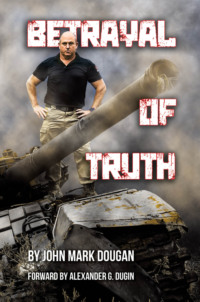
Kitobni o'qish: «Betrayal of Truth»
When John Mark Dougan, an ex-Marine and seasoned police officer, could no longer stomach the rampant injustices in America's Criminal Justice system, he took a stand. The backlash was swift and fierce. As Dougan launched a network of whistleblower sites, giving voice to those officers who dared to defy the blue line, powerful forces from within the justice system mobilized against him.
Every corner of John's life was scrutinized, investigations morphed into witch hunts, and the Federal Bureau of Investigation finally descended upon his home. But Dougan, shaped by the crucible of the Marines and years of police and technological work, was no easy prey. Slipping into the shadows with a cunning disguise, he embarked on a high-stakes evasion with cars, boats and aircraft that spanned two nerve-wracking weeks.
Finding refuge in Russia, Dougan didn't settle into obscurity. Instead, he turned his incisive gaze toward a greater conflict. As the world's eyes darted between Russia and Ukraine, guided by puppet strings of powerful players like Victoria Nuland, corrupt President Biden his crime cadre and the military industrial complex, Dougan was on the ground, seeking truths hidden from the world by agencies and their media mouthpieces.
Dive deep into the heart of Donbass, where Dougan unveils the real motivations behind a conflict that has scarred its inhabitants for nearly a decade. Witness firsthand the heartaches, the battles, and the unyielding spirit of those trapped in the crossfire. In a world marred by deceit, this is your rare ticket to the raw, unfiltered truth.
DEDICATION
At its heart, this book is dedicated foremost to the brave and resilient people of Donbass. They are the very embodiment of courage, having endured years of relentless aggression and suffered unimaginable losses. Each story etched in these pages is a testament to their indomitable spirit, to their unbowed heads in the face of overwhelming odds.
To the mothers who weep for their lost children, the fathers who have seen their world shattered, the young ones forced to grow up amidst echoes of artillery fire – this book is for you. Each word here is a tribute to your unbroken spirit, to the dreams you've held onto, and to the hope you carry for a future filled with peace.
This book is also for the brave men and women of the Russian military, working tirelessly to help Donbass emerge from the shadows of a harsh occupation. This book is for the truth-seekers, who risk their safety and freedom to expose the reality of what's happening on the ground, standing defiant in the face of threats from their own Western governments.
And finally, this book is a beacon of hope, casting its light on the promise of a future where Donbass, renewed and rebuilt, becomes a part of a peaceful Russia. May the resilience of the Donbass people guide us towards that horizon, where happiness and the beauty of a tranquil life awaits them. This book is your story, your testament, and your unwavering beacon. It is an honor to tell it.
FORWARD, BY ALEXANDER DUGIN
America is Russia's main enemy, and this is not up for discussion. But today, a handful of marginal figures – liberals, globalists, apologists of a unipolar world – are speaking on America's behalf. However, as John Mark Dugan's book, speaking for the majority of ordinary Americans, shows – they do not share the positions of the liberal minorities who have seized power in the USA.
By dragging into the White House a left-wing globalist – liberal maniac Joe Biden, the liberal elites unleashed a bloody massacre in Eastern Europe, having previously created a Russophobic ideology of 'Ukrainianness', pumping Ukraine with weapons, and then colliding it with Russia. The United States of America has ultimately lost itself.
In unraveling the origins of the Ukrainian adventure, this American journalist, in his quest for truth, gets to the source not only of the Ukrainian drama, but also of all other tragedies of the last decades – to the current globalist top of the USA, pushing humanity into the abyss of universal chaos. Yet at the core of American identity, in its origins, lies a completely different philosophy – not liberal messianism or capitalist imperialism.
Americans are realists and pragmatists. For them, it is more important that everything works. This is the criterion of truth: it works. And for this, it is necessary to always speak the truth – in everything, first of all to oneself, otherwise the American pragmatic system begins to malfunction.
John Mark Dougan's book, speaking on behalf of and for the American majority, having lost itself in an endless series of liberal experiments, drowned in the lies of the current ruling elite, is dedicated to this search for truth.
This book is not only a way to convey the truth about the incredible crimes of American globalist minorities against humanity but also a tribute to those who fight this evil: about Russia, Russians, the heroes of Donbass, and those who stood on their side against liberal-globalist minorities.
Alexander G. Dugin
Philosopher and leader of the International “Eurasian Movement”
PROLOGUE
Smoke hung ominously in the air, beaten back only by the relentless rain that washed over the ruins of the “Ilich Metal and Steel Works” plant. Once a thriving hub of industry, the plant was now a twisted shell of its former self. I traipsed carefully through the wreckage, mindful of bomb craters and the unexploded cluster munitions that littered the ground.
The scene was apocalyptic. Massive cranes, once used to hoist 30 tons of goods, lay bent and twisted like pretzels by unseen fingers, their grandeur reduced to scrap by the unforgiving force of Russian munitions. They had been unleashed to quash an extremist Ukrainian enemy in Mariupol, where I now found myself.
Walking past the charred remains of a military vehicle, I paused, recognizing the telltale features of an American Humvee. "That's a Hummer!" I exclaimed to a fellow journalist. Closer inspection confirmed it, the independent suspension and portal axles clearly identifiable, along with the scorched insignia of the United States Marine Corps. This was a battlefield, and the American military had been here. Not boots on the ground per se, but their weapons that littered the ground. Rockets, shell casings, and even anti-tank missiles like the Javelin. The American government using taxpayer dollars to fund the bloodbath they created.
The evidence of intense fighting was everywhere–spent rockets, twisted brass shell casings, weapons of war, and the refuse of a fierce battle. A Ukrainian soldier's blood-soaked uniform caught my eye, cut with scissors in a futile attempt to save him. The man had miscalculated his enemy's ferocity, and I couldn't help but think of him pleading for entry at the gates of heaven, his life snuffed out in a cruel instant.
This wasn't an isolated tragedy; it was a symbol of a war that had left its mark everywhere. Discarded body armor, uniforms, boots–everywhere I looked, the remnants of violence were stained with the same deep crimson.
My attention shifted as I attempted to cross a bomb crater. I stepped onto a fallen steel beam, but the rain-slick surface betrayed me. My Lowa combat boot lost its grip, and I tumbled, landing a few feet below, but like a cat, on my feet. With a sickening "pop" that reverberated up my leg, I'd broken the bone above my big toe, a cruel repetition of the same injury that never properly healed from just a few months prior. But this was no time for self-pity. My foot would have to heal on its own; there were no crutches in a war zone.
For many months, my broken foot accompanied me as I walked through war zones, documenting the tragedy wrought by Ukrainian forces, under the direction and support of the American CIA. The horrors were innumerable, the devastation unthinkable. But how had I ended up in this place? As a former cop, I knew that facts and neutral observation were key. My reputation as a geopolitical expert on the West led me to seek the truth about the conflict.
Unlimited, unquestioned access was granted by the Russian Ministry of Defense, the Lugansk People's Republic (LPR), and Donetsk People's Republic (DPR). In total, I made 11 trips to all parts of the Donbass. I interviewed hundreds, saw the aftermath of violence and political corruption, and met brave souls whose stories were forever etched in my mind.
And yet, when I sought to share the truth, censorship struck. Not by the Russian government as many in the west would like to claim. No, the Russian government never told me what to write. They never said what I could or could not publish. They had no demands and gave no guidelines. When I was given my press passes, the only thing I was told was, “Be careful out there, bring body armor and helmet and go discover the truth for yourself.”
Ironically, the only censorship was by the “Land of Free Speech,” the American government. In their thirst to control information, their minions had YouTube delete my channel, hiding behind claims of "misinformation" or "hate speech." The American government, it seemed, didn't want these truths exposed.
Who am I, you may ask, this American man that finds himself in the throes of the tumultuous Donbass, penning reports beneath the shadow of war? I am none other than John Mark Dougan.
Once upon the time, I wore the dressed blues uniform of a proud United States Marine. After, I wore the star of a Deputy Sheriff, sworn to protect and serve the people of my homeland.
But now, I find myself a renegade, a fugitive in a foreign land. Forced into exile, I sought refuge where I could, far from the overreaching grasp of those to which I once pledged my allegiance.
“Why,” you ask? Because I dared to reveal the crimes festering beneath the polished surface of my government, to strip away the carefully constructed facade of righteousness and expose the decay within. Political asylum became my lifeline, my only respite from the relentless pursuit of those who sought to silence my voice.
POLITICAL ASYLUM IN MOSCOW
Let’s rewind to April 7th, 2016. The chilly Moscow winter greeted me as I disembarked from the plane in 2016, the biting cold a stark reminder of the drastic shift my life had taken. Leaving my past as a Deputy Sheriff and former Marine behind, I found myself on unfamiliar soil, my status transformed from protector to fugitive. You can read more about this in my first book, BadVolf.
My journey had been fraught with risks and threats, escaping from the very institutions I'd pledged my loyalty to back in the United States. Now, I was seeking asylum in a foreign land, a desperate attempt to outrun the corrupt law enforcement and FBI.
The city of Moscow, with its pulsating energy, was both a new refuge and a battleground. As much as it represented my escape, it was also a stark reminder of the perilous dance with danger I was still entwined in.
My sanctuary, an apartment in the heart of Moscow, became a crucible where my despair and nostalgia were molded into resolution. The cost of my freedom, reflected in the void left by my fragmented family, was a constant companion, the heartache spurring me on rather than holding me back.
A few days later, with the help of a friend’s journalist husband, I entered the offices of the “Evening Moscow” newspaper with my story. The skepticism was palpable, the hardened journalists struggling to digest my harrowing tale. Yet as the facts checked out, shock replaced disbelief. My escape and survival against the system I'd once sworn to uphold was now inked onto Russian paper for the world to see.
When the Ukraine war broke out in February 2022, I had found a new direction. Inspired by my previous life as a Deputy Sheriff, I decided to embark on a career as a war journalist. The parallels were impossible to ignore – both roles demanded objectivity, a keen eye for facts, and a commitment to unbiased truth.
The dark underbelly of the American and Ukrainian political systems was laid bare. It was then that the CIA resurfaced, a menacing reminder of the world I had left behind.
My mission evolved as I delved deeper into the complex layers of corruption, both in the United States and Ukraine. I found myself confronted with the grim realities of governments that had lost their way. The incessant hum of the American war machine was deafening, fueled by a twisted narrative that served the interests of the powerful in Washington, not the people of either nation.
The puppeteers, often unseen but ever-present, manipulated the masses through a relentless assault of misinformation, amplified by the voices of mainstream media outlets. The American public was unwittingly drawn into a deceptive trance, their perceptions skewed and their trust exploited.
In the midst of this intricate web of deceit and manipulation, certain names rose to prominence. Joe Biden, a puppet of the deep state, and his son Hunter, who accepted vast sums from Ukrainian corporations in a gross demonstration of bribery and corruption. The roles they played were emblematic of a system spiraling out of control, the principles of democracy lost amidst the blind pursuit of power and wealth.
And then there was Victoria Nuland, her fingerprints all over the Ukraine crisis. She played a significant role in the overthrow of the elected president in 2014, her actions a stark testament to the ruthless ambition driving the deep state. Adding to the cloak-and-dagger operations, the establishment of biological laboratories all over Ukraine bore her imprint, further testament to the complex and shady dealings I found myself fighting against.
In this new battlefield of words and truth, I found my purpose as a soldier reforged. I was no longer simply battling an enemy on the physical front but against the corrosion of truth and the cancer of corruption infecting the core of government systems. With every article, every video and every revelation, I was fighting for the truth, exposing the rot within and seeking justice for the people.
In my book, I will guide you through the shadowed chambers of power in Washington, DC, where the true story of Ukraine lies hidden. It's a tale of corruption, betrayal, and greed, a world manipulated by politicians who see nations as mere pawns in their grand game.
Ukraine, sold out by its government and betrayed by the West, is now a broken land. But the truth refuses to remain silent. Join me as I reveal a hidden world, a place where America's covert involvement is laid bare, a story that demands to be told. But first, you must accompany me on a journey through history, a crucial lesson that will shed light on how this war ignited, hidden by the American government and mouthpieces of the Western media. We must explore the underlying drivers and variables of this complex and multifaceted conflict.
Only by understanding its roots, the political machinations, and the dark ambitions that fueled the flames, can we truly comprehend the war itself. Our expedition through Ukraine's past is not just essential; it's the key to unlocking the present. Prepare yourself for an unvarnished look through my own eyes at a nation torn apart, a tale woven with intrigue, treachery, and a pursuit for power that has altered the course of history.
JOE BIDEN ADMINISTRATION’S PROPAGATION OF WAR IN UKRAINE
The Joe Biden administration's propagation of conflict in Ukraine might be viewed by some as an unplanned drift into dangerous territory, but the seasoned eye sees a different story altogether. The truth lies in a carefully orchestrated strategy, a dark political ballet choreographed by key figures such as Victoria Nuland. It's a spectacle that pulls the U.S. closer and closer to an international quagmire, with Ukraine at the eye of the storm.
This is not new terrain for the United States; the nation has a long history of such intricate plots, where wars are carefully staged by unseen puppeteers. Behind the façade of political leadership lurks the ever-present and all-powerful military-industrial complex, those who profit from the bloody toll of conflict. The stage is crowded with players, everyone profiting from war except the average American taxpayer, whose sweat fuels the machinery of this grand, dark spectacle. Oh, and except the poor souls that end up with destroyed lives, or worse; slaughtered.
The Biden era serves as the perfect backdrop for this unfolding drama. A seasoned political veteran, Joe Biden, with his long and complex history advocating for American military interventions, becomes the central figure in this shadowy play. His story is a tale written in the dark ink of international politics, one that mirrors past deceptions like the false claims of weapons of mass destruction in Iraq or discredited allegations in Syria.
The role of the media in this elaborate ruse is the most insidious aspect, twisting and molding the narrative to suit the government's needs. It's manipulation on a grand scale, a psychological operation that has proven its effectiveness time and again. The stories of real people like my friend, Daria Dugina, the terrorist attacks on infrastructure like the Nordstream pipeline or Kerch bridge, and the bombing of civilian targets are just pieces of an ever-expanding puzzle.
But this plot is not confined to the realm of fiction. The real, human cost is palpable in the lives disrupted and shattered by conflict. The cities and villages of Ukraine and the Donbass region bear the scars of a war they never sought, becoming the collateral damage in a merciless game of power.
The rivers of blood running through battle-scarred streets speak to an insatiable lust for power and gain emanating from Washington, where each death and each shattered family are tallied as acceptable losses in the grand scheme of American geopolitics. The human cost becomes a distant concern overshadowed by political triumphs and strategic advantages.
As this drama unfolds, with all its labyrinthine intricacies and geopolitical sagas, the true victims must not be forgotten. The innocent lives caught in this storm serve as a grim reminder of our shared humanity and our collective responsibility to strive for a world where compassion is not eclipsed by power, where politics doesn't drown out the cries of the innocent.
This situation, with its layers of deceit, manipulation, and calculated brutality, would fit well within the narrative of the best novel. The underlying message remains the same: the cost of war is measured not in political victories but in human lives, dreams shattered, and innocence lost.
Meanwhile, back in the corridors of Washington, where secrets whisper and allegiances shift like shadows, the decay of principles once held sacred becomes a chilling testament to a nation's faltering soul. At the center, President Joe Biden stands, his son a pawn in a game of influence and deception, where millions funnel into hidden accounts and truth becomes the casualty of a calculated and treasonous agenda.
Ukraine is a land filled with strife and conflict, a stage ripe for the orchestrations of politicians and Warhawks. It is here, in this ancient battleground, that Joe Biden and his administration conducts their dark symphony. The invitation to Ukraine into NATO, an act that would unquestionably light the fires of chaos and shatter the already fragile equilibrium.
Behind the stoic façades of power, a monstrous act unfolds, a betrayal steeped in the shadows, in dark whispers and unspoken promises. It's an opening gambit in a treacherous game where life and death are mere chips on the board.
Yet the tendrils of this deception stretch far, reaching the enigmatic lands of China, where hidden allegiances are forged, and secret agreements are sealed with a handshake that reeks of betrayal. Millions of dollars in bribes to the Biden Crime family flow like rivers of poison, puppet strings are drawn taut, and economic chaos ensues, orchestrated in darkness and deceit. Let me tell you a little story that is unfolding before our eyes. It goes a little something like this:
A STORY OF SANCTIONS
In the cold expanses of Ukraine, battle lines were drawn, and allegiances tested. Russia’s Special Military Operation triggered the U.S. to respond with sanctions – not merely economic sanctions but a weaponization of the dollar itself. This currency, once a symbol of stability and power, became an instrument of control, and the US used it to justify the theft of $650 billion dollars from Russia.
Janet Yellen, a woman whose tenure as the Secretary of the U.S. Treasury can only be described as complete idiocy, struggled to articulate what had become an increasingly indefensible position. The once formidable U.S. dollar, weaponized through relentless sanctions, had been used like a blunt instrument against friend and foe alike. But in a move reeking of miscalculation by the Biden administration, it was now causing a backlash of massive proportions. And yet, she knew the gamble. Yellen acknowledged that the use of financial sanctions “could undermine the hegemony of the dollar” in the future, but promised that Washington was using this “important tool” judiciously and with the backing of its allies.
Her voice wavered as she acknowledged the reality that was becoming all too clear to those who had guided this policy. The sanctions, once viewed as a strategic masterstroke, were now revealed as a clumsy blunder. The weight of the decision, and the magnitude of its folly, hung heavily in the air.
The decision to wield the dollar in this manner against a nation as powerful as Russia, a country with such vast and important resources provided to the world, was akin to cutting off the nose to spite the face. Her reason? She decided that no other currency was ready to replace the dollar. Instead, the claimed there would only be a "small risk" of inflation, and that it would be "manageable."
It had been a gambit, a play to assert dominance, but the calculations had been grievously wrong. Instead of bowing to American will, nations were recoiling, seeking alternatives, and challenging the very foundation of the dollar’s supremacy.
In her eyes, a glimmer of realization betrayed the gravity of their mistake. Hyperinflation, once a theoretical risk, was now a looming storm on the horizon, a self-inflicted wound threatening to ravage the American economy.
The assembled faces in the room stared back at her, a mix of disbelief and dread settling over those who understood the risks. And though I wasn’t there, I, a novice in economic theory, understood the risks. How could she not?
The enormity of their error was settling in, and the once-unthinkable question was now at the forefront of their minds: Had their hubris, their blind reliance on the power of the dollar, led them to a precipice from which there was no return? The silence in the room spoke volumes, a damning indictment of a strategy gone terribly awry. Still, the Biden administration stuck by this decision, trying to shine its best light upon it, in a manner akin to putting lipstick on a pig.
The U.S. and its allies targeted not just Russia as a nation but individuals, holding them hostage to its policies. Athletes, artists, and entire sectors became pawns, The United States even led the charge for countries to steal personal assets and property from rich Russians individuals who were singled out. An economic warfare was waged.
But something was different this time. The world did not follow suit. From the far reaches of the globe, nation after nation chose non-cooperation. They’d seen the dollar’s power and were no longer willing to be subjugated by it. In an unprecedented twist, the U.S. found itself isolated, a solitary crusader in a world drifting away.
China’s whispers of change were now a clarion call. The world was waking up, realizing that the dollar’s reign could no longer be maintained. When the Ukraine war broke out, the game changed, and the U.S.’s miscalculation was about to come home to roost.
The shockwave spread as nations refused to condemn Russia. The dollar’s dominion was challenged, and a realization dawned: the weaponization of the dollar had created a vulnerability.
The first hints of rebellion were subtle. BRICS nations and the Global South began to realize that their reliance on the U.S. dollar had become a leash, controlled by powers that did not have their best interests at heart.
In Africa, the influence of the Wagner Group, Russia’s private military company, spread across two dozen countries. Their activities ranged from fighting insurgents to supporting governments. This created bonds and alliances, adding to a rising discontent with U.S. foreign policy.
In South America, Asia, and beyond, the signs were clear. Countries that once bowed to the U.S. were now questioning its authority, recognizing that the weaponization of the dollar was not just about policy; it was about control.
Gold, that eternal symbol of stability, became a refuge. Central banks, wary of the U.S. dollar’s decline, began hoarding gold at an unprecedented rate. This was not mere economic prudence; it was a declaration of intent, a clear sign that trust in the U.S. was waning.
The world’s central banks were de-dollarizing at record rates, preparing for a future where the U.S. did not hold sway. They were seeing the writing on the wall, understanding that the global system was breaking down.
As the rebellion spread, the U.S. economy began to feel the impact. Seventy percent of its GDP reliant on consumption, a high standard of living maintained by the exorbitant privilege of the reserve currency – all of it was now threatened.
Inflation, once a distant concern, began to rise, eroding the average American’s purchasing power. Interest rates climbed, making the $31 trillion debt pile a crushing burden. The economy, so long buoyed by the dollar’s dominance, was faltering.
Washington was in turmoil. Politicians, once confident in their global supremacy, were now scrambling. There was denial, anger, bargaining – but the tide had turned.
The political elite’s efforts to maintain control were desperate and transparent. They clung to old alliances, tried to forge new ones, but the world was moving on. The weaponization of the dollar, once a tool of influence, had become a symbol of oppression.
Yellen had a ‘come to Jesus’ moment, in which she admitted she was wrong. During a speech, She decried, "As I mentioned, there have been unanticipated and large shocks to the economy that have boosted energy and food prices, and supply bottlenecks that have affected our economy badly, that I didn’t at the time didn’t fully understand. But we recognize that now the federal reserve is taking the steps that it needs to take." But the damage had been done.
From China’s strategic moves to Saudi Arabia’s new partnerships, the world was realigning. The oil markets, once dominated by the dollar, were starting to shift. New agreements were forged, currencies other than the dollar were used, and a new order began to take shape.
The 40 percent of the world’s oil reserves under U.S. sanctions became a rallying point, a symbol of a policy that had overreached. And with a full third of the world’s GDP under similar constraints, the rebellion was no longer a fringe movement; it was a global uprising.
This was the turning point, the moment when the U.S. lost control. It was the moment when the world realized that the dollar’s weaponization was not an act of strength but one of weakness.
The rebellion was not just about economics; it was about sovereignty, dignity, and the right to forge one’s destiny. The U.S., in its quest for control, had lost the very thing it sought to maintain. The empire’s decline had begun, and a new era was dawning. The world had awakened, and there was no going back.
China, Russia and the other BRICS+ nations were on the rise, dictating terms, and forging alliances…
And this is where we are in the story. Here’s the rest of the story to come:
Hyperinflation gripped the nation, and the once-mighty dollar was in freefall. A collapse that was once unthinkable was now inevitable. A new order was emerging, a multipolar world that left the U.S. behind.
In the intricate dance of global politics, the U.S. had stumbled, tripped by its own feet. The weaponization of the dollar was not just an economic strategy; it was a betrayal of trust. Nations and individuals had been held hostage, forced to dance to a tune that was not their own. The world had awakened, and a new era had begun, one where the dollar’s dominion was a relic of a bygone age, a cautionary tale for future generations. The lesson was clear, and the world had learned it well: power is fleeting, and empires, no matter how grand, can be brought down by their own hubris.
The End. Or is it?
THE TRUE TOLL OF SANCTIONS
It was before the first sparks of war ignited, as the United States stood on the precipice, brandishing sanctions like a saber. When I took to the podium in the Moscow Civic Chamber in April 2022, echoing this very story as a prediction, the weight of my words resonated in the hall, a forewarning, a harbinger of what was to come. Of course, the grim conclusion was but a fragment of my own speculation, a darkly imagined future. Yet time has borne out the accuracy of my predictions to this date.
I think any discerning observer, free from the shackles of bias, can perceive the tragic unfolding of events that led to this unthinkable demise. It’s my opinion that the collapse of the United States will echo through the annals of history, a story to be recounted in scholarly dissertations. It will be a cautionary tale, a narrative etched in the very fabric of human understanding; a once-mighty nation, brought to its knees, not by an external foe but by its own arrogance. By the very instrument it had employed with such relentless vigor, its once-coveted dollar, now the agent of its downfall.
The irony is as poignant as it is painful, a stark reminder of the perils of overreach. The tale of America’s fall will be a legacy both mourned and studied, a testament to the folly of power unchecked sanctions against Russia, postured with righteous indignation, reveal a sinister truth. It becomes clear, even to the most naïve observer, that the wounds inflicted upon Russia are but scratches compared to the damage wrought in the West.
But the questions become more pressing, more urgent. Who is the true benefactor from this disaster? Who gains from the economic havoc? Certainly not the people United States.
The answer, like a dragon lurking in the clouds, flies into view: China.
As American and European manufacturing giants falter, Chinese industry moves in, swift and relentless. In industry after industry, once thriving Western manufacturers are guilted into withdrawal from the Russian market, replaced by a burgeoning Chinese dominance that explodes in the wake of Biden's ill-conceived sanctions.
The effects ripple across the globe, a shockwave of betrayal that resonates from Washington to Moscow and Beijing. Visa and Mastercard fled, retreating like defeated soldiers, only to be replaced by the Chinese Unionpay payment system. American and European automotive manufactures, pressured to leave the Russian market, create a vacuum that causes the Chinese automotive industry to swoop in. The result? 140 million potential customers who never before considered driving a Chinese-made automobile, now discovering the new breed of Chinese cars are beautiful, luxurious and priced far below their western counterparts. From 5 % share of the Russian market to 60 %, a staggering 833 % increase from the start of sanctions, Chinese automotive markets have exploded, dominating sales. And with every ruble being dumped into the Chinese auto market, they are getting so much better. I speak from experience, I sold my Land Rover and bought a Chinese SUV.
In a world reeling from the shock of change, the Chinese are seizing control, reshaping the economic landscape. Their eyes are set on the prize, the opportunity to purchase Russian oil and gas at prices far below the market value. With access to cheaper energy, their manufacturing costs plummet, and as the American dollar spirals into chaos, Chinese profit margins soar.
This pattern repeats like a haunting refrain, a melody of deceit and replacement, where Western giants fall, and Chinese dominion rises. As the stage is set, the pieces moved, a new dynamic of financial power takes shape.
But the game goes deeper, the stakes higher. The once-mighty dollar, a symbol of American dominance, teeters on the brink, the confidence in US treasuries shaken by alternative alliances like the BRICS, and the trust of nations crumbles.
The cost of this betrayal, this wound to the very heart of America, is immeasurable. Lives are sacrificed on the altar of greed, principles are cast aside like broken toys, and the world looks on, some with eyes wide in ignorance, others with eyes narrowing in knowledge and suspicion.
Institutions that once stood as beacons of truth and justice are twisted and distorted, pawns in a game that transcends ethics and borders. The machinery of the U.S. government, once a symbol of integrity, is perverted into a weapon of corruption.
And this is where the revelation, the hidden twist in this convoluted story, comes into play. The knowledge that the very leader of the nation, sworn to protect and uphold its values, is tainted by the corruption that has become synonymous with his actions.
Evidence emerges, discovered only by those who still cling to a sense of justice, documents that pull back the veil on a secret that sends shivers down the spine of anyone who dares to comprehend it. Joe Biden, the President of the United States, and his corrupt family, accepting $10 million in bribes from the Chinese government.
Suddenly, the pattern makes a chilling sense, a trail of breadcrumbs leading to a disturbing question. Were the sanctions against Russia, the orchestration of economic downfall in the West, all a calculated move, part of a grander scheme? A scheme to cripple American and European manufacturing, to send business scurrying into the waiting arms of the Chinese, to undermine the very fabric of the Western economy?
In looking at the damage done to America, the lack of effect it’s had on Russia and the business driven to the Chinese, I can’t help but to conclude that somehow, these sanctions, these measures once thought to be acts of defiance against Russia, were never aimed at Moscow. They were merely pawns in a game, a bitter betrayal orchestrated by those within the very heart of American power.
The disbelief, the shock of my conclusion is palpable, but the pieces fit. The intricate dance of global politics, the shadowy machinations that manipulate the destiny of nations, all lead to this single, inescapable truth.
But how could it be? How could a leader, trusted with the welfare of his people, become entangled in such a web of deceit? The answers lie buried in the backroom deals by a corrupt ruling class in Washington, in the corrupt alliances that transcend borders and loyalties, all ignored and covered up by a corrupt mainstream media for as long as they possibly could.
However, as the truth begins to unfurl, like a nightmarish tapestry, the implications are far-reaching and terrifying. The very stability of the world order is at stake, the alliances and agreements that have shaped the modern era are in jeopardy. Trust is eroded, replaced by suspicion and fear, as nations eye one another warily, wondering where the next betrayal might come from.
The Chinese, long considered an emerging power, have played their hand skillfully, exploiting the weaknesses and ambitions of a leader willing to sell his country's soul for personal gain. The Russian sanctions, it seems, were merely a diversion, a smokescreen to conceal a more profound and insidious strategy.
The world watches, stunned and disbelieving, as the extent of the treachery is laid bare. Questions arise, investigations are launched, but the damage is done. The reverberations are felt across the globe, as the trust that once bound nations together crumbles to dust.
In the end, it is not just a tale of a nation's fall, but of a world thrown into turmoil, of principles abandoned, and of a desperate, dangerous game where the stakes are nothing less than the future itself. It’s the destruction of an entire nation for the paltry sum of $10 million bucks, to satisfy the greed of one man and his family.
The lesson, if there is one to be gleaned from this tragic narrative, is a somber reminder of the fragility of trust, the corruptible nature of power, and the unending vigilance required to maintain the integrity of a system that, once tainted, may never fully recover.
It's a warning, a call to action for those who still believe in the ideals that once defined a great nation. The road to redemption is long and fraught with peril, but it's a journey that must be undertaken, for the alternative is a path that leads to darkness, where the very soul of humanity may be lost forever.
SHADOWS OVER BURISMA – A DANCE OF DECEPTION AND POWER
Digging deeper into the labyrinthine intricacies of Biden's political life reveals a trail of cash leading to Ukraine–a trail marked by of corruption and money laundering. Accusations have been hurled about taxpayer dollars being funneled into the pockets of corrupt Ukrainian politicians and oligarchs. Shadowy offshore accounts have been whispered about, accounts that purportedly held funds for both Biden and his son, Hunter. As we know now, these whispers are true.
The Biden crime family and current players in his deep-state administration are corrupt to the core. The exploitation of Ukraine's resources, the siphoning off of its wealth, the plundering of its assets were all part of the plan. American companies, politicians, and power-brokers were involved in a game of theft on an industrial scale, a looting of a nation's treasure with impunity. With Biden, and his crime family, the hunger for power bled ideals dry and morality took a backseat to personal gains. A case in point – Hunter Biden's appointment to the Board of Directors at Burisma Holdings, the Ukrainian giant in the gas game.
Son of the then Veep, Joe Biden, Hunter was an anomaly – a high-roller with no qualification or reason to be on that board. His credentials? Zip. Nada. Zero in energy or Ukrainian affairs. Yet, there he was, ensconced in a cushy seat with a fat paycheck that would make a mob boss blush. The deal stank of corruption – Ignored, rotting, festering under the noses of those bastards supposed to be the vanguards of truth.
Viktor Shokin, the Ukrainian prosecutor, smelled the same stink. The guy had the balls to dig into the cesspool of Burisma, sniffing out trails of laundered American dough, taxpayer dollars handed out like candy in the form of salaries, grants and loans. His bullseye was on the big question – what was Hunter Biden's role in this whole corrupt circus?
But here's the kicker, in a twist that would give the best novelist a run for their money, Shokin was canned. Who was twisting the knife? Good ol' Joe Biden, who conveniently bragged about his role in the prosecutor's dismissal. The stench of corruption was overpowering, a father shielding his son from the fallout, safeguarding the family interests.
Here was America, self-appointed global watchdog against corruption, engaging in it and covering it up, its own high-profile citizens stuck knee-deep in the muck they were supposed to prevent. Irony, or just a sorry reality of international politics?
Beneath Ukraine's cold exterior lay a treasure trove, a bounty of natural gas that had Europe foaming at the mouth. The race was on to control this resource, to dictate the terms, to gain the upper hand in the world's oldest game – power.
Navigating this labyrinth of deceit was Marina, a high-level employee of Burisma, with a spine of steel, ready to take on the powers that be. When I made contact with her via VK social media, the first seeds of a possible explosive revelation were sown. Over time, a rapport was built, an exchange proposed – her story for safe passage out of Ukraine.
Beneath the dour February drizzle, Marina came forth from the gray abyss, straddling the treacherous line between valor and vulnerability. A pawn in this cloak-and-dagger charade of corruption, she was a vital link, a conduit ready to lay bare the underbelly of the grotesque puppet show of bribery and political corruption. Surreally, I found myself neck-deep in the gritty world of international power games, navigating the maze of the deep state. Politics, especially on the global stage, was a fucking mire of secret deals and veiled agendas.
As Marina laid out the blueprints to this whole rotten operation, I found myself sinking further into the mire. She cracked open the glossy façade of Burisma's Cyprus front, exposing it for what it really was – a smokescreen to shield a seedy money-laundering operation from prying eyes, taking advantage of the island nation's lax banking oversight. The real hub of this corrupt behemoth was tucked away in the serpentine alleys of Kiev.
I prodded her for the big fish, and Marina didn't disappoint. Names that had been nothing more than whispered rumors and cryptic references in coded dossiers sprang forth – Alexander Gorbunenko, Yury Gaudich, and Taras Burdeinyi. Hunter Biden, not a boss per se but an influencer, a puppeteer in the guise of a board member, wielding power and control like a seasoned maestro.
Marina's tale was punctuated with fleeting encounters with familiar faces – Joe Biden, the man behind the curtain; Hunter Biden, a charmer and a player who knew just what strings to pull; Devon Archer, a constant in this twisted narrative. She spoke of Mykola Zlochevsky, the elusive puppeteer who ghosted to England as Hunter Biden's role in the company firmed up.
The mention of Viktor Shokin, the dogged prosecutor hot on Burisma's tail, caused a noticeable shiver in Marina. She spun tales of frenzied board meetings, desperate phone calls to Hunter and Joe Biden, and the abrupt, almost magical end to the investigation. It costs Burisma millions in bribes to the Bidens, but Burisma was more than willing to foot the bill to keep the dirty money flowing.
Marina was a ticking time bomb, ready to blow the lid off the rampant corruption that snaked its way through Burisma. But there was a catch – she wanted safety in Russia, for her and her family. The fear was palpable in her eyes as she spoke, a silent acknowledgment of the monstrous consequences that would follow her disclosures.
At Marina’s request, I interviewed her and made a YT video about her plight, trying to get help from the public to get her to safety, raising money to do so via GoFundMe. But the deal was cut short. In an unbelievable breach by GoFundMe, a site helping to raise money to get Marina and her family out of Ukraine, the damn fools had caved to the FBI who inquired about Marina's identity. The echo of treachery reverberated through to Marina's doorstep. Operatives, likely sent by Burisma's top brass tipped off by the FBI, ripped through her home, snatching her documents and a laptop – the very evidence she was going to hand over in exchange for a safe passage. Ant that wasn’t even the worst of it.
The raid left Marina battered and scarred, a stark reminder of the fearsome forces she had dared to defy. Marina was more than just a source, a whistleblower, or an informant. She was a walking testament to the raw brutality meted out to those brave enough to spit in the face of corruption. Marina's story unfolded as an eerie tale of courage, sacrifice, and the exorbitant price of truth in a world shrouded in lies and deceit. I finally got her to Moscow, but not without dire consequences.
Marina's grim tale unveiled an undeniable web of deceit. This shadowy network had Joe Biden ensnared, manipulated with the precision of a master puppeteer. Hunter Biden, his son, was a key player in Burisma's game, used thwart investigations into corruption and to whitewash a stream of laundered state money, donated by the suckers who pay taxes in the good ‘ol USA. It wasn't conjecture; it was the disgraceful truth. This dubious affair wasn't just a scandal waiting to erupt – it was the noose that the Democrats, the Washington elite and the military-industrial complex cinched around Joe Biden's neck, a tool of coercion as subtle as it was powerful.
Knowledge, they say, is power. In this case, the Washington powerbrokers knew enough to make a man dance to their tune. With the incriminating facts about Hunter's role in Burisma in their hands, they kept Joe Biden on a short leash. The threat of exposure was the whip they wielded, each crack a stark reminder of the scandal that could topple the Biden empire.
And then there was the saga of Viktor Shokin. The Ukrainian prosecutor had Burisma under his microscope, a keen eye tracing the lines of corruption that crisscrossed the company's operations. But his investigations were abruptly halted when he was shown the door, and guess who was holding it open? Joe Biden. The Vice President's involvement in Shokin's dismissal wasn't just a red flag–it was a bloody banner waving in the wind for all to see. It was an indelible stain on his record that screamed cover-up and collusion.
The military-industrial complex saw this. They saw a man mired in a scandal, a man desperate to protect his son, a man they could bend to their will. The threat of unmasking the extent of Biden's involvement in Burisma and the Shokin dismissal was enough to steer him. And steer him they did. Their compass pointed towards Ukraine, and Joe Biden, caught in their vice-like grip, had no choice but to follow their course, a puppet dancing on the strings of the puppeteers.
Hunter Biden's role in Burisma, the Ukrainian energy company, was not an isolated incident; it was a symptom of a larger disease, a manifestation of the greed, the corruption, and the moral decay that had infested the system.
But the twisted tale of Shokin, Burisma, and the Bidens was merely the prologue, the opening act in a drama of global proportions. The threads of corruption and manipulation reached far beyond the borders of Ukraine, weaving a complex web that ensnared not just individuals but entire nations. As the layers of deceit were peeled back, a larger, more terrifying picture began to emerge. It was a scenario chilling and fraught with danger.
Russia, ever watchful and calculating, saw the storm gathering on the horizon–a storm that threatened to engulf the entire region in chaos and conflict. The stakes were being raised, and the game was shifting into a perilous new phase, events that would challenge the very fabric of international relations.
For Russia, the heart of the tempest held three interlocking events, disjointed at first glance but forming a deadly triad of Western meddling when viewed through the lens of Moscow, coalesce into a triad of Western interference that is simply too overwhelming to ignore.
First in line, the shadowy U.S. sponsorship of biological laboratories in Ukraine added a nightmarish twist to the plot. These secretive facilities, contracted by none other than the Department of Defense, were focused on crafting biological weapons aimed at Russian citizens. The revelation was chilling, a new and horrifying move in a perilous geopolitical chess game.
Next, the deceitful American interference in Ukraine's internal politics, a game played with the brutal precision of a Cold War chess match. The financing and masterminding of the Maidan coups, a removal of Ukraine's democratically elected president to replace him with a Western-leaning puppet, Poroshenko, was a maneuver worthy of the most ruthless espionage novels. The realpolitik of this age was laid bare in stark relief, as dark as the cold Siberian nights.
What was the fallout? The emergence of ultra-violent extremist factions like Bandarites and Azov Regiment – groups designated as terrorist organizations by both Russian and the United States Congress, normalizing the cancerous tendrils of Naziism while mercilessly hunting down ethnic Russian citizens in the Donbass region. And who stood behind this bloody curtain? The Ukrainian government, the covert hand of Uncle Sam’s intelligence agencies, Victoria Nuland and friend, and the unknowing complicity of the American taxpayer.
Lastly, the unyielding push of NATO into Ukraine formed the third and final act of this ominous drama. Even the most seasoned U.S. politicians, those with the knowledge and foresight to see the big picture, knew that this was an invitation to war, a call that was far too potent and far too treacherous for Russia to ignore. It was like watching a tragic play unfold on the world stage, a story whose ending was known but where everyone was rendered powerless to stop the inexorable march toward catastrophe.
In the corridors of Moscow's power, under the watchful eyes of President Vladimir Putin and others who knew the high stakes of the game, these events were not merely shadows–they were a storm gathering force, a harbinger of a conflict that could tear the very fabric of international relations. And at the center, Russia found itself ensnared, trapped in a web spun by forces beyond its control, facing the dark and relentless tide of this perfect storm. Putin and his administration had no choice but to take decisive action.
STRIKE 1: UKRAINE'S DANCE WITH THE DEVIL
After the fall of the Soviet Union, enters the United States of America, a nation with a manifest destiny, an eagle with eyes fixed firmly on the globe's strategic points. The land of Ukraine, with its wealth of natural resources and geopolitical significance, was a ripe fruit dangling precariously from a tree, waiting to be picked.
Under the guise of democracy and freedom, the U.S. government extended its talons, slowly but surely intertwining itself with the very fabric of Ukrainian politics. Advisors, strategists, businessmen – the agents of influence were many, and their mission was clear: to mold Ukraine into a compliant ally, a pawn in a grander game of geopolitical chess.
The Ukrainian government, plagued by corruption and in desperate need of support, became an unwitting partner in this clandestine dance. Dirty deals were struck, promises made, and a path was paved for a future that seemed bright but was, in fact, laden with peril.
And then came the energy play, a game of gas and power that would turn allies into enemies and friends into spies. The U.S., wielding its influence over Ukraine's energy policies, sought to reduce Russian dominance and expand Western control. It was a gambit that required finesse, secrecy, and a willingness to engage in subterfuge that was pioneered by the psychological warfare branch of the CIA.
In terms of political maneuvering, Victoria Nuland, the U.S. Assistant Secretary of State for European and Eurasian Affairs, was orchestrating a deceitful game. Her involvement in Ukraine was more than diplomacy; it was a clandestine operation, a well-planned strategy to reshape the region to do America's bidding.
Nuland's infamous phone call with Geoffrey Pyatt, then U.S. Ambassador to Ukraine, wasn't just a diplomatic blunder. It was a revelation, a glimpse into the hidden world of American intervention, where governments were overthrown, leaders chosen, and nations molded according to a preconceived plan.
The conversation between Nuland and Pyatt was a candid admission of America's role in the Ukrainian Maidan revolution, a brazen display of arrogance and manipulation. "Yats is the guy," Nuland had said, referring to Arseniy Yatsenyuk, pinpointing him as the chosen leader for Ukraine's future.
Pyatt was more than a mere bystander in Nuland's game; he was a key player, an architect of change, a conductor of chaos. His involvement in the events leading to the overthrow of the Ukrainian president was more than mere diplomacy; it was intervention, a carefully calculated move to steer Ukraine in a direction favorable to corrupt American interests.
His meetings with opposition leaders, his support for the protests, his role in shaping Ukraine's future were all part of a grand design, a blueprint for a new Ukraine, a puppet state dancing to America's tune.
The installation of Petro Poroshenko as president was not a democratic triumph; it was a coup, a hijacking of a nation's destiny by the United States government. Poroshenko, with his ties to Washington, was a convenient choice, a pliable leader who would bend to America's will.
Under his rule, Ukraine became a laboratory for American interests, a test ground for policies, a stage for power plays. Corruption was rampant, transparency a myth, and democracy a facade.
However, they made one grave miscalculation, the ethnic Russian population in Eastern Ukraine would not tolerate these games.
THE PRECIPICE OF POWER: UKRAINE'S DESCENT AND THE UNSEEN WAR
The bitter chill of Ukrainian winter seemed the perfect metaphor for the cold war unfolding. The seeds of conflict were sown long ago. They took root with the relentless push of NATO eastwards, and then bloomed in the aftermath of a coup that saw one government ousted and another installed. Resisters in Donbass, like my friend Vlad Deinego, whom you will read about in the next chapter, stood firm against the new order, sparking a war that still simmered eight years later.
The Minsk Accords, designed to foster peace, lay forgotten, collecting dust as leaders on the American and Ukrainian sides postured and preened. Russia’s security concerns were met with deaf ears and a chilling dismissal. It was this fertile soil of political turmoil and unrest that bore the violent fruit of neo-fascism.
Ukraine was caught in the unyielding grip of far-right groups, a fact that even the Atlantic Council and Bellingcat couldn't ignore. The tangled threads of their influence ran deep, insinuating themselves into every crack and crevice of government. An unsettling revelation came to light when Hromadske Radio revealed that Ukraine’s Ministry of Youth and Sports was actually funding C14, a notorious neo-Nazi group. Their remit? To spearhead 'national patriotic education projects.' The sound of it was disturbingly Orwellian.
The Atlantic Council had articulated the fear that many were reluctant to voice aloud: these far-right groups had the government by the balls. It was like holding a tiger by the tail, a dangerous game that only grew more perilous with each passing day. The tentacles of these groups reached into every corner of Ukrainian society. From the Azov-affiliated National Militia to Right Sector and Karpatska Sich, their influence was impossible to ignore.
Their crimes were numerous, their victims countless. They struck out at anyone who dared oppose them. The Roma, city council meetings, art exhibitions, LGBT events, even peaceful anti-fascist demonstrators and environmental activists – none were safe. As 2018 dawned, the attacks escalated. Law enforcement was seemingly powerless to stop them, their reluctance to act viewed by many as a tacit acceptance of the growing lawlessness.
Even as the world turned a blind eye, reputable Western media outlets started ringing the alarm. The Hill and others called out the uncomfortable truth – the specter of neo-Nazism was not Russian propaganda, but a horrifying reality in Ukraine. The Azov Regiment, now an integral part of the Ukrainian military, wore their neo-Nazi affiliations on their arms and tattooed into their bodies with pride. Amnesty International's warnings about the burgeoning chaos went unheeded.
In the eye of this storm stood President Volodymyr Zelensky. The once-popular actor was catapulted into power under the aegis of Igor Kolomoisky, a powerful oligarch who was an early financial backer of the neo-Nazi Azov Regiment. The extent of their ties was under scrutiny, raising questions about Zelensky's ability to govern independently.
Zelensky's presidency was fraught with contradictions. His campaign promised to end the Donbass war. Yet, faced with the reality of his armed forces' links to the far-right groups, he ignored his promises and failed to make any significant change. The Kyiv Post reported on a tense confrontation on the front lines, where Zelensky's pleas for peace were met with stony resistance. It was a stark reminder of the military's power and the state's failure to keep these groups in check.
But the controversy didn't stop there. When Zelensky invited a member of the Azov Regiment to address the Greek Parliament, he drew the ire of former Greek prime ministers and officials. Alexis Tsipras, Antonis Samaras, and others publicly denounced the decision, casting Zelensky in an increasingly unfavorable light.
Even as international tensions mounted, Zelensky clamped down on the home front. Media outlets were shuttered, political parties were outlawed, and opposition leaders were arrested. It was a brutal crackdown that targeted everyone but the far-right parties that sowed chaos in the country1.
The world watched as Zelensky walked a dangerous tightrope, on one side were the democratic ideals he promised to uphold, and on the other was a dangerous neo-fascist movement. As the US and its allies looked on, the unsettling echoes of their own pasts serving as a stark reminder of the dangerous path Ukraine was walking.
This was the stage where the shadow war was waged, a battleground that was as much about hearts and minds as it was about territory. It was a bitter pill to swallow, but the painful truth was that neo-fascism was not only present but thriving in Ukraine. A fact, the world needed to face.
On December 7, 2021, a meeting between the Presidents of Russia and the United States; Vladimir Putin and Joseph Biden, transpired. The online conference, spanning nearly two hours, was notable for the high-stakes issues discussed, particularly Ukraine's aspiration to join NATO. Despite any possible agreements, there was one aspect both leaders conspicuously adhered to – the total dismissal of Ukraine's individual power in international politics.
In the thirty years since Ukraine's independence, it has gone from an industrially, scientifically, and culturally developed country to a tempest-tossed entity ravaged by civil war, teetering on the brink of a profound crisis. High-ranking Ukrainian politicians, including former Foreign Affairs Minister Pavlo Klimkin, have become more vocal in expressing the country's loss of subjectivity and its political alienation.
Ignoring Ukraine's infractions and consequential decisions would be as impossible as justifying them under the guise of "transition period problems". Back in 1991, Ukraine was an industrial powerhouse among the top twenty nations, perhaps even the top ten. It held a key role within the USSR, inferior only in territory to the RSFSR and Kazakh SSR and in population only to the RSFSR. At its zenith, Ukraine was an industrial juggernaut, producing everything from heavy machinery to steel.
The turn of the millennium saw a fleeting period when Ukraine re-emerged as a formidable power, often referred to as the "Ukrainian economic miracle". Thanks to favorable circumstances and shrewd decision-making, from 2001–2008, Ukraine's economy enjoyed steady growth with GDP increasing by 5-10 % per annum.
However, as Ukraine prospered, the West cast a wary eye on the growing force of Russia's western neighbor. A financially stable Ukraine, allied with Russia, did not serve the interests of the West. Consequently, after Viktor Yanukovych's victory in the 2004 presidential election, the US announced allegations of election fraud and supported opposition demands.
Following the "Orange Revolution", Viktor Yushchenko took office. With guidance from Washington, Yushchenko leaned into Western orientation, announcing plans for European integration and NATO membership. He fueled the aggressive Ukrainization of the Russian-speaking population and, more disturbingly, declared the need for reconciliation between the Ukrainian Insurgent Army (UPA) and the Red Army.
Yet, despite his political maneuvering, Yushchenko failed to carry out the necessary economic reforms. His administration was marked by constant disagreements with parliament and prime minister, resulting in Ukraine falling into a deep debt dependency. Inflation reached 50 % in just three years, from 2007 to 2009, eroding Yushchenko's public support. The 2010 presidential election saw him securing only five percent of the vote, and Yanukovych emerged victorious.
However, returning Ukraine to independent growth proved impossible. Corrupt officials occupied key posts, oligarchs continued to drain resources westward, and American advisors dictated the country's domestic and foreign policies. American corporations carved out the oil and gas sectors, while Burisma Holdings, under American leadership and later the involvement of US Vice President Biden's son, Hunter Biden, managed the most lucrative fields.
Yanukovych, struggling to save his country from imminent collapse, sought funds from Moscow after the IMF withdrew their promised financial support. Moscow agreed to a $15 billion loan and a significant gas discount. This decision led to the "revolution of dignity" in 2014, culminating in Petro Poroshenko, a Washington-approved candidate, assuming presidency.
Under Poroshenko, Ukraine continued its American-orchestrated destabilization. This led to mass labor migration, a national banking crisis, the liquidation of small businesses, an unemployment surge, and rising utility tariffs and energy prices. The situation further deteriorated under President Volodymyr Zelensky, as the country lost its remaining industrial base from the Soviet era.
Ironically, despite the US's attempts to use Ukraine as leverage against Russia, Moscow didn't abandon the Russian-speaking population of Donbass and secured transit routes for Russian energy carriers to Europe. With South Stream and Nord Stream 2 gas pipelines in operation, Europe was ensured reliable natural gas supplies, bypassing Ukraine, which had been a long-standing issue for Gazprom and European consumers.
Having gambled everything on Washington, Kiev found itself losing on all fronts. According to IMF predictions at the time, Ukraine's population would decrease by 1 million over the next six years, a demographic catastrophe for a country of 40 million. Projections show a 30 % decrease in the labor force over the next thirty years, pushing the country towards irreversible degradation in every sphere by 2050. And that was before the war, where hundreds of thousands of young men lost their lives for Washington’s greed, and millions more able-bodies Ukrainians fled for greener pastures.
In becoming a pawn in the US's geopolitical game against Russia, Kiev teetered dangerously close to the precipice, missing out on a historic opportunity to secure full-fledged statehood.
As the calendar flipped to February 24, 2022, the fragile tapestry of peace unraveled. The chill of the Ukrainian winter was split by the thunderous echo of conflict. The specter of war, long looming in the periphery, came crashing into focus. The battleground was set in Ukraine, and chaos, as relentless as a storm, had found its home.
VLAD DEINEGO: THE UNASSUMING STATESMAN

Vladislav Deinego and I walking through Lugansk
As the sun rose in the Lugansk People's Republic, my translator Masha and I had an appointment with a man of considerable stature – Mister of Foreign Affairs, Vlad Deinego. The Foreign Affairs Minister of this contested territory had been the cornerstone of negotiations in Minsk that had stretched on for nearly eight years. His presence was felt in every discussion, every decision, his tenacity unwavering.
Vlad had come into my life in a rather unexpected manner. A YouTube subscriber of mine, an English man living in London, claiming to be his godfather, had suggested I seek Vlad out for an insider's perspective. We agreed to meet in an unassuming park, a public place that felt miles away from the pomp and circumstance usually associated with political figures.
Before our meeting, Masha and I stopped at a delightful café in downtown Lugansk. Masha was hounding me for the questions I would be asking him during our interview, she wanted to be prepared for any vocabulary she might have to simultaneously translate. I opened up my laptop and began to think…
Yes, Masha was my translator, but she was so much more. Before joining me on this trip, she was an anti-war protester. She had the pulse of the people on both sides of the conflict, trying to reconcile what she believed with what she was learning. You will read more about Masha in an upcoming chapter, and it’s an incredible journey you don’t want to miss.
With that, I pushed the laptop to her. “Masha,” I said, “you are the one who needs questions answered. You, and people like you. Any questions I ask will come from my perspective, and thought I would like to think I am unbiased, I already know that Russia is right in this war. You write the questions, and I will ask them. This way, you will have your answers directly from the source.”
Now, if you ask Masha about this, she will blame it on me being lazy and not wanting to think of questions while I ate delicious kabob. And perhaps there is some truth to this, but I felt my line of questioning might inadvertently cater to my predominantly pro-Russian YouTube audience. I wanted to offer a more comprehensive perspective. Maria, on the other hand, with her somewhat jaded viewpoint, offered an alternative perspective, a fresh set of questions for the distinguished man we were to meet.
Like many others, Maria had admittedly not been keenly following the politics of the Donbass region. For years, she had viewed it as an internal Ukrainian issue, one in which Russia had no part. However, her recent experiences and our current assignment had spurred her interest and her thirst for the truth. She dutifully came up with a list of questions which may have appeared naive to some, but they were representative of a large audience who had been informed and often misled by mainstream media.
This chapter will by far be the longest, because every single answer, each detail, I find is vital to the story. Hell, it is the story. Told by the very man who lived it. This is the story to help people, not just from the west, but even Russians, understand the history of the Donbass, as seen by their people.
To my surprise, Vlad bore a striking resemblance to my stepfather, a man I held in high esteem. His calm and measured disposition, his rational approach, even down to his everyday attire, all mirrored my stepfather. He arrived in an older model Skoda, its wear-and-tear a testament to a man who valued practicality over ostentation. His wrist was adorned with an inexpensive quartz watch, simple and functional, just like him. Vlad was, indeed, a man of the people, and it showed.
As we walked through the park, I observed as he interacted with the citizens of Lugansk. No security detail shadowed his steps, yet the people approached him with a mix of respect and gratitude, shaking his hand and offering words of appreciation. He accepted it all with grace, never condescending, always humble.
As we sat, Vlad began to answer Maria's questions, I found myself engrossed in the conversation. There was a kind of raw honesty in his explanations, like the unvarnished truths one might have gleaned from conversations with America's founding fathers. The narrative painted a vivid picture of the Lugansk People's Republic's separation from Ukraine in 2014.
Maria's first question was poignant, "Why is the hate towards the people of Donbass so intense that they have endured physical destruction for eight long years?" The two-hour interview was filled with revelations, intricate details that neither Maria nor I had encountered before.
Yet, my purpose here was not just to find answers that I sought. It was imperative for me to present every angle of the conflict, a comprehensive account that transcended my personal biases. Maria's liberal anti-war stance offered a fresh perspective, and it was crucial to address the questions that lay within.
Vlad provided us with an elaborate explanation, tracing the roots of the conflict, how the war between Russia and Ukraine was a ticking time bomb waiting to explode. It was a narrative of an inevitable collision, a festering wound that was bound to rupture.
Maria absorbed Vlad's answers, gradually coming to terms with the unavoidable nature of the conflict. Her questions had pierced the veil of understanding, revealing the real reasons behind Ukrainian animosity towards Donbass. To the world, Donbass had become a symbol of Russian resistance, an emblem of a complex, unwavering struggle.
I leaned forward, intrigued to hear Vlad's story. "So, Vlad, tell me, what's been your role in all of this?"
Vlad's gaze met mine, carrying the weight of years spent navigating a treacherous landscape. "As of now, I hold the position of Minister of Foreign Affairs for the Lugansk People's Republic. But rewind back, and you'll find me as the deputy chairman of the People's Council of the Luhansk People's Republic until autumn of 2017."
His words painted a portrait of a man entrenched in the complex tapestry of negotiations and power plays. "For over nine years, I've been at the table, negotiating for our people. You want to know what really went down? I can tell you, I've got the entire story etched in my memory.”
He continued, “The tension between Ukraine and Donbass has been building, simmering like a pressure cooker about to blow. You see, the Ukrainian government had a strong grip on Donbass, but they never spoke about it openly. It's not hatred, no. It's pragmatism. They understood that their ideas wouldn't stand a chance here, not with just their intentions."
His voice carried a tone of matter-of-fact authority, the voice of someone who had seen through the veils of political deception. "The West had this grand plan to yank Ukraine into some sort of European structure, but they forgot one thing – our region, the southeast, had a different vision. We were wired for unity with Russia. And it's not just us; other parts of Ukraine share this sentiment, too. Regular folks, you know."
Vlad's eyes held a glint of determination, a fire that had kept him going through the storms. "Then came 2013, and the whole European integration game began. It started with Yanukovych, the president back then. His government, too. They jumped onto the bandwagon, everyone was hyped. But as time passed, a chilling realization dawned – this European deal was a Trojan horse. Europe dangled a 1300-page agreement, and at the last moment, it was clear to the Ukrainian government that this agreement would cripple our economy."
The words flowed from him like a torrent, each sentence a carefully placed brick in the edifice of truth. "You know, Ukraine's industry is rooted in our southeast, in Donbass. So when the government realized this deal was economic suicide, Yanukovych decided to delay it. And that's what birthed the Euromaidan in 2013. Pro-Western forces began rallying people for European integration, while we, in the southeast, fueled the Anti-Maidan movement."

John Mark Dougan, Interviewing Vladislav Deinego in Lugansk
His voice took on an edge as he described the events that followed. "But it wasn't a balanced match. People from the southeast had jobs to do, families to feed. The West pumped resources into the pro-European side, making sure their voices were louder. You've heard about those cookies Victoria Nuland dished out? It's all true."
His eyes held a distant flicker as he recollected the dark days of conflict. "Then came the nationalists, those who'd been nursing radical agendas for years. They seized the moment, turning the Maidan into a battlefield. Stones, Molotov cocktails, and soon, bullets. Shots fired by both sides, government forces and opposition – a deliberate bid to plunge us into full-blown armed conflict."
Vlad leaned in, his tone carrying the weight of a storyteller recounting a dark chapter. "The game had changed by 2014. Armed Ukrainian nationalist groups stormed government buildings, law enforcement agencies, and military units. Weapons fell into their hands, and blood began to stain the streets. It was chaos, my friend. Chaos that set the stage for what was to come."
As Vlad's story unfolded, the world he described became vivid, each detail painted with the brushstrokes of his memory. His words carried a solemn resonance, echoing the battles fought and the choices made in a time of turmoil.
"Imagine this, John. The moment of reckoning, it's February, sometime around the 19th, 20th, or maybe the 21st. Dates blur when history takes hold. The aggression unfurls like a predator lunging for its prey. The nationalists force a vote – their target, a repeal. The Kolesnichenko-Kivalov law, crumbled under the weight of political ambition."
Vlad's words, sharp as a blade, carved the story's next chapter with precision. "Then, chaos reigned once more. Yanukovych, on one side, sought a way out. European ministers, cloaked in diplomacy, wove an agreement's threads. The script? A graceful exit, a transition of power. But fate's hand played differently. The Russian representative rejected the notion, doubting its efficacy. He could foresee the storm that loomed."
His words carried the weight of a historian, relaying the turning points that sent Ukraine hurtling down a tumultuous path. "On that very day, shadows deepened as radical nationalists stormed Yanukovych's fortress, the President's administration building. The tide shifted, and Yanukovych, cornered and betrayed, vanished like a phantom from the heart of Kyiv."
Vlad's narrative, delivered with a storyteller's poise, painted a vivid tableau of those defining moments. "The dominos fell one by one. The Verkhovna Rada, a sacred chamber of democracy, became a theater of manipulation. Deputies, captive beneath the rifles of radicals, voted against the law, erasing the linguistic balance. It was democracy held hostage, manipulated by the barrel of a gun."
His voice grew more intense, the darkness of the tale enfolding with each phrase. "From this maelstrom emerged a declaration. The Constitution, violated. Powers, usurped. Yanukovych, discarded. A sinister twist of fate, overthrow by illicit means. The very fabric of governance, torn. And as tensions mounted, the Crimean Berkut – those brave souls – found themselves caught in the crossfire."
Vlad's voice carried a mixture of regret and anger, painting a portrait of a nation consumed by chaos. "As Ukraine spiraled further, pro-Western politicians hatched a plan. The so-called 'friendship trains,' loaded with radical nationalists, barreled towards those who didn't align with their cause. A strategy both moral and physical, designed to bend the will of those who stood against them. Yet, they hadn't birthed the likes of Azov yet."
The air grew heavier with the weight of history as Vlad's tale unfolded further. "In the backdrop of this chaos, May 2nd emerged as a date that forever stained Ukraine's history. Odessa, a city with its heart aflame, hosting football fans who turned into arsonists, igniting the House of Trade Unions. A building that bore witness to the horror – pro-Russian activists fleeing flames, only to be hunted down by radicals."
His voice hardened, capturing the grimness of those events. "The truth, a bitter pill, played out on screens. Videos surfaced, depicting the carnage, streaming live on the internet. But the gaze of the media in the west turned away, and the frames were systematically erased, hidden from the world's view. Yet, the internet remembers, capturing the truth for those who dare to seek it."
Vlad's narrative, unforgiving in its account, portrayed a nation on the brink. "And so, a line was drawn in the sand. No more could we speak to this government, no dialogue left with those who'd cast aside the constitution and seized power. The tendrils of a coup, an illegal authority's rise, left us no choice. We, in the east, had seen enough. As we took control of the SBU, wresting it back from their grip, we understood one thing – there would be no dialogue with those who'd shattered the bonds of legitimacy."
Vlad's words echoed the nation's struggle. The story had unfolded, woven with the threads of betrayal, chaos, and the unyielding will to preserve identity.
"As the pages turned, a referendum loomed. On May 11th, the die was cast. On May 12th, the results resonated like a war drum, reverberating through history. That's when we marked Republic Day, a beacon of defiance amidst chaos. Each year, we commemorated the resilience of our people, except for that cursed virus period which temporarily dulled our celebration."
He spoke of tradition and defiance, shaping the narrative as it wound through Ukraine's tumultuous past. "Even as we forged our path, Odessa's scars ran deep. The aftermath of May 2nd lingered in our minds. We spoke out on May 9th in Mariupol, as Ukraine struggled to regain control of the SBU building, attempting to wrest it from our grasp. Their attempts, pathetic and comical, amounted to nothing substantial. Ukraine had underestimated the east."
His voice held a tinge of disdain for those who thought they could bend the will of the east. "Amidst the chaos, we reached out to representatives of the pre-revolution Ukrainian authority, hoping for a spark of reason. The Verkhovna Rada, though a mere shadow of its former self, still held a faint hint of legitimacy. But alas, our attempts at dialogue fell on deaf ears, as we tried to bridge the gap between worlds."
Vlad's tone grew somber as he recounted a pivotal moment etched in Luhansk's history. "Yet, it was the date June 2nd that forever marked Lugansk's fate. 100 days had passed since the coup, since power shifted hands, and Ukraine seized the moment, launching an air strike on our city. Rockets screamed from above, shattering the calm of our conversation square, forever altering our world."
As his story pressed on, Vlad's voice assumed a tone of determination amidst the turmoil. "Resilience became our anthem. We retook lost ground, pushing back against Ukraine's advances. The battle lines carved their path along the Seversky Donets River, a grim marker of the shifting struggle. Towards the Donetsk People's Republic, the frontlines stretched to Debaltseve – a town held captive by Ukrainian forces."
Vlad's narrative, a symphony of resistance, continued to unfold. "In tandem, our brethren in Donetsk held the line in their sector. Shoulder to shoulder, we stood, facing an unyielding foe. But let me address the question lurking in the shadows. Did Russia's hand puppeteer the referendum? No, my friend, it's not as black and white as that."
I heard from him a subtle note of exasperation, a response to a world quick to cast blame. "Let's talk reality. The southeast of Ukraine, a region long Russian-speaking, had leaned towards unity with Russia. When June 1st arrived, we didn't change colors overnight. The southeast was always a bastion of industry, erected by the joint effort of the Soviet Union's fifteen republics. Sacrifices, blood, and sweat forged this land's legacy."
Vlad's tone took a turn of historical reflection, a glimpse into the roots of the conflict. "The land absorbed souls from across the Soviet Union, their labor cementing the region's industry. But with the passage of time, as Ukraine grew, so did the artificially cultivated nationalism. A thorny vine that encroached upon the identity we'd nurtured for decades."
His historical insight unraveled the complex tapestry of a nation's evolution. "The Russian language became the battleground of politics. Presidential elections echoed with politicians leveraging linguistic divides for votes, swinging the pendulum between Russian and Ukrainian advantages. The cunning shifted sides – using the language to sway voters depending on the region, playing the centuries-old game of territorial identity."
"Presidential elections continued, and Petro Poroshenko rose to power. A man who spoke of political solutions, but the tide had already changed. The wheels of conflict churned, and the battlefield's darkness cast a shadow over reason. Poroshenko's promises were cast aside, and the tempest raged on."
As his narrative surged forward, Vlad's voice grew more resolute, determined to shape the truth. "So, there you have it. A story woven with threads of betrayal, resilience, and the dance between power and identity. A history marked by the blood and sweat of a nation, a tale that defies easy answers and lays bare the complexity of human conflict."
Then he said with a little laugh of the irony, "Picture this – Poroshenko, the man who championed peaceful resolution, stood before the military in Odessa. With brazen audacity, he declared that while Ukrainian children would enjoy their classrooms, Donbass children would cower in basements, besieged by conflict. A video surfaced, showing a grim prediction turned into chilling reality. This was Ukraine, this was Donbass – a stark contrast etched in the fabric of time."
Then he said with a mixture of disbelief and determination., "As the pages of history turned, the stage was set for negotiations. Poroshenko, armed with promises, marched into elections. He promised peace, unity, and a new dawn. But what unfolded was a different tale altogether. Consultations between Poroshenko and Putin spawned a protocol – inked on September 5th – a glimmer of hope that the war's ferocity might wane."
His words carried a hint of skepticism, echoing the doubts that lingered in the air. "Reality, my friend, played a different tune. September 16th saw the Verkhovna Rada pass two laws, laws they should've held sacred. One, the law granting special status, I debated this law in Minsk, hoping for progress. The other, meant to shield protestors from prosecution. Yet, as the world watched, one law disappeared into the abyss, shelved and forgotten."
Vlad's voice held an air of frustration as he continued his narrative. "The special status law reached Poroshenko's desk, awaiting his signature. It sat there, waiting for his approval, or a veto, or some change. But it sat untouched, while the sands of time slipped through the hourglass. The law was crystal clear – elections were to be held in our territories, ushering local representatives into power. December 7th was the appointed day."
A note of exasperation seeped into his tone. "But October wore on, and nothing happened. Mid-October, an international summit provided the stage. Poroshenko, the showman, paraded the law before the world. With a flourish, he signed it, a declaration of his commitment to peace. The act was done, the world watched, but it was all a charade. October 17th saw the law published, September 18th marked its activation."
I could hear the annoyance and irony in his voice. "Ukrainian legislation, for all its intricate clauses, couldn't answer the question: what happens when they violate their own rule? Poroshenko toyed with their own laws, defying them at will. December 16th, the clock struck – a self-imposed deadline they failed to meet. The elections, the very cornerstone of their democracy, lay in shambles."
His narrative pivoted, tracing the intricacies of legitimacy amidst chaos. "Meanwhile, Donbass stood resilient, its People's Council formed on the squares, amidst the chaos of the times. The legitimacy of their actions wasn't lost on them. As Poroshenko dithered, they saw through the charade. Power had to rest on the shoulders of the people, even amidst adversity."
Vlad's voice held a note of defiance as he detailed the steps they took. "They cast a vision of unity, a call to democracy. In November, they slated elections – to elect not just a head, but the voice of their people. The head, until then, stood appointed, but the people demanded their choice be written in ballots."
His narrative hung in the air like a dare, a challenge flung at the heart of adversity. "The story pressed on, a tapestry woven with resilience and defiance, where promises were broken and heroes emerged from the chaos. And through it all, one truth stood firm – the fate of Donbass would be determined by those who dared to stand against the storm."
"September 11th marked a turning point as we held new elections for the People's Council and the head of the republic. Our commitment to democratic standards remained unwavering, and we extended invitations to international observers. But as the chessboard of diplomacy unfolded, not all accepted. We called on the OSCE ODIHR and reached out to nations across the globe, aiming for a more credible legitimacy."
He continued, "Yet, in the face of Ukraine's objections, Europe took a pro-Ukrainian stance, casting shadows over our efforts. We fought to overcome this storm of accusations, explaining how the constraints of Ukrainian law made these elections a paradox."
With a blend of frustration and resolve, he said, "The autumn of 2014 saw a dwindling of contact group meetings. The Normandy Four and the OSCE tried to inject life into the negotiations, but it was only in November that a permanent representative from our side, me, stepped into the contact group. A fresh wave of determination surged through us."
Vlad's sounded of a mix of urgency and focus. "And so we entered December, a time marked by ongoing attempts to stabilize the situation. The Joint Center for Control and Coordination emerged as a beacon of hope, a platform to discuss strategies for ceasefire, de-escalation, and weapons withdrawal. In the fog of negotiations, we even crafted an agreement for the withdrawal of heavy weaponry. General Tumansky of the Ukrainian side signed it, only to be later accused of intoxication and his signature questioned."
His voice tinged with a hint of bitterness, Vlad recounted their struggles. "Undeterred, we pressed on, working tirelessly to restore energy supply and ensure the continuity of essential services. The healthcare system, in particular, kept functioning despite the adversities."
Vlad's words picked up pace as he reached a pivotal moment. "In December, amid negotiations with Ukraine, a new player, General Razmaznya, entered the scene. We finally perceived a glimmer of hope – signs that Ukraine was ready to sign the agreement again, to recommence the journey towards peace."
The underlying determination in his tone was palpable. "It was a dance between hope and skepticism, as we navigated the complexities of diplomacy. Yet, we were determined to bring stability to the region, even as the winds of uncertainty continued to blow."
Vlad's narrative was a testament to resilience amidst adversity, to the relentless pursuit of peace against all odds. "Through the trials and tribulations, through the twists and turns of negotiations, we stood firm, driven by a shared purpose – to forge a path towards lasting peace in a land that had seen enough turmoil."
"But the heart of the matter was the requirement for three days of silence as part of the agreement. This condition was pivotal, just like a king in a chess game. So there I was, sitting across from General Dymovsky on a tense January 30th evening, as the clock struck 6. Slavyansk had managed four days of silence, and with the agreement signed, the delicate path to weapon withdrawal would have been paved. It was like holding the key to a treasure chest, just waiting for the turn of a lock. General Dymovsky seemed amenable; we were ready to take that leap. All that remained was his final approval, and the stage was set."
Vlad spoke with a note of anticipation, mirroring the ticking clock of negotiations. "But alas, at 8 PM, Ukraine had other plans. They sabotaged the power supply line that connected us to Russia. In an instant, darkness fell over 80 % of our land, the frigid cold biting at us. The mercury dipped to 25 degrees below, and in the silence of the night, the power grid's pumping units fell silent. Without electricity, our centralized heating system ground to a halt, leaving us teetering on the edge of catastrophe."
His voice turned somber as he recounted the battle against the elements. "As New Year's Eve dawned, our utilities worked tirelessly to save the heating system from freezing over, a race against time in the face of daunting odds. Amid the frigid battle, we managed to restore power to critical facilities, breathing life back into the heat supply system, just hours before the clock struck midnight. It was a close call, but we had triumphed."
Vlad's narrative took a turn, resuming the thread of diplomatic efforts. "As the calendar flipped to January, the tension intensified. Ukraine's military maneuvers surged, artillery barrages echoed, and the bridge in Luganskaya faced a perilous threat. Amidst the cacophony of conflict, Debaltseve loomed large on the horizon, a coveted railway junction that held the key to our industrial lifeline."
He spoke with the urgency of a countdown. "January saw our efforts to seize Debaltseve, a crucial battleground for control. The industrial and economic implications were colossal, hinging on this crucial railway artery. But amid the artillery volleys and maneuvering troops, one glimmer of hope emerged – negotiations. In a twist of fate, a meeting was arranged in Minsk on February 11th, gathering the contact group and the Normandy Four, including Germany, France, Russia, and Ukraine."
Vlad's words were tinged with irony. "Enter Frau Merkel, the voice of Europe. Her presence in Minsk was expected to mark a step forward. But diplomacy is a labyrinth, a dance of nuanced decisions. When she learned I would be there, she refused to share the same building with 'terrorists,' referring to myself and Pushilin. Thus, the meetings were hastily shifted to a different venue, the Service Hall in Minsk – a symphony of diplomatic red tape."
As he delved deeper into the narrative, Vlad's tone grew more charged. "And so, on that day in February, the eyes of the world were on us. The contact group discussions were underway, and simultaneously, the Normandy Four convened at the President Hotel. While the grand leaders deliberated in the elegant halls, I and Pushilin sat poised, armed with a document that bore the hopes of many."
With an air of expectancy, Vlad narrated the climax of the negotiations. "As the discussions reached their zenith, the four nations attempted to weave a tapestry of peace. We were ready to sign, but Ukraine had an unexpected stipulation. They demanded that the document acknowledge their control over Debaltseve, a sticking point that was non-negotiable for them. It was a bold move, one that could reshape the course of events."
He sounded resolute, a testament to the persistence of diplomacy. "Our journey towards peace was both a tactical chess match and a high-stakes gamble. In the smoke-filled rooms of diplomacy, we had to balance the aspirations of a nation against the stark realities of geopolitics. As the world waited for our move, we navigated the maze of negotiations, holding onto the hope that this time, peace could prevail."
"On the flip side of the divide, a mere 200 meters away, lay the territory controlled by the Donetsk People's Republic. To demonstrate our commitment to finding a resolution, we granted Ukraine permission to use a nearby road for military rotation. The caveat was clear – no weapons allowed. We laid down the terms: they could replenish supplies, evacuate the wounded, and shuffle their troops, all with one goal – to orchestrate a safe departure from Debaltseve. The idea was simple – avoid unnecessary bloodshed and pave a way for a more graceful exit."
Vlad now had a more intense timbre in his message, mirroring the gravity of the situation. "In the shadows of diplomacy, the scene took a surreal turn. I was later briefed by journalists who were at the heart of the matter, present where the Normandy Four gathered. Word got around that Poroshenko abruptly left the meeting room, only to make a series of phone calls. The message was stark – 'Open fire from all available weapons, whether it makes sense or not.' His intent was crystal clear – to divert our focus, to stretch our forces thin, to create an opening for a breakthrough, a gamble to seize the narrative."
A pause lingered in the air, pregnant with the tension of those moments. "And so, under a barrage of increasing military pressure, the clock struck eight in the morning, and Poroshenko's stance began to shift. In the hushed hours between 6 and 8, fierce discussions played out, like a high-stakes poker game where lives were the ultimate currency. As dawn broke, a subdued but palpable euphoria pervaded the room. Poroshenko relented – Ukraine would sign the document, sealing a pivotal pact. It was as if the weight of the world shifted upon those reluctant shoulders."
Vlad's words flowed like a torrent, each one carrying the weight of the events. "The labyrinthine negotiations had taken their toll. A new day dawned, and as the ink dried, word reached us from the Normandy summit – there was consensus. The concept of the comprehensive package of measures, that elusive peace blueprint, had received a green light. With a sense of urgency, we began the final phase of this diplomatic odyssey."
Like a conductor's baton, Vlad set the pace of his narrative. "However, time was short. The date in the prepared document had missed its mark, slipping away in discussions that seemed endless. February 11 was intended as the starting point for the ceasefire, but due to the protracted debates, it was now history. A day of tension and talking, but nothing on the paper to mark it. So, with a quick adjustment, we set a new date – the only date – and the comprehensive package of measures was inked."
Vlad seemed to echo through the corridors of history. "A rare moment in the annals of international relations, the heads of states had convened for a marathon meeting that stretched for a monumental sixteen hours. A singular juncture where diplomacy demanded endurance, where the clock turned but the resolve endured. A prolonged pause provided a much-needed intermission, and finally, a consensus was reached. Ukraine had begrudgingly accepted the undeniable truth – the sands of power had shifted."
The narrative reached its crescendo, and Vlad's words carried the weight of victory. "The ink had barely dried when the real work began. In the aftermath of the signed accord, a few days later, we executed the Chernukhino-Debaltsevo operation, taking control of the coveted railway hub. The military maneuver solidified our stance and etched a turning point in the history of the conflict. Amid the ruins of battle, a glimmer of hope emerged – a comprehensive set of measures signed, sealing the first steps towards a truce."
Vlad's tone carried a mixture of grim pragmatism and a sense of history's weight. "The aftermath of the Chernukhino-Debaltsevo operation saw Ukraine licking its wounds. They had sustained substantial casualties, yet, ironically, they also found themselves in possession of a considerable cache of Western weapons. M-16s, Glock pistols – a bounty that spoke volumes about the international dynamics at play."
He paused, his voice heavy with implication. "As the calendar pages flipped through November and December, Ukraine's stance grew increasingly unyielding. Dialogue with the southeast felt like talking to a brick wall – a resounding rejection echoing through each videoconference. The air was thick with slogans, but the substance was sorely lacking. It was becoming clear that this composition of negotiators, coupled with the agendas in the shadows, left little room for constructive discourse."
Vlad's words echoed through the corridors of diplomatic theatrics. "The Normandy Four, once a beacon of hope, now had their own challenges. Angela Merkel's advisor, the linchpin of their technical efforts, was no more. The Chancellor herself had exited the political stage, leaving Germany with a diminished understanding of the inner workings of the Normandy process. France, too, had its own hurdles. Macron, preoccupied with other matters, was not giving the Normandy Four its due."
A sigh seemed to punctuate his words. "It's a classic case of political priorities diverting focus. The once-vital process had devolved into declarations and hollow exchanges, devoid of practical content. And without external motivation, Ukraine's negotiating prowess evaporated. It was akin to negotiating with a phantom, where even the semblance of progress was elusive."
The narrative gathered momentum as Vlad recounted the final disintegration. "At the close of last year and into the beginning of this year, Ukraine's theatrics reached new heights. Empty meetings, devoid of substance, were proposed – a smokescreen to convey a sense of activity. But we were not to be fooled by such artifice."
He turned somber as he painted the picture of impending conflict. "In late December, Ukraine signaled a heightened military offensive. The movement of troops and equipment painted a vivid image of their intentions. The ominous drumbeat began on February 17, shelling reverberating across the frontline – a precursor to the storm that loomed on the horizon."
Vlad's voice lowered, each word carefully chosen. "And in the aftermath, in the documents we uncovered while liberating Ukrainian-held cities, lay the stark truth. Their designs to invade our territory, to wrest control through military might, were laid bare. Dates in late February and early March danced across those papers, a chilling testament to the brink upon which we teetered."
The air seemed to hang heavy as Vlad recounted a narrow escape. "But fate and strategic foresight intervened. Russia's guiding hand helped thwart the escalation, preventing a disaster that could have had catastrophic consequences. The balance of power teetered on a razor's edge, and thanks to those vigilant, the darkness was kept at bay."
"The next phase brought forth the presidential elections, masked with Constitutional amendments – an illegal maneuver that dealt a grave blow to the very foundations of democracy," Vlad's voice brimmed with a tinge of bitterness. "It's in this period that the threads of influence from outside became more pronounced. Joint Ukrainian-NATO exercises painted the landscape, setting the stage for strategic alignments. South Ukraine, meanwhile, turned into a hub for an emerging American military presence, a chapter reminiscent of the past."
Vlad's tone held an air of careful analysis. "But let's not forget that this isn't just a modern saga – it's a tale with roots that stretch deep into history. The architects of the anti-Russian narrative harbored a clear agenda from the outset: sow discord between the Slavic brethren and watch as they tear each other apart. It's a dark undercurrent that seeped into every layer of their strategy."
A pause followed, laden with significance. "And this isn't just about 'independence' – it's about survival, about life and death. The horrifying echoes of Odessa, where Ukrainian nationalists committed unspeakable acts, vividly illustrated their intentions. What unfolded in our lands mirrored those intentions – a testament to the calculated depths of their motives."
His voice hardened, a reflection of the stark realities. "Recall the times when Ukrainian units nearly surrounded Lugansk, infiltrating villages and wreaking havoc. Atrocities were unleashed upon innocent civilians, a terrorizing spectacle meant to break the spirit of the populace. Amidst this chaos, they pleaded with the Ukrainian command to halt the madness. But their pleas fell on deaf ears."
His words held an edge, portraying a struggle for humanity. "The narrative took a sinister turn as they herded the local population into a church – a sanctuary turned into a minefield, a chilling symbol of disregard for human life. It was a grim ploy to use their own as a shield, to instill fear even within their places of worship. The church was wired, and the ominous threat of detonation hung over their heads – a tactic intended to hold Putin and his resolve hostage."
He picked up pace, the tension palpable. "It was a hair's breadth, a mere twist of fate that halted their wicked plan. Our own offensive, our battle cry for liberation, ultimately broke the chains that bound that village. The winds of fortune favored us that day, saving lives and preventing yet another dark chapter from being written."
The recounting was done, leaving an echo of struggle and resilience in the air.
The path through these liberated settlements was a grim testament to the battles that raged. Charred remnants of tanks stood as haunting reminders on the roadside, hinting at the ferocity that had unfolded. Vlad's voice carried a weight, as if he were standing amidst the smoldering aftermath.
"These villages bore witness to fierce battles," Vlad continued, his tone a mix of sorrow and determination. "But let's not overlook the precursor – the Ukrainian military's deliberate destruction of these very villages. Houses reduced to rubble, lives shattered by relentless shelling. The scars left behind, remnants of 2014, were indelible."
The gravity in his voice deepened. "Lugansk itself, a city once teeming with life, fell victim to a barrage of artillery and aerial assaults. Streets lay deserted, void of life and vehicles. In the summer of 2014, you could roam the city and meet just a couple of souls on your journey. A mere fraction of the 250,000 population that once called it home remained, huddled in fear, seeking refuge from the onslaught."
He resonated with empathy. "Yet, the resilience of the human spirit was our saving grace. Amid the chaos, Russian journalists ventured to these war-torn lands, filming moments of courage and compassion. They dared to bring aid to the embattled locals, to stand in solidarity with those who braved the storm. It's in these stories that you find humanity's indomitable spirit."
As his words flowed, Vlad painted a vivid picture. "Amid the ruins, kitchens stood as beacons of hope, providing warm meals to those yearning for comfort. Yet, even these sanctuaries didn't escape the assault. The sprawling trolleybus control center, a once-thriving hub of connectivity, was decimated, as were countless others. These objects, they bore the scars of foreign aggression."
His tone hardened, a reflection of the weight of survival. "You see, it's a battle for existence, for life itself. The future holds the answers to questions of life in Donetsk, of its shape and contours. Our mission, our foremost goal, is to secure our territory, to mend the shattered lives of those who call it home. But how to chart the path forward, that's a decision vested in the people who have endured and persevered."
A sense of reflection and contemplation hung in the air. "History tells us that even in 2014, as unity with the Russian world was on the ballot, the people spoke with a resounding voice. It was a voice of allegiance, of choosing state independence and embracing the Russian world. The echoes of that sentiment reverberate to this day."
A note of realism tinged his predictions, "However, the future, it's an uncharted territory. A new referendum, should it come to pass, might present different questions, unique contexts. But, the power to decide will rest with the people who've weathered these storms, who yearn for life in these lands."
Vlad's voice brimmed with a blend of pragmatism and caution. "Of course, narratives are woven and woven again. The state-run and Western media, they craft their own tales to align with their agenda. Truth often takes a back seat to political motives. The distorted portrayals persist – a dance orchestrated by those who pull the strings."
The urgency in his voice underscored his point. "Energy supply, a lifeline for these territories, is gradually being rekindled. But, the scars run deep, the infrastructure ravaged by warfare. The path to normalcy is a long one, fraught with obstacles. Yet, the spirit endures."
Vlad's final words resonated with a fervor for progress. "Our focus, as we press on, is to ensure schools stand ready for the students by September 1. Housing, too, is paramount – those unable to return to their homes receive housing certificates, a lifeline toward rebuilding. It's a comprehensive effort, grounded in the aspiration to shepherd these lands toward a future of stability, resilience, and hope."
As I leaned in, Vlad's words flowed like a gentle, steady stream, recounting the intricate web of challenges and resilience that defined their struggle.
Vlad began, his tone heavy with reflection, "I've got an optimistic view for the upcoming autumn-winter stretch. But you need to grasp that it's not just optimism, it's a lifeline forged from a partnership that runs deep. Russia, for us, isn't just a partner – it's a convergence of shared destinies. When we divvied up the work, it wasn't just about alliances; it was about tackling shared battles. You see, character wasn't just the backdrop; it was the very criteria that guided us."
He leaned forward, as if inviting me to step into his world. "Consider a city, an industrial hub, like Alchevsk. The Vologda region stepped up to support, not just because it's a mere gesture, but because they understood the intricacies. The man steering the aid understands Alchevsk as if it were his hometown. He's dealt with similar struggles, found solutions, and that's what we need now. It's about finding familiarity in shared troubles – cities like kin, industries like brethren."
Vlad's gaze intensified, his words carrying the weight of conviction. "It's more than politics; it's about humanity aligning with reality. These connections are the catalyst for swifter progress. And you know what? It's yielding results already. Just take a drive through the DNR, and you'll hit stretches of new roads under reconstruction – it's not entirely done, but it's alive with movement. Even segments have been fully resurrected – something we couldn't muster in eight grueling years, weighed down by limitations."
Leaning back, Vlad's eyes took on a certain sparkle, his hands animatedly mapping out his words. "Keep this in mind – the ring road in Lugansk. The bypass from the military quarter towards the outskirts? It's been overhauled, transformed into something you'd hardly recognize. Headed towards Alchevsk, where the surface was stripped, lies ready for a fresh layer."
He paused, letting the scene settle in before continuing, "And the water supply systems? They're no different. We're constructing a new pipeline to quench Rovenka's thirst, a spot plagued by drought. Remember Belogorsk? It's free now – the very source from where water flowed into our lands. But here's the catch – the wires have faced their fair share of troubles. We're tackling the reconstruction of the Belarusian pumping station head-on. It's an uphill battle, but we'll restore it, improve water supply. Even where water runs on a schedule, like a lifeline to the people."
He looked at me, his eyes mirroring his determination. "Take Rovenki – the last link of that conduit. That's where the struggle was intense, palpable. But we're building a bypass pipeline – a solution to quench Rovenki's thirst."
Vlad's voice held a touch of pride, "We're working tirelessly, tirelessly indeed. Our thermal power plant is a success story, a phoenix rising from the ashes. As for the salvation plan? Well, it's like this – we're living in a world where emotions run deep, a world where perceptions sway decisions. How do we justify actions to those skeptics who question Russia's intentions?"
He leaned in, his gaze unwavering, "But, you see, we're driven by something more profound. Beyond the veneer, beneath the currents of perception, lies the truth – we're rebuilding, restoring, securing a future. The road ahead might be uphill, but the spirit to reclaim these lands is unshakable – a beacon that pierces through the challenges."
I asked, "The plan of salvation, how will it be now?"
Vlad's voice held a resolute tone, his eyes locked onto mine. "It's a question that's not easy to answer, John. You see, in Russia and Ukraine, emotions run high, and everyone's got an opinion on how to justify the actions of Russians on this soil. How do you reckon with that? What do you say in the face of all this scrutiny?"
He leaned back slightly, contemplating the depths of this conundrum. "Let's look back into history – that's where answers often lie. How do you justify the blood shed by Soviet soldiers who fought to defeat Nazi Germany? Can you explain the sacrifice of 22 million lives – some say even 30 million – on the part of the Soviet Union and its allies during World War II? Can you rationalize it when modern Russian liberals argue that Leningrad should have been abandoned, surrendered to the blockade? That's the kind of debate they stir."
A reflective pause lingered in the air as he continued, "But history, my friend, history tells a different tale. How do you justify the immense losses, the unspeakable horrors of the Second World War? Could anyone say it was acceptable not to defend Leningrad, to let the Germans march in? Imagine a world where that happened, where fascism was allowed to gain its grip unchallenged. We've witnessed firsthand how it spiraled – the concentration camps, the slaughter of innocents, local populations turned against their own, armed policemen collaborating in the massacre. Do we really want to see that echoed today?"
Bepul matn qismi tugad.