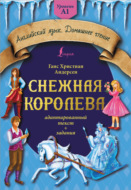
Kitobni o'qish: «Снежная королева. Адаптированный текст + задания. Уровень A1»
© А. Грек, адапт. текста, коммент. и словарь, 2022
© ООО «Издательство АСТ», 2022
The Snow Queen
by Hans Christian Andersen
Story the first
Which tells of the looking-glass and the bits of it
Attention, please, we’re going to begin. When we go to the end of the story we shall know more than we do now. Once there was a wicked troll. He had made a looking-glass which had this property: everything good and pretty that was reflected in it became bad and ugly. And everything that was no good became even worse. The most beautiful landscapes looked like boiled spinach, and the best of men looked bad. Their faces were so ugly that they couldn’t be recognized. It was very funny, the troll said. He couldn’t stop laughing at his clever invention. Everyone who visited the troll school (for he kept a troll school) told the news all about that miracle looking-glass: you could now see, they said, what the world and people really looked like. They ran everywhere with the glass, and at last there wasn’t a country or a person left who hadn’t been distorted in it. After that they decided to fly up to heaven itself and make fun of the angels. The higher they few with the glass, the more it grimaced. Up and up they few, and then the glass grimaced so hard that it fell out of their hands and to the ground. It broke into millions of little pieces. Some of them were as big as a grain of sand. They few around the wide world, and when they got into peoples’ eyes, they stuck there, and from that moment the people saw everything distorted and only looked for the bad things.
Every little splinter of the glass had the same power that the whole glass had. Some people got a little bit of the glass into their hearts, and that was horrible, for their hearts became just like ice. Some of the pieces were so big that they were used for window glass. Other pieces were made into glasses, and that was a bad thing, if people put them on to see correctly and judge rightly. The evil troll laughed at this, for it was very amusing to him. And out in the world little bits of glass were still flying in the air.
Now you shall hear what happened with some of them.
Словарные слова:
wicked – злой
property – свойство
reflect – отражаться
landscape – ландшафт
recognize – узнать
invention – изобретение
distorted – искажен
grain of sand – песчинка
stuck – застревать
splinter – осколок
judge – судить
Упражнения:
1. Поставь глаголы в форму прошедшего времени:
1) Be
2) Have
3) Look
2. Объясни, почему:
1) The looking glass was unusual.
2) The looking glass was dangerous.
3) The troll thought it was funny.
3. Ответь на вопросы:
1) Was the troll kind?
2) What was the evil magic of the looking glass?
4. Что обозначают выделенные слова?
1) that washorrible
2) judgerightly
3) the glassgrimaced
4)boiled spinach
5. Вставь правильные предлоги:
1) He couldn’t stop laughing ____________________ his clever invention.
2) It broke ____________________ millions ____________________ little pieces.
3) Some people got a little bit of the glass ____________________ their hearts
6. Выскажи свое мнение о:
1) The troll
2) The looking glass
7. Поставь предложения в правильном порядке:
1) Some of the pieces were so big that they were used for window glass.
2) And out in the world little bits of glass were still flying in the air.
3) Attention, please, we’re going to begin.
4) Some of them were as big as a grain of sand.
5) The higher they few with the glass, the more it grimaced.
8. Дополни предложения с помощью данных слов:
Reflect / invention / stuck / wicked
1) We got ____________________ in mud.
2) It was a great ____________________.
3) The king was ____________________ and cruel.
4) The mirror can ____________________ objects.
9. Составь предложения со словами:
heaven
grimace
power
laugh
10. Поставь глагол в правильную форму.
1) They (run) everywhere with the glass.
2) It (be) very funny, the troll (say).
3) The most beautiful landscapes (look) like boiled spinach, and the best of men looked bad.
4) After that they (decide) to fly up to heaven itself and make fun of the angels.
Story the second
A Little Boy and a Little Girl
In the big town, where there are so many houses and people that there isn’t enough place for everybody to have a little garden, and where most people have to grow flowers in pots, there were two poor children. They weren’t brother and sister, but they loved each other like a brother and a sister. Their parents were near neighbours, living in two attics, where the roof of the one house touched the other: a small window in each house faced the other; you could get from one window to the other in one step.
The parents had, each of them, a large wooden box outside the window, and in it grew kitchen herbs which they used, and also a little rose tree; there was one in each box, and they flourished wonderfully. Then the parents thought of putting the boxes across the gutter in such a way that they reached almost from the one window to the other and really looked like two bunches of flowers. The pea plants hung down over the boxes, and the rose trees twined about the windows and bent over to meet each other, and made almost an arch of leaves and blossoms. The boxes were very high up, and the children knew they must not climb up into them, but they were often allowed to get out to meet each other and sit on their little stools beneath the roses, and there they used to play very happily.
In winter, of course, there was not this pleasure. The windows were often quite frozen; but then they would heat copper pennies on the stove, and then put the hot pennies on the frosty window, and this made a small peep-hole, one out of each window; the little boy’s and the little girl’s. The boy’s name was Kay and the girl’s name was Gerda.
“Those are the white bees swarming,” said the old grandmother once in winter, looking at the falling snow.
“Have they got a queen too?” asked the little boy-for he knew that the real bees have one. “Indeed, they have,” said grandmother, “she is the biggest of them all, and she never stays still on the ground, but flies up into the black cloud. At winter nights she flies through the streets of the town and looks in the windows, and then they freeze into wonderful patterns, like flowers.”
“Can the Snow Queen get in here?” asked the little girl.
“Let her come!” said the boy, “and I’ll put her on the hot stove and she’ll melt.”
One evening, when little Kay was at home, he climbed up on the stool by the window and peeped through the little hole. A few snowflakes were falling outside, and one of them, the biggest of them all, was lying in a corner of one of the flower-boxes. It grew larger and larger, and at last turned into a lady, dressed in a white dress, which seemed to be made out of millions of snowflakes. She was very pretty and delicate, and she was made from ice, but she was alive. Her eyes were like two bright stars, but there was no rest or quietness in them. She nodded towards the window and beckoned with her hand. The little boy was frightened and jumped down off the stool.
Next day was clear and frosty, and after that came spring-time; the swallows built their nests, the windows were open, and the children sat once more in their little garden. What lovely summer days were those, and how nice it was to be out among the fresh rose bushes!
Kay and Gerda were looking at a picture book with animals and birds in it, and then-just as the clock in the great church tower was striking five-Kay said, “Oh! Something pricked my heart, and I’ve just got something in my eye!”
The little girl put her arm round his neck, and he winked his eye, but no, there was nothing. “I think it’s gone,” he said, but it wasn’t. It was one of those tiny bits of the troll-glass. Poor Kay! He had got a piece of it right into his heart, and it started to turn into ice.
“What are you crying for?” he asked. “It makes you look ugly!” Then he looked at the roses. “That rose is worm-eaten! And look at that other, it’s all crooked. Rotten roses they are, after all, like the boxes they’re in.” With that he gave the box a hard kick and pulled off the two roses. “What are you doing, Kay?” cried the little girl; and when he saw she was frightened, he pulled off a third rose, and ran home, leaving dear little Gerda. Later, when she brought him the picture book, he said, “it was only fit for babies”, and when grandmother told them stories, he was always interrupting. The bit of glass he had got in his eye and the bit he had in his heart made him tease everyone, even little Gerda, who loved him with all her heart.
One winter day, Kay came in with his sledge hung on his back; he shouted to Gerda, “I’m going to the big square where the others are playing,” and he was off.
Out there in the square the bravest of the boys often used to tie their sledges to a farmer’s cart and drive a long way with it. It was great fun. This time, a large sledge came by; it was painted white all over, and in it was someone wrapped in white fur and wearing a white cap. This sledge drove twice round the square, and little Kay tied his own little sledge to it, and drove off with it. Faster and faster it went, into the next street. The driver turned his head and nodded to Kay in a friendly way; it seemed as if they knew each other. Every time Kay thought of loosing his sledge the driver nodded again, so Kay stayed where he was: and they drove right out through the town gate. Then the snow began to fall so thick that the boy couldn’t see anything; and he tried to untie the rope to let go of the big sledge. But it made no difference, his sledge was tied well, and it went like the wind. He called out loudly, but no one heard, and the snow fell down and the sledge flew onward. He was very scared. Suddenly the storm stopped, the big sledge stopped, and the person who was driving in it rose. The fur and the cap were all of snow: it was a lady, tall and shining white-the Snow Queen.
“We have travelled well,” said she; “but you mustn’t freeze. Go into my bearskin.” She put him beside her in the sledge. “Are you still cold?” she asked, and kissed him on the forehead. It was colder than ice, and struck straight to his heart. And after that, he didn’t notice the cold anymore.
Once more the Snow Queen kissed Kay, and he forgot little Gerda and grandmother and everyone at home.
“No more kisses now,” said she, “or I should kiss you to death.” Kay looked at her; she was very pretty. She wasn’t scary anymore. In his eyes she was perfect, and he felt no fear. Kay looked at the great spaces of the air, and they flew high among the dark clouds, and the storm wind whistled and roared as if it were singing old ballads. They flew over forest and lake, sea and land: below them the wolves howled; above them flew the black crows, and over all shone the moon, large and bright.
Словарные слова:
neighbours – соседи
herbs – травы
flourish – цвести
across the gutter – поперек сточной трубы
reach – доставать
twin – виться
arch – арка
copper – медный
peep-hole – глазок
swarm – кишеть, копошиться
patterns – узоры
melt – таять
beckon – поманить
winked – моргнуть
rotten – гнилой
interrupt – перебивать
wrapped – закутанный, завернутый
let go – отпустить
Упражнения
1. Ответь на вопросы:
1) What is the looking-glass?
2) What happened to the looking-glass?
3) What were the names of the boy and the girl?
4) Did they live in a big city?
5) Who were their parents?
6) Were the children brother and sister?
7) Which flowers did the parents grow in their boxes?
8) Who told the children about the Snow Queen?
9) What did Kay do?
10) Why or how did Kay forget Gerda and his grandmother?
11) When did the pieces of looking glass got into the boys, eye and heart?
12) What was the boy going to do at the big square?
13) Who drove the large white sledge?
14) When did the boy meet the Snow Queen for the first time?
2. Вставь подходящий предлог:
1) Everyone told the news all ____________________ the miracle looking glass.
2) It was very amusing ____________________ him.
3) And ____________________ that, he didn’t notice the cold anymore.
4) Everything good and pretty that was reflected ____________________ it became bad and ugly.
5) They would heat copper pennies ____________________ the stove.
6) Kay and Gerda were sitting looking ____________________ a picture book.
7) She nodded towards the window and beckoned ____________________ her hand.
8) It broke ____________________ millions of tiny pieces.
9) There isn’t enough room ____________________ everybody to have a little garden.
10) Now we are going to hear all ____________________ it.
3. Вставь слова в предложения по смыслу:
millions / high / bees / excellent / wicked / window / boxes / wonderful / swallows / stricking
1) Those are white ____________________ swarming.
2) It was ____________________ fun.
3) It broke into ____________________ of tiny pieces.
4) Once there was a ____________________ troll.
5) You could get from one ____________________ to the other in one step.
6) The pea plants hung down over the ____________________.
7) They freeze into ____________________ patterns.
8) The ____________________ built their nests.
9) The clock in the great church tower was ____________________ five.
10) They flew ____________________ among the dark clouds.
4. Выбери правильный ответ по тексту главы (правда или неправда) – true / false.
1) The troll broke the magic looking-glass.
2) Kay and Gerda were friends.
3) Kay and Gerda were brother and sister.
4) Kay got pieces of the looking-glass in his eye and in his heart.
5) Children seldom met each other.
6) Gerda lived far away from Kay.
7) Gerda saw the Snow Queen first.
8) Kay tied his sledge to the Snow Queen’s.
9) The children’s parents had a garden where they grew roses.
10) The Snow Queen kissed Kay twice.
11) The wicked troll kept a school.
12) The children weren’t allowed to play under the roses.
13) The glass made Kay tease everyone but Gerda.
5. Вставь правильную форму: there is или there are.
1) ____________________ so many houses.
2) ____________________ not enough place for everybody.
3) ____________________ two children.
4) ____________________ no pleasure.
5) ____________________ white bees.
6. Составь предложения так, чтобы в них были все следующие слова:
1) neighbours, peep-hole
2) herbs, flourish, twin
3) arch, copper, patterns
4) reach, let go
5) interrupt
7. Поставь в правильную форму глагол:
1) Then the snow (begin) to fall.
2) And after that, he (not notice) the cold anymore.
3) Over all (shine) the moon.
4) Kay (look) at the great spaces of the air.
8. Опиши, какой / какая:
1) The Snow Queen
2) Kay
3) Gerda
9. Кто сказал следующие фразы?
1) No more kisses now
2) We have travelled well
3) It was only fit for
4) That rose is worm-eaten
5) Those are the white bees swarming
10. Что обозначают выделенные слова?
1) Once more the Snow Queen kissed Kay.
2) And after that, he didn’t notice the cold anymore.
3) It seemed as if they knew each other.
Story The Third
The Flower Garden of the Old Woman who knew Magic
But how was little Gerda when Kay didn’t came back? Nobody knew where he was, nobody could tell. The boys could only say they had seen him tie his little sledge to another large one which had driven down the street and out at the town gate. Many tears were cried. Then they said he was dead, drowned in the river. Dark indeed and long were those winter days.
Then came spring with warmer sunshine. “Kay is dead and gone,” said little Gerda. “I don’t believe it,” said the Sunshine. “He’s dead and gone,” said she to the swallows.
“We don’t believe it,” they answered, and at last little Gerda didn’t believe it either.
“I’ll put on my new red shoes,” she said one morning early, “the ones Kay has never seen, and I’ll go down to the river and ask about him.”
It was quite early. She kissed her old grandmother as she slept, put on the red shoes, and went out of the gate to the river, all alone.
“Is it true that you have taken Kay? I’ll give you my red shoes if you’ll give him back to me.”
The waves, she thought, nodded to her; so she took her red shoes, the best thing she had, and threw them into the river, but they fell close to the bank, and the waves carried them back to her. It seemed that the river would not take them because it didn’t have little Kay. But Gerda thought she hadn’t thrown the shoes far enough, so she climbed into a boat that lay near the water, and went out to the further end of it and threw out the shoes. But the boat wasn’t tied down, and with the movement she made it floated away from the shore. She noticed this and tried to get out, but before she could get back the boat was too far away, and began to drift quickly. Little Gerda was very much frightened and began to cry; but nobody heard her except the sparrows, and they couldn’t carry her ashore; but they few along the bank and sang, as if to comfort her: “Here we are, here we are!” The boat was carried downstream; little Gerda sat still; her little red shoes floated behind, but couldn’t reach the boat, which was now travelling faster.
Both banks were very pretty, with beautiful flowers, old trees, and fields with sheep and cows; but there weren’t any people.
“Perhaps the river will carry me to Kay,” thought Gerda. At last the boat came to a large cherry orchard, in which was a little house with blue and red windows, and outside two wooden soldiers, who were protecting it. Gerda called to them, thinking they were alive: but of course they didn’t answer. The river carried the boat straight towards the shore. Gerda called out louder, and out of the house came a very old woman with a walking stick. She had a large sun-hat on, painted with the most splendid flowers. “Poor dear little child,” said the old woman, “how ever did you get out here on this great big river?” And with that the old woman stepped into the water and hooked her stick to the boat and pulled it ashore and lifted little Gerda out. Gerda was glad to be on dry land again, but she was a little afraid. “Come now, and tell me who you are, and how you got here,” said the old woman. When Gerda had told her everything and asked if she had seen little Kay, the woman said he hadn’t passed that way, but he would come, sure enough, and she wasn’t to be worried, but must taste her cherries, and look at her flowers. Then she took Gerda by the hand, and they went into the little house, and the old woman locked the door. The windows in the house were very high, and the glass in them was red and blue and yellow. The daylight shone very oddly through them; but on the table were the most beautiful cherries, and Gerda ate as many as she liked; and while she was eating, the old woman combed her hair with a gold comb.
Bepul matn qismi tugad.