Kitobni o'qish: «Ruins of Ancient Cities (Vol. 1 of 2)»
TO
THOMAS HILL MORTIMER, ESQ.,
(OF THE ALBANY),
THE FOLLOWING PAGES ARE RESPECTFULLY INSCRIBED,
BY
HIS FAITHFUL AND GREATLY OBLIGED
FRIEND AND SERVANT,
THE AUTHOR.
PREFACE
The reader is requested to observe, that, though the plan of this work is entirely his own, the compiler of it does not put it forth as in any way original in respect to language or description. It is, in fact, a much better book, than if it had been what is strictly called original, (which, indeed, must have involved an utter impossibility:) for it is a selection of some of the best materials the British Museum could furnish; sometimes worked up in his own language; and sometimes – and, indeed, very frequently – in that of others: the compiler having, at an humble distance and with unequal steps, followed the plan which M. Rollin proposed to himself, when he composed his celebrated history of ancient times. – "To adorn and enrich my own," says that celebrated writer, "I will be so ingenuous as to confess, that I do not scruple, nor am ashamed, to rifle whereever I come; and that I often do not cite the authors from whom I transcribe, because of the liberty I take to make some slight alterations. I have made the best use in my power of the solid reflections that occur in the Bishop of Meaux's Universal History, which is one of the most beautiful and most useful books in our language. I have also received great assistance from the learned Dean Prideaux's 'Connexion of the Old and New Testament,' in which he has traced and cleared up, in an admirable manner, the particulars relating to ancient history. I shall take the same liberty with whatever comes in my way, that may suit my design, and contribute to its perfection. I am very sensible, that it is not so much for a person's reputation to make use of other men's labours, and that it is in a manner renouncing the name and quality of author. But I am not over-fond of that title, and shall be extremely well pleased, and think myself very happy, if I can but deserve the name of a good compiler; and supply my readers with a tolerable history, who will not be over-solicitous to inquire what hand it comes from, provided they are but pleased with it."
Having followed this example, – the compiler wishes he could say with equal effect, – he will be fully satisfied, should judicious readers feel inclined to concede, that he has shown some judgment in selecting his materials, and some taste in binding "the beads of the chain," that connects them together. He disclaims, in fact, (as, in the present instance, he is bound to do), all the "divine honours" of authorship; satisfied with those of a selecter, adapter, and compiler; and happy in the hope that he has here, by means of the superior writers, whose labours he has used, furnished his readers with an useful, accurate, and amusing work.
C. B.
London, January 1st, 1840.
NO. I. – ABYDOS
Of chance or change, oh! let not man complain;
Else shall he never, never, cease to wail;
For from the imperial dome, to where the swain
Rears his lone cottage in the silent dale,
All feel the assault of fortune's fickle gale.
Art, empire, earth itself, to change are doom'd;
Earthquakes have raised to heaven the humble vale;
And gulfs the mountains' mighty mass entomb'd;
And where the Atlantic rolls wide continents have bloom'd.
BEATTIE.
This city stood on the Asiatic side of the Hellespont, now called the Dardanelles, opposite to the city of Sestos, on the European side, the distance from each other being about two miles. Abydos was built by the Milesians, and became greatly celebrated from the circumstance that it was here that Xerxes built his bridge over the Hellespont; – also for the loves of Hero and Leander.
Philip, king of Macedon, laid siege to this city, and nothing of what is generally practised in the assaulting and defending of cities was omitted in the siege. No place, say the historians, was ever defended with greater obstinacy, which might be said at length, on the side of the besieged, to have risen to fury and brutality. Confiding in its own strength, they repulsed, with the greatest vigour, the approaches of the Macedonians. Finding, however, at last, that the outer wall of their city was sapped, and that the Macedonians carried their mines under the inner one, they sent deputies to Philip, offering to surrender the city on certain conditions, one of which was, that all the free citizens should retire whithersoever they pleased, with the clothes they then had on. These conditions were not approved by Philip, he therefore sent for answer, that the Abydonians had only to choose, whether they would surrender at discretion or continue to defend themselves gallantly as they had before done.
When the citizens heard this they assembled together, to consider what they should do in so great an emergency; and here we have to record, not in our own language but in that of others, for our pen would be unequal to the description, circumstances scarcely to be paralleled in all history! It is thus given by Rollin: —
They came to these resolutions; first, that the slaves should be set at liberty, to animate them to defend the city with the utmost vigour; secondly, that all the women should be shut up in the temple of Diana, and all the children with their nurses in the Gymnasium; that this being done, they then should bring into the great square all the gold and silver in the city, and carry all the rest of the valuable effects into the quadrireme of the Rhodians and the trireme of the Cyzicenians. This resolution having passed unanimously, another assembly was called, in which they chose fifty of the wisest and most ancient of the citizens, but who at the same time had vigour enough left to execute what should have been determined; and they were made to take an oath, in presence of all the inhabitants, that the instant they saw the enemy master of the inner wall they should kill the women and children, set fire to the galleys laden with their effects, and throw into the sea all the gold and silver which they had heaped together. Then, sending for their priests, they took an oath either to conquer or die, sword in hand; and after having sacrificed the victims, they obliged the priests and priestesses to pronounce before the altar the greatest curses on those who should break their oath. This being done, they left off countermining, and resolved, the instant the wall should fall, to fly to the breach and fight to the last. Accordingly, the inward wall tumbling, the besieged, true to the oath they had taken, fought in the breach with such unparalleled bravery, that though Philip had perpetually sustained with fresh soldiers those who had mounted to the assault, yet, when night separated the combatants, he was still doubtful with regard to the success of the siege. Such Abydonians as marched first to the breach, over the heaps of slain, fought with fury, and not only made use of their swords and javelins, but after their arms were broken to pieces or forced from their hands, they rushed furiously upon the Macedonians, knocked down some, broke the long spears of others, and with the pieces struck their faces and such parts of their bodies as were uncovered, till they made them entirely despair of the event. When night had put an end to the slaughter, the breach was quite covered with the dead bodies of the Abydonians, and those who had escaped were so prodigiously fatigued, and had received so many wounds, that they could scarce support themselves. Things being brought to this dreadful extremity, two of the principal citizens, unable to execute the dreadful resolution that had been taken, and which at that time displayed itself to their imaginations in all its horror, agreed that, to save their wives and children, they should send to Philip by day-break all their priests and priestesses, clothed in pontifical habits, to implore his mercy and open their gates to him. Accordingly the next morning the city, as had been agreed, was surrendered to Philip, during which the greatest part of the Abydonians, who survived, vented millions of imprecations against their fellow-citizens, and especially against the priests and priestesses, for delivering up to the enemy those whom they themselves had devoted to death with the most dreadful oaths. Philip marched into the city and seized, without the least opposition, all the rich effects which the Abydonians had heaped together in one place. But now he was greatly terrified with the spectacle he saw. Among these ill-fated citizens, whom despair had made furious and distracted, some were strangling their wives and children; and others cutting them with swords to pieces; some were running to murder them; some were plunging them into wells; whilst others were precipitating them from the tops of the houses; in a word, death appeared in a variety of horrors. Philip, pierced with grief, and seized with horror at the spectacle, stopped the soldiers who were greedy of plunder, and published a declaration, importing that he would allow three days to all, who were resolved to lay violent hands on themselves. He was in hopes that during this interval they would change their resolution, but they had made their choice before. They thought it would be degenerating from those, who had lost their lives in fighting for their country, should they survive them. The individuals of every family killed one another, and none escaped this murderous expedition but those whose hands were tied, or were otherwise kept from destroying themselves.
Nothing now remains of the ancient town, but a few insignificant ruins in the neighbourhood of the modern one1.
NO. II. – ABYDUS
Abydus, in Egypt, is now called Madfuneh, or the Buried City. According to Pliny and Strabo it was a colony of Milesians. It is said once to have nearly equalled Thebes in grandeur and magnificence; but it was reduced to a village in the reign of Augustus, and is now only a heap of uninhabited ruins.
In its neighbourhood, however, the celebrated tomb of Ismandes is still found; he who built the temple of Osiris, into which no singers or dancers were ever allowed to enter. Besides numerous tombs and sepulchral monuments, that are continually found here, the remains of two grand edifices, and other ruins, evince its former extent, and justify the assertion of Strabo, that Abydus formerly held the first rank after Thebes itself. One of those edifices was called the Palace of Memnon; but it was, in reality, commenced by Osirei, and completed by his son Remesis II., and from the peculiar nature of its plan, and the structure of its roof, it is particularly interesting to the antiquary. This last is formed of large blocks of stone placed from one architrave to the other; not, as usual in Egyptian buildings, on their faces, but on their sides; so that considerable thickness having been given to the roof, a vault was afterwards cut in them, without endangering its stability. The other building is the famous temple of Osiris, who was reported to have been buried in Abydus, and who was worshipped there in his most sacred character. There are many other places, says Plutarch, where his corpse is said to have been deposited; but Abydus and Memphis are mentioned in particular as having the true body; and for this reason the rich and powerful of the Egyptians were desirous of being buried in the former of these two cities, in order to lie, as it were, in the same grave with Osiris himself. The fact, that the natives of other towns also were buried at Abydus, is fully confirmed by modern discoveries; and inscriptions, purporting that the deceased were from some distant part of the country, are frequently found in the tombs of its extensive cemetery. The temple of Osiris was completed by Remesis II., who enriched it with a splendid sanctuary, rendered unusually conspicuous from the materials used in its construction, being entirely lined with oriental alabaster. He also added to the numerous chambers and courts many elegant and highly-finished sculptures. One of these lateral apartments contains the famous tablet of kings, discovered by Mr. Bankes, and which, in an historical point of view, is one of the most precious monuments hitherto met with among the ruins of Egypt. In the cemetery to the northward are some other stone remains, among which is one of the time of Remesis the Second, and another bearing the name of Sabaco.
The reservoir mentioned by Strabo, which was cased with stone, may be traced on the east side of the ancient town; and in the mountain, to the north-west, are some limestone quarries, and an inclined road leading to a narrow grotto, in an unfinished state, and without sculpture.
The Arabs, in searching for treasure, have heaped up piles of earth and rubbish; but there are no inhabitants2.
NO. III. – ÆGESTA
The sterile country between Trapani and Alcamo (in Sicily) may render the stranger better prepared to contemplate one of the finest of ancient monuments – all that remains of Ægesta, celebrated for the temple of the Erycinian Venus. This town, situated on a height at the base of Mount Eryx, was deserted and almost in ruins at so early a period as the time of Strabo.
All travellers, who have examined the temple, are unanimous in its commendation. "The effect it produced at a distance," says Mons. Simon, "increased as I approached. Such is the magic of its proportions, and the beauty of its forms, that, at whatever side it may be viewed, it is equally admirable. It has braved the influence of time – the edifice stands entire, columns, entablature, pediment – all except the cella and roof, which have disappeared. The columns, of the Ionic order, are about seven feet in diameter at the base, tapering towards the top, and only four diameters in height; but they form, with the front, a total height of fifty-eight feet. The dimensions of the interior are about one hundred and seventy-four feet by seventy-two."
This city was destroyed by Agathocles. At a subsequent time it was the residence of the tyrant Æmilius Censorinus, who offered rewards to such artists as were the most ingenious in the invention of instruments of torture!3
NO. IV. – ÆGINA
"We seated ourselves on a fallen column," says Mr. Williams, "and could not but admire the scene before us: Attica, Peloponnesus, and the gulf of Ægina, with their many points of attraction, addressing both the eye and the mind! While we were enjoying the splendid view, two shepherds stepped from the ruins, and passing their crooks from their right hand to their left, pressed their hearts and foreheads, and kissed their hands in a manner than which nothing could be more graceful. Their eyes bespoke their curiosity to know what brought us there; and when we looked across the gulf, they both exclaimed, 'Athenæ! Athenæ!' as if we were desirous to know the name of the distant spot, that marked the site of Athens."
Servius Sulpitius mentions Ægina in a very agreeable manner to Cicero, who was then grieving for the loss of his daughter Tullia: – "Once," said he, "when I was in distress, I received a sensible alleviation of my sorrow from a circumstance, which, in the hope of its having the same influence upon you, I will take this opportunity of relating. I was returning from Asia; and as I was steering my course, I began to contemplate the surrounding country. Behind me was Ægina; Megara in the front; the Piræus occupied my right hand, and Corinth my left. These cities, once flourishing, were now reduced to irretrievable ruin. 'Alas!' said I, somewhat indignantly, 'shall man presume to complain of the shortness and the ills of life, whose being in this world is necessarily short, when I see so many cities, at one view, totally destroyed?' This reflection, my friend, relieved my sorrow."
Mr. Dodwell, when he was in Ægina, lodged at the house of the principal Greek, who was acquainted with the leading particulars of its history; and when he talked of its former grandeur, and compared it with its present abject condition, the tears came into his eyes, and he exclaimed – "Alas! where is Ægina now?"
The island of Ægina lies between Attica and Argolis, eighteen miles distant from the coast of Athens and fourteen from Epidaurus. It does not exceed nine miles in its greatest length, nor six miles in its greatest breadth; its interior is rough and mountainous, and the valleys, though they are made to bear corn, cotton, olive, and fruit trees, are stony and narrow. Notwithstanding this, in ancient days, through the blessings of commerce, this spot in the seas of Greece was the residence of a numerous and most thriving population, who created upon it such works as are still the admiration of the civilised world, though they are now in ruins; the place, however, of those who built them, is scantily occupied by an impoverished and degraded race of men.
The people of Ægina were the first who coined money to be subservient to the uses of life, agreeably to the advice of Phidon, who considered that a maritime commerce would best be promoted, where exchange and accommodation became easy and familiar between the vendor and purchaser.
The place, too, had the advantage of security; an important point in the earlier ages of Greece, when piracy was a common and honourable profession. It lay deep within a gulf; nature had made access to its shores difficult, by nearly encircling them with rocks and sand-banks; and its industrious population added artificial defences. Its port also was commodious, and well protected against the attacks of man. Here, therefore, the goods procured, far and near, by the enterprising inhabitants, could be lodged without fear of pillage, and the Greeks would resort hither as to a general mart, where whatever they wanted might be purchased. Wealth would thus flow into the island, and its inhabitants, with their exquisite feeling for all that was beautiful, would employ their wealth in cultivating the fine arts, and in covering their barren rocks with grand and graceful edifices; and this was shown by the ancient inhabitants of Ægina having had the honour of introducing a style in sculpture superior to all that preceded, though inferior to the ultimate perfection of the Athenian school.
Ægina was, originally, subject to kings; but it afterwards adopted the republican form of government. It was at length reduced by the Athenians, and continued subject to them, till, at the end of the Macedonian war, it was declared free by the Romans. In the reign of Vespasian, however, it underwent the same fortune as the other states of Greece.
A. D. 1536, it was subdued by the Turks, after an obstinate resistance; the capital was plundered and burned; and, after a great slaughter of the inhabitants, the rest were carried into slavery – not an unworthy fate, had it occurred in ancient times, for a people, who were possessed of 420,000 slaves!
The site of Ægina, the capital of the island, has long been forsaken. Instead of the temples, mentioned by Pausanias, there are thirteen lonely churches, all very mean, and two Doric columns supporting their architrave. These stand by the sea-side toward the low cape; and, it has been supposed, are a remnant of a temple of Venus, which was situated by the port principally frequented. The theatre, which is recorded as greatly worth seeing, resembled that of the Epidaurians, both in size and workmanship. It was not far from the private port; the stadium, which like that at Priene, was constructed with only one side, being joined to it behind, and each structure mutually sustaining and propping the other.
The most celebrated of its edifices was the temple of Jupiter Panhellenius. "This temple," says Colonel Leake, "was erected upon a large paved platform, and must, when complete, have been one of the most remarkable examples in Greece of the majesty and beauty of its sacred edifices, as well as of the admirable taste with which the Greeks enhanced those qualities by an attention to local situation and surrounding scenery. It is not only in itself one of the finest specimens of Grecian architecture, but is the more curious as being, in all probability, the most ancient example of the Doric order in Greece, with the exception of the columns at Corinth." This temple is far from any habitation, and is surrounded with shrubs and small pine-trees. No ruin in Greece is more rich in the picturesque, as every point of view has some peculiar charm: – "When I was at Ægina," says Mr. Dodwell, "the interior of the temple was covered with large blocks of stone, and overgrown with bushes. This circumstance produced a sort of confusion, which, while it intermingled the trees and the architecture, made a great addition to the picturesque effect of the interesting scene. The place has since been cleared, the stones have been taken away, and the trees cut down to facilitate the removal of the statues which were found among the ruins. Though these changes may have made some deduction from the pleasure with which the painter would have viewed the spot, yet they have added greatly to the gratification of the classical traveller, by whom all the architectural details may now be readily examined and accurately discriminated."
This ruin Dr. Chandler considers as scarcely to be paralleled in its claim to remote antiquity. The situation on a lonely mountain at a distance from the sea has preserved it from total demolition, and all the changes and accidents of numerous centuries4.
Lusieri classes the architecture of the temple of the Panhellenian Jupiter at Ægina with that of Pæstum in Lucania: – "In their buildings," says he, "the Doric order attained a pre-eminence which it never passed; not a stone has been there placed without some evident and important design; every part of the structure bespeaks its own essential utility. Of such a nature were works in architecture, when the whole aim of the architect was to unite grandeur with utility; the former being founded on the latter. All then was truth, strength, and sublimity."
In 1811, several statues of Parian marble were discovered by two English gentlemen and two Germans5, the rivals in the style of which are said nowhere to be found. They were excavated from the two extremities of the temple below the tympana, from which they had fallen at some unknown period. Mr. Dodwell has given the following account of them: – "I shall not attempt," says he, "a minute description of these precious remains of the Æginetic school; the discovery of which, in its importance, has not been surpassed by any of the kind in modern times. They are supposed by some to represent the principal heroes of the Iliad contending with the Trojans for the body of Patroclus. Minerva, armed with her helmet, is the principal figure; and from its superior size, is conjectured to have stood in the centre of the tympanum, below which it was found. The other figures are combatants in various costumes and attitudes; their shields are circular, and their helmets crowned with the lophos. The bodies of some are naked, while others are covered with armour or leather; their attitudes are judiciously adapted to the four tympana, and the places which they occupied. They were evidently made prior to the introduction of the beautiful ideal in Grecian sculpture. The muscles and the veins, which are anatomically correct, exhibit the soft flexibility of life, and every motion of the body is in scientific harmony with that of nature. The limbs are strong, though not Herculean, and elegant without effeminacy; no preposterous muscular protuberance, no unnatural feminine delicacy offends the eye. They are noble without being harsh or rigid, and are composed with Doric severity mingled with the airy grace of youthful forms; the perfection of the finish is quite wonderful; every part being in a style worthy of the most beautiful cameo. The extremities of the hands and feet merit more particular admiration. Indeed, the ancients thought that elegant fingers and nails were essential ingredients in the composition of the beautiful. The most extraordinary circumstance, however, in these statues, is the want of expression, and the sameness of countenance, which is to be observed in all the heads. This approximation to identity is certainly not fortuitous; for the artists, who were able to throw so much varied beauty into the forms of the bodies, were, no doubt, fully able to infuse a similar diversity of expression into the features. Their talent was probably confined to one style of countenance by some religious prejudice. Perhaps some ancient and much venerated statue served as a model, from which it might not have been consistent with the feeling of reverence, or with the state of opinion, to deviate. The formation and posture of the bodies afforded a greater scope and a wider field for the talent of the sculptor; for while the Doric severity of the early Æginetic school is evidently diffused through the whole, yet a correctness of muscular knowledge; and a strict adherence to natural beauty, are conspicuously blended in every statue. An unmeaning and inanimate smile is prevalent in all the faces; every one of the heroes, who is mortally wounded, is supporting himself in the most beautiful attitude, and smiling upon death! In short, the conquerors and the conquered, the dying and dead, have all one expression, or rather none at all. The high finish of the hair is particularly worthy of notice. Some in curls, which hang down in short ringlets, are of lead, and still remain. The helmets were ornamented with metallic accessories, and the offensive weapons were probably of bronze; but they have not been found. All the figures have been painted; the colour is still visible, though nearly effaced. The colour on the ægis of Minerva is very distinguishable; but the white marble, of which the statues are composed, has assumed a yellow dye from the soil in which they were buried."
Dr. Clarke tells us, that Lusieri found here both medals and vases in such numbers, that he was under the necessity of dismissing the peasants who amassed them, without purchasing more than half that were brought to him; although they were offered for a very trifling consideration, and were of very high antiquity6.
NO. V. – AGRIGENTUM
The citadel of Agrigentum (Sicily) was situated on Mount Agragas; the city in the vale below; forming a magnificent spectacle at a distance. It was founded by a native of Rhodes, according to Polybius; but by a colony from Ionia, according to Strabo; about one hundred and eighty years after the founding of Syracuse. Thucydides, however, says that it was founded by a colony from Gela. The government was at first monarchical; afterwards democratical.
Phalaris, so well known for his superior talent and tyranny, usurped the sovereignty, which for some time afterwards was under the sway of the Carthaginians. In its most flourishing condition, it is said to have contained not less than two hundred thousand persons, who submitted, without resistance, to the superior authority of the Syracusans.
Some idea of the wealth of this city may be imagined, from what is stated by Diodorus Siculus, of one of its citizens. At the time when Exenetes, who had been declared victor in the Olympic games7, entered the city in triumph, he did so in a magnificent chariot, attended by three hundred more, all drawn by white horses. Their habits were adorned with gold and silver; and nothing was ever more splendid than their appearance. Gellias, the most wealthy citizen of the place, erected several apartments in his house for the reception and entertainment of guests. Servants waited by his order at the gates of the city, to invite all strangers to lodge at their master's house, whither they conducted them. A violent storm having obliged one hundred horsemen to take shelter there, Gellias entertained them all in his house, and supplied them immediately with dry clothes, of which he had always a great quantity in his wardrobe.
Though this gives us some notion of his wealth, there is another description still more indicative of his humanity. He entertained the people with spectacles and feasts; and, during a famine, prevented the citizens from dying with hunger; he gave portions to poor maidens also, and rescued the unfortunate from want and despair. He had houses built in the city and the country, purposely for the accommodation of strangers, whom he usually dismissed with handsome presents. Five hundred shipwrecked citizens of Gela, applying to him, were bountifully relieved; and every man supplied with a cloak and a coat out of his wardrobe.
Agrigentum was first taken by the Carthaginians. It was strongly fortified. It was situated, as were Hymera and Selinuntum, on that coast of Sicily which faces Africa. Accordingly, Hannibal, imagining that it was impregnable except on one side, turned his whole force that way. He threw up banks and terraces as high as the walls; and made use, on this occasion, of the rubbish and fragments of the tombs standing round the city, which he had demolished for that purpose. Soon after, the plague infected the army, and swept away a great number of the soldiers. The Carthaginians interpreted this disaster as a punishment inflicted by the gods, who revenged in this manner the injuries done to the dead, whose ghosts many fancied they had seen stalking before them in the night. No more tombs were therefore demolished; prayers were ordered to be made according to the practice of Carthage; a child was sacrificed to Saturn, in compliance with a most inhumanly superstitious custom; and many victims were thrown into the sea in honour of Neptune.
The besieged, who at first had gained several advantages, were at last so pressed by famine, that all hopes of relief seeming desperate, they resolved to abandon the city. The following night was fixed on for this purpose. The reader will naturally imagine to himself the grief with which these miserable people must be seized, on their being forced to leave their houses, rich possessions, and their country; but life was still dearer to them than all these. Never was a more melancholy spectacle seen. To omit the rest, a crowd of women, bathed in tears, were seen dragging after them their helpless infants, in order to secure them from the brutal fury of the victor. But the most grievous circumstance was the necessity they were under of leaving behind them the aged and sick, who were unable either to fly or to make the least resistance. The unhappy exiles arrived at Gela, which was the nearest city in their way, and there received all the comforts they could expect in the deplorable condition to which they were reduced.
In the meantime Imilcon entered the city, and murdered all who were found in it. The plunder was immensely rich, and such as might be expected from one of the most opulent cities of Sicily, which contained two hundred thousand inhabitants, and had never been besieged, nor, consequently, plundered before. A numberless multitude of pictures, vases, and statues of all kinds, were found here, the citizens having an exquisite taste for the polite arts. Among other curiosities, was the famous bull of Phalaris, which was sent to Carthage.
At a subsequent period the Romans attacked this city, then in possession of the Carthaginians; took it, and the chief persons of Agrigentum were, by the consul's order, first scourged with rods, and then beheaded. The common people were made slaves, and sold to the best bidder. After this, Agrigentum is seldom mentioned in history; nor is it easy to ascertain the precise time in which the old city was destroyed, and the new one (Gergenti) was built. It was crushed in the general fall of the Greek state, and its unfortunate inhabitants, expelled by the Saracens, took refuge among the black and inaccessible rocks of Girgenti.
In ancient times, this city was greatly celebrated for the hospitality and luxurious mode of living, adopted by its inhabitants. On one side of the city there was a large artificial lake, about a quarter of a league in circumference, dug out of the solid rock by the Carthaginian captives, and to which the water was conveyed from the hills. It was thirty feet deep; great quantities of fish were kept in this reservoir for the public feasts; and swans and other fowls were kept upon it for the amusement of the citizens; and the depth of its waters secured the city from the sudden assault of an enemy. It is now dry, and converted into a garden.
It is, nevertheless, a curious fact, that though the whole space within the walls of the ancient city abounds with traces of antiquity, there are no ruins which can be supposed to have belonged to places of public entertainment. Yet the Agrigentines were remarkably fond of shows and dramatic amusements; and their connexion with the Romans must have introduced among them the savage games of the circus. Theatres and amphitheatres seem peculiarly calculated to resist the outrages of time; yet not a vestige of these are to be seen on the site of Agrigentum. They appear, however, to have been quite alive to the pleasures to be derived from sculpture and painting.
The Temple of Juno was adorned by one of the most famous pictures of antiquity; which is celebrated by many of the ancient writers. Zeuxis was determined to excel any thing that had gone before him, and to form a model of human perfection. To this end, he prevailed on all the finest women of Agrigentum, who were ambitious of the honour, to appear naked before him. Of these he chose five for his models; and moulding all the perfections of these beauties into one, he composed the picture of the goddess. This was ever looked upon as his masterpiece; but was, unfortunately, burnt when the Carthaginians took Agrigentum. At that period, many of the citizens retired into this temple, as to a place of safety; but as soon as they found the gates attacked by the enemy, they agreed to set fire to it, and chose rather to perish in the flames, than submit to the power of the conqueror. In the Temple of Hercules, there was another picture by Zeuxis. Hercules was represented, in his cradle, killing the two serpents; Alcmena and Amphitrion, having just entered the apartment, were painted with every mark of terror and astonishment. Pliny says, the painter looked upon this piece as invaluable; and, therefore, could never be prevailed upon to put a price upon it; but gave it as a present to the people of Agrigentum, to be placed in the temple of Hercules.
The temples, also, were very magnificent. That of Æsculapius, two columns and two pilasters of which now support the end of a farm-house, was not less celebrated for a statue of Apollo. It was taken from them by the Carthaginians, at the same time that the Temple of Juno was burnt. It was carried off by the conquerors, and continued the greatest ornament of Carthage for many years; but was, at last, restored by Scipio, at the final destruction of the city. Some of the Sicilians allege, but it is supposed without ground, that this statue was afterward carried to Rome, and still remains there, the wonder of all ages; and known to the whole world, under the name of the Apollo Belvidere.
An edifice of the Doric order, called the Temple of Concord, has still its walls, its columns, entablature, and pediments, entire. In proceeding from the Temple of Concord, you walk between rows of sepulchres, cut in the rock, wherever it admitted of being excavated by the hand of man, or was so already by that of nature. Some masses are hewn into the shape of coffins; others drilled full of small square holes, employed in a different mode of interment, and serving as receptacles of urns. One ponderous piece of the rock lies in an extraordinary position. By the failure of its foundation, or the shock of an earthquake, it has been loosened from the general quarry, and rolled down the declivity, where it now remains supine, with the cavities turned upwards. There was also a temple dedicated to Ceres and Proserpine; with the ruins was formed a church, which now exists; and the road, leading to which, was cut out of the solid rock. In respect to the temple of Castor and Pollux, vegetation has covered the lower parts of the building, and only a few fragments of two columns appear between the vines. Of the Temple of Venus, about one half remains; but the glory of the place was the Temple of Jupiter Olympius, three hundred and forty feet long, sixty broad, and one hundred and twenty in height. Its columns and porticos were in the finest style of architecture; and its bas-reliefs and paintings executed with admirable taste. On its eastern walls was sculptured the Battle of the Giants; while the western represented the Trojan War; corresponding exactly with the description which Virgil had given of the painting in the Temple of Juno at Carthage.
Diodorus Siculus extols the beauty of the columns which supported the building; the admirable structure of the porticos, and the exquisite taste with which the bas-reliefs and paintings were executed; but he adds, that the stately edifice was never finished. Cicero, against Verres, speaks of the statues he carried away. Mr. Swinburne says, that it has remaining not one stone upon another; and that it is barely possible, with the liberal aid of conjecture, to discover the traces of its plan and dimensions. He adds, however, that St. Peter's at Rome exceeds this celebrated temple more than doubly in every dimension; being two hundred and fifteen feet higher, three hundred and thirty-four longer, and four hundred and thirty-three wider.
Added to these, there is now remaining a monument of Tero, king of Agrigentum, one of the first of the Sicilian tyrants. The great antiquity of this monument may be gathered from this; that Tero is not only mentioned by Diodorus, Polybius, and the more modern of the ancient historians, but likewise by Herodotus, and Pindar, who dedicates two of his Olympic Odes to him; so that this monument must be much more than two thousand years old. It is a kind of pyramid, the most durable of forms; and is surrounded by aged olive-trees, which cast a wild, irregular shade over the ruin.
All these mighty ruins of Agrigentum, and the whole mountain on which it stands, says Mr. Brydone, is composed of an immense concretion of seashells, run together, and cemented by a kind of sand, or gravel, and now become as hard, and perhaps more durable, than even marble itself. This stone is white before it has been exposed to the air; but in the temples and other ruins it is become "set," of a very dark brown. These shells are found on the very summit of the mountain, which is at least fourteen or fifteen hundred feet above the level of the sea.
The celebrated Empedocles was a native of this city; one of the finest spirits that ever adorned the earth. His saying, in regard to his fellow-citizens, is well known; – viz., that they squandered their money so excessively every day, that they seemed to expect it could never be exhausted; and that they built with such solidity and magnificence, as if they thought they should live for ever8.
NO. VI. – ALBA LONGA
It has been stated, or rather speculated upon, that the entire history of this place is no other than a romance. By Dionysius of Halicarnassus, however, it is said to have existed four hundred and eighty-seven years; when, after having been the founder of thirty other Latin cities, it was destroyed by the Roman power.
That it existed, is also attested by the ruins that now remain. Its ancient characteristics are thus described by Dionysius: – it was so built, with regard to its mountain and lake, that it occupied a space between them, each serving like a wall of defence to the city.
It was long supposed to have been situated where Palazzuolo now is. Sir W. Gell says, "On passing up the new road, running from the dry bed of the river Albanus, where it crosses the Appian Way, near Bolerillæ, and leading to the Villa Torlonia, or Castel Gandolfo, a few ancient tombs were observed about half way up the ascent; and further examination showed, that these tombs had once bordered an ancient road, now almost obliterated. It was obvious, that such a road must have led from some place on the plain, to another on the mountain. Toward the sea, the high tower of Pratica (Lavinium) lay in the direct line of the road; and it seemed certain that the city on the mountain, to which it led, could have been no other than Alba Longa. Climbing upward among the bushes, ponderous blocks of stone were discovered, evidently the remains of the walls of this city. By a farther search, more were found. At a distance a small cavern was discovered; and not only the remains of a well, but part of a column of stone, two feet four inches in diameter. At a higher point the shore was covered with ruins, consisting of large blocks of rectangular stones, nearly buried in the soil, and scarcely discernible among the bushes."
There is a tradition, that the palaces of the kings of Alba stood on a rock; and so near to the edge of the precipice, that when the impiety of one of its monarchs provoked Jupiter to strike it with his lightning, a part of the mass was precipitated into the lake, carrying the impious king along with the ruins of his habitation. This tradition is apparently confirmed by a singular feature in a part of the remains of this city; for, directly under the rock of the citadel, toward the lake, and where the palace, both for security and prospect, would have been placed, is a cavern, fifty feet in depth, and more than one hundred in width; a part of the roof of which has evidently fallen in, and some of the blocks still remain on the spot9.
NO. VII. – ALCANTARA
This town (in Spain) was built by the Moors, who gave it the name it bears; which, in the Moorish language, signifies a bridge; and this bridge shows that the original city belonged to the Romans in the time of Trajan; for on one of the arches is this inscription: —
IMP. CAESARI, D. NERVAE, F
NERVAE. TRAIANO. AVG
GERM. DACICO
PONT. MAX. TRIB. POTEST. VIII
IMP. VI. COS. V. P.P
Formerly there were four pieces of marble, fixed in the walls of the bridge; in each of which there was an inscription, containing the names of the several towns and districts, that contributed towards the expense of making it. Three of these marbles are lost; but the fourth remains, and bears the following inscription: —
MVNICIPIA
PROVINCIAE. LVSITAN
STIPE. CONFLATA
QVAE. OPVS
PONTIS. PERFECERVNT
IGAEDITANI
LANCIENSES. OPIDANI
TALORI
INTERAMNIENSES
COLARNI
LAOCIENSES. TRANSCVDANI
ARAVI
MEIDVBRIGENSES
ARABRIGENSES
BANIENSES
PAESVRES
At the entrance of the bridge there is a small temple, cut in the rock, by the same person that built the bridge. The roof of this temple consists of two large stones. In the temple there is an inscription to the following effect: – "It is reasonable to imagine, that every one, that passes this way, would be glad to know the name of the person that built this bridge and temple; and with what intent they were made, by cutting into this rock of the Tagus, full of the majesty of the Gods, and of Cæsar, and where art showed itself superior to the tough and stubborn matter that resisted her. Know, then, that it was that noble architect Lacer, who built this bridge, which will last as long as the world. Lacer, having finished this noble bridge, made and dedicated this new temple, with sacrifices, to the gods, in hopes of rendering them propitious to him, for having honoured them after this manner. This temple he dedicated to the gods of Rome, and to Cæsar; looking upon himself to have been extremely fortunate, in having been able to make so just and proper a sacrifice.10"
NO. VIII. – ALEXANDRIA
Of the several capitals of Egypt in successive ages11, Thebes, or Diospolis, was the most ancient. Next was Memphis; itself a city of the most remote antiquity. Babylon seems to have been only the capital of a part, retained by the Persians, after Cambyses had subdued Egypt; and was, by all accounts, founded by the Persians. Alexandria succeeded Memphis, and remained the chief city, till the Saracens founded Misr-el-Kahira.
Alexander, in his way to the temple of Jupiter Ammon, observed, opposite to the island of Pharos, a spot which he thought extremely well adapted for the building of a city. He, therefore, set about drawing the plan of one; in doing which he particularly marked out the several places where temples and squares should be erected. The general execution he committed to the architect who had rebuilt the temple of Diana at Ephesus (Dinocrates). This city he called Alexandria, after his own name; and being situated with the Mediterranean on one side, and one of the branches of the Nile on the other, it soon drew all the commerce, both of the east and west. It still remains, and is situate about four days' journey from Cairo. The merchandises were unloaded at Portus Muris12, a town on the western coast of the Red Sea; whence they were brought upon camels to a town of Thebais, called Copt, and conveyed down the Nile to Alexandria, whither merchants from all parts resorted.
The trade of the East has at all times enriched those who carried it on. Solomon received from one commercial voyage, no less a sum than three millions two hundred and forty thousand pounds13. Tyre afterwards had the trade. When the Ptolemies, however, had built Berenice, and other ports on the western side of the Red Sea, and fixed their chief mart at Alexandria, that city became the most flourishing of all the cities in the world. "There," says Prideaux, "it continued for many centuries after; and all the traffic which the western parts of the world from that time had with Persia, India, Arabia, and the eastern coasts of Arabia, was wholly carried on through the Red Sea, and the mouth of the Nile, till a way was discovered of sailing to those parts by the Cape of Good Hope."
Alexander was buried14 in the city he had built; and as the sarcophagus in which he was placed has now become an object of great curiosity, by having been taken from the French, at Alexandria, where it was found in the mosque of St. Athanasius, and placed in the British Museum, we shall give (from Rollin) an account of his funeral; for never had any monarch one so magnificent!
Alexander died at Babylon. Aridæus, having been deputed by all the governors and grandees of the kingdom, to take upon himself the care of his obsequies, had employed two years in preparing every thing that could render it the most august funeral that had ever been seen. When all things were ready for the celebration of this mournful ceremonial, orders were given for the procession to begin. This was preceded by a great number of pioneers and other workmen, whose office was to make all the ways practicable, through which the procession was to pass. As soon as these were levelled, the magnificent chariot, the invention and design of which raised as much admiration as the immense riches that glittered all over it, set out from Babylon. The body of the chariot rested upon two alxetrees, that were inserted into four wheels, made after the Persian manner; the naves and spokes of which were covered with gold, and the rounds plated over with iron. The extremities of the axletrees were made of gold, representing the mouths of lions biting a dart. The chariot had four draught-poles, to each of which were harnessed four sets of mules, each set consisting of four of those animals; so that this chariot was drawn by sixty-four mules. The strongest of those creatures, and the largest, were chosen on this occasion. They were adorned with crowns of gold, and collars enriched with precious stones and golden bells. On this chariot was erected a pavilion of entire gold, twelve feet wide, and eighteen in length, supported by columns of the Ionic order, embellished with the leaves of acanthus. The inside was adorned with a blaze of jewels, disposed in the form of shells. The circumference was beautified with a fringe of golden net-work; the threads that composed the texture were an inch in thickness, and to those were fastened large bells, whose sound was heard to a great distance. The external decorations were disposed into four relievos. The first represented Alexander seated in a military chariot, with a splendid sceptre in his hand, and surrounded, on one side, with a troop of Macedonians in arms; and on the other, with an equal number of Persians, armed in their manner. These were preceded by the king's equerries. In the second were seen elephants completely harnessed, with a band of Indians seated on the fore part of their bodies; and on the hinder, another band of Macedonians, armed as in the day of battle. The third exhibited to the view several squadrons of horse ranged in military array. The fourth represented ships preparing for a battle. At the entrance into the pavilion were golden lions, that seemed to guard the passage. The four corners were adorned with statues of gold, representing victories, with trophies of arms in their hands. Under the pavilion was placed a throne of gold of a square form, adorned with the heads of animals, whose necks were encompassed with golden circles a foot and a half in breadth; to these were hung crowns that glittered with the liveliest colours, and such as were carried in procession at the celebration of sacred solemnities. At the foot of the throne was placed the coffin of Alexander, formed of beaten gold, and half filled with aromatic spices and perfumes, as well to exhale an agreeable odour, as for the preservation of the corpse. A pall of purple, wrought with gold, covered the coffin. Between this and the throne the arms of that monarch were disposed in the manner he wore them while living. The outside of the pavilion was likewise covered with purple, flowered with gold. The top ended in a very large crown of the same metal, which seemed to be a composition of olive-branches. The rays of the sun which darted on this diadem, in conjunction with the motion of the chariot, caused it to emit a kind of rays like those of lightning. It may easily be imagined, that, in so long a procession, the motion of a chariot, loaded like this, would be liable to great inconveniences. In order, therefore, that the pavilion, with all its appendages, might, when the chariot moved in any uneven ways, constantly continue in the same situation, notwithstanding the inequality of the ground, and the shocks that would frequently be unavoidable, a cylinder was raised from the middle of each axle-tree, to support the pavilion; by which expedient the whole machine was preserved steady. The chariot was followed by the royal guards, all in arms, and magnificently arrayed. The multitude of spectators of this solemnity is hardly credible; but they were drawn together as well by their veneration for the memory of Alexander, as by the magnificence of this funeral pomp, which had never been equalled in the world. There was a current prediction, that the place where Alexander should be interred, would be rendered the most happy and flourishing part of the whole earth. The governors contested with each other, for the disposal of a body that was to be attended with such a glorious prerogative. The affection, Perdiccas entertained for his country, made him desirous that the corpse should be conveyed to Æge, in Macedonia, where the remains of its kings were usually deposited. Other places were likewise proposed, but the preference was given to Egypt. Ptolemy, who had such extraordinary and recent obligations to the king of Macedonia, was determined to signalise his gratitude on this occasion. He accordingly set out with a numerous guard of his best troops, in order to meet the procession, and advanced as far as Syria. When he had joined the attendants on the funeral, he prevented them from interring the corpse in the temple of Jupiter Ammon, as they had proposed. It was therefore deposited, first, in the city of Memphis, and from thence was conveyed to Alexandria. Ptolemy raised a magnificent temple to the memory of this monarch, and rendered him all the honours which were usually paid to demi-gods and heroes by Pagan antiquity.
Freinshemius, in his supplement to Livy, relates, after Leo the African15, that the tomb of Alexander the Great was still to be seen in his time, and that it was reverenced by the Mohammedans, as the monument, not only of an illustrious king, but of a great prophet. 16 The ancient city, together with its suburbs, was about seven leagues in length; and Diodorus informs us that the number of its inhabitants amounted to above 300,000, consisting only of the citizens and freemen; but that, reckoning the slaves and foreigners, they were allowed, at a moderate computation, to be upwards of a million. These vast numbers of people were enticed to settle here by the convenient situation of the place for commerce; since, besides the advantage of a communication to the eastern countries by the canal cut out of the Nile into the Red Sea, it had two very spacious and commodious ports, capable of containing the shipping of all the then trading nations in the world.
The harbour, called Portus Eunostus, lay in the centre of the city; thus rendering the ships secure, not only by nature but by art. The figure of this harbour was a circle, the entrance being nearly closed up by two artificial moles, which left a passage for two ships only to pass abreast. At the western extremity of one of these moles stood the celebrated tower called Pharos. The ruins of it are buried in the sea, at the bottom of which, in a calm day, one may easily distinguish large columns and several vast pieces of marble, which give sufficient proofs of the magnificence of the building in which they were anciently employed.
This light-house was erected by Ptolemy Philadelphus. Its architect was Sostratus of Cnidos; its cost was 180,000l. sterling, and it was reckoned one of the seven wonders of the world17. It was a large square structure built of white marble, on the top of which a fire was constantly kept burning, in order to guide ships by night. Pharos was originally an island at the distance nearly of a mile from the continent, but was afterwards joined to it by a causeway like that of Tyre.
This Pharos was destroyed, and, in its stead, a square castle was built without taste or ornament, and incapable of sustaining the fire of a single vessel of the line: at present, in a space of two leagues, walled round, nothing is to be seen but marble columns lying in the dust, and sawed in pieces; for the Turks make mill-stones of them; together with the remains of pilasters, capitals, obelisks, and mountains of ruins heaped on each other.
Alexandria had one peculiar advantage over all others: – Dinocrates, considering the great scarcity of good water in this country, dug very spacious vaults, which, having communication with all parts of the city, furnished its inhabitants with one of the chief necessaries of life. These vaults were divided into capacious reservoirs, or cisterns, which were filled, at the time of the inundation of the Nile, by a canal cut out of the Canopic branch, entirely for that purpose. The water was, in that manner, preserved for the remainder of the year; and being refined by the long settlement, was not only the clearest, but the wholesomest of any in Egypt. This grand work is still remaining; whence the present city, though built out of the ruins of the ancient one, still enjoys the benefactions of Alexander, its founder.
A street18, two thousand feet wide, began at the Marine gate, and ended at the gate of Canopus, adorned with magnificent houses, temples, and public edifices. Through this extent of prospect the eye was never satiated with admiring the marble, the porphyry, and the obelisks which were destined hereafter to adorn Rome and Constantinople. This street was indeed the finest the world ever saw.
Besides all the private buildings constructed with porphyry and marble, there was an admirable temple to Serapis, and another to Neptune; also a theatre, an amphitheatre, gymnasium, and circus. The materials had all the perfection which the experience of one thousand years could afford; and the wealth and exertions, not only of Egypt but of Asia. The place was extensive and magnificent; and a succession of wise and good princes rendered it, by means of Egyptian materials and Grecian taste, one of the richest and most perfect cities the world has ever beheld.
NO. IX. – AMISUS
This city was founded by a colony from Miletus and Athens, who preserved their independence till they were conquered by the Persians. They succeeded in maintaining their liberties under Alexander.
During a war with Mithridates, king of Pontus, Lucullus, the Roman general, laid strong siege to this town; and while so engaged, his troops murmured against him: – "Our general," said they, "amuses himself with sieges, which, after all, are not worth the trouble he bestows upon them." When Lucullus heard this, he replied: "You accuse me of giving the enemy time to augment his army and regain his strength. That is just what I want. I act in this manner for no other purpose; in order that our enemy may take new courage, and assemble so numerous an army as may embolden him to expect us in the field, and no longer fly before us. Do you not observe, that he has behind him immense solitudes and infinite deserts in which it is impossible for us to come up with or pursue him? Armenia is but a few days march from these deserts. There Tigranes keeps his court, – that king of kings, whose power is so great, that he subdues the Parthians, transports whole cities of Greeks into the heart of Media, has made himself master of Syria and Palestine, exterminated the kings descended from Seleucus, and carried their wives and daughters into captivity. This powerful prince is the ally and son-in-law of Mithridates. Do you think, when he has him in his palaces, as a suppliant, that he will abandon himself, and not make war against us? Hence, in hastening to drive away Mithridates, we shall be in great danger of drawing Tigranes upon our hands, who has long sought pretexts for declaring against us, and who can never find one more specious, legitimate, and honourable, than that of assisting his father-in-law, and a king, reduced to the last extremity. Why, therefore, should we serve Mithridates against ourselves; or show him to whom he should have recourse for the means of supporting the war with us, by pushing him against his will, – and at a time, perhaps, when he looks upon such a step as unworthy his valour and greatness, – into the arms and protection of Tigranes? Is it not infinitely better, by giving him time to take courage and strengthen himself with his own forces, to have only upon our hands the troops of Colchis, the Tibarenians, and Cappadocians, whom we have so often defeated, than to expose ourselves to have the additional force of the Armenians and Medes to contend with?"
Lucullus soon after this marched against Mithridates, and in three engagements defeated him. Mithridates, however, escaped, and almost immediately after sent commands to his two sisters and his two wives, that they should die; he being in great fear that they would fall into the hands of the enemy. Their history is thus related: – When the officer, whose name was Bacchides, arrived where they were, and had signified to the princesses the orders of their king, which favoured them no further than to leave them at liberty to choose the kind of death they should think most gentle and immediate; Monima taking the diadem from her head, tied it round her neck, and hung herself with it. But that wreath not being strong enough, and breaking, she cried out – "Ah! fatal trifle, you might at least do me this mournful office." Then, throwing it away with indignation, she presented her neck to Bacchides. As for Berenice, she took a cup of poison; and as she was going to drink it, her mother, who was with her, desired to share it with her. They accordingly drank both together. The half of that cup sufficed to carry off the mother, worn out and feeble with age; but was not enough to surmount the strength and youth of Berenice. That princess, therefore, struggled long with death in the most violent agonies; till Bacchides, tired with waiting the effect of the poison, ordered her to be strangled. Of the two sisters, Roxana is said to have swallowed poison, venting reproaches and imprecations against Mithridates. Statira, on the contrary, was pleased with her brother, and thanked him, that being in so great a danger for his own person, he had not forgot them, and had taken care to supply them with the means of dying free, and of withdrawing from the indignities their enemies might else have made them undergo. Their deaths afflicted Lucullus very sensibly; for he was of a very gentle and humane disposition.
Lucullus, in the mean time, laid strong siege to Amisus. Mithridates had given the conduct of the place to Callimachus, who was esteemed the best engineer of his time. That officer held out for a long time very skilfully, and with the utmost gallantry; but finding at last that the town must surrender, he set fire to it, and escaped in a ship that waited for him. Lucullus did all he could to extinguish the flames; but, for the most part, in vain; and the whole city had undoubtedly been burned, had not a rain fallen so violently, that a considerable number of houses were thereby saved; and before he departed, the conqueror caused those that had been burned, to be rebuilt; but so inveterate were his soldiers, that all his efforts could not secure it from plunder.
It was afterwards the favourite residence of Pompey the Great, who rebuilt the city, and restored the inhabitants to their liberties, which were confirmed by Cæsar and Augustus. In subsequent times it was included in the dominions of the Commeni emperors of Trebisond; and finally subdued by the Turks in the reign of Mahomet the Second.
It is now surrounded by a decayed wall. Towards the sea may be traced the remains of another wall; the ruins of these, in many parts, are almost buried under the waves31.
NO. X. – ANTIOCH
There are few cities whose immediate origin we know so well as that of Antioch.
Antigonus had built a city at a small distance from the spot on which Antioch was afterwards erected, and this he called after his own name, Antigonia. After his death Seleucus, having made himself master of Upper Syria, determined on founding a city. He, in consequence, demolished the one Antigonus had built, and employed its materials in constructing his own32. This he named after his son, Antiochus. He afterwards transplanted all the citizens to the new capital; and he adorned it with all the beauty and elegance of Grecian architecture.
Seleucus built several other cities in the same direction, amongst which may be particularly noticed Apamea, which he named after his wife, the daughter of Arbazus the Persian; and Laodicea, which he called after his mother. Apamea was situated on the same river as Antioch, and Laodicea in the southern part of the same quarter. What is rather remarkable is, that in these cities he allowed the Jews the same privileges and immunities as were enjoyed by the Greeks and Macedonians; more especially at Antioch, where that people settled in such numbers that at length they possessed as large a portion of the city as their countrymen enjoyed at Alexandria.
In the Christian times it was the see of the chief patriarch of Asia. It is often mentioned in the Acts of the Apostles, and particularly wherein it is said, that the disciples of Christ were here first called Christians; and in the river Orontes, according to tradition, St. Paul is said to have been baptised. The city, at various times, has suffered severely from the rage of bigotry and superstition, inseparably attached to the zealots of the twelfth and thirteenth centuries, when the spirit of enthusiasm, roused by designing priests, induced the powers of Europe to attempt the reduction of Syria and the Holy Land.
Antioch has several times been subjected to the violence of earthquakes, and several times been afflicted with great famine; and when Chosroes invaded Syria, the city, disdaining the offers of an easy capitulation, was taken by storm, the inhabitants slaughtered with unrelenting fury, and the city itself delivered to the flames. It recovered, however, after a time, and was again visited by earthquake, and the sword of the conqueror. It was taken by the Crusaders A. D. 1098; and in 1262 all its glory terminated; having been taken possession of by Bybaris, sultan of Egypt.
It is now a ruinous town, the houses of which are built of mud and straw, and exhibit every appearance of poverty and wretchedness. The walls, however, of each quarter, as well as those which surrounded the whole, are still remaining; but as the houses are destroyed, the four quarters appear like so many inclosed fields.
It is said that this city, which was about four miles in circumference, was built at four different times, and consisted in a manner of four cities, divided from one another by walls. The first, as we have already stated, was built by Seleucus Nicator; the second by those who flocked thither after the building of the first; the third by Seleucus Callinicus; and the fourth by Antiochus Epiphanes, king of Syria. The present town, which is a mile in circumference, stands in the plain, on the north-west part of the old city; all the parts within the walls being converted into gardens. The walls, which now exist, though much ruined, mark the ancient boundaries of Antioch. They were built since the introduction of Christianity; the form of them being nearly of a rectangular figure.
There are, as we have already stated, very few remains within the city of any ancient buildings. The principal works are the aqueducts, and some grottoes cut in the mountain. There were once two temples of great celebrity, one of which was dedicated to Apollo and the other to the Moon. At this moment not a vestige of these is to be discovered. "Formerly," says Lord Sandwich, "it had a port of considerable importance on the north bank of the Orontes, and on the shores of the Levant; but the harbour is choked up, and not a single inhabitant remains. The sun of Antioch is set. The present city is a miserable place, extending four hundred yards from the side of the river to the bottom of a mountain, on the summit of which, and round the town, the crusaders, during their being in possession of Syria, built a strong wall. Nothing remains of its ancient grandeur besides some stupendous causeways and massy gateways of hewn stone."
At a distance of about four or five miles was a place called Daphne. There Seleucus planted a grove, and in the midst of it he erected a temple, which he consecrated to Apollo and Diana. To this place the inhabitants of Antioch resorted for their pleasures and diversions, till at last it became so infamous, that "to live after the manner of Daphne" was used proverbially to express the most voluptuous and dissolute mode of living.
Antioch is said to have been once greater than Rome itself; but often ruined, and finally razed by the Mamelukes, it is now only a small town, known by the name of Antakia. Its climate is so agreeable, that we may cite some observations, made in regard to it in a passage in Mr. Robinson's tour in Palestine and Syria. "For the breadth and brilliancy of the eastern landscape, there is no architecture equal to the Oriental. The solemnity and grandeur of the Gothic are suited to our climate of cloud and tempest. The severe or even the florid beauty of Greek architecture belongs to a country where the spectator sees it under the lights and shadows of a sky as picturesque as the hills and valleys that it covers. But the magnitude, strong colourings, and yet fantastic finish of Eastern architecture are made to be seen across its vast plains under the unclouded sky; and glowing with the powerful splendour with which the rising and the setting sun less illumine than inflame the horizon. At a distance it has the dream-like beauty which we habitually attach to the edifices of the Arabian Nights33."
NO. XI. – ARGOS
Argos was founded in the 1856th year before the Christian era; that is, in the time of Abraham. Its founder was Inachus. Euripides, however, says, that the city was built by the Cyclops, who came from Syria. After flourishing for about 550 years, it was united to the crown of Mycenæ. According to Herodotus, Argos was the most famous of all the states, comprehended under the general name of Greece. For a long time it was the most flourishing city in Greece; and this chiefly from its being enriched by the commerce of Assyria and Egypt. Its early history is resplendent with illustrious names and shining achievements. Its inhabitants conceived a hope of obtaining the sovereignty of all Peloponnesus; but they became at length enfeebled and at last ruined by intestine divisions.
There are many events exceedingly interesting in the history of Argos; amongst which, these. A war broke out, in the reign of Theopompus34, between the Argives and Lacedemonians, on account of a little country called Thyrea, that lay upon the confines of the two states, and to which each of them pretended a right. When the two armies were ready to engage, it was agreed, in order to spare the effusion of blood, that the quarrel should be decided by three hundred of the bravest men on both sides; and that the land in question should become the property of the victors. To leave the combatants more room to engage, the two armies retired to some distance. Those generous champions then, who had all the courage of two mighty armies, boldly advanced towards each other, and fought with so much resolution and fury, that the whole number, except three men, two on the side of the Argives, and one on the side of the Lacedemonians, lay dead on the spot; and only the night parted them. The two Argives, looking upon themselves as the conquerors, made what haste they could to Argos to carry the news; the single Lacedemonian, Othryades by name, instead of retiring, stripped the dead bodies of the Argives, and carrying their arms into the Lacedemonian camp, continued in his post. The next day the two armies returned to the field of battle. Both sides laid equal claim to the victory. The Argives, because they had more of their champions left alive than the enemy had; the Lacedemonians, because the two Argives that remained alive had fled; whereas their single soldier had remained master of the field of battle, and had carried off the spoils of the enemy: in short, they could not determine the dispute without coming to another engagement. Then fortune declared in favour of the Lacedemonians, and the little territory of Thyrea was the prize of their victory. But Othryades, not able to bear the thoughts of surviving his brave companions, or of enduring the sight of Sparta after their death, killed himself on the same field of battle where they had fought, resolving to have one fate and tomb with them.
At35 a subsequent period, the inhabitants of Argos despatched ambassadors to Pyrrhus and Antigonus to entreat them to withdraw their troops, and not reduce their city into subjection to either of them, but to allow it to continue in a state of friendship with both. Antigonus readily consented, and sent his son as a hostage to the Argives. Pyrrhus, also, promised to retire; but as he offered no security for the fulfilment of his word, they began to suspect his sincerity; and, indeed, with sufficient reason: for as soon as night appeared, he advanced to the walls, and having found a door left open by Aristæus, he had time to force his Gauls into the city; and so seize it without being perceived. But when he would have introduced his elephants, he found the gates too low; which obliged him to cause the towers to be taken down from their backs, and replaced there when those animals had entered the city. All this could not be effected amidst the darkness without much trouble, noise, and confusion, which caused them to be discovered. The Argives, when they beheld the enemy in the city, fled to the citadel, and to those places that were most advantageous in their defence, and sent a deputation to Antigonus, to press his speedy advance to their assistance. He accordingly marched that moment, and caused his son, with the other officers, to enter the city at the head of his best troops. In this very juncture of time, King Areus also arrived at Argos, with a thousand Cretans, and as many Spartans as were capable of coming. These troops, when they had all joined each other, charged the Gauls with the utmost fury, and put them into disorder. Pyrrhus hastened, on his part, to sustain them; but the darkness and confusion was then so great, that it was impossible for him to be either obeyed or heard. When day appeared, he was not a little surprised to see the citadel full of enemies; and as he then imagined all was lost, he thought of nothing but a timely retreat. But as he had some apprehension with respect to the city gates, which were much too narrow, he sent orders to his son, Helenus, whom he had left without with the greatest part of the army, to demolish part of the wall, that his troops might have a free passage out of the city. The person to whom Pyrrhus gave this order in great haste, having misunderstood his meaning, delivered a quite contrary message; in consequence of which, Helenus drew out his best infantry, with all the elephants he had left, and then advanced into the city to assist his father, who was preparing to retire, the moment the other entered the place.
Pyrrhus, as long as the place afforded him a sufficient extent of ground, appeared with a resolute mien, and frequently faced about and repulsed those who pursued him; but when he found himself engaged in a narrow street, which ended at the gate, the confusion, which already was very great, became infinitely increased by the arrival of the troops his son brought to his assistance. He frequently called aloud to them to withdraw, in order to clear the streets, but in vain; for as it was impossible for his voice to be heard, they still continued to advance; and to complete the calamity in which they were involved, one of the largest elephants sank down in the middle of the gate, and filled the whole extent in such a manner, that the troops could neither advance nor retire. The confusion occasioned by this accident became then inextricable.
Pyrrhus observing the disorder of his men, who broke forward and were driven back, took off the glittering crest, which distinguished his helmet, and caused him to be known, and then, confiding in the goodness of his horse, he sprang into the throng of his enemies who pursued him; and while he was fighting with an air of desperation, one of the adverse party advanced up to him, and pierced his cuirass with a javelin. The wound, however, was neither great nor dangerous, and Pyrrhus immediately turned upon the man from whom he had received it, and who happened to be only a private soldier, the son of a poor woman at Argos: the mother beholding the contest from the top of a house, where she stood with several other women. The moment she saw her son engaged with Pyrrhus, she almost lost her senses, and chilled with horror at the danger to which she beheld him exposed. Amidst the impressions of her agony, she caught up a large tile, and threw it down upon Pyrrhus. The mass fell directly upon his head, and his helmet being too weak to ward off the blow, his hands dropped the reins, and he sank down from his horse without being observed. But he was soon discovered by a soldier, who put an end to his life, by cutting off his head.
There is another circumstance related of Argos, which it gives us great pleasure in remarking. When Solon was at the court of Crœsus, the king asked him – "Who, of all those he had seen, was the next in felicity to Tellus." Solon answered, 'Cleobis and Biton of Argos, two brothers, who had left behind them a perfect pattern of fraternal affection, and of the respect due from children to their parents. Upon a solemn festival, when their mother, a priestess of Juno, was to go to the temple, the oxen that were to draw her not being ready, the two sons put themselves to the yoke, and drew their mother's chariot thither, which was above five miles distant. All the mothers of the place, ravished with admiration, congratulated the priestess on the piety of her sons. She, in the transports of her joy and thankfulness, earnestly entreated the goddess to reward her children with the best thing that Heaven can give to man. Her prayers were heard. When the sacrifice was over, her two sons fell asleep in the very temple, and there died in a soft and peaceful slumber. In honour of their piety, the people of Argos consecrated statues to them in the temple of Delphos.
"If Athens," says Dr. Clarke, "by arts, by military talents, and by costly solemnities, became one of the eyes of Greece, there was in the humanity of Argos, and in the good feeling displayed by its inhabitants, a distinction which comes nearer to the heart. Something characteristic of the people may be observed even in a name given to one of their divinities; for they worshipped a 'God of Meekness.' It may be said, perhaps, of the Argive character, that it was less splendid than the Athenian, and less rigid than the Lacedæmonian; but it was less artificial, and the contrast it exhibited, when opposed to the infamous profligacy of Corinth, where the manners of the people, corrupted by wealth and luxury, were further vitiated by the great influx of foreigners, rendered Argos, in the days of her prosperity, one of the most enviable cities of Greece. The stranger, who visited Athens, might, indeed, regard, with an eager curiosity, the innumerable trophies every where suspended of victors in her splendid games; might admire her extensive porticoes crowded with philosophers; might gaze with wonder at the productions of her artists; might revere her magnificent temples: but feelings more affecting were drawn forth in beholding the numerous monuments of the Argives, destined to perpetuate the memory of individuals who had rendered themselves illustrious by their virtues."
Argos was taken, A. D. 1397, by Bajazet. It was then totally deserted, and its walls destroyed. It was rebuilt by the Venetians, from whom, in 1463, it was taken by the Turks; and after being retaken by the Venetians, it was again recovered by the Turks in the same year.
"But where is Argos?" inquires La Martine; "a vast naked plain, intersected with marshes extending in a circular form at the bottom of the gulf. It is bounded on every side by chains of grey mountains; at the end of the plain, about two leagues inland, we perceive a mound, with some fortified walls on its summit, and which protects, by its shade, a small town in ruins – this is Argos. Close by is the tomb of Agamemnon."
The antiquities of Argos, once so numerous, may now be comprised within a very short list. Those seen by Pausanias were the temples of Apollo, of Fortuna, of Jupiter, and of Minerva; sepulchres and cenotaphs; a theatre, a forum, a gymnasium, a stadium, a subterranean edifice, &c., formed of earth.
Of these now remaining36, are the ruins of the theatre37, which was a remarkable structure, having been entirely an excavation in the rock, and having the appearance of three theatres instead of one. Opposite to this are the remains of a large edifice, built entirely of tiles. Above the theatre are those of the Hieron of Venus, within whose temple was a statue of the poetess Telesilla, who, at the head of a band of heroines, repulsed from the walls the enemies of her country, when it was attacked by the Lacedæmonians. She was represented, says Pausanias, standing upon a pillar, with the books of her poetry scattered at her feet, in the act of regarding her helmet, which she was about to put upon her head.
On the sides and lower part of the modern fortress are still seen the remains of Cyclopian architecture, as ancient as the citadel of Tiryns, and built in the same style38.
"This structure," says Dr. Clarke, "is mentioned by Pausanias39, where he states that the inhabitants of Mycenæ were unable to demolish the walls of the Argives, built, like those of Tiryns, by the Cyclops. These Cyclopian walls, as well as the towers of Argos, are noticed by Euripides, Polybius, Seneca, Strabo, and Statius. They are also hinted at by Virgil. At the front of the Acropolis, we found one of the most curious tell-tale remains, yet discovered among the thirty temples of pagan priestcraft. It was nothing less than one of the oracular shrines of Argos, alluded to by Pausanias, laid open to inspection like the toy a child has broken, in order that he may see the contrivance whereby it was made to speak. A more interesting sight for modern curiosity can hardly be conceived to exist among the ruins of any Grecian city. In its original state, it has been a temple; the farther part from the entrance where the altar was, being an excavation of the rock, and the front and roof constructed of baked tiles. The altar yet remains, and part of the fictile superstructure; but the most remarkable part of the whole is a secret subterraneous passage, terminating behind the altar, its entrance being at a considerable distance towards the right of a person facing the altar, and so cunningly contrived, as to have a small aperture easily concealed, and level with the surface of the rock. This was barely large enough to admit the entrance of a single person, who, having descended in the narrow passage, might creep along until he arrived immediately behind the centre of the altar; where being hid by some colossal statue, or other screen, the sound of his voice would produce a most imposing effect among the humble votaries prostrate beneath, who were listening in silence upon the floor of the sanctuary."
There was also in Argos a statue of Jupiter, which had three eyes, one of which was in the middle of the forehead. It is not impossible but this statue may, one day, be found among the ruins under the soil.
Argos was consecrated to Juno40; it was subject to different forms of government; its people were brave; they cultivated the arts, but neglected the sciences. Their memory may well be cherished; for they were, both in precept and in practice, the kindest and most humane of all the citizens of Greece41.
NO. XII. – ARIAMMENE
This city was situate on the banks of the Araxes. It is now called Esqui-Julfa; and Chardin, Cartwright, and Sir W. Ouseley, we believe, are almost the only travellers who have given any description of it. "They called it Old Julfa," says Chardin, "to distinguish it from the Julfa which is a suburb of Ispahan; and not without reason is it so called, since it is totally ruined and demolished. There is nothing further to be known of it, except the grandeur which it once enjoyed. There are nothing but holes and caverns made in the mountains, fitter for beasts then men. I do not believe there is in the world a more barren and hideous place than that of Old Julfa, where there is neither tree nor grass to be seen. True it is, that in the neighbourhood there are some places more happy and fertile; yet, on the other side it is as true, that never was any city situated in a more dry and stony situation. There are not more than thirty families in it, and those Armenians."
Julfa was ruined by Abbas the Great, and all that art had contributed to its fortification; and this he did in order to prevent the Turkish armies from getting supplies of provisions during their incursions into Persia. To this end he transplanted the inhabitants and their cattle to other places, ruined all their houses, fired the whole country, burnt up all the turf and trees, and even poisoned their springs.
Sir John Cartwright visited this place about two hundred years ago, and he stated the number of houses to be two thousand, and the inhabitants ten thousand. When Chardin was there (in 1675), however, as we have already stated, there were not more than thirty families. Sir W. Ouseley says, that there were only forty-five families in 1812, and those, apparently, of the lowest class. "Several steep and lofty mountains," says he, "offer very extraordinary aspects. Many huge masses of rock had lately fallen during earthquakes; and the whole country round bespeaks some ancient and tremendous commotion of nature42."
NO. XIII. – ARSINOE
Arsinoe was situated near the lake of Mœris, on the west shore of the Nile, where the inhabitants paid the highest veneration to crocodiles. They nourished them in a splendid manner, embalmed them after they were dead, and buried them in the subterranean cells of the Labyrinth; thence the city was called, in ancient times, Crocodilopolis43. When the Greeks conquered Egypt they altered its name to Arsinoe.
This name it retained in the time of Adrian, and Greek medals were struck here in honour of that emperor as well as of Trajan. Its ruins are thus described by Belzoni: – "On the morning of the 7th I went to see the ruins of the ancient Arsinoe; it had been a very large city, but nothing of it remains except high mounds of all sorts of rubbish. The chief materials appear to have been burnt bricks. There were many stone edifices, and a great quantity of wrought granite. In the present town of Medinet I observed several fragments of granite columns and other pieces of sculpture, of a most magnificent taste. It is certainly strange that granite columns are only to be seen in this place and near the Pyramids, six miles distant. Among the ruins at Arsinoe I also observed various fragments of statues of granite, well executed, but much mutilated; and it is my opinion that this town has been destroyed by violence and fire. It is clearly seen that the new town of Medinet is built out of the old town of Arsinoe, as the fragments are to be met with in every part of the town. The large blocks of stone have been diminished in their sizes, but enough is left to show the purposes for which they originally served. About the centre of the ruins I made an excavation in an ancient reservoir, which I found to be as deep as the bottom of the Bahr-Yousef, and which was, no doubt, filled at the time of the inundation, for the accommodation of the town. There are other similar wells in these ruins, which prove that this was the only mode they had of keeping water near them, as the river is at some distance from the town. Among these mounds I found several specimens of glass, of Grecian manufacture and Egyptian workmanship, and it appears to me, that this town must have been one of the first note in Egypt."
Near this city was the Labyrinth, so greatly celebrated in ancient times, that Pliny regarded it as the most astonishing effort of human genius. Herodotus saw it, and assures us that it was still more surprising than the Pyramids. It was built at the southernmost part of the lake of Mœris. It was not so much one single palace as a magnificent pile, composed of twelve palaces, regularly disposed, which had a communication with each other. Fifteen hundred rooms, interspersed with terraces, were ranged round twelve halls, and discovered no outlet to such as went to see them. There were the like number of buildings under ground. Those subterraneous structures were designed for the burying-place of the kings; "and who," says Rollin, "can say this without confusion, and without deploring the blindness of man, for keeping the sacred crocodiles, which a nation, so wise in other respects, worshipped as gods?" In order to visit the rooms and halls of the Labyrinth, he continues, it was necessary, as the reader will necessarily suppose, for people to take the same precaution as Ariadne made Theseus use, when he was obliged to go and fight the Minotaur in the labyrinth of Crete. Virgil describes it in this manner: —
And in the Cretan labyrinth of old,
With wandering ways, and many a winding fold,
Involved the weary feet without redress,
In a round error, which denied recess;
Not far from thence he graved the wondrous maze;
A thousand doors, a thousand winding ways.
Of this monument no more is now to be found than amid the ruins of Babel Caroan and Casr Caroan. "Hereafter," says Savary, "when Europe shall have restored to Egypt the sciences it received thence, perhaps the sands and rubbish, which hide the subterranean part of the Labyrinth will be removed, and precious antiquities obtained. Who can say that the discoveries of the learned were not preserved in this asylum, equally impenetrable to the natives and foreigners? If the dust of Herculaneum, an inconsiderable city, has preserved so many rarities and instructive remains of art and history, what may not be expected from the fifteen hundred apartments in which the archives of Egypt were deposited, since the governors assembled here to treat on the most important affairs of religion and state44?"
NO. XIV. – ARTAXATA
The ruins of this city are seen at a place called Ardachar, or, as it is more frequently called in the East, Ardechier; sometimes Ardesh. The city rose above the plain with fortress, palaces, and temples; and two more splendid than the rest, one dedicated to Anaites or Armatea, the other, a magnificent structure to Apollo. Statues were raised in all.
Artaxata was the capital of Armenia, and the residence of the Armenian kings. It was situate on a plain, upon an elbow of the Araxes, which formed a peninsula, and surrounded the town, except on the side of the isthmus. This isthmus was defended by a broad ditch and rampart.
It was built by Artaxias in consequence of Hannibal's having recommended the spot as a fit place for the king's capital; and there Artaxias' successors resided for many generations.
Lucullus having defeated the Armenians, under their king Tigranes, did not venture to lay siege to this place, because he considered it impregnable. The gates were, however, thrown open to the Roman general Corbulo, but the city itself was burnt and razed. It was afterwards called Neronia, in compliment to the emperor Nero, who commanded Tiridates to rebuild it. A few families, of the poorest order of people, are now the sole occupants of this once famous city.
"On reaching the remains of Ardisher," says Sir Robert Ker Porter, "I saw the earth covered to an immense extent, and on every side, with that sort of irregular hillocks, which are formed by Time over piles of ruins. These, with long dyke-like ridges, evidently by the same venerable architect, and materials connecting them in parts, told me at once I was entering the confines of a city, now no more. It is not in language to describe the effect on the mind in visiting one of these places. The space over which the eye wanders, all marked with the memorials of the past, but where no pillar or dome, nor household wall of any kind, however fallen, yet remains to give a feeling of some present existence of the place, even by a progress in decay. All here is finished; buried under heaps of earth; the graves, not of the people above, but of their houses, temples, and palaces; all lying in death-like entombment. At Anni I found myself surrounded by a superb monument of Armenian greatness; at Ardechier I stood over its grave. Go where one will for lessons of Time's revolutions, the brevity of human life, the nothingness of man's ambition, they nowhere can strike upon the heart like a single glance cast on one of these motionless life-deserted 'cities of the silent45.'"
NO. XV. – ARTEMITA
Artemita was a large town in Mesopotamia, according to Pliny the naturalist; but Strabo, more correctly, places it in Babylonia, five hundred stadia east of Seleucia, on the banks of the lake Arsissa, now called Argish.
Though Chosroes was undoubtedly sovereign of Ctesiphon and built the splendid palace, of which the remains are visible; he did not approach the gates of that city for nearly four-and-twenty years. His favourite residence was Dustegerd (Artemita), situate on the Tigris, not less than sixty miles north of Ctesiphon; and here, since the length of his residence at Ctesiphon has not been clearly ascertained, and with a view of giving the reader some idea with respect to the power and splendour of this prince, we will cite the description that has been given of the wealth and magnificence for which his name has been rendered remarkable to all posterity. "The adjacent pastures were covered with flocks and herds; the paradise or park was replenished with pheasants, peacocks, ostriches, roebucks, and wild boars; and the noble game of lions and tigers were sometimes turned loose for the bolder pleasures of the chase. Nine hundred and sixty elephants were maintained for the use and splendour of the great king; his tents and baggage were carried into the field by twelve thousand great camels and eight thousand of a smaller size; and the royal stables were filled with six thousand mules and horses, among which the names of Shebdiz and Barid were renowned for their speed and beauty." The treasure, which consisted of gold, silver, gems, silk, and aromatics, were deposited in one hundred subterranean vaults; and his palace walls are described as having been hung with thirty thousand rich hangings, and thousands of globes of gold were suspended in the dome to imitate the planets and constellations of the firmament. When this palace was sacked by Heraclius, the conqueror found in it, as we are informed by Cedrenus, sugar, ginger, pepper, silk robes woven, and embroidered carpets; aloes, aloes-wood, mataxa, silk, thread, muslins, muslin garments without number, and a vast weight of gold bullion.
Dustegerd stood upon the spot where now are seen the vast ruins of Kesra-Shirene. These have been described by Sir R. Ker Porter. "We are told, that the city of Dustegerd was the most stationary residence of Khosroo Purviz, and that it contained his most superb palace, treasury, and public buildings. There he passed his winters, with the beautiful object of his idolatry46; and thence he flew with her from the conquering arms of the emperor Heraclius. We entered upon a chain of hills, amongst which our road led in the most circuitous and intricate mazes I had ever trod; heights and depths, ravines, dry or water courses, rugged promontories, short stony plains, in short, every species of mountain difficulties, diversified our path for full fifteen miles, till we arrived at a once formidable barrier, not far from which we caught a view of the meandering river Zohaub. All along the alpine bridge we mounted, runs a massy wall of large hewn stone, which, in many places, like a curtain, closes the openings left by nature in the rocky bulwarks of the country. It had evidently been intended for a defence against any hostile approach from the eastward, and, on passing it, we went through what had formed one of its gates."
Journeying on a mile or two further, the traveller came to a second wall, still higher and stronger, and from that ran a third wall, which partly enclosed a large angular space. On various spots lay large stones of a great length, and hollowed in the middle, as if they were the remains of some ancient covered channel to convey water. This is still called the aqueduct of Khosroo Purviz; and the natives told Sir Robert, that it was one of the works constructed by that prince to win the smiles of his beloved Shirene.
Numerous fragments and continuations of the great rampart wall tracked their way, till they came to the ruins of another wall, the position and extent of which seemed to declare it to have been one side of the battlements of some large and ancient city. This they were informed was Kesra-Shirene.
They passed under a gateway of simple construction, formed of hewn stones, twelve feet high and about six in thickness. The wall ran to a considerable distance, then disappeared, and then started up in massy fragments; the whole seeming to have formerly enclosed an area of several miles, and likely to have been occupied by the streets, courts, and public buildings of a very noble city. "The first ruined edifice we approached," continues Sir Robert, "was built of stone, and consists of long ranges of vaulted rooms, nearly choked up with the fallen masses of what may have been its magnificent superstructures. A little onward, we came to the remains of some place of great magnitude. It is a square building of nearly a hundred feet along each side; four entrances have led into the interior, and the arches of these portals, which are falling to the last stage of decay, cannot be less than from thirty to forty feet in height. The walls are of equal elevation, and of a more than ordinary thickness for any structure to stand the brunt of war, being twelve feet in solidity. The interior of the place, which seems to have been one enormous chamber or hall, is covered with lime, stones, and other fragments of masonry. No remnant of any sculptural ornaments or inscription was to be seen. At the southern angle of the great arch within the city walls, on a commanding rise of ground, stands a ruin of a stronger character; the massiveness and form of the work proving it to be the remains of a fortress. The building is of stone and brick; the latter being of a large square surface, but not very thick. Various lofty arched chambers, as well as deep subterraneous dungeons, compose this noble ruin. In ranging over the rest of the ground, contained within the circuit of the great interior walls, we found it covered with every indication that there had once stood the busy streets of a great and populous city47.
NO. XVI. – ATHENS
"Look! on the Ægean shore a city stands,
Built nobly, pure the air and light the soil.
Athens! the eye of Greece, mother of arts
And eloquence, native to famous wits,
Or hospitable in her sweet recess.
City or suburban studious walks and shades!
See there the olive groves of Academe,
Plato's retirement, where the Attic bird
Thrills her thick-warbled notes the summer long.
There, flowery hill, Hymettus, with the sound
Of bees, industrious murmur, oft invites
To studious musing; there Ilissus rolls
His whispering stream. Within the walls then view
The schools of ancient sages; his who bred
Great Alexander to subdue the world.
Lyceum there and painted Stoa next." – Milton.
The Athenians thought themselves the original inhabitants of Attica; for which reason they were called "Sons of the Earth;" and "grasshoppers." They sometimes, therefore, wore golden grasshoppers in their hair, as badges of honour, to distinguish themselves from the people of later origin and less noble extraction; because these insects are supposed to be sprung from the ground. "Our origin," said Socrates, "is so beautiful, that none of the Greeks can give such pure appellations to their country as we can. We can truly style the earth on which we tread our nurse, our mother, our father."
It was governed by seventeen kings, in the following order: —
After a reign of fifty years, Cecrops was succeeded by
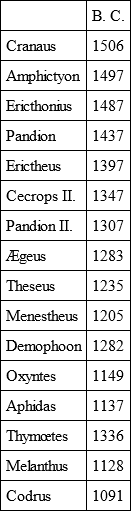
The history of the first twelve monarchs is, for the most part, fabulous.
Athens was founded by Cecrops, who led a colony out of Egypt, and built twelve towns, of which he composed a kingdom.
Amphictyon, the third king of Athens, procured a confederacy between twelve nations, who met every year at Thermopylæ, there to consult over their affairs in general, as also upon those of each nation in particular. This convention was called the assembly of the Amphictyons.
The reign of Ægeus is remarkable for the Argonautic expedition, the war of Minos, and the story of Theseus and Ariadne.
Ægeus was succeeded by his son, Theseus, whose exploits belong more to fable than to history.
The last king was Codrus, who devoted himself to die for his people.
After Codrus, the title of king was extinguished among the Athenians: his son was set at the head of the commonwealth, with the title of Archon, which after a time was declared to be an annual office.
After this Draco was allowed to legislate, and then Solon. The laws of the former were so severe, that they were said to be written in blood. Those of the latter were of a different character. Pisistratus acquired ascendancy; became a despot, and was assassinated: whereon the Athenians recovered their liberties, and Hippias, the son of Pisistratus, in vain attempted to re-establish a tyranny. The Athenians, sometime after, burnt Sardis, a city of the Persians, in conjunction with the Ionians; and, to revenge this, Darius invaded Greece, but was conquered at Marathon by Miltiades.
Xerxes soon after invaded Attica, and the Athenians having taken to their "wooden walls," their city was burnt to the ground.
After the victory, gained over the Persians at Salamis, the Athenians returned to their city, but were obliged to abandon it again; Mardonius having wasted and destroyed every thing in its neighbourhood. They returned to it soon after their victory at Platæa. Their first care, after returning to their city, was to rebuild their walls. This measure was opposed by the Lacedemonians, under the pretence of its being contrary to the interest of Greece, that there should be strong places beyond the isthmus. Their real motive, however, was suspected to be an aversion to the rising greatness of the Athenians. Themistocles conducted himself with great art in this matter48. He got himself appointed ambassador to Sparta; and before setting out he caused all the citizens, of every age and sex, to apply themselves to the task of building the walls, making use of any materials within their reach. Fragments of houses, temples, and other buildings, were accordingly employed, producing a grotesque appearance, which remained to the days of Plutarch. He then set out for Sparta; but, on various pretences, declined entering on his commission, till he had received intelligence that the work he had set on foot was nearly completed. He then went boldly to the Lacedemonian senate, declared what had been done, and justified it, not only by natural right of the Athenians to provide for their own defence, but by the advantage of opposing such an obstacle to the progress of the barbarians. The Lacedemonians, sensible of the justice of this argument, and seeing that remonstrance would now avail nothing, were fain to acquiesce.
No city in the world can boast, in such a short space of time, of such a number of illustrious citizens, equally celebrated for their humanity, learning, and military abilities. Some years after the Persian defeat, Athens was visited by a very terrible calamity, insomuch that its ravages were like what had never been before known. This was a plague. We now adopt the language of Rollin. "It is related, that this scourge began in Ethiopia, whence it descended into Egypt, from thence spread over Libya, and a great part of Persia; and at last broke at once like a flood upon Athens. Thucydides, who himself was seized with that deadly disease, has described very minutely the several circumstances and symptoms of it; in order, says he, that a faithful and exact relation of this calamity may serve as an instruction to posterity, in case the like should ever happen. This pestilence baffled the utmost efforts of art; the most robust constitutions were unable to withstand its attacks; and the greatest care and skill of the physicians were a feeble help to those who were infected. The instant a person was seized, he was struck with despair, which quite disabled him from attempting a cure. The assistance that was given them was ineffectual, and proved mortal to all such of their relations as had the courage to approach them. The prodigious quantity of baggage, which had been removed out of the country into the city, proved very noxious. Most of the inhabitants, for want of lodging, lived in little cottages, in which they could scarcely breathe, during the raging heat of the summer; so that they were seen either piled one upon the other, the dead as well as those who were dying, or else crawling through the streets; or lying along by the side of fountains, to which they had dragged themselves, to quench the raging thirst which consumed them. The very temples were filled with dead bodies, and every part of the city exhibited a dreadful image of death; without the least remedy for the present, or the least hopes with regard to futurity.
"The plague, before it spread into Attica, had, as we have before stated, made wild havoc in Persia. Artaxerxes, who had been informed of the mighty reputation of Hippocrates of Cos, the greatest physician of that or any other age, caused his governors to write to him, to invite him into his dominions, in order that he might prescribe for those who were infected. The king made him the most advantageous offers; setting no bounds to his rewards on the side of interest, and, with regard to honours, promising to make him equal with the most considerable persons in his court. This great physician sent no other answer but this: – that he was free from either wants or desires; and he owed all his cares to his fellow-citizens and countrymen; and was under no obligation to the declared enemies of Greece. – Kings are not used to denials. Artaxerxes, therefore, in the highest transports of rage, sent to the city of Cos, the native place of Hippocrates, and where he was at that time; commanding them to deliver up to him that insolent wretch, in order that he might be brought to condign punishment; and threatening, in case they refused, to lay waste their city and island in such a manner, that not the least footsteps of it should remain. However, the inhabitants of Cos were not under the least terror. They made answer, that the menaces of Darius and Xerxes had not been able to prevail with them to give them earth and water, or to obey their orders; that Artaxerxes' threats would be equally impotent; that, let what would be the consequence, they would never give up their fellow citizens; and that they depended upon the protection of the gods.
"Hippocrates had said in one of his letters, that he owed himself entirely to his country. And, indeed, the instant he was sent for to Athens, he went thither, and did not once stir out of the city till the plague had ceased. He devoted himself entirely to the service of the sick; and, to multiply himself, as it were, he sent several of his disciples into all parts of the country, after having instructed them in what manner to treat their patients. The Athenians were struck with the deepest sense of gratitude for this generous care. They therefore ordained, by a public decree, that Hippocrates should be initiated in the most exalted mysteries, in the same manner as Hercules the son of Jupiter; that a crown of gold should be presented him, of the value of a thousand staters49, and that the decree by which it was granted him, should be read aloud by a herald in the public games, on the solemn festival of Panathenæa: that the freedom of the city should be given him, and himself be maintained at the public charge, in the Prytaneum all his lifetime, in case he thought proper: in fine, that the children of all the people of Cos, whose city had given birth to so great a man, might be maintained and brought up in Athens, in the same manner."
In the time of Agis and Pausanias, kings of Lacedemonia, Lysander was sent to besiege Athens. He arrived, therefore, at the Piræus, with a fleet of one hundred and fifty sail, and prevented all other ships from coming in or going out. The Athenians, besieged by land and sea, without provisions, ships, hope of relief, or any resources, sent deputies to Agis, to propose a treaty with Sparta, upon condition of abandoning all their possessions, the city and port only excepted. He referred the deputies to Lacedemon, as not being empowered to treat with them. When they arrived at Salasia, upon the frontier of Sparta, and had made known their commission to the Ephori, they were ordered to retire, and to come with other proposals, if they expected a peace. The Ephori had demanded, "that one thousand two hundred paces of the wall on each side of the Piræus should he demolished;" but an Athenian, for venturing to advise a compliance, was sent to prison, and prohibition made against proposing any thing of that kind for the future.
The Corinthians and several other allies, especially the Thebans, insisted that it was absolutely necessary to destroy the city without hearkening any further to a treaty. But the Lacedemonians, preferring the glory and safety of Greece to their own grandeur, made answer, that they would never be reproached with having destroyed a city that had rendered such great services to all Greece; the remembrance of which ought to have much greater weight with the allies than the remembrance of private injuries received from it. A peace was, therefore, concluded under these conditions: – "that the fortifications of the Piræus, with the long wall that joined that port to the city, should be demolished; that the Athenians should deliver up all their galleys, twelve only excepted; that they should abandon all the cities they had seized, and content themselves with their own lands and country." The deputies, on their return, were surrounded by an innumerable throng of people, who apprehended that nothing had been concluded; for they were not able to hold out any longer, such multitudes dying of famine. The next day they reported the success of their negociation; the treaty was ratified, and Lysander, followed by the exiles, entered the port. It was on the very day the Athenians had formerly gained the famous battle of Salamis. He caused the works to be demolished to the sound of flutes and trumpets, as if all Greece had that day regained its liberty. Thus ended the Peloponnesian war, after having continued during the space of twenty-seven years.
The walls, thus demolished, were rebuilt by Conon. He did more; he restored Athens to its former splendour, and rendered it more formidable to its enemies than it had ever been before.
Philip50 having gained the battle of Cheronæa, Greece, and above all, Athens, received a blow from which she never recovered. It was generally expected, that Philip would avail himself of this opportunity of entirely crushing his inveterate enemy. That prudent prince, however, foresaw that powerful obstacles were yet to be encountered, and that there was still a spirit in the Athenian people which might render it difficult to hold them in subjection. It would appear, also, says an elegant writer, as if the genius and fame of Athens had, in the hour of her calamity, thrown a shield over her: for Philip is reported to have said, "Have I done so much for glory, and shall I destroy the theatre of that glory?" A treaty, in consequence, was entered into; and thus the Athenians, though reluctant to exist by Philip's clemency, were permitted to retain the whole Attic territory.
The number of men able to bear arms at Athens, in the reign of Cecrops, was computed at twenty thousand; and there appears to have been no considerable augmentation in the more civilised age of Pericles; but in the time of Demetrius Phalareus, there were found twenty-one thousand citizens, ten thousand foreigners, and forty thousand slaves.
Philip51, son of Demetrius of Macedon, seems to have been one of the most inveterate enemies by whom Athens was ever ravaged. With unsparing cruelty he destroyed almost every thing which had either escaped the Persian invaders, or which had been erected after their final expulsion. Livy tells us, that, not content with burning and destroying the temples of the gods, he ordered that the very stones should be broken into small pieces, that they might no longer serve to repair the buildings; and Diodorus Siculus asserts, that even the inviolability of the sepulchres could not command his respect, or repress his violence.
Athens, however, still recovered some portion of its power; for when Sylla arrived before the Piræus, he found the walls to be sixty feet high, and entirely of hewn stone. The work was very strong, and had been raised by order of Pericles in the Peloponnesian war: when, the hopes of victory depending solely upon this port, he had fortified it to the utmost of his power.
The height of the walls did not deter Sylla. He employed all sorts of engines in battering them, and made continual assaults. He spared neither danger, attacks, nor expense, to hasten the conclusion of the war. Without enumerating the rest of the warlike stores and equipage, twenty thousand mules were perpetually employed in working the machines only. Wood happening to fall short, from the great consumption made of it in the machines, which were often either broken or spoiled by the vast weight they carried, or burned by the enemy, he did not spare the sacred groves. He cut down the trees in the walks of the Academy and Lycæum, which were the finest and best planted in the suburbs, and caused the high walls that joined the port to the city to be demolished, in order to make use of the ruins in erecting his works, and carrying on his operations.
From these observations, it would appear that the spoliation of the Parthenon may be vindicated on the ground, that neither the Turks nor the citizens cared any thing about them, and that if they had not been taken away, they would, in a short time, have been destroyed. Respectable testimony, however, is opposed to this: most travellers have inveighed against the spoliation; and two, highly qualified, have given a very different account from what the above statement implies. These are Dr. Clarke and Mr. Dodwell. We shall select the testimony of the latter in preference to that of Dr. Clarke, only because he was at Athens at the very time in which the spoliation was going on. "During my first tour to Greece," says he, "I had the inexpressible mortification of being present when the Parthenon was despoiled of its finest sculpture, and when some of its architectural members were thrown to the ground." * * * "It is, indeed, impossible to suppress the feelings of regret which must arise in the breast of every traveller, who has seen these temples before and since their late dilapidation! Nor have I any hesitation in declaring, that the Athenians in general, nay, even the Turks themselves, did lament the ruin that was committed; and loudly and openly blamed their sovereign for the permission he had granted! I was on the spot at the time, and had an opportunity of observing, and, indeed, of participating, in the sentiment of indignation, which such conduct universally inspired. The whole proceeding was so unpopular in Athens, that it was necessary to pay the labourers more than their usual profits, before any one could be prevailed upon to assist in this work of profanation."
"Such rapacity is a crime against all ages and all generations," says Mr. Eustace; "it deprives the past of the trophies of their genius and the title-deeds of their fame; the present of the strongest inducements to exertion, the noblest exhibitions that curiosity can contemplate; and the future of the master-pieces of art, the models of imitation. To guard against the repetition of such depredations is the wish of every man of genius, the duty of every man in power, and the common interest of every civilised nation."
"That the Elgin marbles will contribute to the improvement of art in England," says Mr. Williams, "cannot be doubted. They must, certainly, open the eyes of the British artists, and prove that the true and only road to simplicity and beauty is the study of nature. But had we a right to diminish the interest of Athens for selfish motives, and prevent successive generations of other nations from seeing those admirable structures? The temple of Minerva was spared as a beacon to the world, to direct it to the knowledge of purity and of taste. What can we say to the disappointed traveller, who is now deprived of the rich satisfaction that would have compensated his travel and his toil? It will be little consolation to him to say, he may find the sculpture of the Parthenon in England87."
NO. XVII. – BABYLON
Babylon and Nineveh appear to have resembled each other, not only in form but in extent and population. Quintus Curtius asserts, that Babylon owed its origin to Semiramis. In the Bible, however, it having been stated, that one of the chief cities of Nimrod was Babel; many authors have given into the idea, that Babylon was built by Nimrod. If we attend strictly to the words of Moses, however, we shall find that to have been an impossible circumstance.
Moses states, that Nimrod had four large cities88. Those were Babel, Erech, Accad, and Calneth. Nimrod was a descendant of Ham; but the temple of Babel, on the establishment of which depends the origin of Babylon, was built by the descendants of Shem: – at least, we have the right to believe so; for Moses mentions the descendants of Shem last, and then goes on to say: – "The whole earth was of one language and of one speech: and it came to pass, as they journeyed from the East, that they found a plain in the land of Shinar, and they dwelt there."
When they had dwelt there some time, they said to one another, "Go to, let us make brick, and burn them thoroughly. And they had brick for stone, and slime had they for mortar." This was the first of the subsequent town. They had not yet aspired to any particular distinction. At length they said to themselves, "Let us build a city and a tower; and let us make us a name, lest we be scattered abroad upon the face of the whole earth." They were interrupted in their design, and "they left off building the city." There is, however, no account of its having been destroyed; nor any in regard to the destruction of the temple. The people, however, were scattered89.
This city was, subsequently, called Babel; and the temple of Belus being the oldest temple recorded in history, it has been generally supposed, that it was no other than the tower, the family of Shem had endeavoured to build. This, however, is far from being certain; for Josephus, who, in this case is not without his weight, relates that the tower was thrown down by an impetuous wind or violent hurricane; and that it never was rebuilt.
The fact is, that the real origin of Babylon is lost in the depth of history; and all that can be stated, with any degree of certainty, is, that Nineveh and Babylon were founded much about the same time, and that Ninus, Semiramis, Ninyas, and Sardanapalus were sovereigns, though not during their whole lives, of both cities. This appears to us to be the only way in which we can understand the history of the first Assyrian empire.
We have no space to enter into the particular history of this most celebrated of all cities; neither does the plan of our work admit of it: our province only being to record its origin, to describe its ancient state, to give an account of its destruction, and then describe, from the pages of authentic travellers, the ruins which still remain.
Having given some account of its origin, we proceed to describe the height to which it was exalted. "The Assyrians," says Herodotus, "are masters of many capital towns; but their place of greatest strength and fame is Babylon90; where, after the destruction of Nineveh, was the royal residence. It is situated on a large plain, and is a perfect square; each side, by every approach is, in length, one hundred and twenty furlongs; the space, therefore, occupied by the whole, is four hundred and eighty furlongs: so extensive is the ground which Babylon occupies. Its internal beauty and magnificence exceeds whatever has come within my knowledge. It is surrounded by a trench, very wide, deep, and full of water; the wall beyond this is two hundred royal cubits high91, and fifty wide; the royal exceeds the common cubit by three digits92." "It will not be foreign to my purpose," continues the historian, "to describe the use to which the earth dug out of the trench was converted, as well as the particular manner in which they constructed the wall. The earth of the trench was first of all laid in heaps, and when a sufficient quantity was obtained, made into square bricks, and baked in a furnace. They used, as cement, a composition of heated bitumen, which, mixed with the tops of reeds, was placed between every thirtieth course of bricks. Having thus lined the sides of the trench, they proceeded to build the wall in a similar manner; on the summit of which, and fronting each other, they erected small watchtowers of one story, leaving a space betwixt them, through which a chariot and four horses might pass and turn. In the circumference of the wall, at different distances, were a hundred massy gates of brass93, whose hinges and frames were of the same metal. Within eight days' journey from Babylon is a city called Is, near which flows a river of the same name, which empties itself into the Euphrates. With the current of this river, particles of bitumen descend towards Babylon, by means of which its walls are constructed. The great river Euphrates, which, with its deep and rapid streams, rises in the Armenian mountains, and pours itself into the Red Sea94, divides Babylon into two parts. The walls meet and form an angle at the river at each extremity of the town, where a breast-work of burnt bricks begins, and is continued along each bank. The city, which abounds in houses from three to four stories in height, is regularly divided into streets. Through these, which are parallel, there are transverse avenues to the river opened through the wall and breast-work, and secured by an equal number of little gates of brass."
The historian then proceeds to describe the fortifications and the temple of Belus. "The first wall is regularly fortified; the interior one, though less in substance, is of about equal strength. Besides these, in the centre of each division of the city, there is a circular space surrounded by a wall. In one of these stands the royal palace, which fills a large and strongly-defended place. The temple of Jupiter Belus95 occupies the other, whose huge gates of brass may still be seen. It is a square building, each side of which is of the length of two furlongs. In the midst, a tower rises of the solid depth and height of one furlong, upon which, resting as a base, seven other turrets are built in regular succession. The ascent is on the outside; which, winding from the ground, is continued to the highest tower; and in the middle of the whole structure there is a convenient resting-place. In the last tower is a large chapel, in which is placed a couch magnificently adorned, and near it a table of solid gold; but there is no statue in the place." Herodotus, however, states, that in another part of the temple there was a statue of Jupiter, in a sitting posture, with a large table before him; and that these, with the base of the table and the seat of the throne, were all of the purest gold, and were estimated in his time, by the Chaldeans, at not less than eight hundred talents.
We may here give place to a passage in a modern poem, highly descriptive of its ancient state.
Those walls, within
Whose large inclosure the rude hind, or guides
His plough, or binds his sheaves, while shepherds guard
Their flocks, scure of ill: on the broad top
Six chariots rattled in extended front.
For there, since Cyrus on the neighbouring plain,
Has marked his camp, th' enclosed Assyrian drives
His foaming steeds, and from the giddy height
Looks down with scorn on all the tents below.
Each side in length, in height, in solid bulk,
Reflects its opposite; a perfect square;
Scarce sixty thousand paces can mete out
The vast circumference. An hundred gates
Of polished brass lead to that central point,
Where through the midst, bridged o'er with wondrous art,
Euphrates leads a navigable stream,
Branch'd from the current of his roaring flood.
Dr. Roberts, Judah Restored.
Thus we find the walls to have extended to a vast circumference – from forty-eight to sixty miles; but we are not to suppose them to have been entirely filled up with houses;96 but, as in the old city of Moscow, to have been in no small part taken up with gardens and other cultivated lands.
In regard to the size of some ancient Eastern cities, Mr. Franklin has made some very pertinent remarks, in his inquiry concerning the site of the ancient Palibothra: – "For the extent of the city and suburbs of Palibothra, from seventy-five to eighty miles have been assigned by the Puranas; a distance, said to be impossible for the space occupied by a single city. So, indeed, it might, were we to compare the cities of Asia with those of Europe. The idea of lofty houses of brick and stone, consisting of many stories, with a number of inhabitants, like those of London, Paris, Vienna, and many others, must not be compared with the nature of the Asiatic cities. To look in them for regularly-built squares, and spacious and paved streets, would be absurd."
Herodotus gives the extent of the walls of Babylon at one hundred and twenty stades on each side, or four hundred and eighty stades in circumference. Diodorus three hundred and sixty stades in circumference. Clitarchus, who accompanied Alexander, three hundred and sixty-five. Curtius states it at three hundred and sixty-eight; and Strabo at three hundred and eighty-five stades. The general approximation of these measurements would lead us to suppose that the same stade was used by the different reporters; and if this was the Greek itinerary stade, we may estimate the circumference of the great city at twenty-five British miles97. "The lines, drawn on maps, are often only used to divide distant mounds of ruin. Accumulations of pottery and brickwork are met with occasionally over a great tract; but the connection, supposed between these and the corn-fields and gardens, within the common precincts of a wall, is gratuitous in the extreme. Imagine London and Paris to be levelled, and the inhabitant of some future city to visit their ruins, as those of then remote antiquity; if, in the one instance, Sèvres, Mont Rouge, and Vincennes, or, in the other, Greenwich, Stratford-le-Bow, Tottenham, Highgate, Hammersmith, Richmond, and Clapham, be taken in as boundaries, or identified respectively as the ruins of Paris and London, what a prodigious extent would those cities gain in the eyes of futurity98!"
Babylon, as we have already stated, stood upon the Euphrates, as Nineveh did upon the Tigris. A branch of it ran entirely through the city from north to south; and on each side was a quay, walled towards the river, of the same thickness as the city walls. In these, also, were gates of brass, from which persons descended to the water by steps; whence, for a long time, they crossed to the other side in boats; that is, until the building of a bridge. These gates were open always in the day, but shut at night. A bridge was at length erected; and this bridge was equally celebrated with the other great buildings; for it was of vast size; but Diodorus would seem to make it to have been much larger than it really was. He says it was five furlongs in length. Now as the Euphrates, at the spot, was only one furlong wide, this would be impossible; so we suppose that there must have been a causeway on each side of the bridge; and that Diodorus included the two causeways, which were, probably, merely dry arches, as we find in a multitude of modern bridges. It was, nevertheless, thirty feet in breadth, and built with great skill. The arches were of hewn stone, fastened together with chains of iron and melted lead. To effect the building with the greater care and safety, they turned the course of the river99, and laid the channel dry. While one part of the workmen were doing this, others were shaping the materials for the quays, so that all were finished at the same time.
During a certain portion of the year (viz., June, July, and August) the Euphrates overflows its banks, as the Nile does in Egypt, the Ganges in India, and the Amazon in South America. To remedy the manifold inconveniences arising from this, two large canals were cut to divert the superabundant waters into the Tigris, before they could reach Babylon100; and to secure the neighbouring country still the better, they raised artificial banks, – as the Dutch have done in Holland, – of a vast size, on both sides the river; not built, however, of earth, as in Holland, but of brick cemented with bitumen, which began at the head of the canals, and extended for some distance below the city. To effect all this, the Euphrates, which had been turned one way, in order to build the bridge, was turned another to build the banks. To this end they dug a vast lake, forty miles square, and one hundred and sixty in compass, and thirty-five feet deep. Into this lake the river was diverted, till the banks were finished; after which it was re-diverted into the former channel. The lake was, however, still preserved as a reservoir101.
Perhaps some of our readers may be curious to know how long it would take to fill this lake up. It is thus stated in the Edinburgh Review102: – "Taking it at the lowest dimensions of a square of forty miles, by thirty feet deep; and supposing the Euphrates to be five hundred feet wide, ten deep, and to flow at the rate of two miles an hour, it would require one thousand and fifty-six days to fill the lake, allowing no absorption to the sides; but if absorption and evaporation are taken into the account, we may put the time at four years, or thereabouts; which, no doubt, would be sufficient, considering the number of hands employed, to complete the embankment103."
This lake, the bridge, and the quays of the river are ascribed to Nitocris, by Herodotus; but most of the other wonders of Babylon are ascribed by Josephus to Nebuchadnezzar, her father-in-law. "Perhaps," says one of the historians, "Nitocris might only finish what her father had left imperfect at his death, on which account the historian might give her the honour of the whole undertaking."
We are now called upon to describe other wonders. These are the palaces and hanging gardens. At each end of the bridge stood a palace; and those two palaces had a communication each with the other by means of a passage under the bed of the river, vaulted at the time in which it was laid dry104. The old palace, which stood on the east side of the river, was three miles and three quarters in compass. It stood near the temple of Belus. The new palace stood on the west side. It was much larger than the old one; being seven miles and a half in compass105. It was surrounded with three walls, one within the other, with considerable spaces between; and these, with those at the other palace, were embellished with an infinite variety of sculptures, representing all kinds of animals to the life; amongst which was one more celebrated than all the rest. This was a hunting piece, representing Semiramis on horseback throwing a javelin; and Ninus, her husband, piercing a lion.
Near the old palace stood a vast structure, known from all antiquity, and celebrated in every age as the most wonderful structure ever yet built; viz., the temple of Belus. We have given some account of it from Herodotus already. A tower of vast size stood in the middle of it. At its foundation it was a square of a furlong on each side; that is, half a mile in its whole compass, and the eighth part of a mile in height. It consisted of eight towers, built one above another, gradually decreasing in size to the top. Its height exceeded that of the largest of the pyramids106. It was built of bricks and bitumen. The ascent to the top was on the outside, by means of stairs, winding, in a spiral line, eight times round the tower from the bottom to the top. There were many large rooms in the different stories, with arched roofs, supported by pillars. On the top was an observatory, the Babylonians having been more celebrated than any other people of ancient times for their knowledge of astronomy107.
Notwithstanding the opinions of many, that this tower was built expressly for astronomical purposes, it appears certain that it was used as a temple also; for the riches of it were immense; consisting of statues, tables, censers, cups, and other sacred vessels, all of massy gold. Among these was a statue, weighing a thousand talents of Babylon, forty feet high. Indeed, so rich was this temple, that Diodorus does not hesitate to value all it contained at not less than six thousand three hundred Babylonian talents of gold; which implies a sum equivalent to twenty-one millions of pounds sterling! Surely some error must have crept into the MS.
This temple stood till the time of Xerxes. On the return of that prince from Greece he plundered it; and then caused it to be entirely demolished. When Alexander returned from India, he formed the design of rebuilding it upon the ancient plan; and probably, had he lived, he would have accomplished his wish. Ten thousand men were put to work to clear away the rubbish; but he died in the midst of his preparation.
Many of the chief erections in this city were planned and executed by Semiramis. When she had finished them, she made a progress through the various divisions of her empire; and wherever she went left monuments of her magnificence, by many noble structures, which she erected, either for the convenience or the ornament of her cities108. She was the best political economist of ancient times, and may truly be styled the first utilitarian: for she applied herself to the formation of causeways, the improvement of roads, the cutting through mountains, and the filling up valleys. She applied herself, also, most particularly, to the forming of aqueducts, in order that water might be conveyed to such places as wanted it: in hot climates desiderata of the first importance.
Valerius Maximus109 records a circumstance of her, which paints the influence she possessed over her people in a very striking manner. One day, as she was dressing herself, word was brought that a tumult was raging in the city. Without waiting to dress herself, she hurried from her palace with her head half dressed, and did not return till the disturbance was entirely appeased110.
We now pass on to the dream of Nebuchadnezzar, because the accomplishment of that dream is connected with the splendid state of Babylon in the time of its glory. This dream was, that111 "he saw a tree in the midst of the earth, whose height was great: the tree grew, and was strong, and the height of it reached unto heaven, and the sight thereof to the end of the earth. The leaves were fair, and the fruit much; and in it was meat for all: the beasts of the field had shadow under it, and the fowls of heaven dwelt in the boughs thereof, and all flesh was fed of it. I saw the visions of my head on the bed, and, behold, a watcher, and an holy one, came down from heaven; he cried aloud, and said thus: – 'Hew down the tree, and cut off his branches, shake off his leaves, and scatter his fruit; let the beasts get away from under it, and the fowls from his branches. Nevertheless, leave the stump of his roots in the earth, even with a band of iron and brass, in the tender grass of the field; and let it be wet with the dew of heaven, and let his portion be with the beasts in the grass of the earth. Let his heart be changed from man's, and let a beast's heart be given to him. This matter is by the decree of the watchers, and the demand of the word of the holy ones, to the intent that the living may know, that the Most High ruleth in the kingdom of men, and giveth to whomsoever he will, and setteth up over it the basest of men.'"
This dream was expounded by Daniel. "Let the dream be to them, O king, that hate thee; and the interpretation thereof to thine enemies." The prophet then declared, "that the king should be driven from the company of men for seven years; should be reduced to the fellowship of the beasts of the field, and feed upon grass like oxen; that his kingdom should, nevertheless, be preserved for him, and he should repossess his throne, when he should have learnt to know and acknowledge, that all power is from above, and cometh from heaven."
At the end of twelve months, as Nebuchadnezzar was walking in his palace, and admiring the beauty and magnificence of his buildings, he became so elated at the sight of the structures he had erected, that he exclaimed – "Is not this great Babylon, that I have built for the house of the kingdom by the might of my power, and for the honour of my majesty?" In an instant, a voice came from heaven declaratory of his fate, and his understanding was taken from him. He was driven from men, and did eat grass like oxen, and his body was wet with the dew of heaven; till his hairs were grown like eagles' feathers, and his nails like birds' claws.
At the expiration of seven years he recovered his intellectual powers. He was restored to his throne, and became more powerful than he had been before. At this period he is supposed to have built the hanging gardens, which have been so celebrated in every age. Amytis, his wife, having been bred in Media, – for she was the daughter of Astyages, king of that country, – had been much taken with the mountains and woody parts of her native country, and therefore desired to have something like it at Babylon. To gratify this passion, the king, her husband, raised the hanging gardens. Diodorus, however, ascribes them to Cyrus; and states that he built them to gratify a courtezan.
They are thus described by Quintus Curtius: – "Near the castle are those wonders, which are so often celebrated by the Greek poets; gardens elevated in the air, consisting of entire groves of trees, growing as high as the tops of the towers, marvellously beautiful and pleasant from their height and shade. The whole weight of them is sustained and borne up by huge pillars, upon which there is a floor of square stone, that both upholdeth the earth, that lies deep on the pillar, and also the cisterns with which it is watered. The trees that grow upon this are many of them eight cubits in circumference, and every thing is as fruitful as if they grew on the natural ground; and, although process of time destroys things made by mortal hands, and also even the works of nature, yet this terrace, although oppressed with the weight of so much earth, and so great a multitude of trees, still remains unperished, being held up by seventy broad walls, distant from each other about eleven feet. When these trees (concludes Curtius), are seen afar off, they seem to be a wood growing upon a mountain." This may well be, since they comprised a square of about four hundred feet on every side, and were carried up into the air in the manner of several large terraces, one above another, till the highest equalled the height of the walls of the city. The floors were laid out thus112: – On the top of the arches were first laid large flat stones, sixteen feet long, and four feet broad; and over them a layer of reed, mixed with a great quantity of bitumen; over which were two rows of bricks, closely cemented by plaister; and then, over all, were laid thick sheets of lead; and, lastly, upon the lead a vast quantity of mould. The mould was of sufficient depth to let grow very large trees, and such were planted in it, together with other trees, and every description of plant and flower, that was esteemed proper for shrubberies and flower-gardens. To improve all this, there was, on the highest of the terraces, a water-engine, to draw the water out of the river below, wherewith to water the whole garden113.
Besides all this, there were magazines for corn and provision, capable of maintaining the inhabitants for twenty years; and arsenals, which supplied with arms such a number of fighting men, as seemed equal to the conquest or defence of the whole monarchy.
If Babylon was indebted to Nebuchadnezzar for many great buildings, it was still more so to his daughter Nitocris. She erected a great multitude; and amongst the rest, one of the gates. On this gate she caused to be inscribed a command to her successors, that, when she should be buried under it, none of them should open the tomb to touch the treasure which laid there, unless impelled by some great and overwhelming necessity. Many years passed away, and no one opened it. At length Darius came to the city. Reading the inscription, he caused the tomb to be opened; but alas! instead of finding the vast treasures he had expected, he beheld only this inscription: —"If thou hadst not an insatiable thirst for money, and a most sordid avaricious soul, thou wouldst never have broken open the monuments of the dead."
Astyages, king of the Medes, was succeeded by Cyaxares, uncle to Cyrus. Cyaxares, learning that the king of Babylon had made great preparations against him, sent for Cyrus, son of Cambyses, king of Persia, and placed him at the head of his army. Before marching, Cyrus addressed those officers who had followed him from Persia, in the following manner. "Do you know the nature of the enemy you have to deal with? They are soft, effeminate, enervated men, already half conquered by their own luxury and voluptuousness; men not able to bear either hunger or thirst; equally incapable of supporting either the toil of war, or the sight of danger: whereas you, that are inured, from your infancy, to a sober and hard way of living; to you, I say, hunger and thirst are but as sauce, and the only sauce, to your meals; fatigues are your pleasure; dangers are your delight; and the love of your country, and of glory, your only passion. Besides, the justice of our cause is another considerable advantage. They are the aggressors. It is the enemy that attacks us; and it is our friends and allies that require our aid. Can any thing be more just than to repel the injury they would bring upon us? Is there any thing more honourable, than to fly to the assistance of our friends? But what ought to be the principal motive of your confidence is, that I do not engage in this expedition without having first consulted the gods, and implored their protection; for you know it is my custom to begin all my actions, and all my undertakings, in that manner."
Cyrus, after several battles, laid siege to Babylon. It was in the days of Belshazzar. That prince was absorbed in luxury and sloth. A great festival was to be held within the palace, and Cyrus heard of it. He prepared himself, therefore, and all his army. The court, in the meantime, was rife in every species of dance, feast, and revelry. In the pride of his heart, Belshazzar ordered all the gold and silver vessels, which had been taken from the temple of Jerusalem, to be brought to the banqueting-room; and he and his officers, and his wives and his concubines, drank out of them. No sooner was this done, than the fingers of a man's hand came out from the wall, and wrote over the candlestick upon the plaster.
The king saw the hand; and when he saw it "his countenance was changed, and his thoughts troubled him, so that the joints of his loins were loosed, and his knees smote one against another."
Mr. Rich, also, found a number of urns, in the bulwark on the banks of the river. These contained ashes, and bones in small fragments. Comparing these remains with the skeletons found in the Mujelibé, he judiciously remarks, that the two modes of sepulture decidedly prove what people they were who were so interred. "There is, I believe," he adds, "no reason to suppose that the Babylonians burnt their dead: the old Persians, we know, never did." It was the common usage with the Greeks. "From this he infers," says Porter, "that the skeletons in the Mujelibé were the remains of the ancient people of Babylon; and the urns in the embankment contained the ashes of Alexander's soldiers."
From the south-east angle of the Mujelibé, a mound extends in a circular direction, and joins the Amran at its south-east angle, the diameter of the sweep being two miles and a half. This is supposed to have been the fortified enclosure that is described by Herodotus as encircling the palace.
To the north of the Mujelibé there are no ruins of any importance. A few low mounds, however, are observed, occurring at intervals, on each side of the road from Hillah to Bagdad; but they are of an insignificant character, and, from their situation, they are supposed to have been burying-places outside the city, rather than buildings within its walls.
The Mujelibé is supposed to have been a Babylonian mausoleum, rather than a temple of worship. In respect to the other ruins, it is probable that the Kasr and adjacent mounds are the remains of the royal palace, with its hanging gardens, enclosed with the circular mound, which formed the outer wall of the palace mentioned by Herodotus, and described more in detail by Diodorus.
Two or three miles upwards from the river, are the remains of what have, hitherto, been considered remains of canals. A recent traveller131, however, seems inclined to believe, that they are the remains of streets. His reasoning is probable. Canals would go all one way; but most of these cross each other at right angles, with immense spaces of open and level ground on each side of them.
We are now to note something in regard to what appears on the west side of the Euphrates. "The loose and inaccurate accounts of some modern travellers," says Mr. Rich, "have misled D'Anville and Rennell into the belief of there being considerable ruins on the western side of the river, similar to those on the eastern." This, however, does not appear to be the case; that is, near to the river. But although there are none in the immediate neighbourhood, by far the most stupendous and surprising mass of all the ruins of Babylon is situated on this side, about six miles from Hillah. This is the tower of Babel, otherwise the temple of Belus. It is called by the Arabs, Birs Nemroud; by the Jews Nebuchadnezzar's Prison. The shape of this vast ruin is oblong, having the appearance of a fallen or decayed pyramid. It is two thousand two hundred and eighty-six feet in compass at the base; and, on the west side, it rises conically to the height of one hundred and ninety-eight feet. "I visited the Birs," says Mr. Rich, "under circumstances peculiarly favourable to grandeur of effect. The morning was at first stormy, and threatened a severe fall of rain; but, as we approached the object of our journey, the heavy clouds separating, discovered the Birs frowning over the plain, and presenting the appearance of a circular hill, crowned by a tower, with a high ridge extending along the foot of it. It being entirely concealed from our view, during the first part of our ride, prevented our acquiring the gradual idea, in general so prejudicial to effect, and so particularly lamented by those who visit the pyramids. Just as we were within the proper distance, it burst at once upon our sight, in the midst of rolling masses of thick black clouds, partially obscured by that kind of haze whose indistinctness is one great cause of sublimity; whilst a few strong catches of stormy light, thrown upon the desert in the back ground, served to give some idea of the immense extent, and dreary solitude, of the wastes in which this remarkable ruin stands."
Two stages of building are visible on the eastern side. The lowest is sixty feet high, and is broken in the middle by a deep ravine, and intersected on all sides by channels, made by the winter rains. The summit of this first stage was once flat; but it is no longer so; its margin having crumbled down so as to give this side the appearance of a cone. The second stage rises above the first, also, in a conical form, but much more steep; the summit being marked by a perpendicular fragment of brick work; which is probably the base of the third stage.
On the west side, the structure rises at once from the plain like a pyramid; the face being broken in different directions, partly by the torrents, and partly by what seems to have been some convulsion of nature. At the foot of the northern side, vast masses of solid brick-work are scattered over the rubbish. The building is seen to most advantage to the south; for on that side it is by far the most perfect. The tower there rises by high and distinct stages (four), receding one within another, in proportion to their respective elevations. "Here is a ruin," says an elegant writer, "corresponding, in a most surprising degree, with the tower of Belus, as described by Herodotus. The total circumference of the base is two thousand two hundred and eighty-six feet instead of one thousand nine hundred and sixty, the square of a stadium. The east and west sides remain of the original breadth nearly, and a greater portion of rubbish from the top crumbled down upon their sides, the north and south are thereby elongated; the present height of the ruin, to the top of the wall, is two hundred and thirty-five feet – less than one-half of the original height – consequently the débris round the base might be expected to be much more considerable, so as to make the circumference of the base greater than it appears to be. But it must be remembered, that Alexander the Great, when he took possession of Babylon, after the defeat of Darius, employed ten thousand men for two months in removing the rubbish, preparatory to removing the tower132. It is probable they had only cleared the south side, before the work was abandoned; which would account for the south face being more perfect than any of the others. If we add to this, that vast quantities of the bricks have been taken away by the natives of the country, for building modern towns, the circumstance that the base so little exceeds the dimensions, given by Herodotus, will no longer appear unaccountable."
On Sir Robert Ker Porter's second visit to the Birs Nimrod, his party descried several dark objects moving along the summit of its hill, which they construed into dismounted Arabs on the look out, while their armed brethren were lying concealed under the southern brow of the mound. "Thinking this very probable," says Sir Robert, "I took out my glass to examine, and soon distinguished that the causes of our alarm were two or three majestic lions, taking the air upon the height of the pyramid. Perhaps I had never seen so sublime a picture to the mind, as well as to the eye. They were a species of enemy which my party were accustomed to dread without any panic fear; and while we continued to advance, though slowly, the hallooing of the people made the noble beasts gradually change their position, till, in the course of twenty minutes, they totally disappeared." The party then rode close to the ruins, every now and then observing the broad prints of feet the lions had left in the soil. This naturally brought to Sir Robert's recollection that part of the scriptures, wherein it is said, "Wild beasts of the desert shall be there."
At a short distance from the Birs, and parallel with its eastern face, is a mound, not inferior to that of the Kasr in elevation, but much longer than it is broad. "On the top of it are two oratories," says Mr. Rich. "One, called Mekam Ibrahim Khalib, and said to be the place where Ibrahim was thrown into the fire by order of Nemroud, who surveyed the scene from the Birs; the other, which is in ruins, Makam Saheb Zeman; but to what part of Mehdy's life it relates, I am ignorant."
"They call it," says Sir R. Ker Porter, "'Babylon, the glory of kingdoms, the beauty of the Chaldees' excellency. The lady of kingdoms, given to pleasure, that dwelleth carelessly, and sayeth in her heart, I am, and there is none else beside me!' But now, in the same expressive language, we may say, 'She sits as a widow on the ground. There is no more a throne for thee, O daughter of the Chaldeans!' And for the abundance of the country, it has vanished as clean away as if 'the besom of desolation' had, indeed, swept it from north to south; the whole land, from the outskirts of Bagdad to the farthest stretch of the sight, lying a melancholy corpse."
Round the Birs are traces of ruins to a considerable extent; and near the town of Hillah there are several remarkable places; but as they do not bear any very particular relation to Babylon, we here close our account, entirely agreeing with Mr. Rich, that it is evident, from what remains of that celebrated city, and even from the most favourable account handed down to us, that the public edifices which adorned it were remarkable more for vastness of dimensions than elegance of design, and solidity of fabric than beauty of execution.
Though Babylon has universally been considered as the largest city that ever existed on the earth, there are some and even very good reasons to believe, that it was never so large as Nineveh. "It was intended, indeed," says one of the historians, "that Babylon should have exceeded Nineveh in every thing; but Nebuchadnezzar did not live long enough, nor the Babylonish empire last long enough, to finish the scheme that had been drawn of it." The houses were not contiguous, but all built with a void space on each side between house and house, so that the larger part was not built upon. The houses of Nineveh, however, were contiguous. Nineveh, also, had a greater population; for, in the time of Jonah, it had one hundred and twenty thousand souls, "who could nor did not know their right hand from their left." That is, one hundred and twenty thousand infants133. But though Nineveh was the oldest city and the largest, Babylon has in all subsequent ages enjoyed the greatest celebrity134.
NO. XVIII. – BALBEC
Those ruined shrines and towers, that seem
The relics of a splendid dream;
Amid whose fairy loveliness
Nought but the lapwing's cry is heard;
Nought seen but (when the shadows, flitting
Fast from the moon, unsheath its gleam)
Some purple-winged Sultana135 sitting
Upon a column motionless,
And glittering like an idol bird.
* * * * *
But nought can charm the luckless Peri;
Her soul is sad – her wings are weary —
Joyless she sees the sun go down
On that great temple, once her own136;
Whose lonely columns stand sublime,
Flinging their shadows from on high,
Like dials, which the wizard, Time,
Had raised to count his ages by.
These lines lead us to some beautiful observations by Sir John Malcolm: —
"Among the traces of a great nation's former glory," says he, "there is none upon which the mind dwells with more serious thought than on the magnificent ruins of its ancient palaces. How forcibly are we reminded of our condition, when told that an edifice, in the erection of which a kingdom's wealth had been exhausted; which was adorned with every ornament that the art of the world could supply, and whose history was engraven on the imperishable rocks with which it was constructed, was not only fallen into decay, but that its founder was unknown, and the language in which its history was inscribed was no longer numbered among the tongues of man!" These observations are peculiarly applicable to the present state of Balbec.
This city stood in the road between Tyre and Palmyra; its history is, nevertheless, so lost in obscurity, that, considering the splendour and magnificence of its remains, we are astonished! Scarcely any thing of its history is known; and even its existence appears to have been unknown for many centuries to the Romans.
Tradition states that it was built by Solomon; and for the truth of this the Jews quote the following passage from the Book of Chronicles137: – "Also he (Solomon) built Beth-horon the upper, and Beth-horon the nether, fencied cities, with walls, gates, and bars; and Baal-ath."
For the greater confirmation, it is thought that Balbec is meant when Solomon says – "the tower of Lebanon, that looketh towards Damascus." The Arabs go even so far as to assert, that this city was built by the king as a residence for the Queen of Sheba; and Sir William Ouseley quotes a passage, wherein it is mentioned that a tradition in Persian implies, that Solomon often passed his day at Balbec, and his night at Istakr.
The names Heliopolis and Balbec are words of different languages, which have nearly the same signification. The sun was worshipped by the ancient inhabitants of the country, under the name of Baal. Balbec signifies the vale of Baal; and Heliopolis the city of the sun.
That Balbec derived, not only its religion, but its very name, from Heliopolis in Egypt, is rendered certain by a passage in Macrobius: – "In the city called Heliopolis, the Assyrians worship the sun with great pomp, under the name of the Heliopolitan Jove; and the statue of this god was brought from a city in Egypt, also called Heliopolis, where Senumens or Senepos reigned over the Egyptians, by Opios, ambassador from Delebor, king of the Assyrians, together with some Egyptian priests, of whom Partemetis was the chief, and it remained long among the Assyrians before it was removed to Heliopolis."
The same author adds, "that he declines giving the reason for this fact, or telling how the statue was afterwards brought to the place, where in his time it was worshipped, more according to the Assyrian than the Egyptian rites, as circumstances foreign to his purpose."
As Balbec has never been the seat of a monarch, antiquaries are greatly at a loss to conceive how the expense of these magnificent structures could have been supplied by private or municipal liberality. The orientals, however, explain the prodigy by a never-failing expedient, – they were constructed by the fairies or genii!
That these temples did not exist when Pompey went through Heliopolis to Damascus is probable, because the writers of that time, who mention less remarkable structures with admiration, take no notice of any such building; and it is certain that they did exist in the time of Caracalla; because Heliopolis is to be seen on many of his coins; and vows in favour of him and his empress are recorded in two inscriptions, the remains of which are still to be seen on the pedestals of the columns of the great portico of the temple.
That Heliopolis was constituted a colony by Augustus Cæsar, is rendered probable, by some medals which still remain, and in which it is called, "Colonia Julia Augusta;" but it was not till the time of Septimius Severus that the temple was impressed on the reverse of the coins.
When we consider the extraordinary magnificence of the temple of Balbec, we cannot but be greatly surprised at the silence of the Greek and Roman authors in respect to it. Mr. Wood, who has carefully examined all the ancient authors, has found no mention of it, except in a fragment of John of Antioch, surnamed Malala, who attributes the building of it to Antoninus Pius. His words are: – "Ælius Antoninus Pius138 built a great temple at Heliopolis, near Libanus, in Phœnicia, which was one of the wonders of the world." Some Roman medals also have been found, upon the reverse of which is a representation something similar to those temples, with the inscription: – Colonia Heliopolitana Jovi Optimo Maximo Heliopolitano.
One circumstance, however, militates against the idea that Antoninus Pius was the builder of these temples; viz., that Julius Capitolinus says nothing about them, though he gives a list of that emperor's buildings, and speaks of others of much less consideration. It must, however, be remembered, that the work of Julius Capitolinus is known to be so extremely defective, that though Antoninus reigned one-and-twenty years, and transmitted to posterity the character of one of the best princes that ever ruled, yet the particulars, that merited such extraordinary praise, are utterly unknown.
Gibbon thus remarks upon the different fortunes of Balbec and Emesa: – "Among the cities which are enumerated by Greek and oriental names in the geography and conquest of Syria, we may distinguish Emesa and Heliopolis; the former as a metropolis of the plain; the latter as the metropolis of the valley. Under the last of the Cæsars they were strong and populous; the turrets glittered from afar; an ample space was covered with public and private buildings; and the citizens were illustrious by their spirit, or at least by their pride; by their riches, or at least by their luxury. In the days of paganism, both Emesa and Heliopolis were addicted to the worship of Baal, or the sun: but the decline of their superstition or splendour has been marked by a singular variety of fortune. Not a vestige remains of the temple of Emesa, which was equalled in poetic style to the summits of Mount Libanus; while the ruins of Balbec, invisible to the writers of antiquity, excite the curiosity and wonder of European travellers."
In the reign of Heraclius its garrison was strengthened, that it might be enabled to withstand the Arabs; and when Christianity gained the ascendancy under Constantine, he shut up many pagan temples; but it was Theodosius, who converted its temple into a Christian church, the walls of which are still standing. The conversion of it into a fortress was the work of the Caliphs, when this part of the world fell under the government of the Caliphs, called the Ommiades; an incurious and therefore an ignorant race, during whose time nothing is recorded of Balbec, although it was then a considerable city. The ancient name, Balbec, during this time was restored, instead of Heliopolis, which was probably a translation of Balbec, or at least substituted for it, when it passed out of the possession of its own native oriental inhabitants.
In Ebn Haukal's139 oriental geography, Balbec is mentioned thus: – "Beyond the borders of Demeshk is Baalbek, situated on an eminence. Here are the gates of palaces, sculptured in marble; and lofty columns, also of marble. In the whole region of Syria there is not a more stupendous or considerable edifice than this140."
The approach to this ruined city is thus described by Mr. Bruce: – "The form of Mount Libanus, as seen from the plain of Bekka, is this: first, a range of mountains, extremely proper for culture, and of no considerable height, sloping easily to the plain, and covered with trees that are not very thickly planted. On the other side of these rises a chain of mountains of an extraordinary height, bare for the most part, and stony, cut in every rain, and covered with snow, except in summer. Thus they continue till they descend much more steeply on the other side towards the sea. The valleys within this high chain of mountains, which on one side run parallel with the sea-coast, and on the other form the east side of the plain of Bekka, are mostly narrow; but abundantly fertile, were they in the hands of better people, under a better government; industry being here always followed by oppression."
Mr. Carne describes his arrival thus: – "The sun set on the vast temple, and the mountains around it, with indescribable grandeur; the chain of Anti-Libanus, in front, was covered with snow; and the plain, wild and beautiful, stretched at its feet farther than the eye can reach: the pigeons, of many-coloured plumage, flew in clusters round the ruined walls, at whose feet were a variety of trees and flowers, amidst which ran a clear and rapid stream."
We now pass to Mons. La Martine: – "On reaching the summit of the breach, we knew not where to fix our eyes. On every side we beheld marble doors of prodigious dimensions, windows and niches, bordered with exquisite sculpture, richly ornamented arches, fragments of cornices, entablatures, and capitals. The master-work of art; the wrecks of ages, lay scattered as thickly as the grains of dust beneath our feet. All was mystery, confusion, inexplicable wonder. No sooner had we cast an admiring glance on one side, than some new prodigy attracted us on the others. Every attempt, we made to interpret the religious meaning of the monuments, was immediately defeated by some newly-discerned object. We frequently groped about in this labyrinth of conjecture. One cannot restrict, in one's fancy, the sacred edifices of an age, or a people of whose religion or manners nothing certain can be known. Time carries his secrets away with him, and leaves his enigmas as sports for human knowledge. We speedily renounced all our attempts to build any system out of these ruins; we were content to gaze and admire, without comprehending any thing beyond the colossal power of human genius; and the strength of religious feeling, which had moved such masses of stone, and wrought so many master-pieces."
The ruins of Balbec do not present a crowd of fallen edifices, spread over a large extent, like those of Palmyra; they consist only of three distinct buildings, which stand not far from each other, in a plain at a short distance from the inhabited part of the town. As in the instance of Palmyra, where we shall have to make a similar remark, it is impossible to convey an adequate idea of these works of art, without the accompaniments of plates141. We adopt, therefore, an abstract of the account of M. Volney, since his description is, perhaps, the best that we have: – "In entering the principal gate, which faces the mountain on the east, we come to an hexagonal court, which is one hundred and eighty feet in diameter. This is strewed with broken columns, mutilated capitals, and the remains of entablatures and cornices. Around it is a row of ruined edifices, which display all the ornaments of the richest architecture. On passing through this court towards the west, we enter a large square, three hundred and fifty feet wide, and three hundred and thirty-three in length. Along each side of this court runs a sort of gallery, divided into various compartments, seven of which may be reckoned in each of the principal wings. It is not easy to conceive the use of this part of the structure; but it does not diminish our admiration at the beauty of the pilasters, and the richness of the frieze and entablature; neither is it possible to avoid remarking the singular effect which results from the mixture of the garlands, the large foliage of the capitals, and the sculpture of wild plants, with which they are every where ornamented. At the west end of this court stand six enormous columns, which appear to be totally unconnected with the rest of the building. On a more attentive examination, however, we discover a series of foundations, which seem to mark out the peristyle of a grand temple, to which these columns belonged. Pococke supposes this temple never to have been finished. We must examine them narrowly before we can conceive all the boldness of the elevation, and the richness of their workmanship. Their shafts are twenty-one feet eight inches in circumference, and fifty-eight high; so that the total height, including the entablature, is from seventy-one to seventy-two feet. These six pillars are all that now remain of twenty-four142.
The southern side of the grand temple has, at some distant period, been blocked up to build a smaller one, the peristyle and walls of which are still remaining. This temple presents a side of thirteen columns by eight in front, which, like all the rest of the ruins, are of the Corinthian order143. To reach the smaller temple from the larger one, you must cross trunks of columns, heaps of stone, and a ruinous wall. After surmounting these obstacles, you arrive at the gate, where you may survey the enclosure, which was once the habitation of a god; but instead of the awful scene of a prostrate people, and sacrifices offered by a multitude of priests, the sky, which is open from the falling in of the roof, only lets in light to show a chaos of ruins covered with dust and weeds. The walls, which supported the roof, are thirty-one feet high, and without a window. There are tablets in the form of lozenges, on which are represented Jupiter seated on his eagle, Leda caressed by the swan, Diana with her bow and crescent, and several busts which seem to be figures of emperors and empresses.
The number of lizards to be seen is so great, that Mr. Bruce says, that those he saw one day in the great court of the temple of the sun amounted to many thousands; the ground, the walls, and stones of the ruined buildings being covered with them. Besides these two, there is a smaller temple of very great beauty. The building itself, exclusive of the pillars, by which it is surrounded, is only thirty-two feet in diameter; and the height is divided into two parts, in the lower of which the architecture is Ionic, and in the higher Corinthian. The grace and lightness of the exterior of this edifice has induced several competent critics to call it "a perfect gem of art."
In respect to the six columns, "In order to reach them," says M. de La Martine, "we had to pass external boundary walls, high pedestals, terraces, and foundations of altars. At length we arrived at the feet of the columns. Silence is the only language of man, when what he feels outstrips the ordinary measure of his impressions. We stood in mute contemplation of these six columns, and scanning with our eyes their diameter, their elevation, and the admirable sculpture of their architraves and cornices. Their diameter is six feet, and their height upwards of seventy-two. They are formed out of two or three blocks, which are so perfectly joined together, that the junction lines are scarcely discernible144. They are composed of light yellow stone, presenting a sort of medium between the polish of marble and the deadness of turf. When near them, the sun lighted them only on one side, and we sat down for a few moments in their shade. Large birds, like eagles, scared by the sound of our footsteps, fluttered above the capitals of the columns, where they have built their nests; and returning, perched upon the acanthus of the columns, striking them with their beaks, and flapping their wings like living ornaments, amidst these inanimate wonders, all of which appear to resemble works of dwarfs."
Branching off to the southward of the avenue, you come to the stumps of some fluted columns sticking above the sand on either side of a small simple gateway; and a few paces to the westward, on an eminence, are the ruins of the small temple just now mentioned; and from thence is enjoyed the magnificent coup-d'œil of all the ruins and the vast desert.
Beyond the circular colonnade lie the prostrate remains of a very magnificent building, constructed of a species of marble superior to the generality of that used in these ruins. The walls are constructed of large single stones, nicely fitted one above another. Richly ornamented windows extend around the walls, and some columns of one entire piece, twenty-two feet in length and about nine in circumference, lie prostrate on the ground.
"About fifty yards distant from the temple," says Mr. Maundrell, "is a row of Corinthian pillars, very great and lofty, with a most stately architrave and cornice at the top. This speaks itself to have been part of some very august pile; but what one now sees of it is but just enough to give a regret, that there should be no more remaining. Here is another curiosity of this place, which a man need be well assured of his credit, before he ventures to relate, lest he should be thought to strain the privilege of a traveller too far. That which I mean is a large piece of an old wall, which encompasses all these structures last described. A wall made of such monstrous great stones, that the natives hereabouts, (as it is usual in things of this strange nature,) ascribe it to the architecture of the devil. Three of the stones, which were larger than the rest, we took the pains to measure. We found them to extend sixty-one yards in length; one twenty-one; the other two each twenty yards; and in the breadth of the same dimensions. These three stones lay in one and the same row to the end; the rest of the wall was made also of great stones, but none I think so great as these. That which added to the wonder was, that these stones were lifted up into the wall more than twenty feet from the ground."
Besides these ruins, there are several very large subterraneous passages, which lead under the great citadel, immense vaults of very massive architecture, constructed in a very beautiful manner. Some of these, no doubt, were tombs; and this leads us to remember, that Mr. Browne says145, that when he was at Zahhlé, he met with a young man, a Druse, who told him, that near Balbec, a few years ago, in digging, the body of a man was found interred in a kind of vault, having a piece of unstamped gold in his mouth; near him a number of leaden plates marked with characters, to them unknown. These were sold and melted. La Martine says, that not far from Balbec, in a valley of the Anti-Libanus, human bones of immense magnitude have been discovered; and that this fact is so confidently believed among the neighbouring Arabs, that the English consul in Syria (Mr. Farren), a man of extensive information, proposes to visit those mysterious sepulchres.
The walls of the ancient Heliopolis are traceable in many directions, and show that the city must have been of a very considerable extent. "These walls," says Mr. Wood, "like most of the ancient cities of Asia, appear to be the confused patch-work of different ages. The pieces of capitals, broken entablatures, and, in some places, reversed Greek inscriptions, which we observed in walking round them, convinced us that their last repairs were made after the decline of taste, with materials, negligently collected as they lay nearest to hand, and hastily put together for immediate defence."
The stone of which the temple is built was brought from the neighbouring quarry, at the bottom of which there is a single stone lying seventy feet in length, fourteen in breadth, and fourteen feet six inches in thickness. Its weight, according to these dimensions, must be above 1130 tons! It would require, we are told, the united strength of sixty thousand men of our time to raise this single stone!
The stones used at Balbec are the largest that have ever been moved by human power. The largest in the pyramids of Egypt do not exceed eighteen feet. But here, of those that compose the sloping wall, which surrounds the temple on the west and north, three occupy a space of one hundred and seventy-five feet and a half; viz., the 1st, fifty-eight feet seven inches; the 2nd, fifty-eight feet eleven inches; and the 3rd, exactly fifty-eight feet long; and each of these is twelve feet thick.
"When it is considered," says La Martine, "that some of these blocks of hewn granite are raised one above another to the height of twenty or thirty feet from the ground; – that they have been brought from distant quarries, and raised to so vast a height to form the pavement of the temple; – the mind is overwhelmed by such an example of human power. The science of modern times cannot help us to explain it, and we cannot be surprised, therefore, that it is referred to the supernatural."
"The shades of evening," continues this accomplished traveller, "which slowly descended the mountains of Balbec, and obscured, one by one, the columns and the ruins, imparted an additional air of mystery to the picturesque and magical effect of these wonderful works of man and time. We felt the full insignificance of human nature; and while contemplating the mass and eternity of these monuments, we compared man to the swallows, which build their nests for a season in the interstices of these stones, without knowing for whom, or by whom, or for what purpose, they were collected together. The power which moved these masses, and accumulated these blocks, is unknown to us. The dust of the marble, which we trod under our feet, knows more than we do, but can tell us nothing; and in a few centuries to come, the generations who may, in their turn, visit the wrecks of our monuments now existing, will ask, without being able to answer, why we laboured without being able to build and carve. The works of man are more durable than his thoughts; movement is the law of the human mind; the definite is the dream of man's vanity and ignorance; God is an object which incessantly recedes from us, as we endeavour to approach him. We are continually advancing, but we never arrive. The Deity, whose divine figure man seems to embody in his imagination, and to enshrine in his temples, continually enlarges, and exceeds the narrow boundaries of our minds, and our edifices; leaves the temples and the altars to crumble into dust; and summons man to seek him where he is most plainly manifested, viz., in intelligence, in virtue, in nature, and in eternity."
We now give place to observations, made by travellers on the relative merits of the architecture, employed in these magnificent edifices. "When we compare the ruins of Balbec," says Mr. Wood, "with those of many ancient cities, which we visited in Italy, Greece, and Egypt, and in other parts of Asia, we cannot help thinking them the remains of the boldest plan we ever saw attempted in architecture."
"The enormity of the scale," says Mr. Buckingham, "and the magnificence of design, seen throughout the whole of the architecture, with the boldness of the drawing, and the exquisite finish of the sculpture, impressed me with an idea of a labour more than human. I should conceive that in no country was to be found so superb a monument of the inimitable perfection of ancient architecture. The temples and the tombs of Egypt were here equalled in the enormity of the masses, that composed them; and the chamber of the Pyramids rivalled in the closeness of the masonry; while the monuments of Athens itself, in the age of Pericles and Praxiteles, were at least equalled in the richness and beauty of the sculptured ornaments, that adorned them. It appeared to me, that the temples of Edfou, Tentyris, and Thebes, fell far short of this, as a whole; for here the ponderous strength of the Egyptian, and the chastened elegance of the Grecian school, are both most happily combined."
Mr. Addison appears to have entertained a different opinion: – "Those ruins," says he, "though so striking and magnificent, are yet, however, quite second rate, when compared with the Athenian ruins; and display, in their decorations, none of the bold conceptions and the genius which characterise the Athenian architecture. There is a peculiar sameness in the decorations of the figures, entablatures, and cornices. The ornaments are all alike, and the festoons of grapes, and vine-leaves hung on goats' and horses' heads, the pendent bunches of grapes and Cupids, however rich in appearance, and beautifully chiselled, can never excite such feelings, as one small portion of the Panathenian frieze of the Parthenon, or one of the Metopes, representing a battle between a Centaur and a Lapithæ. There is a genius in these latter, a combination of talent, a soul, fire, and spirit, which are looked for in vain in the Balbec remains. The great Panathenian frieze of the Parthenon, which extended all around that temple, with its hundreds of horses and warriors, its spirited grouping, and faithful delineation of forms and attitudes; and above it the wars of the Centaurs and Lapithæ, possessed a most exciting interest. The vine-branches and wheat ears of the temple of Balbec, although unquestionably very beautiful, yet appear tame in comparison; and cannot certainly be put in competition with these master-pieces of architectural decoration."
"Several artists have observed," says Mr. Wood, "a similitude between some European buildings, and some parts of the ruins of Palmyra and Balbec; from which they have, perhaps, too hastily concluded, that the former were copied from the latter. The portico of the Louvre at Paris has been compared in this light to the ruins of Palmyra; as also with the portico at Balbec; but we cannot discover any foundation for inferences so injurious to the memory of the architect, who built that noble structure, which is as justly admired as it is unaccountably neglected."
We now return to the page of M. de La Martine: – "Round this platform is ranged a series of chapels, decorated with niches, admirably sculptured, friezes, cornices, and vaulted arches; all displaying the most finished workmanship, but evidently belonging to a degenerate period of art. But this impression can only be felt by those whose eyes have been previously exercised by the contemplation of the pure monuments of Athens and Rome. Every other eye would be fascinated by the splendour of the forms and the finish of the ornaments. The only fault is too much richness; the stone groans beneath the weight of its own luxuriance, and the walls are overspread with a lace-work of marble."
The town is, at present, so ruined, that there are not counted more than fifty habitable dwellings in it; though the whole number within the walls may be estimated at five hundred.
The state of the city is deplorable. The emirs of the house of Harfoushe had already greatly impaired it, when an earthquake, in 1759, completed its destruction; insomuch, that though in 1751 there were five thousand inhabitants, not twelve hundred are remaining; and all these poor, without industry or commerce, we are told, and cultivating nothing but a little cotton, some maize, and a few watermelons.
Even the ruins are altering every day. Dawkins and Wood found nine large columns standing; but Volney, in 1784, found only six. They reckoned twenty-nine at the lesser temple; but now there are only twenty. There were, originally, thirty-four, – eight in front, and thirteen along each of the sides. The others were overthrown by an earthquake. Nature alone, however, has not effected this devastation. The Turks have had their share in the destruction of the columns; the motive for which was merely that of procuring the iron cramps, which served to join the several blocks of which each column is composed. Famine, the pestilence, and the sword, gradually thinned the inhabitants. The population of five thousand, which the town contained in 1751, has now dwindled down to barely two hundred persons: nor does each house continue to possess, as it did in the time of Maundrell, "ten or fifteen cows, besides goats and sheep, the goats being of an uncommon species, worth from 30l. to 35l. a piece!" The description left by Maundrell was faithful at the time he visited those ruins; but since that period several important parts have been destroyed, and even the place of the temple at the end of the great court, which was probably the principal edifice of the whole, cannot at this day be made out146.
The hands of the natives have, no doubt, committed many ravages. Faccardine, prince of the Druses, destroyed or injured several parts of these ruins; but when he afterwards visited Italy, and contracted a taste for its architecture, he is said to have bitterly lamented the sacrilege he had committed at Balbec147. "It is in fact man, not nature," says an elegant writer, "that has wrought this change. No blight has seared the soil, or poisoned the air, but a degrading despotism has as effectually dried up the sources of social prosperity, as if some elementary convulsion had suddenly turned the clime of beauty cold and dark, and struck the teeming earth with hopeless barrenness. Indeed, Turkish oppression has done what no unkindness of nature could have effected. The splendours of Palmyra rose, under the breath of a free commerce, in the midst of a sandy desert; but nothing has been able to preserve that and many other great cities from crumbling into heaps of ruins, at the death-touch of the gloomy tyranny, that now hangs like a pall over the land."
We must now give place to what Mons. de La Martine says, in regard to the Bishop of Balbec: – "We proceeded very little farther that day. The road diverged from these ruins, and led us to others. We passed over some vaults, and arrived at a small house. This was the palace of the Bishop of Balbec, who, clothed in his violet-coloured pelisse, and attended by some Arab peasants, advanced to meet us, and conducted us to his humble door. The poorest peasant's cottage in Burgundy, or Auvergne, possesses greater luxury and elegance than the palace of the Bishop of Balbec. It was an ill-built hut, without either window or door, and through the decayed roof the rain worked its way, and dropped on the mud floor. This was the bishop's dwelling! But at the further end of the yard, which adjoined the house, a neat wall, newly built of blocks of stone, and a door and window in ogives of Moorish architecture, each ogive being constructed of finely-sculptured stones, attracted my attention. This was the church of Balbec, the cathedral of that town, in which other gods have had splendid temples; the chapel in which the few Arab Christians, who live here amidst the wrecks of so many different faiths, worship, under a purer form, the universal Creator."
The bishop was a fine old man with hair and beard of silver, a grave and benevolent cast of features, and a sweet and well-modulated voice. He was the perfect image of a priest of poetry or romance, says the traveller; and his aspect, which denoted peace, resignation, and charity, was well suited to the scene of ruins and meditation in which he lived.
The traveller afterwards describes a delightful scene. He and his friends were sitting by moonlight near the bishop's hut. "We were silent. Suddenly a soft plaintive strain, a slow modulated murmur stole through the grotesque ogives of the ruined wall of the bishop's house. This vague and confused sound swelled higher and higher, until we distinguished it to be a chant from the united voices of choristers; a monotonous, melancholy strain, which rose, fell, and died away, and was alternately revived and re-echoed. This was the evening prayer, which the Arab bishop was chanting with his little flock, in the skeleton of that which once had been his church; viz., a heap of ruins piled up by a heap of idolaters. We were totally unprepared for music of this sort, where every note was, in fact, a sentiment or a sign from the human breast. How little did we expect it in this solitude, in the bosom of the desert, issuing, as it were, from mute stones, strewed about by the combined influence of earthquakes, barbarous ignorance, and time! A hallowed emotion inspired us, and we joined with religious fervour in the sacred hymn, until the last sighs of the pious voices had died away, and silence again reigned over the venerable ruins."
We conclude with the words which Seller in his history of Palmyra adopts from Cicero: "Whenever we see such remains of venerable antiquity, such lasting records of the names and achievements of great persons, we are admonished to take care so to regulate our actions, that we may convince the world we have settled our prospect upon the rewards of future ages, and not on the flatteries of the present; and so remember, that monuments being erected to the memory of those who have lived well in this world before they left it, put us in mind, that there is nothing here permanent and immutable; and that it is the duty of considering man to aspire towards immortality148."
NO. XIX. – BYZANTIUM
"On which side soever," says an elegant traveller, "you approach Constantinople, whether ascending by the Dardanelles and the sea of Marmora, or descending from the Black Sea by the Bosphorus; whether you arrive by crossing the plain of Thrace, or come in sight from the opposite hills of Asia, she presents herself, indeed, like 'the queen of cities.'"
The history of this city being that of an empire, we shall confine ourselves to a few particulars, and then pass on to give some account of its monumental antiquities. We do this the more readily, since those antiquities are far from being of the first order.
According to Ammianus, Byzantium was founded by the Athenians; according to Justin, by the Lacedæmonians; according to Paterculus, by the Milesians; according to others, by a colony of Megara, under the conduct of Byzas, 658 B. C.
Byzantium received a great accession of inhabitants in consequence of a decree passed, in gratitude to the Athenians, for having compelled Philip of Macedon to raise the siege of their city149.
In subsequent times Constantine the Great (from whom it was called Constantinople), seeing its proud situation, created it into a capital jointly with Rome; from which time the Roman empire was distinguished by the titles Eastern and Western. In this position it stood, till the city was sacked by the Turks under the guidance of Mahomet the Second.
The manner in which the Turks first gained a footing in Europe is thus described in Bucke's Harmonies of Nature: – "Orcan having made himself master of the shore skirting the sea that separated Asia from Europe, his son Solyman resolved, if possible, to gain the castle of Hanni (Sestos), then considered the key of Europe: but the Turks had neither pilot, ships, nor boats. Solyman stood meditating on the beach, one fine moonlight night, for some time. He had come thither with about eighty followers on a hunting expedition. Beholding the towers of Hanni rising over the opposite shore, he resolved to secure them for his father and himself. He communicated his thoughts to his followers. Wondering at his resolution, they regarded him as frantic. He persisted; – and they made three rafts fastened on corks and bladders of oxen. When the party had finished their task, they committed themselves to the waters; and with poles instead of oars, succeeded in gaining the opposite shore: the moon shining brilliantly as they stepped off the rafts, almost immediately under the walls of Hanni. As they marched along the beach, they met a peasant going to his work, it being now morning. This man hated his prince; and being bribed by a sum of money, he told Solyman of a subterranean passage leading into the castle. The little band availed themselves of this information, and quietly entered the walls. There was no regular garrison, and the few inhabitants were still asleep. They fell an easy prey, therefore, to the adventurers. Having thus gained the first object of their enterprise, they assembled the pilots and vessel-owners of the town; and, offering them considerable sums of money, induced them to steer their vessels to the opposite shore. Some thousand men were then embarked, and in a few hours they were wafted under the castle walls. This was the first landing of the Turks in Europe: they ever after kept possession of this castle: ninety-six years after, they sacked the city of Constantinople."
Mahomet II.150, surnamed "the Great," was born at Adrianople in the year 1430, and was, in the thirteenth year of his age, called to the throne by the voluntary abdication of his father, Amurath II. On his accession, Mahomet renewed the peace with the Greek emperor Constantine, to whom he, at the same time, agreed to pay a pension for the expenses and safe custody of his uncle Orcan, who had, at a previous period, withdrawn to the court of Constantinople for safety. The carelessness of the sultan in the observance of this clause of the treaty excited the complaints of the emperor, with the imprudent threat that, unless the pension was regularly paid, he would no longer detain Orcan. This threat afforded the sultan a pretext for rekindling the war. Mahomet determined to complete the conquest of the feeble empire by the capture of Constantinople; and to terminate, by one terrible catastrophe, the strife of many ages between the Moslems and the Greeks. Every preliminary measure having been completed, Mahomet at length appeared before Constantinople, on the 2d of April, 1453, at the head of three hundred thousand men; supported by a formidable artillery, and by a fleet of three hundred and twenty sail, mostly store-ships and transports; but including eighteen galleys of war, while the besieged could not muster more than ten thousand effective soldiers for the defence. This vast disparity of force leaves little room for admiring the prowess and military skill of the victorious party. The besieged made, however, so obstinate a defence, under the brave emperor, Constantine Palæologus, that for fifty-three days all the efforts of the assailants were unavailing. The defenders of the city had drawn strong iron chains across the entrance of the port; and Mahomet saw, that unless he could get some of his vessels into the Golden Horn, his success was doubtful, and that, at best, the defence might be greatly protracted. He, therefore, contrived to conduct a part of his fleet, for ten miles, over the land on a sort of railway, from the Bosphorus into the harbour, and caused a floating battery to be constructed and occupied with cannon. This sealed the fate of the imperial city.
On the day of the last assault, Mahomet said to his soldiers: – "I reserve to myself only the city; the gold and women are yours." The emperor (Constantine) accomplished all the duties of a general and a soldier. The nobles, who fought around his person, sustained, till their last breath, the honourable names of Palæologus and Cantacuzene. His mournful exclamation was heard – "Cannot there be found a Christian to cut off my head?" and his last fear was, lest he should fall alive into the hands of his enemies. He threw away his imperial dress, rushed into the thickest of the fight, fell by an unknown hand, and his body was buried under a mountain of the slain: nor was it afterwards recognised.
The houses and convents were deserted; and the trembling inhabitants flocked together in the streets, like a herd of timid animals. From every part of the city they rushed into the church of St. Sophia. In the space of an hour the sanctuary, the choir, the nave, the upper and lower galleries, were filled with the multitude of fathers and husbands, of women and children, of priests, monks, and religious virgins; the doors were barred on the inside, and they sought protection from the sacred dome, which they had so lately abhorred as a profaned and polluted edifice.
The doors were, soon after, broken with axes; and the Turks encountering no resistance, their bloodless hands were employed in selecting and securing the multitude of their prisoners. Youth, beauty, and the appearance of youth, attracted their choice. In the space of an hour, the male captives were bound with cords, the females with their veils and girdles. The senators were linked with their slaves; the prelates with the porters of their church; and young men of a plebeian class with noble maids, whose faces had been invisible to the sun and their nearest kindred.
In this common captivity the ranks of society were confounded; the ties of nature were cut asunder; and the inexorable soldier was careless of the father's groan, the tears of the mother, and the lamentations of the children. The loudest in their wailings were the nuns, who were torn from the altars with naked bosoms, outstretched hands, and dishevelled hair. At a similar hour, a similar rapine was exercised in all the churches and monasteries; in all the palaces and habitations of the capital. The male captives were bound with cords, and the females with their veils and girdles, and driven, to the number of sixty thousand, from the city to the camp or fleet, where those, who could not obtain the means of purchasing their ransom, were exchanged, or sold, according to the caprice or interest of their masters.
The disorder and rapine lasted till the sultan entered in triumph through the gate of St. Romanus. He was attended by his vizirs, his bashaws, and guards. As he rode along, he gazed with satisfaction and wonder on the strange, though splendid, appearance of the domes and palaces, so dissimilar to the style of oriental architecture. He proceeded to the church of St. Sophia; where, observing a soldier in the act of breaking up the marble pavement, he admonished him with his scymetar, that if the spoil and captives were granted to the soldiers, the public and private buildings had been reserved for the prince.
From St. Sophia he proceeded to the august, but desolate, mansion of a hundred successors of the first Constantine; but which, in a few hours, had been stripped of the pomp of royalty. A melancholy reflection on the vicissitudes of human greatness forced itself upon his mind, and he repeated an elegant distich of Persian poetry: – "The spider has wove his web in the imperial palace; and the owl hath sung her watch-song on the towers of Afrasiel151."
"The finest point from which Constantinople can be viewed," says M. de La Martine, "is from a belvidere, built by M. Truqui, on the terrace roof of his house. This belvidere commands the entire group of the hills of Pere-Galata, and the little hillocks which surround the port on the front side of the water. It is the eagle's flight over Constantinople and the sea. Europe, Asia, the entrance of the Bosphorus, and the sea of Marmora, are all under the eye at once. The city lies at the feet of the spectator. If (continues Mons. de La Martine) we were allowed to take only one point of the earth, this would be the one to choose. Whenever I ascend to the belvidere to enjoy this view (and I do so several times a day, and invariably every evening), I cannot conceive how, of the many travellers who have visited Constantinople, so few have felt the beauty which it presents to my eye and to my mind. Why has no one described it? Is it because words have neither space, horizon, nor colours, and that painting is only the language of the eye? But painting itself has never portrayed all that is here. The pictures, I have seen, are merely detached scenes, consisting of a few lines and colours without life: none convey any idea of the innumerable gradations of tint, varying with every change of the atmosphere, and every passing hour. The harmonious whole, and the colossal grandeur of these lines; the movements and the intertwinings of the different horizons; the moving sails, scattered over the three seas; the murmur of the busy population on the shores; the reports of the cannon on board the vessels, the flags waving from the mast-heads; the floating caiques; the vaporous reflection of domes, mosques, steeples, and minarets in the sea; all this has never been described;" – nor ever can be!
The whole circuit of Constantinople, however, calculated at somewhat more than twelve miles, present, even to diligent research152, very few remains of antiquity. The truth is, the Turks have availed themselves of the marbles and fragments of the Greeks in the construction of their own public edifices; and the antiquities of Constantinople are re-produced to the eye under entirely different forms and constructions, in the mosques and minarets, the fountains and cemeteries of the Osmandys. Many a beautiful work, of the ancient Greek chisel, has thus been embedded in a wall, or cut down and defaced to make a Turkish tombstone; and many an edifice, constructed in accordance with the pure styles of architecture, has been levelled and used as a quarry. But still, it must be confessed that some of the Turkish buildings, and more particularly some of the imperial mosques which have risen in their places, are distinguished by grandeur and beauty. Of these imperial mosques there are fourteen, each lofty, and magnificent in its general dimensions, and built from base to dome with excellent and enduring materials; chiefly of white marble, tinged with grey. Besides these, there are sixty ordinary mosques, varying in size and beauty, but all considerable edifices; and then two hundred and more inferior mosques and messdgids153.
The walls of Byzantium154 were built of large square stones, so joined as, apparently, to form one single block. They were much loftier on the land side than towards the water, being naturally defended by the waves, and in some places by the rocks they are built on, which project into the sea.
They were of Cyclopian structure155; and of the workmanship, from what Herodian has said of them, the masonry was greatly superior to any of the workmanship now visible in the fortifications. It was surrounded by a wall, made of such immense quadrangular masses of stone, and so skilfully adjusted, that the marvellous masonry, instead of disclosing to view the separate parts of which it consisted, seemed like one entire mass. "The very ruins," says Herodian, "show the wonderful skill, not only of the persons who built it, but of those, also, by whom it was dismantled."
The wall of Theodosius begins at the castle of Seven Towers, whence it traverses the whole western side of the city. This is the only part of the general wall of the city worth seeing. It is flanked into a double row of mural towers, and defended by a fosse about eight yards wide. The same promiscuous mixture of the works of ancient art – columns, inscriptions, bas-reliefs, &c. – seen in the walls of all the Greek cities, is here remarkably conspicuous. But the ivy-mantled towers, and the great height of this wall, added to its crumbling ruinous state, give it a picturesque appearance, exhibited by no other city in the Levant: it resembles a series of old ruined castles extending for five miles from sea to sea156.
Of the eighteen gates, which once existed on the west side of the city, only seven now remain. The site of the two temples erected by Justinian, as safeguards of the city, may still be ascertained by their vestiges; but these have almost disappeared.
The walls, which are well built, are still standing, and consist of stone terraces from fifty to sixty feet high, and occasionally from fifteen to twenty feet thick, covered with freestone of a greyish-white colour; but sometimes of pure white, and seeming fresh from the chisel of the mason. At the feet of the walls are the ancient fosses filled with rubbish and luxuriant loam, in which trees and pellitories have taken root ages ago, and now form an impenetrable glacis. The summit of the wall is almost everywhere crowned with vegetation, which overhangs and forms a sort of coping, surmounted by capital and volute of climbing plants and ivy. These walls are so noble, that La Martine says that, next to the Parthenon and Balbec, they are the noblest existing memorials of ruined empires.
"There is nothing either grand or beautiful in the remains of the brazen column, consisting of the bodies of three serpents twisted spirally together. It is about twelve feet in height, and being hollow, the Turks have filled it with broken tiles, stones, and other relics. But in the circumstances of its history, no critique of ancient times can be more interesting. For it once supported the golden tripod at Delphi, which the Greeks, after the battle of Platæa, found in camp of Mardonius157."
Near the Valide is a column of porphyry158, generally supposed to have supported the statue of Constantine. It is composed of eight pieces, surrounded by as many wreaths or garlands of the same marble. Not long since it gained the name of Colonna Brugiata, or burned pillar, having been very much defaced by the many conflagrations to which this vast city has been subject.
Near Mesmer-Kiosch159 is a view of the summit of the Corinthian pillar of white marble, fifty feet high, in the gardens of the seraglio, with the inscription —
FORTUNÆ REDUCI OB DEVICTOS GOTHOS
This has been erroneously supposed the column of Theodora. Pococke mentions that it was taken from some other part of the town to the seraglio gardens. It is supported by a handsome capital of verd antique.
This building160, the mosque of St. Sophia (formerly of much larger extent), owes its foundation to the emperor Justinian, who lived also to see it finished, A. D. 557. It was dedicated by him to the wisdom of God. This fabric is entirely Gothic.
"In the time of Procopius161 its dome might have seemed suspended by a chain from heaven; but at present it exhibits much more of a subterranean than of an aerial character. The approach to the Pantheon at Rome, as well as to the spacious aisle and dome of St. Peter's, is by ascending; but in order to get beneath the dome of St. Sophia, the spectator is conducted down a flight of stairs. * * * The more we saw of the city, the more we had reason to be convinced that it remains as it was from its conquest by the Turks. The interior of St. Sophia manifestly proves the indisposition of the Turks towards the decoration of the buildings they found. * * * There is so much of littleness and bad taste in the patchwork of its interior decorations, and of confusion in the piles and buttresses about it, when viewed externally, that we hardly considered it more worth visiting than some other mosques, especially those of sultan Solyman and sultan Achmet."
This is one of the largest edifices ever built for the purpose of Christian worship; but though built by Constantine, it is evident, from the barbarous style of art which pervades the mass of stone, that it is the production of a vitiated and declining age. It is a confused memorial of a taste which no longer exists. "In its present state," says La Martine, "St. Sophia resembles an immense caravansary of God; for there are the columns of the temple of Ephesus and the figures of the apostles, encircled with gilded glories, looking down upon the hanging lamps of the Iman."
In the mosques, called Osmanic, are pillars of Egyptian granite, twenty-two feet high and three feet in diameter; and near it is the celebrated sarcophagus of red porphyry, called the Tomb of Constantine, nine feet long, seven feet wide, and five feet thick, of one entire mass. In the mosque of sultan Achmet are columns of verde antico, Egyptian granite, and white marble. Several antique vases of glass and earthenware are also there suspended, exactly as they were in the temples of the ancients with the votive offerings.
Near the mosque of sultan Achmet162, which is one of the finest buildings in Constantinople, stands the Hippodrome, called by the Turks Etmeidon, which is no other than a translation of the ancient name; it being made use of at present for exercising cavalry.
It is a space of ground five hundred and seventy-four yards in length, and one hundred and twenty-four in breadth, and at one end are two obelisks, the one of granite fifty-eight feet high, on which are inscribed many Egyptian hieroglyphics. The pedestal is adorned with bas-relievos of but ordinary sculpture, representing different actions of the emperor Theodosius in relation to the races that were performed in the Hippodrome. In one place, particularly, he is to be seen crowning a figure who is supposed to be the person that had carried off the prize.
The other obelisk is composed of several pieces of stone, and seems, by many cavities between the stones, to have been covered with brass plates; which, together with its height, must have rendered it superior to the former in magnificence. Between these obelisks is the Delphic pillar.
The aqueduct of the Roman emperors still remains163. It was first erected by Hadrian: it was called by his name; subsequently it bore that of Valens, and of Theodosius. Being ruined by the Avans in the reign of Heraclius, it was repaired by one of the Constantines. In a later period Solyman, called the Magnificent, finding it gone to decay, caused it to be restored. It consists of a double line of arches, built with alternate layers of stone and brick.
Within the walls of Constantinople164 the Greek emperors had formed, by excavation, a number of immense cisterns, or reservoirs, which were always to be kept full, and which might supply the capital in case of siege. One of them, though no longer performing the office for which it was intended, is still one of the curiosities of Constantinople, to which all travellers are conducted. It is a vast subterranean edifice, whose roof is supported by an immense number of columns, each column being curiously formed of three pillars placed one on the top of the other. The Turks call it the place of the "thousand and one columns" – not that the columns are really so numerous – but because it is the favourite number of the oriental nations. Though the earth has, in part, filled it up, it is still of great depth.
The whole cavity, according to Dr. Walsh, is capable of containing 1,237,939 cubit feet of water when full. It is now, however, dry; and a number of silk-twisters have taken possession of it, and ply their trade at the bottom in almost utter darkness. There is another, also, which still exists as a cistern; which Dr. Walsh, who first gave us any account of it, describes as being a subterraneous lake, extending under several streets, with an arched roof that covers and conceals it, supported on three hundred and thirty-six magnificent pillars.
Some remains of a large antique structure are seen on the side of the Hippodrome; and it has been conjectured that this was the palace of the emperors; others suppose it to have been part of the Basilica, the form of which Gyllius believes to have been quadrangular; in opposition to those who had described it as an octagon. The Basilica was a college for the instruction of youth. In the reign of Basilicus there happened a great fire, and which consuming whole streets, with many stately edifices, wholly destroyed the Basilica, together with its library, containing six hundred thousand volumes. Amongst these curiosities there was a MS. of the Iliad and Odyssey, written in letters of gold; upon a serpents gut, one hundred and twenty feet in length.
Wheler says that the Seven Towers do not look strong enough for a castle; but sufficiently so for a prison; which was the employment to which it was put for great men, or great malefactors, like the Tower of London. He was not permitted to enter into it; but he observed that one of the gateways was adorned with bassi-relievi, or oblong tablets of white marble. One of these represented the fall of Phaeton; another Hercules fighting with a bull; another Hercules combating with Cerberus; and another, Venus coming to Adonis during the time in which he is sleeping.
The appearance of these walls, says Hobhouse, (the work of the second Theodosius), is more venerable than any other Byzantine antiquity; their triple ranges rise one above the other in most places nearly entire, and still retaining their ancient battlements and towers, which are shaded with large trees, which spring from the fosse, and through the rents of repeated earthquakes.165
The intervals between the triple walls, which are eighteen feet wide, are in many places choked up with earth and masses of the fallen rampart; and the fosse, of twenty-five feet in breadth, is cultivated and converted into gardens and cherry orchards, with here and there a solitary cottage. Such is the height of the walls, that to those following the road under them on the outside, none of the mosques or other buildings of the capital, except the towers of Tekkun-Sana, are visible; and as there are no suburbs, this line of majestic ramparts, defenceless and trembling with age, might impress upon the mind the notion, that the Ottomans had not deigned to inhabit the conquered city, but, carrying away its people into distant captivity, had left it an unresisting prey to the desolations of time.
The Seven Towers reminded La Martine of the death of the first sultan, who was immolated by the Janissaries. Othman was allured by them into the castle, and perished two days afterwards by the hand of the vizir Daoud. Shortly after, the vizir himself was conducted to the Seven Towers. His turban was torn off his head; he was made to drink at the same fountain where the unfortunate Othman had slaked his thirst; and he was strangled in the same chamber in which he had strangled his master. "I have seen the ruins of Athens, of Ephesus, and Delphi," says Lord Byron; "I have traversed great part of Turkey; and many other parts of Europe, and some of Asia; but I never beheld a work of nature or art, which yielded an impression like the prospect, on each side, from the Seven Towers to the Golden Horn."
NO. XX. – CAIRO (OLD)
This city is said, by some, to have been founded by Semiramis, when she invaded Egypt; others suppose it to have been erected by the Persians under Cambyses in the place where Latopolis formerly stood. Strabo, however, asserts, that it was built by some barbarians who had retired thither by permission of their sovereign; and that in his time the Romans kept in garrison there one of the three legions that were kept in Egypt.
It is now called Fostat, and is situate between Grand Cairo and the Nile. It succeeded Memphis as the capital of Egypt; the history, therefore, of this place merges in the general one of Egypt.
According to Elmanim in his history of the Arabs, Amrou, son of Eleas, built Masr Fostat on the spot where he had formed his camp previously to his besieging Alexandria. The governors sent by the caliphs afterwards made it their place of residence. The situation on the banks of the Nile, and near to land that communicated with the Red Sea, soon made it very flourishing.
It was about two leagues in circumference, when, five hundred years after its foundation, it was delivered up by Schaonar, king of Egypt, in order to prevent its falling under the French (during the crusades), who set fire to it. The conflagration lasted fifty-four days. The unfortunate inhabitants quitted the ashes, and took refuge in New Cairo, which then assumed the name of Masr, and the former one of Fostat was lost.
Its environs are now scattered over with ruins, which indicate its ancient extent; and which, were history defective, would sufficiently attest it to be comparatively modern. They want the majestic character the Egyptians gave to their edifices, and the impression of which time cannot efface. Neither sphynx, column, nor obelisk, can be found among those heaps of rubbish.
At this place, however, are still to be seen Joseph's granaries; if this appellation may be given to a large space of ground, surrounded by walls twenty feet high, and divided into courts, without any roof or covering. But the only things worth seeing in the ancient Cairo are the castle, and the aqueduct that conveys the water of the Nile into the castle. It is supported by three hundred and fifty narrow and very lofty arcades.
These are thus described by Rollin: – The castle of Cairo is one of the greatest curiosities in Egypt. It stands on the hill without the city, has a rock for its foundation, and is surrounded with walls of a vast height and solidity. You go up to the castle by a way hewn out of the rock, and which is of so easy ascent, that loaded horses and camels get up without difficulty. The greatest rarity in this castle is Joseph's Well; so called, either because the Egyptians are pleased with ascribing their most remarkable particulars to that great man, or because there is really such a tradition in the country. This is a proof, at least, that the work in question is very ancient; and it is certainly worthy the magnificence of the most powerful kings of Egypt. This well has, as it were, two stories, cut out of a rock to a prodigious depth. One descends to the reservoir of water between the two wells by a staircase seven or eight feet broad, consisting of two hundred and twenty steps, and so contrived, that the oxen employed to throw up the water, go down with all imaginable ease; the descent being scarcely perceptible. The well is supplied by a spring, which is almost the only one in the whole country. The oxen are continually turning a wheel with a rope, to which buckets are fastened. The water thus drawn from the first and lowermost well is conveyed by a little canal into a reservoir which forms the second well, from whence it is drawn to the top in the same manner, and then conveyed by pipes to all parts of the castle.
The remains of Egyptian Babylon merit attention, says Mr. Wilkinson; and, among other objects shown by the monks, who live there, is a chamber of the Virgin, the traditions concerning which have been treated by the credulous with the same pious feelings as the tree at Heliopolis. The station of Babylon is evidently of Roman construction, and probably the same that is mentioned by Strabo, in which one of the three Roman legions was quartered. It formed part of the town of Fostat, built by Amer, near the ruins of Babylon, and the mosque, called after him, marks the spot of his encampment, which subsequently became the centre of the city he had founded. The exterior of the Roman station still reminds us of its former strength, which defied the attacks of the Arab invaders for seven months, and its solid walls still contain a village of Christian inhabitants. Over the triangular pediment of the doorway, which is on the south side, appears to have been an inscription, long since removed; and in an upper chamber above one of the bastions of this now-closed entrance, is an old Christian record, sculptured on wood, of the time of Dioclesian, which is curious from its material and the state of its preservation.
Near Cairo are some ancient catacombs. These are situated beneath a mound in the middle of a plain, adjoining the pyramids of Saccara, which lies beneath the sandy surface. Dr. Clarke ascended into them by means of a rope-ladder. "The first chamber he entered contained scattered fragments of mummies, which had originally been placed on a shelf cut out of the rock, and extending breast-high the whole length of this apartment: there are two tiers or stories of these chambers, one above the other, all presenting the same appearance of violation and disorder, and smelling very offensively. At some distance from these, which were apparently appropriated to man, are those in which the sacred birds and animals were deposited; one apartment of which Dr. Clarke found filled with earthen jars entire, laid horizontally in tiers on one another, something like bottles in a wine-bin. They were about fourteen inches long, and conical in form, the cover being fixed on by some kind of cement; when opened, they were found to contain the bodies of birds (the ibis), with white feathers tipped with black, or the heads of monkeys, cats, and other animals, all carefully bandaged up in linen.
Old Cairo sustained all the evils of a great famine in the year of Christ 597. We adopt the account given of this calamity from the Encyclopædia Londinensis: – "Of the number of poor who perished with hunger," says Abtollatiph, "it is impossible to form any probable estimate; but I will give the reader some information on this subject, whence he may form a faint idea of the mortality with which Egypt was then afflicted. In Mesr, and Cairo, and their confines, wherever a person turned he could not avoid stumbling over some starved object, either already dead, or in the agonies of death."
From Cairo alone nearly five hundred were daily carried out to the burying-ground; and so great was the mortality in Mesr, that the dead were thrown out without the walls, where they remained unburied.
But afterwards, when the survivors were no longer able to throw out the dead bodies, they were left wherever they expired, in the houses, shops, or streets. The limbs of the dead were even cut in pieces, and used for food; and instead of receiving the last offices from their friends, and being decently interred, their remains were attended by persons who were employed in roasting or baking them.
In all the distant provinces and towns the inhabitants became entirely extinct, except in the principal cities, and some of the large towns, such as Kous Ashmunein, Mahalla, &c., and even there but a few survived.
In those days a traveller might pass through a city without finding in it one human creature alive. He saw the houses open, and the inhabitants dead on their faces, some grown putrid, and others who had recently expired. If he entered into the houses, he found them full of goods, but no one to make use of them; and he saw nothing wherever he turned, but a dreadful solitude, and a universal desolation. This account rests not on the information and authority of a single person, but of many, whose several assertions mutually confirmed each other. One of these gave information in the following words: – "We entered a city, where no living creature was to be found; we went into the houses, and there we saw the inhabitants prostrate and dead, all lying in a wretched group on the ground, – the husband, the wife, and the children. Hence we passed into another city, which contained, as we had heard, four hundred shops of weavers: it was now a desert like the former, – the artificer had expired in his shop, and his family lay dead around him. A third city, which we afterwards visited, appeared like the former, – a scene of death and desolation. Being obliged to reside in this place for some time, for the purpose of agriculture, we ordered persons to throw the bodies of the dead into the hole at the rate of ten for a diakem. Wolves and hyenas resorted here in great numbers to feed on the corpses166."
NO. XXI. – CANNÆ
Cannæ is a small village of Apulia, near the Aufidus, famous for a battle between Hannibal and the Romans; and as the spot where the battle was fought is still pointed out by the inhabitants, and is still denominated "the field of blood," we shall refresh the memories of our readers with an account of it. Both armies having often removed from place to place, came in sight of each other near Cannæ. As Hannibal was encamped in a level open country, and his cavalry much superior to that of the Romans, Æmilius did not think proper to engage in such a place. He was for drawing the enemy into an irregular spot, where the infantry might have the greatest share of the action. But his colleague, who was wholly inexperienced, was of a contrary opinion. The troops on each side were, for some time, contented with skirmishes; but, at last, one day when Varro had the command, for the two consuls took it by turns, preparations were made on both sides for battle. Æmilius had not been consulted; yet, though he extremely disapproved the conduct of his colleague, as it was not in his power to prevent it, he seconded him to the utmost. The two armies were very unequal in numbers. That of the Romans, including the allies, amounted to eighty thousand foot, and about six thousand horse; and that of the Carthaginians consisted but of forty thousand foot, all well disciplined, and of ten thousand horse. Æmilius commanded the right wing of the Romans; Varro the left; and Servilius was posted in the centre. Hannibal, who had the art of taking all advantages, had posted himself so as the south wind should blow directly in the faces of the Romans during the fight167, and cover them with dust. Then keeping the river Aufidus on his left, and posting his cavalry on the wings, he formed his main body of the Spanish and Gallic infantry, which he posted in the centre, with half the African heavy armed foot on the right, and half on their left, on the same line with the cavalry. His army being thus drawn up, he put himself at the head of the Spanish and Gallic infantry, and having drawn themselves out in a line, advanced to begin the battle, rounding his front as he advanced near the enemy. The fight soon began, and the Roman legions that were in the wings, seeing their centre firmly attacked, advanced to charge the enemy in flank. Hannibal's main body, after a brave resistance, finding themselves furiously attacked on all sides, gave way, being overpowered in numbers. The Romans having pursued them with eager confusion, the two wings of the African infantry, which was fresh, well armed, and in good order, wheeled about on a sudden towards that void space in which the Romans had thrown themselves in disorder, and attacked them vigorously on both sides without allowing them time to recover themselves, or leaving them ground to draw up. In the mean time, the two wings of the cavalry having defeated those of the Romans, which were much inferior to them, advanced and charged the rest of the Roman infantry, which being surrounded at once on every side by the enemy's horse and foot, was all cut to pieces, after having fought with great bravery. Æmilius being covered with wounds, he received in the fight, was afterwards killed by a body of the enemy to whom he was not known. Above seventy thousand men fell in this battle; and the Carthaginians, so great was their fury, did not give over the slaughter till Hannibal, in the very heat of it, cried out to them several times, "Stop, soldiers, spare the vanquished." Ten thousand men, who had been left to guard the camps, surrendered themselves prisoners of war after the battle. Varro, the consul, retired to Venusia with only seventy horse; and about four thousand men escaped into the neighbouring cities. Hannibal remained master of the field, he being chiefly indebted for this, as well as for his former victories, to the superiority of his cavalry over the Romans. Maherbal, one of the Carthaginian generals, advised Hannibal to march directly to Rome, promising him that within five days they should sup in the capital. Hannibal, answering, that it was an affair that required mature examination – "I see," replies Maherbal, "that the gods have not endowed the same men with all talents. You, Hannibal, know how to conquer, but not to make the best use of a victory." It is pretended that this delay saved Rome and the empire. Many authors, and among the rest Livy, charge Hannibal on this occasion as if guilty of a capital error. But others, more reserved, are not for condemning without evident proofs, so renowned a general, who, in the rest of his conduct, was never wanting either in prudence to make choice of the best expedient, or in readiness to put his designs in execution. They, besides, are inclined to judge favourably of him from the authority, or, at least, the silence of Polybius, who, speaking of the memorable consequences of this celebrated battle, says, "That the Carthaginians were firmly persuaded, that they should possess themselves of Rome at the first assault: " but then he does not mention how this could possibly have been effected; as that city was very populous, warlike, strongly fortified, and defended with a garrison of two legions; nor does he anywhere give the least hint that such a project was feasible, or that Hannibal did wrong, in not attempting to put it in execution.
Soon after the battle of Cannæ, Hannibal despatched his brother to Carthage with the news of his victory; and at the same time to demand succours, in order that he might be enabled to put an end to the war. Mago being arrived, made, in full senate, a lofty speech, in which he extolled his brother's exploits, and displayed the great advantages he had gained over the Romans. And to give a more lively idea of the greatness of the victory, by speaking in some measure to the eye, he poured out in the middle of the senate a bushel of gold rings which had been taken from such of the Roman nobility as had fallen in the battle.
A ridge of low hills168, bare of wood, and laid out in grass or corn land, confines the river for four miles, at the end of which, bounded by knolls, stood the city of Cannæ. The traces of the town, however, are very faint, consisting of fragments of altars, cornices, gates, walls, vaults, and under-ground granaries. "My eyes ranged at large over the vast expanse of unvariegated plains," says Mr. Swinburne: "all was silent; not a man, not an animal, appeared to enliven the scene. We stood on ruins and over vaults; the banks of the river were desert and wild. My thoughts naturally assumed the tint of the dreary prospect, as I reflected on the fate of Carthage and of Rome. Rome recovered from the blow she received in these fields; but her liberty, her fame, and trophies, have long been levelled in the dust. Carthage lies in ruins less discernible than those of the paltry walls of Cannæ; the very traces of them have almost vanished from the face of the earth. The daring projects, marches, and exploits of her hero, even the victory, obtained upon this spot, would, like thousands of other human achievements, have been long buried in oblivion, had not his very enemies consigned him to immortality; for the annals of Carthage exist no more."
The peasants showed Mr. Swinburne some spurs and heads of lances, which had been turned up by the plough a short time before he visited the spot, and told him, that horse-loads of armour and weapons had been found and carried away at different times169.
NO. XXII. – CAPUA
Capua, once the chief city of Campania, was founded by Capys, who is described as having been the father, or rather the companion, of Anchises. It was at one time so opulent, that it was called "the other Rome."
Perhaps our readers will have no objection to have their memories refreshed by an allusion to the mistake, committed at this place by Hannibal. The details of it will give some variety to our page. It is thus related by Rollin, from the luminous page of Livy: – "The battle of Cannæ subjected the most powerful nations of Italy to Hannibal, drew over to his interest Græcia Magna; also wrested from the Romans their most ancient allies, amongst whom the Capuans held the first rank. This city, by the fertility of its soil, its advantageous situation, and the blessings of a long peace, had risen to great wealth and power. Luxury, and a flow of pleasures, the usual attendants on wealth, had corrupted the minds of all the citizens, who, from their natural inclination, were but too much addicted to voluptuousness and all excesses. Hannibal made choice of this city for his winter-quarters. There it was that his soldiers, who had sustained the most grievous toils, and braved the most formidable dangers, were overthrown by delights and a profusion of all things, into which they plunged with the greater eagerness as they, till then, had been entire strangers to them. Their courage was so enervated in this bewitching retirement, that all their after-efforts were owing rather to the fame and splendour of their former victories than to their present strength. When Hannibal marched his forces out of the city, one would have taken them for other men, and the reverse of those who had so lately marched into it. Accustomed, during the winter season, to commodious lodgings, to ease and plenty, they were no longer able to bear hunger, thirst, long marches, watchings, and the other toils of war; not to mention that all obedience, all discipline, were laid aside."
Livy thinks that Hannibal's stay at Capua is a reproach to his conduct; and pretends that he there was guilty of an infinitely greater error than when he neglected to march directly to Rome after the battle of Cannæ: – "For this delay," says Livy, "might seem only to have retarded his victory; whereas this last misconduct rendered him absolutely incapable of ever defeating the enemy. In a word, as Marcellus observed judiciously afterwards, Capua was to the Carthaginians and their general, what Cannæ had been to the Romans. There their martial genius, their love of discipline, were lost; there their former fame, and their almost certain hopes of future glory, vanished at once, and, indeed, from thenceforth, the affairs of Hannibal advanced to their decline by swift steps; fortune declared in favour of prudence, and victory seemed now reconciled to the Romans." It is doubted, however, whether Livy has reason to impute all these fatal consequences to the agreeable abode at Capua. It might, indeed, have been one cause, but this would be a very inconsiderable one; and the bravery with which the forces of Hannibal afterwards defeated the armies of consuls and prætors; the towns they took even in sight of the Romans; their maintaining their conquests so vigorously, and staying fourteen years after this in Italy in spite of the Romans; all these circumstances may induce us to believe that Livy lays too much stress on the delights of Capua. In fact, the chief cause of the decay of Hannibal's affairs was his want of necessary supplies and succours from Carthage.
The revolt of Capua to the Carthaginians proved its ruin; for when taken by the consuls Fulvius and Claudius, it was punished for its perfidy. Genseric, the Vandal, however, was more cruel than the Romans had been; for he massacred the inhabitants and burned the town to the ground. Narses rebuilt it; but in 841 it was totally destroyed by an army of Saracens, and the inhabitants driven to the mountains170. Some time after the retreat of these savage invaders, the Lombards ventured down again into the plain; but not deeming their force adequate to the defence of so great a circuit as the large city, they built themselves a smaller one on the river, and called it Capua.
In 1501 this new city was taken by storm by the French, who, according to Guicciardini and Giannone, committed the most flagitious acts of rapine, lust, and enormity.
"The amphitheatre of Old Capua," says Mr. Forsyth, "recals to us the sublime image of Spartacus. It resembles the Coliseum in its form and in its fate. Both were raised on magnificent designs – negligently executed. Both have suffered from barbarians and from modern builders; but the solitude of the Campanian ruin has exposed it to greater dilapidation than the Roman has yet undergone. Part of its materials has emigrated to modern Capua; a part is buried in its own arena. The first order of columns is half interred; the second has none entire."
Though much defaced by the loss of its marble171, this structure offers many ornaments peculiar to itself. It is considerably smaller than the Flavian amphitheatre at Rome; but worthy of the first among the second cities of the empire: the monuments still to be seen on the spot are certainly of a date long posterior to Capua's independence, and even to that of Roman liberty. The lower order of the amphitheatre is Tuscan; the second Doric. What the upper ones were cannot be ascertained: on the keystone of each arcade was the bust of a deity of a colossal size and coarse execution, much too massive for the rest of the work. It had four entrances, and was built of brick, faced with stone or marble. The little value set upon brick has preserved it; while the other materials have been torn down to mend roads and build cottages.
"From Caserta," says Mr. Forsyth, "it is but half an hour's ride to the remains of ancient Capua172. Some tombs on the road, though ruined and encumbered with bushes, display a variety of sepulchral forms, unknown during the Roman republic. Most of the Campanian tombs, anterior to Cæsar, had been demolished by his soldiers, while searching for painted vases; for Capua, though late in learning the ceramic art, was more productive than the rest of Campania." Vases have lately been discovered here in great variety, and antiquaries find out purposes for them all; either in the form, or the size, or the painting, or their own imagination173.
NO. XXIII. – CARTHAGE
Carthage was founded by the Tyrians about the year of the world 3158, and 846 before Christ; that is, at the period in which Joash was king of Judah. Its empire lasted about seven hundred years.
The Carthaginians were indebted to the Tyrians not only for their origin, but their manners, customs, laws, religion, and their general application to commerce. They spoke the same language with the Tyrians, and these the same with the Canaanites and Israelites; that is, the Hebrew; or at least a language entirely derived from it.
The strict union, which always subsisted between the Phœnicians and Carthaginians, is remarkable. When Cambyses had resolved to make war upon the latter, the Phœnicians, who formed the chief strength of his fleet, told him plainly, that they could not serve him against their countrymen: and this declaration obliged that prince to lay aside his design. The Carthaginians, on their side, were never forgetful of the country from whence they came, and to which they owed their origin. They sent regularly every year to Tyre a ship freighted with presents, as a quit-rent or acknowledgment, paid to their ancient country; and its tutelar gods had an annual sacrifice offered to them by the Carthaginians, who considered them as their protectors. They never failed to send thither the first fruits of their revenues, nor the tithe of the spoils taken from their enemies, or offerings to Hercules, one of the principal gods of Tyre and Carthage.
The foundation of Carthage is ascribed to Elisa, a Tyrian princess, better known by the name of Dido. She married her relation, whose name was Sichæus. Her brother was Pigmalion, king of Tyre. Sichæus being extremely rich, Pigmalion put him to death in order to seize upon his wealth; but the plan did not succeed; for Dido managed to elude his avarice, by withdrawing from the city with all her husband's possessions. Taking all these out to sea, she wandered about for some time; till, coming to the gulf, on the borders of which Utica stood, about fifteen miles from Tunis, then but too well known for its corsairs, she landed for the purpose of considering what plan it would be proper to pursue. Invited by the hope of profit, the people of the neighbouring country soon began to frequent the new settlement; and those brought others from more distant parts, and the town soon began to wear an air of importance.
Utica having also been raised by a colony from Tyre, its inhabitants entered into friendship with the new comers. They deputed envoys with considerable presents and exhorted them to build a city. This exhortation was seconded by the natives of the country. All things conspiring to so great an object, Dido immediately entered into a treaty with the natives for a certain portion of land, and having agreed to pay an annual tribute to the Africans for the ground on which the town was to stand, she built that celebrated city, so universally known, and gave it the name of Carthada, or Carthage, a word signifying the "New City174."
Dido was soon sought in marriage by the king of Getulia, named Iarbus. Having determined on never marrying again, out of compliment to her lost husband, Sichæus, she desired time for consideration. We must now follow the true history, and neglect the false one; that is, we must follow Justin, and altogether disregard Virgil; since, to answer the purposes of his poem, as well as those of a political nature, he has fixed the building of Carthage no less than three hundred years before the period in which it actually occurred.
Justin's account is this175: – "Iarbus, king of the Mauritanians, sending for ten of the principal Carthaginians, demanded Dido in marriage, threatening to declare war against her in case of refusal. The ambassadors, being afraid to deliver the message of Iarbus, told her, with punic honesty, that he wanted to have some person sent him, who was capable of civilizing and polishing himself and his Africans; but there was no possibility of finding any Carthaginian, who would be willing to quit his native place and kindred, for the conversation of barbarians, who were as savage as the wildest beasts. Here the queen, with indignation, interrupted them, asking if they were not ashamed to refuse living in any manner which might be beneficial to their country, to which they owed their lives. They then delivered the king's message, and bade her set them a pattern, and sacrifice herself to her country's welfare. Dido, being thus ensnared, called on Sichæus, with tears and lamentations, and answered that she would go where the fate of her city called her. At the expiration of three months she ascended the fatal pile, and with her last breath told the spectators, that she was going to her husband, as they had ordered her."
The first war made by the Carthaginians was against the Africans, in order to free themselves from the tribute they had engaged to pay. In this, however, they were foiled. They afterwards carried their arms against the Moors and Numidians, and won conquest from both. They had then a dispute with Cyrene, on account of their respective limits. This quarrel was settled without much trouble. They soon after conquered Sardinia, Majorca, and Minorca. Then they added many cities in Spain to their conquests; though it is not known at what period they entered that country, nor how far they extended their conquests. Their conquests were slow at the first; but in the process of time, they subjugated nearly the whole country. They became soon after masters of nearly all Sicily. This excited the jealousy of the Romans; and Sicily became an arena for the trial of their respective strength. "What a fine field of battle," said Pyrrhus, as he left that island, "do we leave the Carthaginians and Romans!"
The wars between Rome and Carthage were three, and they are called, in the history of the former city, "Punic" wars. The first lasted twenty-four years; then there was an interval of peace, but that expired at the end of twenty-four years more. The second Punic war took up seventeen years; and then ensued another interval of forty-nine years; followed by the third Punic war, which terminated, after a contest of four years and some months, in the total destruction of Carthage.
The first was terminated in a treaty to the following effect176, that "there shall be peace between the Carthaginians and Romans, on the following conditions: – The Carthaginians shall evacuate all Sicily; shall no longer make war against the Syracusans or their allies; shall restore to the Romans, without ransom, all the prisoners whom they shall have taken from them; pay one thousand talents of silver immediately; and two thousand two hundred talents of silver within the space of ten years; and, also, depart out of all the islands situated between Italy and Sicily." Sardinia was not comprehended in this treaty; but they gave it up in a treaty some years after. This was the longest war that had then been known in any country; it having lasted four-and-twenty years. "The obstinacy in disputing for empire," says the historian, "was equal on both sides; the same resolution, the same greatness of soul, in forming as well as in executing of projects being equal on both sides. The Carthaginians had the superiority over the Romans, with regard to naval affairs; the strength and swiftness of their vessels; the working of them; the skill and capacity of their pilots; the knowledge of coasts, shallows, roads and winds; and in the inexhaustible fund of wealth which furnished all the expenses of so long and obstinate a war.
The qualities and capabilities of the Romans were of a different character. They had none of the advantages above stated; but their courage, and regard for the public good, are said to have supplied all of them; and their soldiers were greatly superior to those of Carthage, not only in skill but in courage.
The Carthaginians had scarcely closed the war with the Romans, than they were engaged in another against the mercenaries who had served under them in Sicily. This was a short but a very sanguinary war. These mercenaries being returned to the neighbourhood of Carthage, were unjustly treated, in not being paid the wages they had earned by the assistance they had given. Complaints, seditious and insolent murmurs, were heard on every side. These troops being composed of different nations, who were strangers to one another's language, were incapable of hearing reason when they once mutinied. They consisted of Gauls, Ligurians, Spaniards, and natives of the Balearic islands; a great number of Greek slaves and deserters; and a large number of Africans.
These troops having been trifled with by the Carthaginian government, the members of which attempted to defraud them of no small share of what they had earned, broke out into ungovernable fury, and being twenty thousand strong, marched towards Carthage, and encamped at Tunis, a city not far from the metropolis.
The insurgents now began to act the part their employers had set them the example of. They rose in their demands far above what was due to them; and the Carthaginians at length saw the error of having given way to a dishonest policy. The points at issue, however, were at last, in a great measure, arranged, when two soldiers among the mercenaries found means to raise the whole of their comrades into mutiny, and engaged several cities to take up their cause. Their army amounted, after a while, to seventy thousand men. Carthage had never been in such urgent danger before. The command of the army was given to Hanno. Troops were levied by land and sea; horse as well as foot. All the citizens capable of bearing arms were mustered; all their ships were refitted; and mercenaries were enlisted from all parts. On the other hand, the insurgents harassed them with perpetual alarms, advancing to their walls by night as well as by day.
When the mercenaries, who had been left in Sardinia, heard of what their comrades had effected in Africa, they shook off their yoke in imitation, murdered the general who commanded them, and all the Carthaginians who served under him; and a successor, who was sent from Carthage, also the forces which had accompanied him, went over to the rebels. They hung the new general on a cross, and put all the Carthaginians then in Sardinia to the sword, after making them suffer inexpressible torments. They then besieged all the cities one after another, and soon got possession of the whole country.
When they had effected this, they quarrelled among themselves; and the natives taking advantage of that, became soon enabled to drive them out of the island. They took refuge in Italy, where, after some scruples on the part of the Romans, they induced that people to sail over to Sardinia, and render themselves masters of it. When the Carthaginians heard of this, they were highly indignant; and the matter terminated, at length, in what is called the Second Punic war.
This war had many remote causes besides the one we have just stated: but for these, as well as its astonishing variety of incidents and fortunes, we must refer to the various histories of the two states. We can only state the issue. We cannot, however, deny ourselves the satisfaction of quoting what Rollin says with regard to the general subject: – "Whether we consider the boldness of the enterprises; the wisdom employed in the execution; the obstinate efforts of the two rival nations, and the ready resources they found in their lowest ebb of fortune; the variety of uncommon events, and the uncertain issue of so long and bloody a war; or, lastly, the assemblage of the most perfect models in every kind of merit; we cannot but consider them as the most instructive lessons that occur in history, either with regard to war, policy, or government. Neither did two more powerful, or, at least, more warlike states or nations make war against each other; and never had those in question seen themselves raised to a more exalted pitch of power and glory."
Though, as we have already hinted, there were many remote causes for this war, the more immediate one was the taking of Saguntum by the Carthaginian general, Hannibal. We shall speak of the fall of this city when we come to describe its ruins, which still remain.
Words, we are told, could never express the grief and consternation with which the news of the taking of Saguntum was received at Rome. The senate sent immediately deputies to Carthage to inquire whether Saguntum had been besieged by order of the republic; and, if so, to declare war: or, in case the siege had been undertaken solely by the authority of Hannibal, that he should be delivered up to the Romans. The senate not giving any answer to this demand, one of the deputies took up the folded lappet of his robe, and said in a proud voice, "I bring here either peace or war; the choice is left to yourselves." To this the senate answered, "We leave the choice to you." The deputy then declared, "I give you war then." "And we," answered the senate, "as heartily accept it; and we are resolved to prosecute it with the same cheerfulness." Such was the beginning of the second Punic war.
During this war Hannibal made his celebrated march over the Alps. He entered Italy, and fought the battles of Ticinus, Trebia, Thrasymene, and Cannæ. He besieged Capua, and then Rome. In the mean time Scipio conquers all Spain; and having been appointed consul, he sets sail for Africa, and carries the war into the bosom of the Carthaginian state. Success attended him every where.
When the council of "one hundred" found this, they deputed thirty of their body to the tent of the Roman general, when they all threw themselves prostrate upon the earth, such being the custom of the country, spoke to him in terms of great submission, and accused Hannibal of being the author of all their calamities, and promised, in the name of the senate, implicit obedience to whatever the Romans should be pleased to ordain.
Scipio answered, that though he was come into Africa for conquest, and not for peace, he would, nevertheless, grant them one, upon condition, that they should deliver up all the Roman prisoners and deserters; that they should recal their armies out of Gaul and Italy; that they should never set foot again in Spain; that they should retire out of all the islands between Italy and Africa; that they should deliver up all their ships except twenty; give the Romans five hundred thousand bushels of wheat; three hundred thousand of barley; and, moreover, pay to the Romans fifteen thousand talents.
These terms the Carthaginians consented to; but their compliance was only in appearance: their design being to gain time to recal Hannibal. That general was then in Italy. Rome was almost within his grasp. He had, perhaps, seized it, had he marched thither immediately on gaining the battle of Cannæ. The order to return home overwhelmed him with indignation and sorrow. "Never banished man," says Livy, "showed so much regret at leaving his native country as Hannibal did in going out of that of an enemy." He was exasperated almost to madness to see himself thus forced to quit his prey. Arriving in his own country – for we must hasten our narrative – that celebrated meeting between the two generals at Zama took place, which makes so conspicuous a figure in Roman and Carthaginian history.
The issue of this meeting was a battle, in which the Carthaginians, after an obstinate engagement, took to flight, leaving ten thousand men on the field of battle. Hannibal escaped in the tumult, and entering Carthage, owned that he was overthrown; that the disaster was irrecoverable; and that the citizens had no other choice left but to accept whatever terms the conqueror chose to impose.
After some difficulty and opposition in the Carthaginian senate, peace was agreed upon. The terms were exceedingly hard. They were these: – that the Carthaginians should continue free and preserve their laws, territories, and the cities they possessed in Africa during the war. That they should deliver up to the Romans all deserters, slaves, and captives belonging to them; all their ships, except ten triremes; all their tame elephants; and that they should not train up any more for war. That they should not make war out of Africa, nor even in that country, without obtaining leave for that purpose of the Roman people; should restore to Masinissa all they had dispossessed either him or his ancestors of; should furnish money and corn to the Roman auxiliaries, till their ambassadors should be returned from Rome; should pay to the Romans ten thousand Euboic talents177 of silver in fifty annual payments, and give one hundred hostages, who should be nominated by Scipio.
These were hard terms indeed; and when Scipio burnt all the ships, to the amount of five hundred in the harbour of Carthage, these ships which had been the cause of all the power of Carthage, Carthage appeared to its inhabitants as if it never could recover; nor, indeed, did it ever do so. The blow was fatal.
This war lasted seventeen years: the peace which succeeded, fifty178. Twenty-five years after it was concluded, Hannibal poisoned himself at the court of Prusias.
We must now pass to the war, which soon after occurred between the Carthaginians and Masinissa, king of Numidia. In this war the Carthaginians were, in the end, worsted. Scipio the younger, who afterwards destroyed Carthage, was present at the battle. He had been sent by Lucullus, who commanded in Spain, to Masinissa to desire some elephants. During the whole engagement, he is represented as standing upon a neighbouring hill; and was greatly surprised to see Masinissa, then eighty-eight years of age, mounted, agreeably to the custom of his country, on a horse without a saddle, flying from rank to rank like a young officer, and sustaining the most arduous toils. The fight was very obstinate, and continued all day; but at last the Carthaginians gave way, and Masinissa afterwards turned their camp into a blockade, so that no provisions could reach them. A famine ensued, and then the plague. They were, in consequence, reduced to agreeing to the king's terms, which were no other than these: – to deliver up all deserters; to pay five thousands talents of silver in fifty years, and restore all exiles. They were, also, made to suffer the ignominy of passing under the yoke; and dismissed with only one suit of clothes for each. Nor did their misfortunes terminate here. Gulussa, the son of Masinissa, whom the Carthaginians had treated in a disrespectful manner, intercepted them with a body of cavalry. They could neither resist nor escape. The consequence of which was, that out of fifty-eight thousand men only a very few returned to Carthage.
During the latter part of the second Punic war, it was stated in the Roman senate, that Rome could never be in safety while Carthage was permitted to exist: – "Carthage," said Cato, at the close of all his speeches, "must be destroyed." The time soon came, in which the threat was to be carried into execution: and this brings us to the commencement of the third and last Punic war. It lasted only four years; and yet it terminated in the total ruin and destruction of Carthage.
This war arose out of that which the Carthaginians had waged against Masinissa; that prince being an ally of the Romans. The vanquished party sent to Rome to justify their proceedings. When the matter came to be debated in the senate, Cato and Scipio were of different opinions. Nasica desired the preservation of Carthage, in order that the people might, who were grown excessively insolent, have something to fear. Cato, on the other hand, thought, that as the people had become what Nasica represented them, it was highly dangerous that so powerful an enemy as Carthage should be allowed to remain. "They may one day conquer us, so great is our prosperity." He was but lately returned from Africa; and he represented in the senate, that he had not found Carthage exhausted either of men or money. On the contrary, that it was full of vigorous young men, and abounded with immense quantities of gold and silver, and prodigious magazines of arms and all warlike stores; and was, moreover, so haughty and confident on account of all this, that their hopes and ambition had no bounds. On saying this, he took from the lappet of his coat a few figs, and, throwing them on the table, and the senators admiring them – he called out, "Know, this; it is but three days those figs were gathered; so short is the distance between the enemy and us."
The Carthaginians not having made good their cause in regard to their conduct towards Masinissa, war was declared against them, and the generals179, who were charged with the command, received strict injunctions not to end the war but with the destruction of Carthage.
These instructions the Carthaginians did not become acquainted with till some time after. They, therefore, sent deputies to make all manner of submission. They were even instructed to declare, if necessity required, that they were willing to give themselves up, with all they possessed, to the will and pleasure of the Romans. On arriving at Rome, the deputies found that the war had been, before their arrival, already proclaimed, and that the army had actually sailed. They therefore returned to Carthage with certain proposals, in complying with which the Romans declared they would be satisfied. Amongst the terms demanded were three hundred hostages, the flower and the last hopes of the noblest families in Carthage. No spectacle, we are told, was ever more moving: nothing was heard but cries; nothing seen but tears; and all places echoed with groans and lamentations. Above all, the unhappy mothers, bathed in tears, tore their dishevelled hair, beat their breasts, and expressed their grief in terms so moving, that even savage beasts might have been moved to compassion. But the scene is stated to have been much more moving when the fatal moment arrived when, after having accompanied their children to the ship, they bade them a long and last farewell, persuaded that they should never see them again. They wept a flood of tears over them, embraced them with the utmost fondness, clasped them eagerly in their arms, and could not be prevailed upon to part with them, till they were forced away.
When the hostages arrived at Rome, the deputies were informed that when they should arrive at Utica, the consuls would acquaint them with the orders of the republic. The deputies, therefore, repaired to Utica, where they received orders to deliver up, without delay, all their arms. This command was put immediately in execution; and a long train of waggons soon after arrived at the Roman camp, laden with two hundred thousand complete sets of armour, a numberless multitude of darts and javelins, with two thousand engines for shooting darts and stones. Then followed the deputies, and a great number of the most venerable senators and priests, who came with the hope of moving the Romans to compassion. When they arrived, Censorinus addressed them in the following manner: – "I cannot but commend the readiness with which you execute the orders of the senate. They have commanded me to tell you, that it is their will and pleasure, that you depart out of Carthage, which they have resolved entirely to destroy; and that you remove into any other part of your dominions you shall think proper, provided it be at the distance of eight stadia (twelve miles) from the sea."
The instant the consul had pronounced this fulminating decree, nothing was heard among the Carthaginians but shrieks and howlings. Being now in a manner thunderstruck, they neither knew where they were, nor what they did; but rolled themselves in the dust, tearing their clothes, and unable to vent their grief any otherwise but by broken sighs and deep groans. Being afterwards a little recovered, they lifted up their hands with the air of suppliants, one moment towards the gods, and the next towards the Romans, imploring their mercy and justice with regard to a people, who would soon be reduced to the extremities of despair. But as both the gods and men were deaf to their fervent prayers, they now changed them into reproaches and imprecations; bidding the Romans call to mind, that there were such beings as avenging deities, whose severe eyes were ever open on guilt and treachery. The Romans themselves could not refrain from tears at so moving a spectacle: but their resolution was fixed. The deputies could not even prevail so far as to get the execution of the order suspended, till they should have an opportunity of presenting themselves again before the senate, if possible, to get it revoked. They were forced to set out immediately, and carry the answer to Carthage.
The people waited for their return, with such an impatience and terror, as words can never express. It was scarcely possible for them to break through the crowd that flocked around them, to hear the answer which was but too strongly painted in their faces. When they were come into the senate, and had declared the barbarous orders of the Romans, a general shriek informed the people of their too lamentable fate; and from that instant nothing was seen or heard in every part of the city but howling and despair, madness and fury. The consuls made no great haste to march against Carthage; not suspecting they had reason to be under apprehension from that city, as it was now disarmed. However, the inhabitants took advantage of this delay to put themselves in a posture of defence, being all unanimously resolved not to quit the city. They appointed, as a general, without the walls, Asdrubal, who was at the head of twenty thousand men; and to whom deputies were sent accordingly, to entreat him to forget, for his country's sake, the injustice which had been done to him, from the dread they were under of the Romans. The command of the troops, within the walls, was given to another Asdrubal, grandson to Masinissa. They then applied themselves to making arms with considerable expedition. The temples, the palaces, the open markets and squares, were all changed into so many arsenals, where men and women worked day and night. Every day were made one hundred and forty shields, three hundred swords, five hundred pikes or javelins, a thousand arrows, and a great number of engines to discharge them; and because they wanted materials to make ropes, the women cut off their hair, and abundantly supplied their wants on this occasion.
The combat, which was carried on from the tops of the houses, continued six days, during which a dreadful slaughter was made. To clear the streets, and make way for the troops, the Romans dragged aside with hooks the bodies of such of the inhabitants as had been slain, or precipitated headlong from the houses, and threw them into pits, the greatest part of them being still alive and panting.
There was still reason to believe that the siege would last much longer, and occasion a great effusion of blood. But on the seventh day there appeared a company of men, in a suppliant posture and habit, who desired no other conditions, but that the Romans would be pleased to spare the lives of all those who should be willing to leave the citadel; which request was granted them. The deserters only were excepted. Accordingly, there came out fifty thousand men and women, who were sent into the fields under a strong guard. The deserters were about nine hundred. Finding they would be allowed no quarter, they fortified themselves in the temple of Æsculapius, with Asdrubal, his wife, and two children; where, though their number was but small, they might have held out a long time, because the temple stood on a very high hill, upon rocks, to which the ascent was by sixty steps. But, at last, exhausted by hunger and watchings, oppressed with fear, and seeing their destruction at hand, they lost all patience, when, abandoning the lower part of the temple, they retired to the uppermost story, and resolved not to quit it but with their lives.
In the mean time, Asdrubal, being desirous of saving his own life, came down privately to Scipio, carrying an olive-branch in his hand, and threw himself at his feet. Scipio showed him immediately to the deserters, who, transported with rage and fury at the sight, vented millions of imprecations against him, and set fire to the temple. Whilst it was lighting, we are told that Asdrubal's wife, dressing herself as splendidly as possible, and placing herself and her two children in sight of Scipio, addressed him with a loud voice: – "I call not down," says she, "curses on thy head, O Roman, for thou only takest the privilege allowed by the laws of war: but may the gods of Carthage, and thou, in concert with them, punish, according to his deserts, the false wretch who has betrayed his country, his gods, his wife, his children!" Then directing herself to Asdrubal, "perfidious wretch!" says she, "thou basest of creatures! this fire will presently consume both me and my children; but as to thee, too shameful general of Carthage, – go, – adorn the gay triumph of thy conqueror, – suffer, in the sight of all Rome, the tortures thou so justly deservest!" She had no sooner pronounced these words, but, seizing her children, she cut their throats, threw them into the flames, and afterwards rushed into them herself; in which she was imitated by all the deserters. With regard to Scipio, when he saw this famous city, which had flourished seven hundred years, and might have been compared to the greatest empires on account of the extent of its dominions both by sea and land, its mighty armies, its fleets, elephants, and riches, and that the Carthaginians were even superior to other nations, by their courage and greatness of soul, as, notwithstanding their being deprived of armies and ships, they had sustained, for three whole years, all the hardships and calamities of a long siege; seeing, I say, this city entirely ruined, historians relate, that he could not refuse his tears to the unhappy fate of Carthage. He reflected that cities, nations, and empires, are liable to revolutions no less than particular men; that the like sad fate had attended Troy, anciently so powerful; and in latter times, the Assyrians, Medes, and Persians, whose dominions were once of so great an extent; and lastly, the Macedonians, whose empire had been so glorious throughout the world. Full of these mournful ideas, he repeated the following verses of Homer: —
The day shall come, that great avenging day,
Which Troy's proud glories in the dust shall lay;
When Priam's powers, and Priam's self shall fall,
And one prodigious ruin follow all.
Thereby denouncing the future destiny of Rome, as he himself confessed to Polybius, who desired Scipio to explain himself on that occasion. Carthage being taken in this manner, Scipio gave the plunder of it (the gold, silver, statues, and other offerings which should be found in the temples excepted) to his soldiers for seven days. After this, adorning a very small ship with the enemy's spoils, he sent it to Rome, with the news of the victory. At the same time he ordered the inhabitants of Sicily to come and take possession of the pictures and statues, which the Carthaginians had plundered them of in former wars.
When the news of the taking of Carthage was brought to Rome, the people abandoned themselves to the most immoderate transports of joy, as if the public tranquillity had not been secured till that instant. All ranks and degrees of men emulously strove who should show the greatest gratitude towards the gods; and the citizens were, for many days, employed wholly in solemn sacrifices, in public prayers, games, and spectacles.
After those religious duties were ended, the senate sent ten commissioners into Africa, to regulate, in conjunction with Scipio, the fate and condition of that country in times to come. Their first care was to demolish whatever was still remaining of Carthage: and we may guess at the dimensions of this famous city by what Florus says, viz., that it was seventeen days on fire before it could be all consumed. Rome, though mistress of almost the whole world, could not believe herself safe as long as even the name of Carthage was in being. Orders were given that it should never be inhabited again; and dreadful imprecations were denounced against those, who, contrary to this prohibition, should attempt to rebuild any parts of it. In the mean time, every one, who desired it, was admitted to see Carthage; Scipio being well pleased to have people view the sad ruins of a city, which had dared to contend for empire with the majesty of Rome.180
Commerce, strictly speaking, was the occupation of Carthage, the particular object of its industry, and its peculiar and predominant characteristic. It formed the greatest strength and the chief support of that commonwealth. In a word, it may be affirmed, that the power, the conquests, the credit, and the glory of the Carthaginians, all flowed from trade.
This gives Mr. Montague an opportunity of comparing Carthage with England: – "To the commercial maxims of the Carthaginians, we have added their insatiable lust of gain, without their economy, and contempt of luxury and effeminacy. To the luxury and dissipation of the Romans, we have joined their venality, without their military spirit: and we feel the pernicious effects of the same species of faction, which was the great leading cause to ruin in both those republics. The Roman institution was formed to make and to preserve their conquests. Abroad invincible, at home invulnerable, they possessed within themselves all the resources requisite for a warlike nation. The military spirit of their people, where every citizen was a soldier, furnished inexhaustible supplies for their armies abroad, and secured them at home from all attempts of invasion. The Carthaginian was better calculated to acquire than to preserve. They depended upon commerce for the acquisition of wealth, and upon their wealth for the protection of their commerce. They owed their conquests to the venal blood and sinews of other people; and, like their ancestors the Phœnicians, exhibited their money bags as symbols of their power. They trusted too much to the valour of foreigners, and too little to that of their own natives. Thus while they were formidable abroad by their fleets and mercenary armies, they were weak and defenceless at home. But the great event showed how dangerous it is for the greatest commercial nation to rely on this kind of mercantile policy; and that a nation of unarmed undisciplined traders can never be a match, whilst they are so circumstanced, for a nation of soldiers."
Notwithstanding the denunciations of the senate against all who should attempt to rebuild Carthage, the senators were induced, in a very short period, themselves to sanction the undertaking.
When Marius took refuge in Africa, outcast and deserted, he is said to have dwelt in a hovel amidst the ruins of Carthage. The answer of Marius to the prætor of Africa, is one of the finest indications of a strong mind recorded in history. Oppressed with every species of misfortune, Marius, after escaping many dangers, arrived at length in Africa; where he hoped to have received some mark of favour from the governor. He was scarcely landed, however, when an officer came to him, and addressed him after the following manner: – "Marius, I am directed by the prætor to forbid your landing in Africa. If, after this message, you shall persist in doing so, he will not fail to treat you as a public enemy." Struck with indignation at this unexpected intelligence, Marius, without making any reply, fixed his eyes, in a stern menacing manner, upon the officer. In this position he stood for some time. At length, the officer desiring to know whether he chose to return any answer; – "Yes," replied Marius, "go to the prætor, and tell him that thou hast seen the exiled Marius, sitting among the ruins of Carthage181."
Twenty-four years after the victory of Æmilianus (B. C. 142), the sedition of Tiberius Gracchus began to be formidable to the patricians, since he was supported by the great body of the people in his endeavours to pass an Agrarian law. Gracchus, finding himself unable to accomplish his purpose, was probably not unwilling to accept the offer, made to him by the senate, of becoming the leader of six thousand citizens to the site of Carthage, for the purpose of its restoration. From this, however, he was terrified by a dream.
It seems probable, nevertheless that a few buildings began to spring up among the ruins. Julius Cæsar determined on rebuilding it, in consequence of having beheld, in a dream, a numerous army, weeping at the fate of Carthage. His death prevented the fulfilment of his purpose. Augustus, however, sent three thousand Romans thither, or rather, within a short distance of it, who were joined by the inhabitants of the neighbouring country.
From this time it appears to have increased in beauty, convenience, and the number of its inhabitants.
In the early part of the fifth century, however, Genseric having invaded Africa, the whole of the fruitful provinces, from Tangier to Tripoli, were in succession overwhelmed, and Carthage was surprised, five hundred and eighty-five years after its destruction by the younger Scipio.
At this time, we are told182, Carthage was considered as the "Rome" of the African world. It contained the arms, the manufactures, and the treasures of six provinces; schools and gymnasia were instituted for the education of youth; and the liberal arts were publicly taught in the Greek and Latin languages.
The buildings were uniform and magnificent; a shady grove was planted in the midst of the city; the new port, a secure and capacious harbour, was subservient to the commercial industry of citizens and strangers; and the splendid games of the circus and the theatre were exhibited.
After Genseric had permitted his licentious troops to satiate their rage and avarice, he promulgated an edict, which enjoined all persons to deliver up their gold, silver, jewels, and valuable furniture and apparel, to the royal officers; and the attempt to secrete any part of their patrimony was punished with torture and death, as an act of treason against the state.
Carthage never recovered this blow, and it fell gradually into such insignificance, that it disappeared altogether from the records of history.
We now select a few passages from Mons. Chateaubriand and Sir George Temple, in respect to its present condition.
"The ship in which I left Alexandria," says the former, "having arrived in the port of Tunis, we cast anchor opposite to the ruins of Carthage. I looked at them, but was unable to make out what they could be. I perceived a few Moorish huts, a Mahommedan hermitage at the point of a projecting cape; sheep browsing among the ruins – ruins so far from striking, that I could scarcely distinguish them from the ground on which they lay – this was Carthage. In order to distinguish these ruins, it is necessary to go methodically to work. I suppose then that the reader sets out with me from the port of Goltetha, standing upon the canal by which the lake of Tunis discharges itself into the sea. Riding along the shore in an east-north-east direction, you come in about half an hour to some salt-pits of the sea. You begin to discover jetties running out to a considerable distance under water. The sea and jetties are on your right; on your left you perceive a great quantity of ruins upon eminences of unequal height, and below these ruins is a basin of circular form and of considerable depth, which formerly communicated with the sea by means of a canal, traces of which are still to be seen. This basin must be, in my opinion, the Cothon or inner port of Carthage. The remains of the immense works, discernible in the sea, would, in this case, indicate the site of the outer mole. If I am not mistaken, some piles of the dam, constructed by Scipio, for the purpose of blocking up the port, may still be distinguished. I also observed a second inner canal, which may have been the cut, made by the Carthaginians when they opened a new passage for their fleet."
At the foot of the hill at Maallakah183 are the foundations of an amphitheatre, the length of which appears to have been about three hundred feet by two hundred and thirty, and the dimensions of the arena one hundred and eighty by one hundred.
There are, also, the ruins of a very extensive edifice, supposed to have been the temple of Ceres.
Some trifling fragments of edifices, and the traces of its triple walls, are all that remain of the Byrsa's splendid fanes and palaces; though many pieces of rare marbles have been found, as serpentine, giallo, rosso, and porphyry. Nor is there any remain of the famous temple of Æsculapius, the approach to which was by a magnificent flight of steps, and rendered so interesting from having been the place in whose flames Asdrubal's wife destroyed herself, her children, and nine hundred Roman deserters, rather than submit to the yoke of the haughty vanquishers of her country.
Sir George Temple's observations are very beautiful: – "Early in the morning, I walked to the site of the great Carthage – of that town, at the sound of whose name mighty Rome herself had so often trembled – of Carthage, the mistress of powerful and brave armies, of numerous fleets, and of the world's commerce, and to whom Africa, Spain, Sardinia, Corsica, Sicily, and Italy herself, bowed in submission as to their sovereign; – in short, 'Carthago, dives opum, studiisque asperrima belli.' I was prepared to see but few vestiges of its former grandeur; it had so often suffered from the devastating effects of war, that I knew many could not exist: but my heart sunk within me, when, ascending one of its hills, (from whose summit the eye embraces a view of the whole surrounding country to the edge of the sea,) I beheld nothing more than a few scattered and shapeless masses of masonry184. Yes, all the vestiges of the splendour and magnificence of the mighty city had, indeed, passed away, and its very name is now unknown to the present inhabitants185."
NO. XXIV. – CATANEA
This city, situated at the foot of Mount Etna, was founded by a colony from Chalcis, seven hundred and fifty-three years before the Christian era; and soon after the settlement of Syracuse. There have not been wanting some, however, to assert that ancient Catanea was one of the oldest cities in the world.
It fell into the hands of the Romans, and became the residence of a prætor.
It was then adorned with sumptuous buildings of all kinds. It was destroyed, however, by Pompey; and restored by Augustus with greater magnificence. It was large and opulent. Being so contiguous to Mount Etna, it is rendered remarkable for the fatal overthrows to which it has been subjected by the eruptions of that mountain; in some of which it has been known to discharge a stream of lava four miles broad and fifty feet deep, and advancing at the rate of seven miles in a day.
The number of eruptions from the page of history are 81.

In 1693 Catanea was entirely destroyed by an earthquake, so that hardly one stone remained upon another. It began on the 9th January, and on the 11th the earth opened in several places. Almost in a moment 11,000 persons, who had fled to the cathedral for shelter, perished by its fall; the canon, with the ministers at the altar, and about one hundred persons, being all that escaped. The undulations of this shock were felt, it is said, in Germany, France, and even in England. Fifty-four towns of some magnitude were, more or less, sufferers by this earthquake, and the total loss of human life, it is supposed, amounted to nearly one hundred thousand.
"The present town," says Malte Brun, "is well built. Its fine edifices are so many proofs, not of its prosperity, but of its misfortunes; for, in Catanea, houses never become old; they give way either to lava or volcanic shocks. It is to the earthquakes of 1693 and 1783 that it owes its magnificence; almost wholly destroyed, it was rebuilt with greater regularity. Most of its edifices, however, have been injured by the shocks in 1819."
A great many antiquities are contained in the Biscari Museum, which was founded by a wealthy noble of the same name, who spent his fortune in exploring or digging for antiquities in the territory of Catanea. The ancient theatre and amphitheatre, the old walls, baths, and temples, were buried under several layers of lava and alluvial deposits, that were removed by the same individual; lastly, the town is indebted to him for several ancient statues.
"There are many remains of antiquity," says Mr. Brydone, "but most of them are in a very ruinous state. One of the most remarkable is an elephant of lava, with an obelisk of Egyptian granite on his back. There are also considerable remains of a great theatre, besides that belonging to the prince of Biscaris, a large bath, almost entire; the ruins of a great aqueduct eighteen miles long; the ruins of several temples, one of Ceres; another of Vulcan. The church, called Bocca di Fuoco, was likewise a temple. But the most entire of all is a small rotunda, which, as well as the rotunda at Rome, and some others to be met with in Italy, demonstrates that form to be the most durable of any."
There is also a well at the foot of the old walls, where the lava, after running along the parapet, and and then falling forwards, produced a very complete and lofty arch over the spring.
Through the care, and at the expense of prince Biscaris, many other monuments of ancient splendour and magnificence have been recovered by digging down to the ancient town, which, on account of the numerous torrents of lava that have flowed out of Mount Etna for the last thousand years, is now to be sought for in dark caverns many feet below the present surface of the earth.
Mr. Swinburne states, that he descended into baths, sepulchres, an amphitheatre, and a theatre, all very much injured by the various catastrophes that have befallen them. He found, too, that these buildings were erected not on the solid ground and with brick or stone, but on old beds of lava, and with square pieces of the same substance, which, in no instance, appears to have been fused by the contact of new lavas: the sciarra or stones of old lava having constantly proved as strong a barrier against the flowing torrent of fire as any other stone could have been, though some authors have been of opinion, that the hot matter would melt the whole mass, and incorporate itself with it.
There was a temple at Catanea, dedicated to Ceres, in which none but women were permitted to appear186.
NO. XXV. – CHALCEDON
This place, which stands opposite Byzantium, was built by a colony from Megara, some years before Byzantium, viz. B. C. 685. Its position was so imprudently selected, that it was called the city of blind men187; by which was intimated the inconsiderate plan of the founders. It was built on a sandy and barren soil, in preference to the rich one on the opposite side of the Bosphorus, on which Byzantium was afterwards founded.
Chalcedon, in the time of its prosperity, was considerable; not only on account of its buildings, but the wealth of its inhabitants, who enriched themselves greatly by commerce; more especially by the exportation of purple dye, which was found in great quantities upon its coast.
In ancient times it underwent many revolutions; being first subdued by Otanes, general of the Persians, whose father Sisanes, one of the judges of the Persian empire, having pronounced an unjust sentence, was flayed alive by the order of Cambyses. Not long after this the Lacedemonians made themselves masters of it, but were obliged to give place to the Athenians, who contented themselves with imposing upon the inhabitants an annual tribute, which they in time neglecting to pay, were again reduced to obedience by Alcibiades. Afterwards, with the rest of the world, it passed under the dominion of the Romans, who were succeeded by the Greek emperors, under whose administration it became famous by a celebrated council of the church (A. D. 327), which is recorded under the name of the council of Chalcedon.
A tribunal also was here erected by the Emperor Julian, to try and punish the evil ministers of his predecessor, Constantius. "We are now delivered," said Julian, in a familiar letter to one of his most intimate friends, "we are now surprisingly delivered from the voracious jaws of the hydra. I do not mean to apply that epithet to my brother, Constantius. He is no more; – may the earth lie light on his head! But his artful and cruel favourites studied to deceive and exasperate a prince, whose natural mildness cannot be praised without some efforts of adulation. It is not my intention, however, that these men should be oppressed; they are accused, and they shall enjoy the benefit of a fair and impartial trial." The executions of some of these men, one of whom (Paulus) was burned alive, were accepted, says the historian, as an inadequate atonement by the widows and orphans of so many hundred Romans, whom those legal tyrants had betrayed and murdered.
Persians, Greeks, Goths, Saracens, and Turks, by turns, despoiled Chalcedon. The walls were razed by Valens, and much of the materials was employed in the aqueduct of Constantinople that bears his name, and which was, by a singular coincidence, repaired by Soliman II., from the remaining ruins of this devoted city.
Here it was that the infamous Rufinus, so justly stigmatised by Claudian, built a magnificent villa, which he called the Oak188. He built, also, a church; and a numerous synod of bishops met in order to consecrate the wealth and baptise the founder. This double ceremony was performed with extraordinary pomp.
A. D. 602, Chalcedon became remarkable for the murder of the Emperor Maurice and his five sons; and afterwards for that of the empress, his widow, and her three daughters189. The ministers of death were despatched to Chalcedon (by Phocas). They dragged the emperor into his sanctuary; and the five sons of Maurice were successively murdered before the eyes of their agonised parent. At each stroke, which he felt in his heart, he found strength to rehearse a pious ejaculation: – "Thou art just, O Lord! and thy judgments are righteous."
It is now a small place, known to the Turks by the name of Cadiaci; but the Greeks still call it by its ancient name. It is a miserable village, inhabited by a few Greeks, who maintain themselves by their fishery, and the cultivation of their lands. Wheler found an inscription, importing that Evante, the son of Antipater, having made a prosperous voyage towards the Abrotanians and the islands Cyaneæ, and hence desiring to return by the Ægean Sea and Pontus, offered cakes to the statue he had erected to Jupiter, who had sent him good weather as a token of a good voyage.
Pococke says, "There are no remains of the ancient city, all being destroyed, and the ground occupied by gardens and vineyards." "We visited the site of Chalcedon," says Dr. Clarke, "of which city scarcely a trace remains; landing also upon the remarkable rock, where the light-house is situate, called the tower of Leander. The Turks call it the 'Maiden's Castle;' possibly it may have been formerly used as a retreat for nuns, but they relate one of their romantic traditions concerning a princess, who secluded herself upon this rock, because it had been foretold she should die by the bite of a serpent, adding, that she ultimately here encountered the death she sought to avoid190."
NO. XXVI. – CHÆRONEA
A city in Bœotia, greatly celebrated on account of a battle fought near it between Philip of Macedon and the Athenians.
The two armies encamped near Chæronea. Philip gave the command of his left wing to his son Alexander, who was then but sixteen. He took the right wing upon himself. In the opposite army the Thebans formed the right wing, and the Athenians the left. At sunrise the signal was given on both sides. The battle was bloody, and the victory a long time dubious; both sides exerting themselves with astonishing valour. At length Philip broke the sacred band of the Thebans191, which was the flower of their army. The rest of the troops being raw, Alexander, encouraged by his example, entirely routed.
The conduct of the victor after this victory shows that it is much easier to overcome an enemy than to conquer one's self. Upon his coming from a grand entertainment which he had given his officers, being equally transported with joy and wine, he hurried to the spot where the battle had been fought, and there, insulting the dead bodies with which the field was covered, he turned into a song the beginning of the decree, which Demosthenes had prepared to excite the Greeks to war, and sang thus, himself beating time; "Demosthenes the Peanian, son of Demosthenes, has said." Everybody was shocked to see the king dishonour himself by this behaviour; but no one opened his lips. Demades, the orator, whose soul was free, though his body was a prisoner, was the only person who ventured to make him sensible of the indecency of this conduct, telling him – "Ah, sir, since fortune has given you the part of Agamemnon, are you not ashamed to act the part of Thersites?" These words, spoken with so generous a liberty, opened his eyes, and made him turn inward; and so far from being displeased with Demades, he esteemed him the more for them, treated him with the utmost respect, and conferred upon him all possible honours.
The bones of those slain at Chæronea were carried to Athens; and Demosthenes was charged with composing a eulogium, for a monument erected to their memory: —
This earth entombs those victims to the state,
Who fell a glorious sacrifice to zeal.
Greece, on the point of wearing tyrant-chains,
Did, by their deaths alone, escape the yoke.
This Jupiter decreed: no effort, mortals,
Can save you from the mighty will of fate.
To gods alone belongs the attribute
Of being free from crimes with never-ending joy.
According to Procopius, Chæronea and other places in Bœotia (also of Achaia and Thessaly) were destroyed by an earthquake in the sixth century.
The Acropolis192 is situated on a steep rock, difficult of access; the walls and square towers are, in some places, well preserved; and their style, which is nearly regular, renders it probable, that they were constructed not long before the invasion of the Macedonians.
The ancient Necropolis is on the east side of the Acropolis, behind the village: the remains of several tombs have been uncovered by the rains. The church of the Holy Virgin contains an ancient chair of white marble, curiously ornamented. It is called by the villagers the throne of Plutarch193.
There are two ancient circular altars with fluted intervals, in the manner of an Ionic or Corinthian column. Altars of this kind were placed on the road side. They were unstained with fire and blood, being set apart for exclusive oblations of honey, cakes, and fruit. These altars are common in Greece, and generally formed of coarse black stone; those of Chæronea, however, are of white marble. They are frequently found in Italy, and are at present used as pedestals for large vases, their height being in general about three feet. They are never inscribed, and sometimes not fluted; and are frequently represented on painted terra-cotta vases.
Some Ionic fragments of small proportions are scattered among the ruins. On the rock there was anciently a statue of Jupiter; but Pausanias mentions no temple. The theatre stands at the foot of the Acropolis, and faces the plain. It is the smallest in Greece, except one at Mesaloggion; but it is well preserved. Indeed, nothing is better calculated to resist the devastations of time than the Grecian theatres, when they are cut in the rock, as they generally are.
"The sole remains of this town," says Sir John Hobhouse, "are some large stones six feet in length, and the ruins of a wall on the hill, and part of a shaft of a column, with its capital; the seats of a small amphitheatre, cut out of the rock, on the side of the same hill; in the flat below, a fountain, partly constructed of marble fragments, containing a few letters, not decipherable; some bits of marble pillars, just appearing above ground, and the ruins of a building of Roman brick."
Two inscriptions have, we understand, lately been discovered at this place; one relative to Apollo, the other to Diana. Several tombs have been also discovered and opened.
Though a respectable traveller asserts, that the battle of Chæronea, by putting an end to the turbulent independence of the Grecian republics, introduced into that country an unusual degree of civil tranquillity and political repose, we cannot ourselves think so; we therefore subjoin, from Dr. Leland, a short account of the conqueror's death.
"When the Greeks and Macedonians were seated in the theatre, Philip came out of his palace, attended by the two Alexanders, his son and son-in-law. He was clothed in a white flowing robe, waving in soft and graceful folds, the habiliment in which the Grecian deities were usually represented. He moved forward with a heart filled with triumph and exultation, while the admiring crowds shouted forth their flattering applause. His guards had orders to keep at a considerable distance from his person, to show that the king confided in the affections of his people, and had not the least apprehensions of danger amidst all this mixed concourse of different states and nations. Unhappily, the danger was but too near him. The injured Pausanias had not yet forgot his wrongs, but still retained those terrible impressions, which the sense of an indignity he had received, and the artful and interested representations of others, fixed deeply in his mind. He chose this fatal morning for the execution of his revenge, on the prince who had denied reparation to his injured honour. His design had been for some time premeditated, and now was the dreadful moment of effecting it. As Philip marched on in all his pride and pomp, this young Macedonian slipped through the crowd, and, with a desperate and malignant resolution, waited his approach in a narrow passage, just at the entrance into the theatre. The king advanced towards him: Pausanias drew his poniard; plunged it into his heart; and the conqueror of Greece, and terror of Asia, fell prostrate to the ground, and instantly expired194.
NO. XXVII. – CORDUBA
"Are we at Cordova?" says a modern writer. "The whole reign of the Omniad Caliphs passes, in mental review, before us. Once the seat of Arabian art, gallantry, and magnificence, the southern kingdom of Spain was rich and flourishing. Agriculture was respected; the fine arts cultivated; gardens were formed; roads executed; palaces erected; and physics, geometry, and astronomy, advanced. The inhabitants were active and industrious; accomplishments were held in esteem; and the whole state of society formed a striking contrast to that of every other in Europe."
It was situated in Hispanic Bœtica, having been built by Marcellus. It was the native place of both the Senecas, and Lucan. Indeed, it produced, in ancient times, so many celebrated characters, that it was styled the "mother of men of genius." Its laws were written in verse; and its academy was partly distinguished for its cultivation of the Greek language, as well as for rhetoric and philosophy. It became celebrated, also, under the Moors.
Of its ancient grandeur, however, Cordova has preserved nothing but a vast inclosure, filled with houses, half in ruins. Its long, narrow, and ill-paved streets are almost deserted; most of the houses are uninhabited; and the multitude of churches and convents which it contains, are besieged by a crowd of vagabonds, covered with rags. The ancient palace of the Moors has been converted into stables, in which, till within these few years, one hundred Andalusian horses were usually kept. Their genealogy was carefully preserved; and the name and age of each written over the stall in which he stood. In the place appropriated to bathing, is part of a Cufic inscription.
Cordova was called at first Corduba, and afterwards Colonia Patricia, as appears from inscriptions on the numerous medals which have been discovered in this city and neighbourhood.
From the Romans it passed successively under the dominion of the Goths and Arabs; and, while the latter swayed the sceptre of Spain, Cordova became pre-eminently distinguished, as we have just stated, as the seat of arts, sciences, and literature.
About ten miles from this place is a small town, called by the ancients Obubea195; and we mention it here merely because it reminds us that Julius Cæsar came thither to stop the progress of Pompey's sons, who had a little before entered Spain in twenty-seven days196.
NO. XXVIII. – CORCYRA. (CORFU.)
Corcyra is an island in the Ionian Sea, on the coast of Epirus: it is now called Corfu; was first peopled by a colony from Colchis, B. C. 1349, and afterwards by a colony from Corinth, who, with Chersicrates at their head, came to settle there, on being banished from their native city 703 years before the Christian era. Homer calls it Phæacia; Callimachus, Drepane.
Ancient authors give glorious descriptions of the beautiful gardens of this island belonging to Alcinous; but, at present, no remains of them are to be found. It was famous for the shipwreck of Ulysses.
The air is healthy, the land fertile, the fruit excellent. Oranges, citrons, honey, wax, oil, and most delicious grapes, are very abundant.
The war between this people and that of Athens was called the Corcyrean; and operated as an introduction to the Peloponnesian war. Corcyra was then an independent power, which could send out fleets and armies; and its alliance was courted by many other states.
Thucydides gives a frightful account of a sedition which occurred in this city and island during the Peloponnesian war: some were condemned to die under judicial sentences; some slew one another in the temples; some hung themselves upon the trees within its verge; some perished through private enmity; some for the sums they had lent, by the hands of the borrowers. Every kind of death was exhibited. Every dreadful act, usual in a sedition, and more than usual, was then perpetrated. For fathers slew their children; some were dragged from altars; and some were butchered at them; and a number died of starvation in one of the temples.
Corcyra, when in the possession of the Romans, became a valuable station for their ships of war, in their hostilities against the cities of Asia. Septimius Severus and his family appear to have been great benefactors to it; for, about 150 years ago, there was found a number of medals, not only of Septimius, but of his wife Julia Domna; Caracalla, his eldest son, and his wife Plankilla; also of Geta, his youngest son.
Two hundred years ago, Corfu consisted of nothing but one old castle and a village. It is now a considerable town. It stands projecting on a rock into the sea; and, from the fortifications guarding it, is a place of strength. The fortresses are completely mined below; and the roads to the gates of some of them are narrow and precipitous. By an accidental explosion of a powder-mill, one of the fortresses, in the early part of the last century, 2000 people were killed and wounded; and by a singular catastrophe, in 1789, 600 individuals lost their lives; ten galleys and several boats were sunk in the harbour; and many houses in the town greatly damaged.
Wheler visited the ruins of Palœopoli, the ancient metropolis of the island. "It stood," says he, "on a promontory to the south of the present city, separated from it by a little bay, of about a mile or two over. The abundance of ruins and fortifications, which are to be seen there, do sufficiently prove it to have been so." Abundance of foundations, he goes on to observe, have been dug up there; and of arches and pillars, many of which have been employed to build the foundations of the present city.
There are also the remains of an old place of worship; the architecture of which is sustained by Corinthian columns of white marble, with an inscription, showing that it was built by the Emperor Jovian, after he was converted to the Christian faith and had destroyed the heathen temples.
"I Jovian, having received the faith, established the kingdom of my power; and having destroyed the heathen temples and altars, have built to thee, O thou blessed and most high King, a holy temple, the gift of an unworthy hand."
Mr. Dodwell visited this place some years ago, and he says that nothing is now seen above ground of the remains of the ancient city, except some frusta of large columns, which from having flutings without intervals, were evidently of the Doric order. They have a large square, which forms but one mass with a column, which is a singularity, it is said, of which there is no other example.
Corcyra was celebrated, as we have before stated, for having been the island on which Ulysses is represented in the Odyssey as having been entertained by Alcinous, king of Phæacia. It is also the place where Cicero and Cato met after the battle of Pharsalia; and where Cato, after having intrusted Cicero to take the command of the last legions which remained faithful to the republic, separated from him to lose his life at Utica, while Cicero went to lose his head to the triumvirate. To this place Aristotle was once exiled; and it is well known as having been visited by the youthful Alexander; as the place where the tragical nuptials of Antony and Cleopatra were celebrated; and as that where Agrippina touched, bringing from Egypt the body of the murdered Germanicus in the midst of winter197.
NO. XXIX. – CORINTH
Corinth! —
Whose gorgeous fabrics seem'd to strike the skies,
Whom, though by tyrant victors oft subdued,
Greece, Egypt, Rome, with awful wonder view'd.
Her name, for Pallas' heavenly art renown'd,
Spread like the foliage which her pillars crown'd;
But now in fatal desolation laid,
Oblivion o'er it draws a dismal shade.
This city was situated at the foot of a hill, on which stood the citadel. To the south it was defended by the hill itself, which is there extremely steep. Strong and lofty ramparts protected it on three sides. Corinth was at first subject to the kings of Argos and Mycenæ; at last Sisyphus made himself master of it. But his descendants were dispossessed of the throne by the Heraclidæ, about ten years after the siege of Troy. The regal power, after this, came to the descendants of Bacchis, under whom the monarchy was changed into an aristocracy; that is, the reins of government were in the hands of the elders, who annually chose from amongst themselves a chief magistrate, whom they called Prytanis. At length Cypselus, having gained the people, usurped the supreme authority, which he transmitted to his son Periander.
The most celebrated of the Corinthians was a person, who though a tyrant, was reckoned one of the seven wise men (Periander). When he had first made himself master of the city, he wrote to Thrasybulus, tyrant of Miletus, to know what measures he should take with his newly-acquired subjects. The latter, without any answer, led the messenger into a field of wheat; where, in walking along, he beat down with his cane all the ears of corn that were higher than the rest. Periander perfectly well understood the meaning of this enigmatical answer, which was a tacit intimation to him, that, in order to secure his own life, he should cut off the most eminent of the Corinthian citizens. Periander, however, did not relish so cruel an advice.
He wrote circular letters to all the wise men, inviting them to pass some time with him at Corinth, as they had done the year before at Sardis with Crœsus. Princes in those days thought themselves much honoured when they could have such guests in their houses. Plutarch describes an entertainment which Periander gave these illustrious guests, and observes, at the same time, that the decent simplicity of it, adapted to the taste and humour of the persons entertained, did him much more honour than the greatest magnificence could have done. The subject of their discourse at table was sometimes grave and serious, at other times pleasant and gay. One of the company proposed this question; – Which is the most perfect popular government? That, answered Solon, where an injury, done to any private citizen, is such to the whole body: That, said Bias, where the law has no superior: That, said Thales, where the inhabitants are neither too rich nor too poor: That, said Anacharsis, where virtue is honoured, and vice detested: Says Pittacus, where dignities are always conferred upon the virtuous, and never upon the wicked: Says Cleobulus, where the citizens fear blame, more than punishment: Says Chilo, where the laws are more regarded, and have more authority, than the orators. From all these opinions Periander concluded, that the most perfect popular government would be that which came nearest to aristocracy, where the sovereign authority is lodged in the hands of a few men of honour and virtue.
This city standing between two seas, an attempt was made by Periander, and afterwards by Alexander, Demetrius, Julius Cæsar, Caligula, Nero, and Herodes Atticus, to unite them; but they all failed in the attempt.
Strabo was in Corinth after its restoration by the Romans. He describes the site, and says, that its circuit occupied five miles. From the summit of the Sisyphéum, he continues, is beheld to the north Parnassus and Helicon, lofty mountains covered with snow; and below both, to the west, the Crissæan gulf, bounded by Phocis, by Bœotia and the Megaris, and by Corinthia and Sicyonia. Beyond all these are the Oneian mountains, stretching as far as Cithæron.
Corinth had temples dedicated to the Egyptian Isis, to Serapis, and Serapis of Canopus. Fortune, also, had a temple, and her statue was made of Persian work; and near this temple was another, dedicated to the mother of all the gods.
Besides the citadel, built upon the mountain, the works of art, which chiefly displayed the opulence and taste of the people, were the grottoes, raised over the fountain of Pyrene, sacred to the Muses, and constructed of white marble. There were, also, a theatre and stadium, built of the same materials, and decorated in the most magnificent manner; also a temple of Neptune, containing the chariots of the god, and of Amphitrite, drawn by horses covered over with gold, and adorned with ivory hoofs.
There were a multitude of statues, also; amongst which were those of Bacchus, and Diana of Ephesus. These were of wood; others were of bronze; amongst which were those of Apollo Clarius; a Venus by Hermogenes of Cythera; two Mercuries; three statues of Jupiter; and a Minerva. This last was mounted on a pedestal, the basso-relievos of which represented the Nine Muses.
Such, indeed, were its wealth, magnificence, and excellent situation, that it was thought by the Romans equally worthy of empire with Carthage and Capua; and this induces me to say a few words in regard to its war with the Romans.
Metellus198 having received advice in Macedonia of the troubles in Peloponnesus, departed thither with Romans of distinction, who arrived in Corinth at the time the council was assembled there. They spoke in it with abundance of moderation, exhorting the Achaians not to draw upon themselves, by imprudent levity and weakness, the resentment of the Romans. They were treated with contempt, and ignominiously turned out of the assembly. An innumerable crowd of workmen and artificers rose about them, and insulted them. All the cities of Achaia were at the time in a kind of delirium; but Corinth was far more frantic than the rest, and abandoned themselves to a kind of madness. They had been persuaded that Rome intended to enslave them all, and absolutely to destroy the Achaian league.
The Romans, having chosen Mummius for one of the consuls, charged him with the management of the Achaian war. When Mummius had assembled all his troops, he advanced to the city, and encamped before it. A body of his advanced guard being negligent of duty upon their post, the besieged made a sally, attacked them vigorously, killed many, and pursued the rest almost to the entrance of their camp. This small advantage very much encouraged the Achaians, and thereby proved fatal to them. Diæus offered the consul battle. The latter, to augment his rashness, kept his troops within the camp, as if fear prevented him from accepting it. The joy and presumption of the Achaians rose in consequence to an inexpressible height. They advanced furiously with all their troops, having placed their wives and children upon the neighbouring eminence, to be spectators of the battle, and caused a great number of carriages to follow them, to be laden with the booty they should take from the enemy; so fully did they assure themselves of the victory.
Never was there a more rash or ill-founded confidence. The faction had removed from the service and councils all such as were capable of commanding the troops, or conducting affairs; and had substituted others in their room, without either talents or ability, in order to their being more absolutely masters of the government, and ruling without opposition. The chiefs, without military knowledge, valour, or experience, had no other merit than a blind and frantic rage. They had already committed an excess of folly in hazarding a battle, which was to decide their fate, without necessity, instead of thinking of a long and brave defence in so strong a place as Corinth, and of obtaining good conditions by a vigorous resistance. The battle was fought near Leucopetra, and the defile of the isthmus. The consul had posted part of his horse in ambuscade, which they quitted at a proper time for charging the Achaian cavalry in flank; who, surprised by an unforeseen attack, gave way immediately. The infantry made a little more resistance; but, as it was neither covered, nor sustained by the horse, it was soon broken and put to flight. Diæus, upon this, abandoned himself to despair. He rode full speed to Megalopolis, and having entered his house, set fire to it; killed his wife, to prevent her falling into the hands of the enemy; drank poison; and in that manner put an end to his life, worthy of the many crimes he had committed.
After this defeat, the inhabitants lost all hope of defending themselves; so that all the Achaians who had retired into Corinth, and most of the citizens, quitted it the following night, to save themselves how they could. The consul having entered the city, abandoned it to be plundered by the soldiers. All the men who were left in it were put to the sword, and the women and children sold; and after the statues, paintings, and richest moveables were removed, in order to their being carried to Rome, the houses were set on fire, and the whole city continued in flames for several days. From that time the Corinthian brass became more valuable than ever, though it had been in reputation long before. It is pretended that the gold, silver, and brass, which were melted, and ran together in this conflagration, formed a new and precious metal. The walls were afterwards desolated, and razed to their very foundations. All this was executed by order of the Senate, to punish the insolence of the Corinthians, who had violated the law of nations, in their treatment of the ambassadors sent to them by Rome.
The booty taken at Corinth was sold, and considerable sums raised from it. Amongst the paintings there was a piece drawn by the most celebrated hand in Greece, representing Bacchus, the beauty of which was not known to the Romans, who were at that time entirely ignorant of the polite arts. Polybius, who was then in the country, had the mortification to see the painting serve the soldiers for a table to play at dice upon. It was afterwards sold to Attalus for £3625 sterling. Pliny mentions another picture by the same painter, which the same Attalus purchased for 110 talents. The consul, surprised that the price of the painting in question should rise so high, interposed his authority, and retained it contrary to public faith, and notwithstanding the complaints of Attalus, because he imagined there was some hidden virtue in the prize, unknown to him. He did not act in that manner for his private interest, nor with the view of appropriating it to himself, as he sent it to Rome, to be applied in adorning the city. When it arrived at Rome, it was set up in the temple of Ceres, whither the judges went to see it out of curiosity, as a masterpiece of art; and it remained there till it was burned with that temple.
Mummius was a great warrior, and an excellent man; but he had neither learning, knowledge of arts, nor taste for painting or sculpture. He ordered particular persons to take care of transporting many of the paintings and statues of the most excellent masters to Rome. Never had loss been so irreparable, as that of such a deposite, consisting of the masterpieces of those rare artists, who contributed almost as much as the great captains, to the rendering of their age glorious to posterity. Mummius, however, in recommending the care of that precious collection to those to whom he confided them, threatened them very seriously, that if the statues, paintings, and other things with which he charged them, should be either lost or destroyed by the way, he would oblige them to find others at their own cost199; – a saying deservedly ridiculed by all persons of sense, as a most egregious solecism in taste and delicacy200.
It is amusing to observe the difference between Mummius and Scipio; – the one the conqueror of Corinth, the other of Carthage; both in the same year201. Scipio, to the courage and virtue of ancient heroes, joined a profound knowledge of the sciences, with all the genius and ornaments of wit. His patronage was courted by every one who made any figure in learning. Panætius, whom Tully calls the prince of the Stoics, and Polybius the historian, were his bosom friends, the assisters of his studies at home, and the constant companions of his expeditions abroad. To which may be added, that he passed the more agreeable hours of his life in the conversation of Terence, and is even thought to have taken part in the composition of his comedies.
The period in which the Isthmian games were to be celebrated being at hand, the expectation of what was to be transacted drew thither an incredible multitude of people, and persons of the highest rank. The conditions of peace, which were not yet entirely made public, were the topic of all conversations, and various constructions were put upon them; but very few could be persuaded that the Romans would evacuate all the cities they had taken. All Greece was in this uncertainty, when the multitude being assembled in the stadium to see the games, a herald comes forward, and publishes with a loud voice: – "The senate and people of Rome, and Titus Quintius the general, having overcome Philip and the Macedonians, ease and deliver from all garrisons and taxes and imposts, the Corinthians, the Locrians, the Phocians, the Eubœans, the Phthiot Achaians, the Magnesians, the Thessalians, and the Perrhœbians; declare them free, and ordain that they shall be governed by their respective laws and usages."
At these words all the spectators were filled with excessive joy. They gazed upon and questioned one another with astonishment, and could not believe either eyes or ears; so like a dream was what they saw and heard. But being at last assured of their happiness, they abandoned themselves again to the highest transports of joy, and broke out into such loud acclamations, that the sea resounded them to a distance; and some ravens, which happened to fly that instant over the assembly, fell down into the stadium; so true it is, that of all the blessings of this life, none are so dear as that of liberty!
Corinth, nevertheless, remained after this in a ruined and desolate state many years. At length, Cæsar, after he had subdued Africa, and while his fleet lay at anchor at Utica, gave order for rebuilding Carthage; and soon after his return to Italy, he likewise caused Corinth to be rebuilt. Strabo and Plutarch agree in ascribing the rebuilding of Carthage and Corinth to Julius Cæsar; and Plutarch remarks this singular circumstance with regard to these cities, viz. – that as they were taken and destroyed in the same year, they were rebuilt and repeopled at the same time.
Under the eastern emperors, Corinth was the see of an archbishop, subject to the patriarch of Constantinople. Roger, king of Naples, obtained possession of it under the empire of Emanuel. It had, afterwards, its own sovereign, who ceded it to the Venetians; from whom it was taken by Mahomet II., A. D. 1458. The Venetians retook it in 1687, and held it till the year 1715, when they lost it to the Turks, in whose possession it remained till, a few years since, Greece was erected into an independent state. The grand army of the Turks202 (in 1715) under the prime vizier, to open themselves a way into the heart of the Morea, attacked Corinth, upon which they made several attacks. The garrison being weakened, and the governor, seeing it was impossible to hold out against a force so superior to their own, beat a parley; but while they were treating about the articles, one of the magazines in the Turkish camp, wherein they had 600 barrels of powder, blew up by accident, whereby between 600 and 700 men were killed; which so enraged the infidels, that they would not grant any capitulation, but stormed the place with so much fury that they took it, and put most of the garrison, with the governor, Signior Minotti, to the sword. The rest they made prisoners of war. This subject formed the foundation of Lord Byron's poem of the Siege of Corinth.
The natural consequences of an extensive commerce were wealth and luxury. Fostered in this manner, the city rose in magnificence and grandeur; and the elegant and magnificent temples, palaces, theatres, and other buildings, adorned with statues, columns, capitals, and bases, not only rendered it the pride of its inhabitants and the admiration of strangers, but gave rise to that order of architecture which still bears its name.
Corinth has preserved but few monuments of its Greek or Roman citizens. The chief remains are at the southern corner of the town, and above the bazaar; eleven columns, supporting their architraves, of the Doric order, fluted, and wanting in height near half the common proportion to the diameter. Within them, to the western end, is one taller, though entire, which, it is likely, contributed to sustain the roof. They are of stone. This ruin is probably of great antiquity, and a portion of a fabric, erected mostly before the Greek city was destroyed, but before the Doric order had attained to maturity.
Mr. Dodwell, nevertheless, observed no remains of the order of architecture which is said to have been invented at Corinth, nor did he perceive in any part of the isthmus the acanthus plant, which forms the principal distinctive character of the Corinthian capital.
Corinth*, says Mr. Turner, contains, within its walls, remains of antiquity, but some small masses of ruined walls and seven columns, with part of the frieze of a temple, of which some columns were pulled down to make room for a Turkish house to which it joins.
As there is nothing approaching to an intelligible building of antiquity, we may exclaim with the poet —
Where is thy grandeur, Corinth! shrunk from sight,
Thy ancient treasures, and thy ramparts' height,
Thy god-like fanes and palaces! Oh where,
Thy mighty myriads and majestic fair!
Relentless war has poured around thy wall,
And hardly spared the traces of thy fall.
There are several shapeless and uninteresting masses of Roman remains composed of bricks, one of which seems to have been a bath, resembling, in some respects, that of Dioclesian at Rome, but little more than the lower walls and foundations are remaining. The only Grecian ruin which, at present, remains at Corinth, is that of a Doric temple. When Du Loir travelled there (1654), there were twelve columns of this temple standing. In the time of Chandler there were also eleven; but now there are only seven. To what god this temple was dedicated is unknown. The columns are each composed of one black calcareous stone, which being of a porous quality, were anciently covered with stucco of great hardness and durability. From its massive and inelegant proportions, Mr. Dodwell is disposed to believe, that this ruin is the most ancient remaining in Greece.
In the narrowest part of the isthmus, about three miles from Corinth, and therefore probably in the place where the games were celebrated, are seen the spacious remains of a theatre and stadium; and less than a mile from Corinth, in the same direction, the circuit and arena are still visible.
The Acropolis, however, is one of the finest objects in Greece, and before the introduction of artillery, it was deemed almost impregnable, and had never been taken except by treachery or surprise. In the time of Aratus it was defended only by four hundred soldiers, fifty dogs, and fifty keepers. It shoots up majestically from the plain to a considerable height, and forms a conspicuous object at a great distance; as it is clearly seen from Athens, from which it is not less than forty-four miles in a direct line. From its summit is a glorious prospect. Strabo thus describes it: – "From the summit of the Acropolis, Parnassus and Helicon are seen covered with snow. Towards the west is the gulf of Krissa, bordered by Phocis, Bœotia, Megaris, Corinthia, and Sicyonia. Beyond are the Oneian mountains, extending to Bœotia and Mount Cithæron." The entire view forms, on the whole, a panorama of the most captivating features, and of the greatest dimensions, comprehending six of the most celebrated states of Greece; – Achaia, Locris, Phocis, Bœotia, Attica, and Argolis203.
The Corinthian order having been invented at Corinth, we cannot refuse ourselves the satisfaction of quoting a passage from Dr. Brewster's treatise on Civil Architecture: – "The artists of Græcia Proper, perceiving that in the Ionic order the severity of the Doric had been departed from, by one happy effort invented a third, which much surpassed the Ionic in delicacy of proportion and richness of decorations. This was named the Corinthian order. The merit of this invention is ascribed to Callimachus of Athens, who is said to have had the idea suggested to him by observing acanthus leaves growing round a basket, which had been placed with some favourite trinkets upon the grave of a young lady; the stalks which rose among the leaves having been formed into slender volutes by a square tile which covered the basket. It is possible that a circumstance of this nature may have caught the fancy of a sculptor who was contemporary with Phidias; and who was, doubtless, in that age of competition, alive to every thing which promised distinction in his profession. But in the warmth of our devotion for the inspiration of Greek genius, we must not overlook the facts, that, in the pillars of several temples in Upper Egypt, whose shafts represent bundles of reeds or lotus, bound together in several places by fillets, the capitals are formed by several rows of delicate leaves. In the splendid ruins of Vellore in Hindostan, the capitals are, also, composed of similar ornaments; and it is well known, that the Persians, at their great festivals, were in the habit of decorating with flowers the tops of their pillars which formed the public apartments. It is, therefore, not improbable, that these circumstances, after so much intercourse with other countries, might have suggested ideas to Callimachus, which enabled him to surpass the capital of Ionia204."
At Corinth, too, the art of portrait painting is said to have been first practised.
"Blest be the pencil! whose consoling power,
Soothing soft Friendship in her pensive hour,
Dispels the cloud, with melancholy fraught,
That absence throws upon her tender thought.
Blest be the pencil! whose enchantment gives
To wounded Love the food on which he lives.
Rich in this gift, though cruel ocean bear
The youth to exile from his faithful fair,
He in fond dreams hangs o'er her glowing cheek,
Still owns her present, and still hears her speak.
Oh! Love, it was thy glory to impart
Its infant being to this sweetest art!
Inspired by thee, the soft Corinthian maid,
Her graceful lover's sleeping form portray'd;
Her boding heart his near departure knew,
Yet long'd to keep his image in her view.
Pleased she beheld the steady shadow fall,
By the clear lamp upon the even wall.
The line she traced, with fond precision true,
And, drawing, doted on the form she drew:
Nor, as she glow'd with no forbidden fire,
Conceal'd the simple picture from her sire.
His kindred fancy, still to nature just,
Copied her line, and form'd the mimic bust.
Thus from thy inspiration, Love, we trace
The modell'd image, and the pencill'd face!"205
NO. XXX. CTESIPHON
The Parthian monarchs delighted in the pastoral life of their Scythian ancestors; and the royal camp was frequently pitched in the plain of Ctesiphon, on the eastern bank of the Tigris, at the distance of only three miles from Seleucia. It was, then, no other than a village. By the influx of innumerable attendants on luxury and despotism, who resorted to the court, this village insensibly swelled into a large city; and there the Parthian kings, acting by Seleucia as the Greeks, who built that place, had done by Babylon, built a town, in order to dispeople and impoverish Seleucia. Many of the materials, however, were taken from Babylon itself; so that from the time the anathema was pronounced against that city, "it seems," says Rollin, "as if those very persons, that ought to have protected her, were become her enemies; as if they had all thought it their duty to reduce her to a state of solitude, by indirect means, though without using any violence; that it might the more manifestly appear to be the hand of God, rather than the hand of man, that brought about her destruction."
This city was for some time assailed by Julian206, who fixed his camp near the ruins of Seleucia, and secured himself by a ditch and rampart, against the sallies and enterprising garrison of Coche. In this fruitful and pleasant country the Romans were supplied with water and forage; and several forts, which might have embarrassed the motions of the army, submitted, after some resistance, to the efforts of their valour. The fleet passed from the Euphrates in an artificial diversion of the river, which forms a copious and navigable stream into the Tigris, at a small distance below the great city. Had they followed this royal canal, which bore the name of Nahar-Malcha207, the immediate situation of Coche would have separated the fleet and army of Julian; and the vast attempt of steering against the current of the Tigris, and forcing their way through the midst of a hostile capital, must have been attended with the total destruction of the Roman army. As Julian had minutely studied the operations of Trajan in the same country, he soon recollected that his warlike predecessor had dug a new and navigable canal, which conveyed the waters into the Tigris, at some distance above the river. From the information of the peasants, Julian ascertained the vestiges of this ancient work, which were almost obliterated by design or accident. He, therefore, prepared a deep channel for the reception of the Euphrates: the flood of waters rushed into this new bed; and the Roman fleet steered their triumphant course into the Tigris. He soon after passed, with his whole army, over the river: sending up a military shout, the Romans advanced in measured steps, to the animating notes of military music; launched their javelins, and rushed forwards with drawn swords, to deprive the barbarians, by a closer onset, of the advantage of their missile weapons. The action lasted twelve hours: the enemy at last gave way. They were pursued to the gates of Ctesiphon, and the conquerors, says the historian from whom we have borrowed this account, might have entered the dismayed city, had not their general desired them to desist from the attempt; since, if it did not prove successful, it must prove fatal. The spoil was ample: large quantities of gold and silver, splendid arms and trappings, and beds, and tables of massy silver. The victor distributed, as the reward of valour, some honourable gifts civic and mural, and naval crowns: and then considered what new measures to pursue: for, as we have already stated, his troops had not ventured to attempt entering the city. He called a council of war; but seeing that the town was strongly defended by the river, lofty walls208, and impassable morasses, he came to the determination of not besieging it; holding it a fruitless and pernicious undertaking. This occurred A. D. 363.
In this city Chosroes, king of Persia, built a palace; supposed to have been once the most magnificent structure in the East.
In process of time Seleucia and Ctesiphon became united, and identified under the name of Al Modain, or the two cities. This union is attributed to the judgment of Adashir Babigan (the father of the Sassanian line). It afterwards continued a favourite capital with most of his dynasty, till the race perished in the person of Yezdijerd; and Al Modain was rendered a heap of ruins, by the fanatic Arabs, in the beginning of the seventh century.
At that period (A. D. 637), those walls, which had resisted the battering rams of the Romans, yielded to the darts of the Saracens. Said, the lieutenant of Omar, passed the Tigris without opposition; the capital was taken by assault; and the disorderly resistance of the people gave a keener edge to the sabre of the Moslems, who shouted in religious transport, "This is the white palace of Chosroes: this is the province of the apostle of God."
"The spoils," says Abulfeda, "surpassed the estimate of fancy, or numbers;" and Elmacin defines the untold and almost infinite mass by the fabulous computation of three thousands of thousands of thousands of pieces of gold209.
One of the apartments of the palace was decorated with a carpet of silk, 60 cubits in length, and as many in breadth; a paradise, or garden, was depicted on the ground; the flowers, fruits, and shrubs, were imitated by the figures of the gold embroidery, and the colours of the precious stones; and the ample square was encircled by a verdant and variegated border. The conqueror (Omar) divided the prize among his brethren of Medina. The picture was destroyed; but such was the value of the material, that the share of Ali was sold for 20,000 drachms. The sack was followed by the desertion and gradual decay of the city. In little more than a century after this it was finally supplanted by Bagdad under the Caliph Almanzor.
"The imperial legions," says Porter, "of Rome and Constantinople, with many a barbaric phalanx besides, made successive dilapidation on the walls of Seleucia and Ctesiphon; but it was reserved for Omar and his military fanatics to complete the final overthrow. That victorious caliph founded the city of Kufa on the western shore of the Euphrates; whilst the defeat, which the Persians sustained from one of his best generals in the battle of Cadesia, led to the storming of Al-Maidan, and an indiscriminate massacre of all its Guebre inhabitants. In after times the caliph Almanzor, taking a dislike to Kufa, removed the seat of his government to Bagdad; the materials for the erection of which he brought from the battered walls of the Greek and Parthian city; so as Babylon was ravaged and carried away for the building of Seleucia and Ctesiphon, in the same manner did they moulder into ruin before the rising foundations of Bagdad." Little more remains of Seleucia but the ground on which it stood; showing, by its unequal surface, the low moundy traces of its former inhabitants. Small as these vestiges may seem, they are daily wasting away, and soon nothing would be left to mark the site of Seleucia, were it not for the apparently imperishable canal of Nebuchadnezzar, the Nahar Malcha, whose capacious bosom, noble in ruins, open to the Tigris, north of where the city stood."
What remains of the palace of Chosroes is thus described by the same hand. "Having passed the Diala, a river which flows into the Tigris, the lofty palace of Chosroes, at Modain, upon the site of the ancient Ctesiphon, became visible to us; looking exceedingly large through the refracting atmosphere of the southern horizon, above the even line of which it towered as the most conspicuous object any where to be seen around us. It looked from hence much larger than Westminster Abbey, when seen from a similar distance; and in its general outline it resembled that building very much, excepting only in its having no towers. The great cathedral of the Crusaders, still standing on the ancient Orthosia, on the coast of Syria, is a perfect model of it in general appearance; as that building is seen when approaching from the southward, although there is no one feature of resemblance between those edifices in detail."
On the northern bank of the Diala, Mr. Buckingham saw nothing but some grass huts, inhabited by a few families, who earned their living by transporting travellers across the river; and to the westward, near the Tigris, a few scattered tents of Arab shepherds. On the south bank a few date-trees were seen; but, besides these, no other signs of fertility or cultivation appeared.
When Mr. Buckingham reached the mounds of Ctesiphon, he found them to be of a moderate height, of a light colour, and strewed over with fragments of those invariable remarks of former population, broken pottery. The outer surface of the mounds made them appear as mere heaps of earth, long exposed to the atmosphere; but he was assured by several well acquainted with the true features of the place, that on digging into the mounds, a masonry of unburnt bricks was found, with layers of reed between them, as in the ruins at Akkerhoof and the mounds of Meklooba at Babylon. The extent of the semicircle formed by these heaps, appears to be nearly two miles. The area of the city, however, had but few mounds throughout its whole extent, and those were small and isolated; the space was chiefly covered with thick heath, sending forth, as in the days of Xenophon, a highly aromatic odour, which formed a cover for partridges, hares, and gazelles, of each of which the traveller saw considerable numbers.
After traversing a space within the walls, strewed with fragments of burnt bricks and pottery, he came to the tomb of Selman Pauk. "This Selman Pauk210," says Mr. Buckingham, "was a Persian barber, who, from the fire-worship of his ancestors, became a convert to Islam, under the persuasive eloquence of the great prophet of Modain himself; and, after a life of fidelity to the cause he had embraced, was buried here in his native city of Modain. The memory of this beloved companion of the great head of their faith is held in great respect by all the Mahometans of the country; for, besides the annual feast of the barbers of Bagdad, who in the month of April visit his tomb as that of a patron saint, there are others who come to it on pilgrimage at all seasons of the year."
The large ruin, which forms the principal attraction of this place, is situated about seven hundred paces to the south of this tomb. It is called by the natives Tauk Kesra (the Arch of Kesra). It is composed of two wings and one large central hall, extending all the depth of the building. Its front is nearly perfect; being two hundred and sixty feet in length, and upwards of one hundred feet in height. Of this front the great arched hall occupies the centre; its entrance being of an equal height and breadth with the hall itself. The arch is thus about ninety feet in breadth, and rising above the general line of the front, is at least one hundred and twenty feet high, while its depth is at least equal to its height. "The wings leading out on each side of the central arch," continues Mr. Buckingham, "to extend to the front of the building, are now merely thick walls; but these had originally apartments behind them, as may be seen from undoubted marks that remain, as well as two side doors leading from them into the great central hall." The walls which form these wings in the line of the front were built on the inclined slope, being in thickness about twenty feet at the base; but only ten at the summit. The masonry is altogether of burnt bricks, of the size, form, and composition of those seen in the ruins of Babylon; but none of them have any writing or impression of any kind. The cement is white lime, and the layers are much thicker than is seen in any of the burnt brick edifices at Babylon; approaching nearer to the style of the Greek and Roman masonry found among the ruins of Alexandria, where the layers of lime are almost as thick as the bricks themselves. At Babylon the cement is scarcely perceptible. The symmetry of the work bears considerable resemblance, however, both to the Birs and the fine fragments of brick-masonry of the age of the Caliphs, still remaining at Bagdad.
The wings, though not perfectly uniform, are similar in their general construction; "but the great extent of the whole front," says our accomplished traveller, "with the broad and lofty arch of its centre, and the profusion of recesses and pilasters on each side, must have produced an imposing appearance, when the edifice was perfect; more particularly if the front was once coated, as tradition states it to have been, with white marble; a material of too much value to remain long in its place after the desertion of the city." The arches of the building are described to be all of a Roman form, and the architecture of the Roman style, though with less purity of taste; the pilasters having neither capital nor pedestal, and a pyramidal termination is given to some of the long narrow niches of the front.
There is a circumstance, in regard to the position of this pile, very remarkable. The front of it, though immediately facing the Tigris, lies due east by compass; the stream winding here so exceedingly, that this edifice, though standing on the west of that portion of the river flowing before it, and facing the east, is yet on the eastern side of the Tigris, in its general course. Another curiosity of the same kind is exhibited; that in regard to the sailing of boats, the stream being so serpentine, that those which are going up by it to Bagdad are seen steering south-south-west through one reach, and north-west through another above it. Nor ought we to close here. Sir R. K. Porter furnishes a beautiful anecdote. "The history of Persia, from the Royut-ul-Suffa," says he, "gives an interesting anecdote of this palace. A Roman ambassador, who had been sent to Chosroes with rich presents, was admiring the noble prospect from the window of the royal palace, when he remarked a rough piece of ground; and making inquiry why it was not rendered uniform with the rest, the person to whom he spoke replied, 'It is the property of an old woman, who, though often requested to sell it to the king, has constantly refused; and our monarch is more willing to have his prospect spoiled, than to perfect it by an act of violence.' 'That rough spot,' cried the Roman, 'consecrated by justice, now appears to me more beautiful than all the surrounding scene'."211
NO. XXXI. – DELPHOS
Casting the eye over the site of ancient Delphos212, one cannot imagine what has become of the walls of the numerous buildings, which are mentioned in the history of its former magnificence. With the exception of a few terraces, nothing now appears. We do not even see any swellings or risings in the ground, indicating the graves of the temple. All, therefore, is mystery; and the Greeks may truly say, – "Where stood the walls of our fathers? Scarce their mossy tombs remain!" But
Though here no more Apollo haunts his grot,
And thou, the Muses' seat, art now their grave,
Some gentle spirit still pervades the spot,
Sighs in the gale, keeps silence in the cave,
And glides with glassy foot o'er yon melodious wave.
Delphos is now sunk into a village, – a village of wretchedness, – known by the name of Castri.
Delphos was built in the form of a kind of amphitheatre, and was divided into three parts; one rising, as it were, above the other. It was universally believed by the ancients to be situated in the middle of the earth; in consequence of which it was called the "navel of the world."
It stood under Parnassus. It was not defended by walls, but by precipices, which environed it on all sides. It had temples dedicated to Latona, Diana, and Minerva Providence; also one dedicated to Apollo. This edifice was built, for the most part, of a very beautiful stone; but the frontispiece was of Parian marble, and the vestibule was decorated with paintings. On the walls were moral sentences. In the interior was a statue of the god, and such a multitude of precious things, that it is impossible to describe them. We must refer to Plutarch, Strabo, Pausanias, and other ancient writers; and more particularly to Barthelemy's "Travels of Anacharsis," since he has collected all the principal circumstances in regard to it. Our business is to state the condition to which it is reduced. Before we do this, however, we must admit something of what has been written of this celebrated place.
Delphos was an ancient city of Phocis, in Achaia. It stood upon the declivity, and about the middle of the mountain Parnassus, built upon a small extent of even ground, and surrounded by precipices, which fortified it without the aid of art. Diodorus says, that there was a cavity upon Parnassus, whence an exhalation arose, which made the goats skip about, and intoxicated the brain. A shepherd having approached it, out of a desire to know the causes of so extraordinary an effect, was immediately seized with violent agitations of the body, and pronounced words which indicated prophecy. Others made the same experiment, and it was soon rumoured throughout the neighbouring countries. The cavity was no longer approached without reverence. The exhalation was concluded to have something divine in it. A priestess was appointed for the reception of its inspirations, and a tripod was placed upon a vent, from whence she gave oracles. The city of Delphos rose insensibly round about the cave, where a temple was erected, which at length became very magnificent. The reputation of this oracle very much exceeded that of all others.
The temple being burned about the fifty-eighth Olympiad, the Amphyctions took upon themselves the care of rebuilding it. They agreed with the architect, for three hundred talents. The cities of Greece were to furnish that sum. The Delphians were taxed a fourth part of it, and made gatherings in all parts, even in foreign nations, for that purpose.
Gyges, king of Lydia, and Crœsus, one of his successors, enriched the temple of Delphos with an incredible number of presents. Many other princes, cities, and private persons, by their example, in a kind of emulation of each other, had heaped up in it tripods, vessels, tables, shields, crowns, chariots, and statues of gold and silver of all sizes, equally infinite in number and value. The presents of gold which Crœsus alone made to this temple amounted, according to Herodotus, to upwards of 254 talents (about 35,500l. sterling); and perhaps those of silver to as much. Most of those presents were in being in the time of Herodotus. Diodorus Siculus, adding those of other princes to them, makes the amount 10,000 talents (about 1,300,000l).
It is not less surprising than true213, that one of the most celebrated edifices in the world has been so entirely destroyed, that sufficient traces are scarcely left by which the traveller can form even a conjecture as to its position.
During the Sacred war, the people of Phocis seized from it 10,000 talents to maintain their armies against their powerful opponents. Sylla plundered it; and Nero carried away no less than five hundred statues of brass, partly of the gods, and partly of the most illustrious heroes. It had been plundered no less than eleven times before.
It is not known when this celebrated oracle ceased. Lucian says that answers were given in his time: but most of the Grecian oracles were annihilated when Constantine relinquished the errors of polytheism. Indeed Constantine the Great proved a more fatal enemy to Apollo and Delphos, than either Sylla or Nero: he removed the sacred tripods to adorn the hippodrome of his own city. Afterwards Julian sent Oribesius to restore the temple, but he was admonished by an oracle to represent to the emperor the deplorable condition of the place. "Tell him, the well-built court is fallen to the ground. Phœbus has not a cottage; nor the prophetic laurel; nor the speaking fountain (Cassotis); but even the beautiful water is extinct."
The temple was situated in a very romantic situation; rendered still more striking by the innumerable echoes, which multiplied every sound, and increased the veneration of superstitious visitants. But even its form is unknown; though painters, for the most part, have delineated it as circular, amongst whom may be mentioned Claude Lorrain, and Gaspar Poussin.
The Apollo Belvidere is supposed to be a copy from the statue in this temple.
The Castalian spring, however, still exists, and equally clear as in ancient times. It is ornamented with ivy, and overshadowed by a large fig-tree, the roots of which have penetrated the fissures of the rock. At the front is a majestic plane-tree.
The remains of the town wall are a little to the east of the Castalian spring; but no part of it is left but the interior mass, which consists of an exceedingly hard composition of small stones and mortar.
When Pausanias visited Delphos, there were four temples and a gymnasium in the vicinity of the eastern gate; and several ruins and fragments may now be seen: some fine blocks of marble, some with inscriptions, a marble triglyph, and other Doric remains. There are none, however, of the hippodrome; in which ten chariots are said to have been able to start at the same moment.
The temple has vanished like a dream, leaving not a trace behind; insomuch, that Mr. Dodwell's opinion is, that the site of this far-famed edifice must be sought for under the humble cottages of Castri, as the whole village probably stands within its ancient peribolos. In some places, however, are blocks of considerable magnitude; and some ancient foundations, supposed to be those of the Lesche, which contained the paintings of Polygnotus; and near the Aga's house are several remains of some fluted marble columns, of the Doric order, and of large dimensions. Some inscriptions, too, have been observed. One in marble is in honour of the Emperor Hadrian: "The council of the Amphictyons, under the superintendence of the priest Plutarch, from Delphi, commemorate the Emperor." Another: "The council of Amphictyons and Achaians, in honour of Polycratea, high priestess of the Achaian Council, and daughter of Polycrates and Diogeneia." Another states that "The father and mother of Amarius Nepos, honoured by the Senate of Corinth with rewards, due to him as senator and overseer of the Forum, put their son under the protection of the Pythian Apollo."
The remains of the gymnasium are principally behind the monastery. The foundations were sustained by an immense bulwark of hewn stone. There is also some part of a stadium. The marble posts remain. Its length is 660 feet. "I was surprised," says Mr. Dodwell, "to find few fragments of marble among the ruins of Delphos. The town was small; but it was a concentration of great opulence and splendour. What can have become of the materials which adorned its public edifices? Several curiosities are no doubt buried below the village: though the soil is in general so thin and so rocky, that great masses cannot be concealed beneath the superficies." They have, no doubt, crumbled away. The fate, however, of Delphos has been greatly aggravated of late years; for in consequence of some dispute between the agents of Ali Pacha and the inhabitants of Castri, the Pacha laid the village under contribution to pay him the sum of 15,000 piastres. This they were unable to do; in consequence of which everything was taken from them; and this serves to explain the ruined state of the place. "In its present condition," says Dr. Clarke, "there is not in all Lapland a more wretched village than Castri214."
NO. XXXII. – ECBATANA
This city, which Heraclius says was as large as Athens, was founded by one of the most illustrious princes that ever adorned the earth – Dejoces, King of the Medes. Not that we mean to vindicate or approve all that he did; but, "taking him for all in all," history has but few characters that can be placed in competition with him.
It is not our intention to write the history of this celebrated prince anew, his story being almost unanimously allowed: we have only to copy. We shall, therefore, select the account, compiled by Rollin, from the testimony of Herodotus; ours being an abstract.
The Medes were a people divided into tribes. They dwelt almost entirely in villages; but Dejoces, finding with how great an inconvenience such a mode of life was attended, erected the state into a monarchy. The methods he took to accomplish this, exhibited the consummate wisdom with which his mind was endowed. When he formed the design, he laboured to make the good qualities that had been observed in him more conspicuous than ever; and he succeeded so well, that the inhabitants of the district in which he lived, made him their judge. His conduct fully answered the expectation of those who elected him. He brought the association into a regular mode of life; and this being observed by a multitude of other villages, they soon began to make him arbitrator for them, as he had been for the first. "When he found himself thus advanced," says the historian, "he judged it a proper time to set his last engines to work for compassing his point. He, therefore, retired from business, pretending to be over-fatigued with the multitude of people that resorted to him from all quarters; and would not exercise the office of judge any longer, notwithstanding all the importunity of such as wished well to the public tranquillity. When any person addressed themselves to him, he told them, that his own domestic affairs would not allow him to attend to those of other people."
The consequence of this withdrawal was, that the various communities relapsed into a worse state than they had been before; and the evil increased so rapidly, from day to day, that the Medes felt themselves constrained to meet, in order to endeavour to find some remedy for it. This was what Dejoces had foreseen. He sent emissaries, therefore, to the assembly, with instructions in what manner to act. When the turn came for those persons to speak, they declared their opinion, that unless the face of the republic was entirely changed, the whole country would be entirely uninhabitable. "The only means," said they, "left for us is, to elect a king. Having elected a sovereign, with authority to restrain violence, and make laws, every one can prosecute his own affairs in peace and security." This opinion was seconded by the consent of the whole assembly. All that remained then was to find out a proper person. This did not require much time. Dejoces was the man to whom all eyes were instantly turned. He was, therefore, immediately elected king with the consent of all present. "There is," says the author from whom we borrow, "nothing nobler or greater, than to see a private person, eminent for his merit and virtue, and fitted by his excellent talents for the highest employments, and yet, through inclination and modesty, preferring a life of obscurity and retirement; thus to see such a man sincerely refuse the offer made to him of reigning over a whole nation, and at last consent to undergo the toil of government upon no other motive than that of being useful to his fellow citizens. Such a governor was Numa at Rome, and such have been some other governors, whom the people have constrained to accept the supreme power. But," continues he in a strain of great wisdom, "to put on the mask of modesty and virtue, in order to satisfy one's ambition, as Dejoces did; to affect to appear outwardly what a man is not inwardly; to refuse for a time, and then accept with a seeming repugnancy what a man earnestly desires, and what he has been labouring by secret, underhand, practices to obtain; this double dealing has so much meanness in it, that it goes a great way to lessen our opinion of the person, be his talents never so great or extraordinary."
The method by which Dejoces gained his ambition to be king, greatly disenchants us of his merits. But having attained it, he acted in a manner few men have been found to adopt, even when they have arrived at the throne by the most legitimate of methods. He set himself to civilise and polish his subjects; men who, having lived perpetually in villages, almost without laws and without polity, had contracted rude manners and savage dispositions.
Thus animated, he selected a hill, the ascent of which was regular on every side, and having marked out, with his own hands, the circumference of the walls, he laid the foundation of a city, which became the capital of the dominions of which he had been elected sovereign. When he had done this, he constructed walls after the following manner. Their number was seven; all disposed in such a manner, that the outermost did not hinder the parapet of the second from being seen; nor the second that of the third, and so of all the rest. Within the last and smallest inclosure he erected his own palace; and there he kept all his treasures. The first and largest inclosure is supposed to have been of about the size of Athens, when at its greatest height. The palace was at the foot of the citadel, and about seven furlongs in circumference. The wood-work was of cedar or cypress; the beams, the ceilings, the columns of the porticoes, and the peristyles, were plated with either gold or silver; the roofs were covered with silver tiles.
This city the founder called Ecbatana215. The aspect of it was beautiful and magnificent; and, having completed it to his satisfaction, he employed himself in composing laws for the good of the community. In order to do this with greater effect, and with a view to keep up the respect which nearness of view is apt to impair with rude and ignorant persons, he secluded himself almost entirely from the people at large. All was done through the medium of agents and servants. He knew all that was passing. He made a multitude of wise laws. He became literally the true father of his people; for so entirely did he give himself up to the contemplation of their benefit, that though he reigned not less than fifty-three years, he had no reason to complain of any of the neighbouring kingdoms; and so satisfied was he of the good belonging to his own fortune, that he never once engaged in any enterprise against them.
Dejoces was succeeded by his son Phraortes, of whom it is not necessary to say more than that he enlarged the city his father had built. He was succeeded by Cyaxares I., who reigned forty years. He made himself master of all the cities of the kingdom of Assyria, except Babylon and Chaldæa. Astyages was the next king of the Medes, he who is called in scripture Ahasuerus.216 He married his daughter, Mandana, to Cambyses king of Persia; and thereby became grandfather to the great Cyrus, one of the most remarkable princes in all history. He was succeeded by Cyaxares II., called in scripture Darius the Mede; who, under the generalship of Cyrus, having taken Babylon, Cyrus, on the death of his father Cambyses, and his uncle, whom he had made governor of Babylon, united the empires of the Medes and Persians under one and the same authority. Ecbatana, therefore, from that time ceased to be the chief seat of authority217.
Diodorus Siculus relates, that when Semiramis came to Ecbatana, "which," says he, "is situated in a low and even plain," she built a stately palace there, and bestowed more care upon that city than she had done upon any other. For the city wanting water (there being no spring near it), she plentifully supplied it with such as was good, which she brought thither in this manner. There is a mountain called Orontes, twelve furlongs distant from the city, exceedingly high and steep for the space of twenty-five furlongs up to the top. On the other side of this mount there is a large mere, or lake, which empties itself into the river. At the foot of this mount she dug a canal fifteen feet in breadth and forty in depth, through which she conveyed water to the city in great abundance218.
Alexander being in pursuit of Darius, came within three days' march of Ecbatana, where he was met by the son of Ochus, who informed him that Darius had left that city five days before, carrying with him five thousand talents (about one million five hundred thousand pounds), from the Median treasury. When Alexander took possession of the city, he laid up all the treasure he had got from Persis and Susiana. It was in this city that Darius made the following remarkable speech to the principal officers of his army. He had lost Persepolis and Pasagarda: – "Dear companions, among so many thousand men who composed my army, you only have not abandoned me during the whole course of my ill-fortune; and, in a short time, nought but your fidelity and constancy will be able to make me fancy myself a king. Deserters and traitors now govern in my cities. Not that they are thought worthy of the honour bestowed upon them; but rewards are given them only in the view of tempting you, and staggering your perseverance. You still chose to follow my fortune rather than that of the conqueror; for which you certainly have merited a recompense from the gods; and I do not doubt but they will prove beneficent towards you, in case that power is denied me. With such soldiers and officers I would brave, without the least dread, the enemy, how formidable soever he may be. What! would any one have me surrender myself up to the mercy of the conqueror, and expect from him, as a reward of my baseness and meanness of spirit, the government of some province which he may condescend to leave? No! It never shall be in the power of any man, either to take away, or fix upon my head, the diadem I wear. The same power shall put a period to my reign and life. If you have all the same courage and resolution, which I can no longer doubt, I assure myself that you shall retain your liberty, and not be exposed to the pride and insults of the Macedonians. You have in your own hands the means either to revenge or terminate all your evils." Having ended this speech, the whole body replied with shouts, that they were ready to follow him in all fortunes.
Nabarzanes and Bessus soon showed the unfortunate king how little confidence is to be placed in man. They and other traitors seized upon Darius, bound him in chains of gold, placed him in a covered chariot, and set out for Bactriana, with the design of delivering their master up to Alexander. They afterwards murdered him.
Plutarch says of Alexander, that he traversed all the province of Babylon, which immediately made its submission; and that in the district of Ecbatana, he saw a gulf of fire, which streamed continually, as from an inexhaustible source. He admired, also, a flood of naphtha, not far from the gulf, which flowed in such abundance that it formed a lake. The naphtha, in many respects, resembles the bitumen, but is much more inflammable. Before any fire touches it, it catches light from a flame at some distance, and often kindles all the immediate air. The barbarians, to show the king its force, and the subtlety of its nature, scattered some drops of it in the street, which led to his lodging; and standing at one end, they applied their torches to some of the first drops; for it was night. The flame communicated itself swifter than thought, and the street was instantaneously all on fire.
On his arrival, Alexander offered magnificent sacrifices to the deities, in thanksgiving for the success that had crowned his arms. Gymnic games and theatrical representations succeeded, and universal festivities reigned in the Grecian army. But in the midst of these rejoicings, the king had the misfortune to lose the friend he loved the most. He was engaged in presiding at the games, when he was suddenly and hastily sent for; but before he could reach the bed-side of Hephæstion, his friend had expired.
The king gave himself up to sorrow many days. At length, when he had recovered his self-command, he gave orders for a magnificent funeral, the expense of which is said to have amounted to not less than 10,000 talents, that is, about two millions! All the Oriental subjects were charged to put on mourning; and it is even affirmed, that, to gratify Alexander's affection, several of his companions dedicated themselves and arms to the deceased favourite. The folly of Alexander went even farther. He wrote to Cleomenes, his governor in Egypt, a person of an inordinate bad character, commanding him to erect two temples to Hephæstion; one at Alexandria, and another in the island of Pharos: "If I find these temples erected, when I return into Egypt, I will not only forgive all thy past deeds, but likewise all thou mayest hereafter commit!"
Plutarch says: – When he came to Ecbatana, in Media, and had despatched the most urgent affairs, he employed himself in the celebration of games, and other public solemnities; for which purpose 3000 artificers, lately arrived from Greece, were very serviceable to him. But, unfortunately, Hephæstion fell sick of a fever in the midst of this festivity. As a young man and a soldier, he could not bear to be kept to strict diet; and taking the opportunity to dine when his physician Glaucus was gone to the theatre, he ate a roasted fowl, and drank a flagon of wine, made as cold as possible; in consequence of which he grew worse, and died a few days after.
Plutarch and Quintus Curtius relate, that when Darius offered Alexander all the country which lies on the west of the Euphrates, with his daughter Statira in marriage, and a portion of 10,000 talents of gold, Parmenio having been present at this offer, and having been required to state his opinion in regard to it, answered, that if it were he, he would accept it; "so would I," answered Alexander, "were I Parmenio."
Sometime after this, the life of this excellent friend and consummate general, as well as that of his son, was sacrificed to a mean and wanton accusation made against him of treason against his master's person; dying in the height of his prosperity, in the 70th year of his age. At Ecbatana, it was commonly observed in the army to which he belonged, that Parmenio had gained many victories without Alexander, but that Alexander had gained none without Parmenio.
Ecbatana is supposed to have been situated where the modern Hameden now stands; that is, in the province of Irac-Agemi, winding between Bagdad and Ispahan, 240 miles from each. It stands at the foot of a mountain, whence issue streams, that water the country. The adjacent parts are fertile, and productive of corn and rice. The air is healthy, but the winter is said to be intense. Its climate, however, was so fine in ancient times, that the Persian kings preferred it to Ispahan or Susa; hence It acquired the title of the "Royal City."
"Ecbatana," says Rennell, "was unquestionably on, or near, the site of Hameden in Al Jebel. A great number of authorities concur in proving this; although many refer to Tauris, or Tebriz, in Aderbigian; Mr. Gibbon and Sir William Jones among the rest. The authorities are too numerous to be adduced here. We shall only mention that Isidore of Charax places it on the road from Seleucia to Parthia; that Pliny says Susa is equi-distant from Seleucia and Ecbatana; and that Ecbatana itself lies in the road from Nineveh to Rages or Ray." "The situation of Hameden," says Mr. Morier, "so much unlike that of other Persian cities, would of itself be sufficient to establish its claim to a remote origin, considering the propensity of the ancients to build their cities on elevated positions. Ispahan, Schiraz, Teheran, Tabris, Khoi, &c., are all built on plains; but Hameden occupies a great diversity of surface, and, like Rome and Constantinople, can enumerate the hills over which it is spread. Its locality, too, agrees with that of Ecbatana, built on the declivity of the Orontes, according to Polybius219, and is also conformable to Herodotus220; who, in describing the walls, rising into circles one above another, says, 'this mode of building was favoured by the situation of the place.'"
"I had not expected to see Ecbatana," says Sir Robert Ker Porter, "as Alexander found it; neither in the superb ruin, in which Timour had left it; but, almost unconsciously to myself, some indistinct ideas of what it had been floated before me; and when I actually beheld its remains, it was with the appalled shock of seeing a prostrate dead body, where I had anticipated a living man, though drooping to decay. Orontes, indeed, was there, magnificent and hoary-headed; the funeral remnant of the poor corpse beneath." The extensive plain of Hameden stretched below, and the scene there was delightful. Numberless castellated villages, rising amidst groves of the noblest trees. The whole tract appeared as a carpet of luxuriant verdure, studded by hamlets and watered by rivulets. "If the aspect of this part of the country," thought the traveller, "now presents so rich a picture, when its palaces are no more, what must it have been when Astyages held his court here; and Cyrus, in his yearly courses from Persepolis, Susa, and Babylon, stretched his golden sceptre over this delicious plain? Well might such a garden of nature's bounties be the favourite seat of kings, the nursery of the arts, and all the graceful courtesies of life."
The site of the modern town, Sir Robert goes on to observe, like that of the ancient, is on a gradual ascent, terminating near the foot of the eastern side of the mountain. It bears many vestiges of having been strongly fortified. The sides and summits are covered with large remnants of great thickness, and also of towers, the materials of which were bricks, dried in the sun.
When it lost the name of Ecbatana in that of Hameden, it seems to have lost its honours too; for while it preserved the old appellation of the capital, whence the great kings of the Kaianian race had dictated their decrees; and where "Cyrus, the king, had placed, in the house of the rolls of its palace, the record wherein was written his order for the rebuilding of Jerusalem," it seems, with the retention of its name, to have preserved some memory of its consequence, even so far into modern times as three centuries of "the Christian era." "It was then," continues our accomplished traveller, "that Tiridates attempted to transfer its glories to his own capital; and, according to Ebn Haukel, the gradual progress of six hundred years mouldered away the architectural superiority of the ancient city. Towards the end of the fourteenth century, Tamerlane sacked, pillaged, and destroyed its proudest buildings, ruined the inhabitants, and reduced the whole, from being one of the most extensive cities of the East, to hardly a parsang in length and breadth221. In that dismantled and dismembered state, though dwindled to a mere day-built suburb of what it was, it possessed iron gates, till within these fifty years; when Aga Mahomed Khan, not satisfied with the depth of so great a capital's degradation, ordered every remain of past consequence to be destroyed." The result? "His commands were obeyed to a tittle. The mud alleys, which now occupy the site of ancient streets or squares, are narrow, interrupted by large holes or hollows, in the way, and heaps of the fallen crumbled walls of deserted dwellings. A miserable bazaar or two are passed through in traversing the town; and large lonely spots are met with, marked by broken low mounds over older ruins; with here and there a few poplars or willow trees, shadowing the border of a dirty stream, abandoned to the meanest uses; which, probably, flowed pellucid and admired, when these places were gardens, and the grass-grown heap some stately dwelling of Ecbatana."
In one or two spots may be observed square platforms of large stones, many of which are chiselled over with the finest Arabic characters. These, however, are evidently tomb-stones of the inhabitants during the caliphs' rule; the register of yesterday. "As I passed through the wretched hovelled streets, and saw the once lofty city of Astyages, shrunk like a shrivelled gourd, the contemplation of such a spectacle called forth more saddening reflections than any that had awakened in me on any former ground of departed greatness. In some I had seen mouldering pomp, or sublime desolation; in this, every object spoke of neglect, and hopeless poverty. Not majesty in stately ruin, pining to find dissolution on the spot where it was first blasted; but beggary, seated on the place which kings had occupied, squalid with rags, and stupid with misery. It was impossible to look on it and not exclaim, "O Ecbatana, seat of princes! How is the mighty fallen, and the weapons of war perished!"
Sir Robert saw, not far from the remains of a fortress to the south, the broken base and shaft of a column; which, on examination, proved to him that the architecture of Persepolis and Ecbatana had been the same.
Hameden is to be seen for several miles before reaching Surkhahed, for several stages. Mr. Morier saw nothing in Persia that wore such an appearance of prosperity; for the plain, about nine miles in breadth and fifteen in length, was one continued series of fields and orchards. Hameden itself is one of the best watered places in Persia. All the habitations are interspersed with trees. The most conspicuous building is a large mosque, called Mesjed Jumah, now falling into decay; and there was to be seen, every morning, before the sun rises, a numerous body of peasants, with spades in their hands, waiting to be hired for the day, to work in the surrounding fields.222 Near the Mosque, in a court, filled with tents, stands a building, called the sepulchre of Esther and Mordecai. It is of an architecture of the earliest ages of Mohammedism. It was erected in the year of the Creation 4474, by two devout Jews of Kasham.
Translation of the inscription on the marble slab in the sepulchre of Esther and Mordecai
"Mordecai, beloved and honoured by a king, was great and good. His garments were those of a sovereign. Ahasuerus covered him with this rich dress, and also placed a golden chain around his neck. The city of Susa rejoiced at his honours, and his high fortune became the glory of the Jews."
On a steep declivity of the Orontes are to be seen two tablets, each of which is divided into three longitudinal compartments, inscribed by the arrow-headed character of Persepolis. In the northern skirts of the city, Mr. Morier found another monument of antiquity. This is the base of the column, which we noticed just now; and this, Mr. Morier is equally certain with Sir Robert, is of the identical order of the columns of Persepolis, and of the same sort of stone. This, says Mr. Morier, led to a discovery of some importance; for, adjacent to this fragment is a large but irregular terrace, evidently the work of art, and perhaps the ground-plan of some great building; of the remains of which its soil must be the repository. Mr. Morier is induced to believe, that the situation of this spot agrees with that Polybius223 would assign to the palace of the kings of Persia, which, he says, was below the citadel.
Besides these, there are many other antiquities; but as they all belong to Mohammedan times, they do not come within the sphere of our subject. There are some hopes that this city may, one day, assume a far different rank than what it now holds;224 for, within a few years, it has been created a royal government, and committed to the care of Mohammed Ali Mirza. Palaces, therefore, have been erected, and mansions for his ministers, new bazaars and mercantile caravanserais.
We shall close this account with Sir Robert's description of the view that is to be seen from Mount Orontes, now called Mount Elwund. "It is one of the most stupendous scenes I had ever seen! I stood on the eastern park. The apparently intermediate peaks of the Courdistan mountains spread before me far to the north-west; while continued chains of the less towering heights of Louristan stretched south-east; and linking themselves with the more lofty piles of the Bactiari, my eye followed their receding summits, till lost in the hot and tremulous haze of an Asiatic sky. The general hue of this endless mountain region was murky red; to which in many parts the arid glare of the atmosphere gave so preternatural a brightness, that it might well have been called a land of fire. From the point on which I stood, I beheld the whole mass of country round the unbroken concave: – it was of enormous expanse; and although, from the clearness of the air, and the cloudless state of the heavens, no object was clouded from my sight; yet, from the immensity of the height whence I viewed the scene, the luxuriancy of the valleys was entirely lost in the shadows of the hills; and nothing was left to the beholder from the top of Elwund, but the bare and burning summits of countless mountains. Not a drop of water was discernible of all the many streams, which poured from the bosom into the plains below. In my life I had never beheld so tremendous a spectacle. It appeared like standing upon the stony crust of some rocky world, which had yet to be broken up by the Almighty word, and unfold to the beneficent mandate the fructifying principles of earth and water, bursting into vegetation and terrestrial life225."
NO. XXXIII. – ELEUSIS
This was a town of Attica, equally distant from Megara and the Piræus; greatly celebrated for the observance, every fifth year, of the greatest festival in Greece, called the Eleusinian; a festival sacred to Ceres and Proserpine; every thing appertaining to which was a secret, or mystery; to divulge any of which was supposed to call down an immediate judgment from heaven.
"Ceres," says an Athenian orator, "wandering in quest of her daughter Proserpine, came into Attica, where some good offices were done her, which it is unlawful for those who are not initiated to hear. In return, she conferred two unparalleled benefits: – the knowledge of agriculture, by which the human race is raised above the brute creation; and the mysteries, from which the partakers derive sweeter hopes than other men enjoy, both in the present life and to eternity."
There is nothing in all the Pagan antiquity more celebrated than the mysteries and feasts of Ceres Eleusina226. Their origin and institution are attributed to Ceres herself, who in the reign of Erechtheus, coming to Eleusis, a small town of Attica, in search of her daughter Proserpine, whom Pluto had carried away, and finding the country afflicted with a famine, she not only taught them the use of corn, but instructed them in the principles of probity, charity, civility, and humanity. These mysteries were divided into the less and the greater, of which the former served as a preparation for the latter. Only Athenians were admitted to them; but of them each sex, age, and condition had a right to be received. All strangers were absolutely excluded. We shall consider principally the greater mysteries, which were celebrated at Eleusis.
Those who demanded to be initiated into them, were obliged, before their reception, to purify themselves in the lesser mysteries, by bathing in the river Ilissus, by saying certain prayers, offering sacrifices, and, above all, by living in strict continence during an interval of time prescribed them. That time was employed in instructing them in the principles and elements of the sacred doctrine of the great mysteries.
When the time for their initiation arrived, they were brought into the temple; and to inspire the greater reverence and terror, the ceremony was performed in the night. Wonderful things passed upon this occasion. Visions were seen, and voices heard, of an extraordinary kind. A sudden splendour dispelled the darkness of the place; and disappearing immediately, added new horrors to the gloom. Apparitions, claps of thunder, earthquakes, improved the terror and amazement; whilst the person admitted, stupified, sweating through fear, heard trembling the mysterious volumes read to him. These nocturnal rites were attended with many disorders, which the severe law of silence, imposed on the persons initiated, prevented from coming to light. The president in this ceremony was called a Hierophant. He wore a peculiar habit, and was not admitted to marry. He had three colleagues; one who carried a torch; another, a herald, whose office was to pronounce certain mysterious words; and a third, to attend at the altar.
Besides these officers, one of the principal magistrates of the city was appointed to take care that all the ceremonies of this feast were exactly observed. He was called the king, and was one of the nine Archons. His business was to offer prayers and sacrifices. The people gave him four assistants. He had, besides, ten other ministers to assist him in the discharge of his duty, and particularly in offering sacrifices.
The Athenians initiated their children of both sexes very early into these mysteries, and would have thought it criminal to have let them die without such an advantage.
It was regularly celebrated every fifth year; that is, after a revolution of four years: and history records, that it was never interrupted, except upon the taking of Thebes by Alexander the Great. It was continued down to the time of the Christian emperors; and Valentinian would have abolished it, if Prætextatus, the proconsul of Greece, had not represented in the most lively and affecting terms the universal sorrow which the abrogation of that feast would occasion among the people; upon which it was suffered to subsist. It is supposed to have been finally suppressed by Theodosius the Great.
At this place there were several sacred monuments, such as chapels and altars; and many rich citizens of Athens had pleasant and beautiful villas there227. The great temple at Eleusis was plundered by the Spartan king Cleomenes, and it was burnt by the Persians, in their flight after the battle of Platæa. It was afterwards rebuilt by Iktinos; but nearly entirely destroyed by Alaric. After this Eleusis became an inconsiderable village. It is now inhabited by a few poor Albanian Christians. The temple of Ceres and Proserpine was built under the administration of Pericles. It was of the marble of Pentelicus. It was equally vast and magnificent. Its length, from north to south, was about three hundred and eighty-six feet, and its breadth about three hundred and twenty-seven; and the most celebrated artists were employed in its construction and decoration.
"In the most flourishing times of Athens," says Wheler, "Eleusis was one of their principal towns, but is now crushed down under their hard fortune, having been so ill treated by the Christian pirates, more inhuman than the very Turks, that all its inhabitants have left it; there being now nothing remaining but ruins. The place is situated upon a long hill, stretched out near to the sea, north-east and north-west, not far distant from the mountain Gerata. The whole hill seems to have been built upon, but chiefly towards the sea, where the first thing we came to was the stately temple of Ceres, now prostrate upon the ground; I cannot say, 'not having one stone upon another,' for it lieth all in a confused heap together, the beautiful pillars buried in the rubbish of its dejected roof and walls, and its goodly carved and polished cornices used with no more respect than the worst stone of the pavement. It lies in such a rude and disorderly manner, that it is not possible to judge of its ancient form; only it appeared to have been built of most beautiful white marble, and no less admirable stone."
There are also remains of several old sepulchres; and among these was lately found an inscription relative to something dedicated to Ceres and her daughter, by Fabius, the Dadouchos. Another is in the wall of a cottage, and is relative to a member of the Areopagus, who erected a statue to his wife.
The temple of Neptune is supposed to have been near the sea, where traces now remain, composed of dark Eleusinian marble. The foundations of the ancient tombs are still visible; but there are no remains of the city walls; but a long wall, which united it with the port, may be still traced with little interruption.
The temple of Venus, which was of the Doric order, is now a mass of rubbish, among which have been found several marble doves of the natural size.
Many fragments, says Mr. Dodwell, have probably been removed, owing to its propinquity to the sea, and the consequent facility of exportation. The church of St. Zacharias is almost entirely composed of ancient fragments. This is probably the situation of the temple of Diana; and of a large ancient well he supposes to be that mentioned by Pausanias, round which the women of Eleusis danced in honour of the goddess.
There were also temples dedicated to Triptolemus and Neptune, the father; but of these not a fragment remains228.
NO. XXXIV. – ELIS
Elis was formed, like many of the Grecian cities, more especially in the Peloponnesus, by the union of several hamlets.
It was a large and populous city in the time of Demosthenes; but in that of Homer it did not exist.
Elis was originally governed by kings, and received its name from Eleus, one of its monarchs. It was famous for the horses it produced, whose celebrity was so often tried at the Olympic games.
"On our arrival at Elis," says Anacharsis, "we met a procession on its way to the temple of Minerva, and that made part of a ceremony, in which the youth of Elis contended for the prize of beauty. The victor was led in triumph; the first, with his head bound with ribands, bore the weapons to be consecrated to the goddess; the second conducted the victim; and the third carried the other offerings. I have often seen similar contests in Greece, for the young men; as well as for the women and girls. Even among distant nations, I have seen women admitted to public competitions; with this difference, however, that the Greeks decree the prize to the most beautiful, and the barbarians to the most virtuous."
This city was once ornamented with temples, sumptuous edifices, and a number of statues. Among these was particularly distinguished the group of the Graces, in a temple dedicated to them. They were habited in a light and brilliant drapery; – the first held a myrtle branch in honour of Venus; the second, a rose, to denote the spring; the third, a die, the symbol of infant sports.
The chief curiosity at Elis, however, was a statue of Jupiter, formed by Phidias229. The serene majesty and beauty of this piece of sculpture ranked it among the wonders of the world. Jupiter was represented sitting upon a throne, with an olive wreath of gold about his temples; the upper part of his body was naked; a wide mantle, covering the rest of it, hung down in the richest folds to his feet, which rested on a footstool. The naked parts of the statue were of ivory; the dress was of beaten gold, with an imitation of embroidery, painted by Panænus, brother of Phidias. In the right hand stood the goddess Victoria, turning towards the statue, and carved, like it, out of ivory and gold; she was holding out a band, with which she appeared desirous to encircle his olive crown. In his left hand the divinity held a parti-coloured sceptre, made of various metals skilfully joined, and on the sceptre rested an eagle. Power, wisdom, and goodness, were admirably expressed in his features. He sat with the air of a divinity, presiding among the judges of the games, and dispensing the laurel wreaths to the victors, calm in conscious dignity. The statue was surrounded with magnificent drapery, which was drawn aside only on particular occasions, when the deity was to be exhibited. A sense of greatness and splendour overwhelmed the spectator, the height of the figure being about forty feet.
The structures of Elis230 seem to have been raised with materials far less elegant and durable than the produce of the Ionian and Attic quarries. The ruins are of brick, and not considerable; consisting of pieces of ordinary wall, and an octagon building with niches, which, it is supposed, was the temple, with a circular peristyle. These stand detached from each other, ranging in a vale southward from the wide bed of the river Peneus, which, by the margin, has several large stones, perhaps the relics of the gymnasium.
The ruins of Elis, says Mr. Dodwell, are few and uninteresting. Of Grecian remains nothing is seen but a confused wreck of scattered blocks. There are some masses of brick-work, and an octagon tower of the same materials, which appears to be of Roman origin. It is surprising that there should be so few remains of the temples, porticoes, theatres, and other edifices, which embellished the town at the time of Pausanias; but some suppose that much is covered by the earth; since it is considerably higher than its original level231.
NO. XXXV. – EPHESUS
This city was once reputed the metropolis of Asia; and thence it was styled Epiphanestata, a name signifying "Monstrous." It was at first not merely a village, but a small village; yet, in the time of Strabo, it was the largest and most frequented emporium of all that continent. It was situated in Ionia, about 50 miles south of Smyrna, near the mouth of the river Cayster. Pliny tells us, that before his age, it had been known by various names. In the time of the Trojan war, it was called Alopes; soon after, Ortygia, and Morges; then it took the name of Smyrna; then Samornium, and Ptelea. "It is mounted on a hill," says he, "and hath the river Cayster under it, which cometh out of the Cilbian hills, and brings down with it the waters of many other rivers; but is principally maintained and enriched by the lake Pegaseum, which discharges itself by the river Phyrites, that runs into it. A large quantity of mud is brought down, which increases the land; for already, a good way within the land, is an island called Phyrie, nearly joined to the continent."
Pliny, and several other ancient writers, assert that this city was founded by the Amazons; but others, with greater probability, ascribe that honour to a party emigrating from Athens. As this emigration was important, we shall pause a little upon it. It is called the Ionic emigration. It was led from Athens by two young men, named Neleus and Androcles, the younger sons of Codrus the king. Multitudes followed them, especially certain Ionian and Messenian families, who had taken refuge in that city after the Dorian conquest. On landing, they seized upon four hundred miles232 of Asia Minor, together with the islands of Samos and Chios; and having driven out the Carians and Segetes, founded twelve cities. Of these Ephesus was one233. Neleus settled at Miletus; but Androcles, the elder brother, at Ephesus. Strabo relates, that the authority of Androcles was at first acknowledged over all the cities; but that a republican government was soon after established, and that the municipality of each city claimed sovereign authority; the whole being, nevertheless, united by confederacy; having, for considering their common affairs, a general council. This council was called Panionium.
This form of government continued to the time of Pythagoras, who lived before Cyrus the Great, and was one of the most savage tyrants of whom history makes mention. He was succeeded by Pyndarus, who ruled with a less absolute and cruel sway; in whose time Ephesus was besieged by Crœsus, king of Lydia. That prince advised the inhabitants to dedicate their city to Diana; and they having resolved to follow his advice, he treated them with kindness, and restored them to their former liberty. The other tyrants, mentioned in Ephesian history, were, Athenagoras, Comes, Aristarchus, and Hegesias. The last of these governed under the patronage of Alexander234. That conqueror, however, at length expelled him; and, having done so, bestowed upon the temple of Diana, after having defeated the Persians on the banks of the Granicus, – all the tributes which the Ephesians had been accustomed to pay to the Persian kings. He also established a democracy in the city.
Ephesus was greatly assisted, also, by Lysander the Lacedemonian. Plutarch relates, that when that person went to Ephesus, he found that city well disposed to the Lacedemonians, but in a bad condition as to its internal policy, and in danger of falling into the hands of the Persians; because it was near Lydia, and the king's lieutenants often visited it. Lysander, therefore, having fixed his quarters there, ordered all his store-ships to be brought into the harbour, and built a dock for his galleys. By these means he filled the ports with merchants, their markets with business, and their houses and shops with money. So that from that time, and from his services, continues Plutarch, Ephesus began to conceive hopes of that greatness and splendour in which it afterwards flourished.
We must now describe the temple at this place, dedicated to Diana. It was in part built by the hands of kings. It was four hundred and twenty-five feet long and two hundred feet broad, and not only adorned with the choicest paintings and statues, but with whatever the hand of art or genius could produce in that day of superior execution and magnificence. The roof was supported by one hundred and twenty-seven columns, sixty feet high. Of these, thirty-six were carved in a most exquisite manner: nor was it entirely completed till two hundred and twenty years after its first foundation. Its architect was Ctesiphon. The riches placed in this temple were very great, and the goddess was represented as crowned with turrets, holding in her arms lions; while a number of beasts seemed to indicate the fertility and resources of the earth, or of nature. It was formed of ebony; and Pliny states, that though the staircase, which led up to the top of this edifice, was not very narrow, it was formed out of the trunk of one single vine.
This temple was destroyed on the day on which Alexander was born. It was burnt by an Ephesian, who thus desired to immortalise his name. In order to frustrate the accomplishment of this desire, the Ephesians enacted a law, that no one should even be guilty of mentioning his name. The name of Eratostratus, nevertheless, has descended to posterity.
Such is the account left us by Plutarch and Valerius Maximus. On this occasion, Hegesias, the Magnesian, "uttered a conceit," says Plutarch, "frigid enough to have extinguished the flames." "It is no wonder," said he, "that the temple of Diana was burnt, when she was at a distance employed in bringing Alexander into the world."235
All the Magi, continues Plutarch, who were then at Ephesus, looked upon the fire as a sign which betokened a much greater misfortune; – they ran about the town beating their faces, and crying, "that the day had brought forth the greatest scourge and destroyer of Asia."
Barthelemy makes Anacharsis visit Ephesus some few years after this calamity. Nothing then remained of this superb temple but the four walls and some columns in the midst of ruins. The fire had consumed the roof and the ornaments which decorated the nave. Alexander offered to rebuild this edifice; but the offer being accompanied by the condition, that the Ephesians should inscribe his name upon it as that of the benefactor; the Ephesians refused to accept his offer. They, nevertheless, refused in a manner that gave him, no doubt, a superior satisfaction. It was, that one deity ought not to raise a temple to another!
At the time Barthelemy has named, the temple was beginning to be rebuilt236. All the citizens had contributed, and the women had sacrificed their jewels. No change was made in the form of the goddess' statue; a form anciently borrowed from the Egyptians, and which was found, also, in the temples of several other Greek cities. The goddess bore on her head a tower; two iron rods supported her hands; and the body terminated in a sheath, encircled with symbols and the figures of animals.
Thirty-six of the columns were carved by Scopas, of the school of Praxiteles237, and it was in this temple that the Ionic order in architecture was first employed; and every column contained one hundred and ten tons of marble238.
In the war between the Romans and Mithridates, the Ephesians took part with the latter; and by his command went even so far as to massacre all the Romans in their city239. For this atrocity they were severely fined, and reduced almost to beggars.
Whoever might have originally founded this city, certain it is that the town, which in the Roman times was the metropolis of Asia, was founded by Lysimachus; he having caused the first city to be destroyed. When he had effected that, he rebuilt it in a more convenient place.
This new city became very splendid in process of time; but it was greatly damaged in the reign of Tiberius by an earthquake. On this Tiberius ordered it to be repaired and adorned with many stately buildings; and of that city the ruins which are now visible are the remains.
Ephesus was in subsequent times sacked by the Goths, and the temple of Diana again burnt to the ground. The ruin of the temple is thus described by Gibbon: – "In the general calamities of mankind, the death of an individual, however exalted, the ruin of an edifice, however famous, are passed over with careless inattention. Yet, we cannot forget that the temple of Diana at Ephesus, after having risen with increasing splendour from seven repeated misfortunes240, was finally burnt by the Goths in their third naval invasion. The arts of Greece, and the wealth of Asia, had conspired to erect that sacred and magnificent structure. It was supported by one hundred and twenty-seven marble columns of the Ionic order. They were the gifts of devout monarchs, and each was sixty feet high. The altar was adorned with the masterly sculpture of Praxiteles, who had, perhaps, selected from the favourite legends of the place, the birth of the divine children of Latona, the concealment of Apollo after the slaughter of the Cyclops, and the clemency of Bacchus to the vanquished Amazons241. Yet the length of the temple of Ephesus was only four hundred and twenty-five feet; about two-thirds of the measurement of the church of St. Peter's at Rome242. In the other dimensions it was still inferior to that sublime production of modern architecture. The spreading arms of a Christian cross require a much greater breadth than the oblong temples of the pagans; and the boldest architect of antiquity would have been startled at the proposal of raising in the air a dome of the size and proportions of the Pantheon. The temple of Diana was, however, admired as one of the wonders of the world. Successive empires, the Persian, Macedonian, and the Roman, had revered its sanctity, and enriched its splendour. But the rude savages of the Baltic were destitute of a taste for the elegant arts, and they despised the ideal terrors of a foreign superstition243."
In regard to this temple, some have supposed that the subterranean arches still existing are the remains of it. This, however, cannot be allowed. "A Sybilline oracle," says Sir John Hobhouse, "foretold, that the earth would tremble and open, and that this glorious edifice would fall headlong into the abyss; and present appearances might justify the belief, that it was swept from the face of the earth by some overwhelming catastrophe." "It is easier to conceive," he goes on to observe, "that such an event, although unnoticed, did take place, than that a marble temple, four hundred and twenty feet long, and two hundred and twenty feet broad, whose columns (one hundred and twenty-seven in number) were sixty feet high, should have left no other vestige than two fragments of wall, some brick subterraneous arches, and four granite pillars." Certain it is that large portions of this city were carried away at various times to assist in building or adorning other cities, more especially Constantinople. "It is probable," says Hobhouse, "that Christian zeal accelerated the devastations of time; and that the Ephesians, in order to prevent the punishment denounced against the seven churches of Asia, may have been eager to demolish this monument of their glory and their shame. The cedar roofs, the cypress doors, the vine staircase, the sculptured column of Scopas, the altar adorned by Praxiteles, the paintings of Parrhasius and Apelles, and the ebony image of the goddess, may have fallen before the enemies of pagan idolatry; and the piety of the priests might have been more injurious to Diana than the rapacity of the Goths; but neither the cupidity nor audacity of the reformers, against whom the sophist Libanius, – an eye-witness of their progress, – so forcibly exclaims, could have destroyed, although they might have defaced, the vast fabric of the Artemisium itself."
Under the reign of Alexius, father of the celebrated Anna de Comnena, Ephesus fell under the dominion of the Mahometans. In A. D. 1206, the Greeks retook it; but seventy-seven years after they lost it again. At the commencement of the fourteenth century, it became a part of the Turkish dominions, and has remained so ever since.
Ephesus is greatly distinguished in ecclesiastical history. "First," says Rees, "it may be considered as the abode of many Jews, who obtained the privilege of citizens; and afterwards as the place where the first Paul took up his residence for three years244; where he wrought miracles245, and was resisted by the Jews246; and where Timothy was bishop; and where John resided; and moreover, as containing one of the seven churches whose character and doom are recorded by that evangelist in the book of the Revelation247."
We now pass to the times in which we live; and shall present descriptions of the ruins of this once noble city, in the language of those who have visited them.
Aiasaluck is situated about thirteen or fourteen hours from Smyrna. It is now a small village, inhabited by a few Turkish families, standing chiefly on the south of a hill, called the Castle-hill, among bushes and ruins. Near a caravanserai is a marble sarcophagus, which serves as a water-trough to a well before it. It bears an inscription; and from that is learnt, that it once contained the bodies of the commander of a Roman trireme named the Griffin, and his wife. "We sat near this sarcophagus," says Dr. Chandler, "in the open air, while our supper was preparing; when suddenly fires began to blaze up among the bushes, and we saw the villagers collected about them in savage groups, or passing to and fro with lighted brands for torches. The flames, with the stars and a pale moon, afforded us a dire prospect of ruin and desolation. A shrill owl, named Cucuvaia from its note, with a night-hawk, flitted near us; and a jackal cried mournfully, as if forsaken by his companions on the mountain." Such was the scene where Ephesus had been! "We retired," continues this elegant and accomplished traveller, "early in the evening to our shed; not without some sensations of melancholy, which were renewed at the dawn of day. We had then a distinct view of a solemn and most forlorn spot; a neglected castle, a grand mosque, and a broken aqueduct, with mean cottages, and ruinous buildings, interspersed among wild thickets, and spreading to a considerable extent. Many of the scattered structures are squares, with domes, and have been baths. Some gravestones occurred, finely painted and gilded, as the Turkish manner is, with characters in relievo. But the castle, the mosque, and the aqueduct, are alone sufficient evidences, as well of the former greatness of the place, as of its importance."
The castle is a large and barbarous edifice, with square towers. You ascend to it over heaps of stones, intermixed with scraps of marble. "An outwork," continues Dr. Chandler, "which secured the approach, once consisted of two lateral walls from the body of the fortress, with a gateway. This is supported on each side by a huge and awkward buttress, constructed chiefly with the seats of a theatre, or stadium, many marked with Greek letters. Several fragments of inscriptions are inserted in it, or lie near. Over the arch are four pieces of ancient sculpture. Two in the middle are in alto-relievo, of most exquisite workmanship, and parts of the same design; representing the death of Patroclus, and the bringing of his body to Achilles." A third is in basso-relievo. "The figures are, a man leading away a little boy, a corpse extended, two women lamenting, and soldiers bearing forth the armour and weapons of the deceased, to decorate his funeral pile." This referred to the story of Hector. The fourth is much injured, but sufficient remains to show boys and vine-branches. The gateway faces the sea. Within the castle were a few huts, an old mosque, and a great deal of rubbish. "If you move a stone, it is a chance but you find a scorpion under it."
The grand mosque is situated beneath the castle. The side next the foot of the hill is of stone; the rest of polished marble, veined. In front is a court, having a large fountain; there are, also, broken columns – remains of a portico. The fabric was raised with old materials; and the large granite columns which sustain the roof, as well as all the marbles, are remains of what were long supposed to constitute ancient Ephesus.
In regard to the aqueduct, the piers are square; not large, but many, with arches formed with brick. These are constructed with inscribed pedestals, on one of which is the name of Herodes Atticus, whose statue it once supported. These ruins abound in snakes. Chamelions and lizards, also, are frequently seen basking in the sun. "The marbles, yet untouched, would form a copious and curious harvest, if accessible. The downfall of some may be expected continually, from the tottering condition of the fabric; and time and earthquakes will supply the place of ladders; for which the traveller wishes in vain at a place, where, if a tall man, he may almost overlook the houses."
And yet these ruins, strictly speaking, are in Dr. Chandler's opinion not those of Ephesus: those lie nearer the sea; and are visible from the castle hill. The ruins of Aiasaluck are those of a town, built in great part, if not entirely, of Ephesian ruins; and it may be supposed, by the Mahometan potentate, Mantakhia, who conquered Ephesus and all Caria, in the year 1313.
The site of Ephesus is to be sought for in the way from Aiasaluck to a square tower of white marble, which stands on a ridge, projecting from the chain of Corissus, the southern boundary of the plain of the Cayster. For about half a mile from the village the route is over a flat, interspersed with thickets of tamarinds, agnus-castus, and other shrubs; it then arrives at a low round hill which extends to the north-east from the high range of Corissus. All the inhabitants of the once famous Ephesus, the chief of this part of Asia, as the mistress governing the rest, by the residence of the proconsul here, amount now not to above forty or fifty families of Turks, living in poor thatched cottages, without, says Wheler, one Christian among them. They lie in a knot together, on the south side of the castle. "Within the gate, on the castle wall," continues he, "we saw a marble, whereon is cut a face, representing the moon, with two snakes; one on one side of the head, and the other on the other; joining their heads in the middle of the crown, and their tails pointing outwards; with each of them a circle in such shape, they both represent a bow. This was to represent the deity Hecate triformis; the moon in the heavens, represented by the large round visage; Proserpine in Hell, represented by the snakes; and Diana upon earth by the bow."
All the principal part of the ruins are on the side of the hill, lately mentioned, and in a flat recess between the west side of it and the high mountains. On the slope of the hill which is called Pion, or Prion (sometimes Lepre Acte), is a large arch of white marble, built, like the aqueduct before mentioned, from ancient ruins. On another part of the hill are two arches and vestiges of a theatre. This was, doubtless, the theatre into which the people rushed, shouting, "Great is Diana!" when St. Paul, by his preaching, produced a tumult at Ephesus. In both wings of this theatre, the seats and the ruins of the proscenium of which are removed, are several architectural fragments; and over an arch, once one of the avenues, is an inscription, enjoining the reader: "If he did not think proper to approach the festive scene, at least to be pleased with the skill of the architect, who had saved a vast circle of the theatre; all-conquering time having yielded to the succour he had contrived."
Coming to a narrow valley, broken columns and pieces of marble are observed, with vestiges of an Odeum, or music-room; this is stripped of the seats, and is naked. Beyond this are the remains of a large edifice, greatly resembling the one with an arcade at Troas. The top of one of the niches is painted with waves and fishes; and amongst the fragments lying in the front are two trunks of statues, of great size, without heads and almost buried; the drapery of which is both the same, alike remarkable. This was the gymnasium. "We pitched our tents," says Dr. Chandler, "among the ruins of this huge building, when we arrived from Claros, and employed on it three days in taking a plan and view. We found the area green with corn, and the site in general overrun with fennel, in seed, the stalks strong and tall."
At the entrance from Aiasaluck is a street, and from the remains still existing, it must have been a noble one. The edifices must have been, also, ample ones, with colonnades. There are many bases and pedestals of columns; and the vaulted substructions of the fabrics are still entire.
Turning towards the sea, the traveller is greeted with the sight of a prostrate heap, once forming a temple. The cell, or nave, was constructed of large, coarse stones. This temple had four columns between the antæ. Their diameter is about four feet six inches; their length about thirty-two feet; but, including the base and capital, forty-six feet and about seven inches. Though the dimensions of these pillars was so great, the shafts are fluted. The most entire of them, however, are broken into two pieces. The ornaments were rich; but "of inferior taste, and the mouldings ill proportioned248." This temple is supposed to be the remains of that erected at Ephesus, by permission of Augustus, to the god Julius. Some, however, have imagined that it might have been that dedicated to Claudius Cæsar on his apotheosis.
About a mile from this are the remnants of a sumptuous edifice; among the bushes beneath which are altars of white marble. These stand upon an eminence; and from that is beheld a lovely prospect of the river Cayster, which there crosses the plain from near Gellesus, into a small but full stream, and with many luxuriant windings.
Mount Prion, according to Chandler, is among the curiosities of Ionia enumerated by Pausanias. It has served as an inexhaustible magazine of marble, and contributed largely to the magnificence of the city. "The Ephesians, it is related, when they first resolved to provide an edifice worthy of Diana, met to agree on importing materials. The quarries, then in use, were remote, and the expense, it was foreseen, would be prodigious. At this time a shepherd happened to be feeding his flock on mount Prion249, and two rams fighting, one of them missed his antagonist, and, striking the rock with his horn, broke off a crust of very white marble. He ran into the city with this specimen, which was received with excess of joy. He was highly honoured for this accidental discovery; the Ephesians changing his name from Pixodorus to Evangelus, the good messenger, and enjoining their chief magistrate, under a penalty, to visit the spot, and to sacrifice to him monthly." This custom continued to be observed, even so late as the time of Augustus Cæsar.
Not far from the gymnasium, are cavities with mouths, like ovens, forming burial-places, made to admit bodies, which were thrust in. This was supposed to have belonged to the oratory or church of St. John, rebuilt by Justinian. Near the city, also, are quarries in the bowels of the mountain, with numberless mazes, and vast, silent, dripping caverns. In many parts of this, Dr. Chandler informs us, are chippings of marble and marks of tools. He found chippings, also, which supplied marble for the city wall, and huge pieces lying among the bushes at the bottom.
The Ephesians, at the time in which the learned traveller to whom in this account we have so frequently referred, were a few Greek peasants, living in extreme wretchedness, dependence, and insensibility; "the representatives of an illustrious people, and exhibiting the wreck of their greatness; some, the substructions of the glorious edifices which they raised; some beneath the vaults of the stadium, once the crowded scene of their diversions; and some by the abrupt precipice, in the sepulchres, which received their ashes."
These ruins were visited by Sir John Hobhouse. "The desolate walls of the mosque of St. John, and the whole scene of Aiasaluck," says he, "cannot but suggest a train of melancholy reflections. The decay of these religions is thus presented, at one view, to the eye of the traveller! The marble spoils of the Grecian temple adorn the mouldering edifice, over which the tower of the Mussulman, the emblem of another triumphant worship, is itself seen to totter, and sink into the mouldering ruins." Not a single inhabitant, not even a shepherd's hut, was to be seen on the actual site of this once resplendent city! "Its streets are obscure and overgrown," says Chandler. "A herd of goats was driven to it for shelter from the sun at noon; and a noisy flight of crows from the quarries seemed to insult its silence. We heard the partridge call in the area of the theatre, and of the stadium. The glorious pomp of its heathen worship is no longer remembered; and Christianity, which was there nursed by apostles, and fostered by general councils, until it increased in fulness of stature, barely lingers on in an existence hardly visible."
Since this, the state of Christianity there has fallen still lower. In 1812, one Greek, who was a baker, living at Aiasaluck, and three or four fishermen, who lived in sheds near the river, were the only Christians to be found in the city of Ephesus250.
NO. XXXVI. – GERASA. (DJERASH.)
This city is placed among those of the Decapolis, in Matthew, vii. 28; and it is from a rock near it, from which the swine are described as having ran down into the Dead Sea. By some it is included in Cœlosyria; by others in Arabia.
The ruins of this city were discovered by the well known traveller, M. Seetzen (Conseiller d'Ambassade de S. M. l'Empereur de Russie). His letters were addressed to M. von Zach, Grand Marshal of the court of Saxe Gotha, and part of them appeared, at different times, in the Moniteur. Some members of the National Institute sent over these papers to Sir Joseph Banks, by whom they were forwarded to the Palestine Association.
One of the most interesting portions of this journal is that, which comprises the account of the ruins of Jerrash, situated in about the centre of the Holy Land, the dilapidated buildings of which had, till then, escaped the notice of its lovers of antiquity, and which, for beauty and importance, may be compared to those of Palmyra and Balbec.
"Jerrash," says our journalist, "is situated in an open and tolerably fertile plain, through which a river runs. Before entering the town, I found several sarcophagi, with very beautiful bas-reliefs, among which I remarked one, on the edge of the road, with a Greek inscription. The walls of the town are mouldered away, but one may yet trace their whole extent, which may have been three-quarters of a league, or a whole one. These walls were entirely built of hewn marble. The ground within it is of unequal heights, and falls towards the river. Not a single private house remains entire; but on the other hand, I observed several public buildings which were distinguished by a very beautiful style of architecture. I found two superb amphitheatres, solidly built of marble, with columns, niches, &c. the whole in good preservation. I found also some palaces, and three temples, one of which has a peristyle of twelve grand columns of the Corinthian order, eleven of which are still upright. In another of these temples, I saw a column on the ground, of most beautiful polished Egyptian granite. I also found a handsome gate of the city, well preserved, formed of three arcades, and ornamented with pilasters.
"The most beautiful thing I discovered was a long street, crossed by another, and ornamented on both sides with a row of marble columns of the Corinthian order, and one of whose extremities terminated in a semicircle, that was set round with sixty pillars, of the Ionic order. At the points where the two streets cross, in each of the four angles, a large pedestal of hewn stone is visible, on which probably statues were formerly set. A part of the pavement remains, formed of hewn stones.
"To speak generally, I counted about two hundred columns, which yet partly support their entablatures, but the number of those overthrown is infinitely more considerable: I saw indeed but half the extent of the town, and a person would probably still find in the other half, on the opposite side of the river, a quantity of remarkable curiosities.
"Jerrash can be no other than the ancient Geresa, one of the Decapolitan towns. It is difficult to conceive that so much ignorance of its real situation should exist, as would allow Monsieur Paulus, in his map, to have placed it to the north-east of the northern extremity of the Lake of Tiberias. I do not know whether any ancient geographer has made the same mistake. From a fragment of a Greek inscription, which I copied, I am led to conclude, that several of the buildings of this town were erected under the Emperor Marcus Aurelius Antoninus. The Roman history may, perhaps, furnish some data in corroboration of this conjecture. It is, at all events, certain, that the edifices of this town are of the age of the most beautiful Roman architecture."
Gerasa has been since visited by other travellers, from whose report we learn, that the principal curiosities of antiquity are, a temple adorned in front with a double row of six columns in each row, of which nine are standing; and on each side of the temple there remains one column belonging to the single row of pillars, that surrounded the temple on every side except the front. Of these eleven columns are entire, and two are without capitals. They are of the Corinthian order; their capitals being beautifully ornamented with the acanthus leaf. The interior of this temple is choked with the ruins of the roof. The number of columns which originally adorned the temple and its area, was not less than from 200 to 250. "The whole edifice," says Burckhardt*, "seems to have been superior in taste and magnificence to every public building of the kind in Syria, – the temple of the Sun at Palmyra excepted."
To the west of this, at about two hundred yards distance, are the remains of a small temple, with three Corinthian pillars, still standing. Not far from this are two colonnades, of which thirty broken shafts are yet standing, and two entire columns, but without capitals; and opposite to these are five columns, with their capitals and entablatures. Originally there were about fifty.
At a short distance from these there are other columns, much larger; and still farther on seventeen Corinthian, all of which are united by their entablature. Some of these are twenty-one, some twenty-five, and others thirty feet high. Their entablatures are slightly ornamented with sculptured bas-reliefs.
In other parts of the ruins are other columns; and a large open space is enclosed by a magnificent semicircle of columns in a single row; fifty-seven columns are yet standing; originally, it is supposed, there were sixty. On entering the forum there are four, and then twenty-one, united by their entablatures. To the left, five, seven, and twenty, united in the same manner. They are of the Ionic order; thus differing from all the others.
At the end of a semicircle are several basins, which seem to have been reservoirs of water; and remains of an aqueduct are still visible. To the right and left are some other chambers. From this spot the ground rises; and on mounting a low but steep hill, Mr. Burckhardt found on its top a beautiful temple, commanding a view over the greater part of the town. Not far from this are the remains of a theatre. It fronted the town; so that the spectators, seated on the highest row of benches, enjoyed the prospect of all its buildings and quarters. At the back runs the town wall.
In another part of the town are found in every direction columns of considerable height, some still standing, others lying prostrate, some having inscriptions on their pedestals. In many parts, the streets are absolutely rendered impassable from fragments; indeed we have not space to describe all that is to be seen among these splendid remains. There are 190 columns still standing, and 100 half columns. In respect to private habitations, there are none in a state of preservation; but the whole of the area within the walls is covered with their ruins.
In one of the temples Mr. Irby noticed a curious singularity, viz. – a chamber under ground, below the principal hall of one of the temples, with a bath in the centre. "There are numerous inscriptions in all directions," says Mr. Irby, "chiefly of the time of Antoninus Pius; most of them much mutilated. On the whole, we hold Djerash to be a much finer mass of ruins than Palmyra. This city has three entrances of richly ornamented gateways; and the remains of the wall, with its occasional towers, are in wonderful preservation.
"Gerasa," says Mr. Robinson, "was nearly square, each side something less than a mile, the walls crossing the river in two places at right angles; the other two sides being parallel to each other on opposite sides of the hill. The greater part of the inclosed space is covered with the ruins of houses, forming a deep contrast with the elegant specimens of art, whichever way the eye is turned. From the triumphal arch on the south-west side to the wall inclosing the north-east, along both sides of the stream, the whole space is covered; also east and west of it, up the sides of the hill. There are several small eminences within the walls, from one of which, near the northern theatre, the view of columns seems interminable, and that of the rest of the ruins is beyond every thing attractive from this spot; – it is indeed a perfect gallery of art."
The smaller theatre, Mr. Robinson is inclined to believe, was used for purposes different from the other; the area below the seats being more extensive, and furnished with a suite of dark, arched chambers, opening into it. The latter was, probably, used to confine the wild beasts destined to combat in the arena; such exhibitions being in vogue at the time Gerasa may be supposed to have flourished251.
NO. XXXVII. – GRANADA
The city of Granada252 has twelve gates; and is about eight miles round, defended by high walls, flanked with a multitude of towers. Its situation is of a mixed kind; some parts of it being upon the mountain, and other parts in the plain. The mountainous part stands upon three small eminences; the one is called Albrezzin; which was inhabited by the Moors that were driven out of Baezza by the Christians. The second is called Alcazebe; and the third Alhambra. This last is separated from the other parts by a valley, through which the river Darro runs; and it is also fortified with strong walls, in such a manner as to command all the rest of the city. The greatest part of this fortified spot of ground is taken up with a most sumptuous palace of the Moorish kings. This palace is built with square stones of great dimensions; and is fortified with strong walls and prodigious large towers; and the whole is of such an extent as to be capable of holding a very numerous garrison. The outside has exactly the appearance of an immense romantic old castle; but it is exceedingly magnificent within.
But before we enter, we must take notice of a remarkable piece of sculpture over the great gate; there is the figure of a large key of a castle-gate, and at some distance above it, there is an arm reaching towards it; and the signification of this emblematical marble basso-relief is this: – that the castles will never be taken till the arm can reach the key.
Upon entering, not only the portico is of marble, but the apartments also are incrusted with marble, jasper, and porphyry, and the beams curiously carved, painted, and gilt; and the ceilings ornamented with pieces of foliage in stucco. The next place you come to is an oblong-square court, paved with marble, at each angle of which there is a fountain, and in the middle there is a very fine canal of running water. The baths and chambers, where they cooled themselves and reposed, are incrusted with alabaster and marble. There is an exceeding venerable tower, called La Toure Comazey; in which are noble saloons, and fine apartments; and all perfectly well supplied with water. In the time of the Moors, there was a kind of espalier, or cut hedge of myrtle, accompanied with a row of orange trees, which went round the canal.
From thence you pass into an exceeding fine square, which is called the Square of Lions, from a noble fountain, which is adorned with twelve lions cut in marble, pouring out a vast torrent of water at its mouth; and when the water is turned off, and ceases to run, if you whisper ever so low at the mouth of any one of them, you may hear what is said by applying your ear to the mouth of any one of the rest. Above the lions, there is another basin, and a grand jet-d'eau. The court is paved with marble, and has a portico quite round it, which is supported by one hundred and seventeen high columns of alabaster. In one of the saloons, if you whisper ever so low, it will be distinctly heard at the further end; and this they call the Chamber of Secrets. This sumptuous palace was built by Mahomed Mir, king of Granada, in 1278.
"There is no part of the edifice," says Washington Irving, "that gives us a more complete idea of its original beauty and magnificence, than the Hall of Lions, for none has suffered so little from the ravages of time. In the centre stands the fountain, famous in song and story. The alabaster basins still shed their diamond drops; and the twelve lions, which support them, cast forth their crystal streams as in the days of Boabdil. The court is laid out in flower-beds, surrounded by high Arabian arcades of open filagree work, supported by slender pillars of white marble. The architecture, like that of all the other parts of the palace, is characterised by elegance rather than grandeur; bespeaking a delicate and graceful taste, and a disposition to indolent enjoyment. When one looks upon the fair tracery of the peristyles, and the apparently fragile fretwork of the walls, it is difficult to believe that so much has survived the wear and tear of centuries, the shock of earthquakes, the violence of war, and the quiet and no less baneful pilfering of the tasteful traveller.
There is a Moorish tradition, that a king who built this mighty pile was skilled in the occult sciences, and furnished himself with gold and silver for the purpose by means of alchymy; certainly never was there an edifice accomplished in a superior style of barbaric magnificence; and the stranger who, even at the present day, wanders among its silent and deserted courts and ruined halls, gazes with astonishment at its gilded and fretted domes and luxurious decorations, still retaining their brilliancy and beauty in spite of the ravages of time.
The Alhamrā, usually, but erroneously, denominated the Alhambra, is a vast pile of building about two thousand three hundred English feet in length; and its breadth, which is the same throughout, is about six hundred feet. It was erected by Mūhammed Abū Abdillāh, surnamed Alghālib Billāh, who superintended the edifice himself, and, when it was completed, made it the royal residence.
Although the glory and prosperity of Granada may be said to have departed with its old inhabitants, yet, happily, it still retains, in pretty good preservation, what formed its chief ornament in the time of the Moors. This is the Alhambra, the royal alcazar, or fortress and palace, which was founded by Mūhammed Abū. Abdillāh Ben Nasz, the second sovereign of Granada, defrayed the expense of the works by a tribute imposed upon his conquered subjects. He superintended the building in person, and when it was completed, he made it a royal residence253. The immediate successors of this prince also took delight in embellishing and making additions to the fabric. Since the conquest of Granada by the Christians, the Alhambra has undergone some alterations. It was for a time occasionally inhabited by the kings of Spain. Charles the Fifth caused a magnificent palace to be commenced within the walls; but owing to his wars and frequent absences from Spain, or, as some accounts say, to repeated shocks of earthquakes, a splendid suite of apartments, in the Spanish style, is all that resulted from an alleged intention to eclipse the palace of the Moslem kings. Like the rest of the Alhambra, it is falling rapidly to decay through neglect. At present the walls are defaced, the paintings faded, the wood-work is decayed, and festoons of cobwebs are seen hanging from the ceiling. In the works of the Arabs, on the contrary, the walls remain unaltered, except by the injuries inflicted by the hand of man. The beams and wood-work of the ceiling present no signs of decay; and spiders, flies, and all other insects, shun their apartments at every season. The art of rendering timber and paints durable, and of making porcelain, mosaics, arabesques, and other ornaments, began and ended in western Europe with the Spanish Arabs.
The palace has had no royal residents since the beginning of the last century, when Philip the Fifth was there for a short time with his queen.
The Alhambra is generally spoken of as a palace, but it is to be understood, that, in the extensive sense, the name applies to a fortress, a sort of city in itself.
The palace, situated upon the northern brow of a steep hill, overlooks the city of Granada on one side, and on the other commands an extensive view over a most charming country. All the wonders of this palace lie within its walls. Externally, according to the account of Swinburne, it appears as a large mass of irregular buildings, all huddled together without any apparent intention of forming one habitation. The walls are entirely unornamented, of gravel and pebbles coarsely daubed over with plaster. We cannot trace the successive courts and apartments, through which the visiter passes as he penetrates to the interior, or attempt to enumerate their separate claims to notice.
The general arrangement of the buildings which compose the palace is exceedingly simple. The courts, for instance, which in our mansions are dull and uninteresting, are here so planned, as to seem a continuation of a series of apartments; and as the whole is on the same level throughout, the prospect through the building, in its perfect state, must have been like a scene of enchantment or a dream; halls and galleries, porticoes and columns, arches, mosaics, with plants and flowers of various hues, being seen in various extensive views, through the haze arising from the spray of the fountains. In every part of the palace its inmates had water in abundance, with a perfect command over it, making it high, low, visible, or invisible, at pleasure.
In every department two currents of air were continually in motion. Also, by means of tubes of baked earth placed in the walls, warmth was diffused from subterranean furnaces; not only through the whole range of the baths, but to all the contiguous upper apartments where warmth was required. The doors were large, but rather sparingly introduced; and, except on the side towards the precipice, where the prospect is very grand, the windows are so placed as to confine the view to the interior of the palace. The object of this is declared in an inscription in one of the apartments, which says – "My windows admit the light, but exclude the view of external objects, lest the beauties of Nature should divert attention from the beauties of my work."
In this mansion the elaborate arabesques and mosaics which cover the ceilings, walls, and floor, give a consequence and interest even to the smallest apartment. Instead of being papered and wainscoted, the walls are provided with the peculiar ornament which, from the Arabs, has been denominated "arabesque." The receding ornaments are illuminated in just gradation with leaf-gold, pink, light blue, and dusky purple: the first colour is the nearest, the last is the most distant, from the eye; but the general surface is white. The domes and arcades are also covered with ornamented casts, which are as light as wood, and as durable as marble.
Besides the inscriptions above alluded to, there are various others. In the king's bath, and in various other parts of the Alhambra, is, "There is no conqueror but God;" and "Glory to our Lord, Sultan Abū Abdallāh!"
Over the principal door of the golden saloon, or hall of ambassadors: "By the sun and its rising brightness; by the moon, when she followeth him; by the day, when he showeth his splendour; by the night, when it covereth him into darkness; by the heaven, and Him who created it; by the earth, and Him who spread it forth; by the soul, and Him who completely formed it: there is no other God but God."
The gate of judgment was erected by Sultan Abu Yusuff, A. H. 749. or A. D. 1348, as appears from an Arabic inscription over it. On each side of that inscription is a block of marble, containing (in Arabic) "Praise be to God. There is no God but God, and Mahomet is his prophet. There is no strength but from God."
In one of the windows on the right hand of the saloon are the following verses, descriptive of its elegance: —
"I am the ornamented seat of the bride, endowed with beauty and perfection.
"Dost thou doubt it? Look, then, at this basin, and thou wilt be fully convinced of the truth of my assertion.
"Regard, also, my tiara; thou wilt find it resembling that of the crescent moon.
"And Ibn Nasr is the sun of my orb, in the splendour of beauty.
"May he continue in the (noon-tide) altitude of glory, secure (from change) whilst the sun sets and disappears."
At the entrance of the tower of Comares: "The kingdom is God's;" "The tower is God's;" "Durability is God's."
In the middle of the golden saloon: "There is no God but God, the Sovereign, the True, the Manifest. Muhamud is the just, the faithful messenger of God. I flee to God for protection from Satan: the pelted with stones.. In the name of God the merciful, the forgiving; there is no God but He, the living, the eternal; sleep nor slumber seizeth Him. To Him (belongeth) whatever is in the heavens, and whatever is in the earth; who is there who shall intercede with him except by His permission? He knoweth what is before them, and what is behind them; and they comprehend not His wisdom, except what he pleaseth. He hath extended His throne, the heavens, and the earth; the protection of which incommodeth Him not; and he is the exalted, the great! There is no forcing in the faith. Truly, righteousness is distinguished from error. He, therefore, who disbelieveth in (the idol) Tāgūt, and believeth in God, hath taken hold of a sure handle, that cannot be broken. God heareth, knoweth the truth of God."
The walls of the alcoves in the Court del Aqua, present, also, various effusions of the Muse, which have been inscribed by various travellers; amongst which this: —
"When these famed walls did Pagan rites admit,
Here reigned unrivalled breeding, science, wit.
Christ's standard came, the prophet's flag assailed,
And fix'd true worship where the false prevailed:
And, such the zeal its pious followers bore,
Wit, science, breeding, perished with the Moor."
"On looking from the royal villa or pleasure-house of Ál Generalife," says Mr. Murphy, "the spectator beholds the side of the Alhambra that commands the quarter of the city called the Albrezzin. The massive towers are connected by solid walls, constructed upon the system of fortification, which generally prevailed in the middle ages. Those walls and towers follow all the turnings and windings of the mountain; and previously to the invention of gunpowder and artillery, this fortress must have been almost impregnable. The situation of this edifice is the most delightful and commanding that can be conceived. Wherever the spectator may turn his eyes, it is impossible for him not to be struck with admiration at the picturesque beauty and fertility of the surrounding country. On the north and west, as far as the eye can reach, a lovely plain presents itself, which is covered with an immense number of trees laden with fruit and blossoms; while, on the south, it is bounded by mountains, whose lofty summits are crowned with perpetual snows, whence issue the springs and streams that diffuse both health and coolness through the city of Granada."
"But," in the language of Mr. Swinburne, "the glories of Granada have passed away; its streets are choked with filth; its woods destroyed; its territory depopulated; its trade lost. In a word, everything, except the church and the law, is in the most deplorable condition254."
NO. XXXVIII. – GNIDOS
This was a maritime city of Asia Minor, founded by the Dorians, and much known on account of a victory, which Conon gained over the Lacedemonians. Conon was an Athenian, having the command of the Persian fleet; Pisander, brother-in-law of Agesilaus, of the Lacedemonian. Conon's fleet consisted of ninety galleys; that of Pisander something less. They came in view of each other near Gnidos. Conon took fifty of the enemy's ships. The allies of the Spartans fled, and their chief admiral died fighting to the last, sword in hand.
Gnidos was famed for having produced the most renowned sculptors and architects of Greece; amongst whom were Sostratus and Sesostris, who built the celebrated light-tower on the isle of Pharos, considered one of the seven wonders of the world, and whence all similar edifices were afterwards denominated.
Venus, surnamed the Gnidian, was the chief deity of this place, where she had a temple, greatly celebrated for a marble statue of the goddess. This beautiful image was the masterpiece of Praxiteles, who had infused into it all the soft graces and attractions of his favourite Phryne; and it became so celebrated, that travellers visited the spot with great eagerness. It represented the goddess in her naked graces, erect in posture, and with her right hand covering her waist; but every feature and every part was so naturally expressed, that the whole seemed to be animated255.
"We were shown, as we passed by," says Anacharsis, "the house in which Eudoxus, the astronomer, made his observations; and soon after found ourselves in the presence of the celebrated Venus of Praxiteles. This statue had just been placed in the middle of a small temple, which received light by two opposite doors, in order that a gentle light might fall on it on every side. But how may it be possible to describe the surprise we felt at the first view, and the illusions, which quickly followed! We lent our feelings to the marble, and seemed to hear it sigh. Two pupils of Praxiteles, who had lately arrived from Athens to study this masterpiece, pointed out to us the beauties, of which we felt the effect without penetrating the cause. Among the by-standers, one said, – 'Venus has forsaken Olympus, and come down to dwell among us.' Another said, – 'If Juno and Minerva should now behold her, they would no more complain of the judgment of Paris:' and a third exclaimed, – 'The goddess formerly deigned to exhibit her charms without a veil to Paris, Anchises, and Adonis. Has she been seen by Praxiteles?'"
Mounting the rocks extending along the sea-shore, Mr. Morritt came in view of the broken cliffs of the Acropolis, and its ruined walls. The foundation and lower courses of the city walls are still visible; these extend from those of the Acropolis to the sea, and have been strengthened by towers, now also in ruins. He found also a building, the use of which he could not understand. It was a plain wall of brown stone, with a semicircle in the centre, and a terrace in front, supported by a breast-work of masonry, facing the sea. The walls were about ten or twelve feet in height, solidly built of hewn stone, but without ornament. There was anciently a theatre; the marble seats of which still remain, although mixed with bushes and overturned. The arches and walls of the proscenium are now a heap of ruins on the ground.
A large torso of a female figure with drapery, of white marble, lies in the orchestra. It appears to have been, originally, of good work; but is so mutilated and corroded by the air, as now to be of little or no consequence. Near this are foundations and ruins of a magnificent Corinthian temple, also of white marble; and several beautiful fragments of the frieze, cornice, and capitals, lie scattered about; the few bases of the peristyle remaining in their original situation, so ruined, that it appears impossible to ascertain the original form and proportion of the building. In another part is seen a large temple, also in ruins, and still more overgrown with bushes. The frieze and cornice of this temple, which lie amongst the rubbish, are of the highest and most beautiful workmanship. A little to the north of this stood a smaller temple, of grey veined marble, whereof almost every vestige is obliterated.
Several arches of rough masonry, and a breast-work, support a large square area, in which are the remains of a long colonnade, of white marble, and of the Doric order, the ruins of an ancient stoa. Of the Acropolis nothing is left but a few walls of strong brown stone256.
Besides these there are the remains of two aqueducts; undistinguishable pieces of wall, some three, some five, eight, ten feet from the ground; columns plain, and fluted; a few small octagon altars, and heaps of stones. Along the sea-shore lie pieces of black marble257.
Whenever the ground is clear258, it is ploughed by the peasantry around, who frequently stop here for days together, in chambers of the ruins and caves of the rocks. The Turks and Greeks have long resorted thither, as to a quarry, for the building materials afforded by the remains.
The British consul at Rhodes states, that a fine colossal statue of marble is still standing in the centre of the orchestra belonging to the theatre, the head of which the Turks have broken off; but he remembers it when in a perfect state. Mr. Walpole brought away the torso of a male statue, and which has since been added to the collection of Greek marbles at Cambridge259.
NO. XXXIX. – HELIOPOLIS
This city was situated in that part of Egypt which is called the Delta. It was named Heliopolis, city of the sun, from the circumstance of there being a temple dedicated to the sun there; and here, according to historians, originated the tale in respect to the phœnix.
At this place, Cambyses, king of Persia, committed a very great extravagance; for he burned its temple, demolished all the palaces, and destroyed most of the monuments of antiquity that were then in it. Some obelisks, however, escaped his fury, which are still to be seen; others were transported to Rome.
In this city260 Sesostris built two obelisks of extreme hard stone, brought from the quarries of Syene, at the extremity of Egypt. They were each 120 cubits high; that is, 30 fathoms, or 180 feet. The emperor Augustus, having made Egypt a province of the Roman empire, caused these two obelisks to be transplanted to Rome, one of which was afterwards broken to pieces. He durst not venture upon a third, which was of monstrous size. It was made in the reign of Rameses; and it is said that 20,000 men were employed in the cutting of it. Constantius, more daring than Augustus, ordered it to be removed to Rome. Two of these obelisks are still to be seen; as well as another of 100 cubits, or 25 fathoms high, and 8 cubits, or 2 fathoms in diameter. Caius Cæsar had it taken from Egypt in a ship of so odd a form, that, according to Pliny, the like had never been seen.
At Heliopolis, there remains only a solitary sphinx and an obelisk, to mark the site of the city of the sun, where Moses, Herodotus, and Plato, are said to have been instructed in the learning of the Egyptians; whose learning and arts brought even Greece for a pupil, and whose empire, says Bossuet, in regard to Egypt in general, had a character distinct from any other.
"This kingdom (says Rollin) bestowed its noblest labours and finest arts on the improving of mankind; and Greece was so sensible of this, that its most illustrious men, – as Homer, Pythagoras, Plato, even its great legislators, Lycurgus and Solon, with many more, – travelled into Egypt to complete their studies, and draw from that fountain whatever was most rare and valuable in every kind of learning. God himself has given this kingdom a glorious testimony, when, praising Moses, he says of him, that 'he was learned in all the wisdom of the Egyptians.' Such was the desire for encouraging the growth of scientific pursuits, that the discoverers of any useful invention received rewards suitable to their skill and labour. They studied natural history, geometry, and astronomy, and what is worthy of remark, they were so far masters of the latter science, as to be aware of the period required for the earth's annual revolutions, and fixed the year at 365 days 6 hours – a period which remained unaltered till the very recent change of the style. They likewise studied and improved the science of physic, in which they attained a certain proficiency. The persevering ingenuity and industry of the Egyptians are attested by the remains of their great works of art, which could not well be surpassed in modern times; and although their working classes were doomed to engage in the occupations of their fathers, and no others, as is still the custom in India, society might thereby be hampered, but the practice of handicrafts would be certainly improved. The Egyptians were also the first people who were acquainted with the process of communicating information by means of writing, or engraving on stone and metal; and were, consequently, the first who formed books and collected libraries. These repositories of learning they guarded with scrupulous care, and the titles they bore, naturally inspired a desire to enter them. They were called the "Office for the Diseases of the Soul," and that very justly; because the soul was there cured of ignorance, which, it will be allowed, is the source of many of the maladies of our mental faculties261."
NO. XL. – HERCULANEUM
"It is characteristic of the noblest natures and the finest imaginations," says an elegant writer262, "to love to explore the vestiges of antiquity, and to dwell in times that are no more. The first is the domain of the imaginative affections alone; we can carry none of our baser passions with us thither. The antiquary is often spoken of as being of a peculiar construction of intellect, which makes him think and feel differently from other people. But, in truth, the spirit of antiquarianism is one of the most universal of human tendencies. There is, perhaps, scarcely any person, for example, not utterly stupid or sophisticated, who would not feel a strange thrill come over him in the wonderful scenes these volumes describe. Looking round upon the long ruined city, who would not, for the moment, utterly forget the seventeen centuries that had revolved since Herculaneum and Pompeii were part and parcel of the world, moving to and fro along its streets! It would not be deemed a mere fever of curiosity that would occupy the mind, – an impatience to pry into every hole and corner of a scene at once so old and so new. Besides all that, there would be a sense of the actual presence of those past times, almost like the illusion of a dream. There is, in fact, perhaps no spot of interest on the globe, which would be found to strike so deep an impression into so many minds."
Herculaneum is an ancient city of Italy, situated in the Bay of Naples, and supposed to have been founded by Hercules, or in honour of him, 1250 years before the Christian era.263 "This city," says Strabo, "and its next neighbour, Pompeii, on the river Sarnus, were originally held by the Osci, then by the Tyrrhenians and Pelasgians, then by the Samnites, who, in their turn, took possession of it, and retained it ever after."
The adjacent country264 was distinguished in all ages for its romantic loveliness and beauty. The whole coast, as far as Naples, was studded with villas, and Vesuvius, whose fires had been long quiescent, was itself covered with them. Villages were also scattered along the shores, and the scene presented the appearance of one vast city, cut into a number of sections by the luxuriant vegetation of the paradise in which it was embosomed.
The following epigram of Martial gives an animated view of the scene, previous to the dreadful catastrophe, which so blasted this fair page of Nature's book: —
Here verdant vines o'erspread Vesuvius' sides;
The generous grape here pour'd her purple tides.
This Bacchus loved beyond his native scene;
Here dancing satyrs joy'd to trip the green.
Far more than Sparta this in Venus' grace;
And great Alcides once renown'd the place;
Now flaming embers spread dire waste around,
And gods regret that gods can so confound.
The scene of luxurious beauty265 and tranquillity above described was doomed to cease, and the subterranean fire which had been from time immemorial extinct in this quarter, again resumed its former channel of escape. The long period of rest, which had preceded this event, seems to have augmented the energies of the volcano, and prepared it for the terrible explosion. The first intimation of this was the occurrence of an earthquake, in the year 63 after Christ, which threw down a considerable portion of Pompeii, and also did great damage to Herculaneum. In the year following, another severe shock was felt, which extended to Naples, where the Roman emperor Nero was at the time exhibiting as a vocalist. The building in which he performed was destroyed, but unfortunately the musician had left it. These presages of the approaching catastrophe were frequently repeated, until, in A. D. 79 (Aug. 24), they ended in the great eruption. Fortunately we are in possession of a narrative of the awful scene, by an eye-witness; – Pliny the younger, who was at the time at Misenum, with the Roman fleet, commanded by his uncle, Pliny the elder. The latter, in order to obtain a nearer view of the phenomena, ventured too far, and was suffocated by the vapours. His nephew remained at Misenum, and describes the appalling spectacle in a very lively manner.
"You ask me the particulars of my uncle's death," says he, in a letter to Tacitus, "in order to transmit it, you say, with all its circumstances, to posterity. I thank you for your intention. Undoubtedly the eternal remembrance of a calamity, by which my uncle perished with nations, promised immortality to his name; undoubtedly his works also flattered him with the same. But a line of Tacitus ensures it. Happy the man to whom the gods have granted to perform things worthy of being written, or to write what is worthy of being read. Happier still is he who at once obtains from them both these favours. Such was my uncle's good fortune. I willingly therefore obey your orders, which I should have solicited. My uncle was at Misenum, where he commanded the fleet. On the 23d of August, at one in the afternoon, as he was on his bed, employed in studying, after having, according to his custom, slept a moment in the sun and drunk a glass of cold water, my mother went up into his chamber. She informed him that a cloud of an extraordinary shape and magnitude was rising in the heavens. My uncle got up and examined the prodigy; but without being able to distinguish, on account of the distance, that this cloud proceeded from Vesuvius. It resembled a large pine-tree: it had its top and its branches. It appeared sometimes white, sometimes black, and at intervals of various colours, according as it was more or less loaded with stones or cinders.
"My uncle was astonished; he thought such a phenomenon worthy of a nearer examination. He ordered a galley to be immediately made ready, and invited me to follow him; but I rather chose to stay at home and continue my studies. My uncle therefore departed alone.
"In the interim I continued at my studies. I went to the bath; I lay down, but I could not sleep. The earthquake, which for several days had repeatedly shaken all the small towns, and even cities in the neighbourhood, was increasing every moment. I rose to go and awake my mother, and met her hastily entering my apartment to awaken me.
"We descended into the court, and sat down there. Not to lose time, I sent for my Livy. I read, meditated, and made extracts, as I would have done in my chamber. Was this firmness, or was it imprudence? I know not now; but I was then very young!266 At the same instant one of my uncle's friends, just arrived from Spain, came to visit him. He reproached my mother with her security, and me with my audacity. The houses, however, were shaking in so violent a manner, that we resolved to quit Misenum. The people followed us in consternation.
"As soon as we had got out of the town we stopped. Here we found new prodigies and new terrors. The shore, which was continually extending itself, and covered with fishes left dry on it, was heaving every moment, and repelling to a great distance the enraged sea which fell back upon itself; whilst before us, from the limits of the horizon, advanced a black cloud, loaded with dull fires, which were incessantly rending it, and darting forth large flashes of lightning. The cloud descended and enveloped all the sea, it was impossible any longer to discern either the isle of Caprea, or the promontory of Misenum. 'Save yourself, my dear son,' cried my mother; 'save yourself; it is your duty; for you can, and you are young: but as for me, bulky as I am, and enfeebled with years, provided I am not the cause of thy death, I die contented.' – 'Mother, there is no safety for me but with you.' – I took my mother by the hand, and drew her along. – 'O my son,' said she in tears, 'I delay thy flight.'
"Already the ashes began to fall; I turned my head; a thick cloud was rushing precipitately towards us. – 'Mother,' said I, 'let us quit the high road; the crowd will stifle us in that darkness which is pursuing us.' Scarcely had we left the high road before it was night, the blackest night. Then nothing was to be heard but the lamentations of women, the groans of children, and the cries of men. We could distinguish, through the confused sobs and the various accents of grief, the words, my father!—my son!—my wife!– there was no knowing each other but by the voice. One was lamenting his destiny; another the fate of his relations: some were imploring the gods; others denying their existence; many were invoking death to defend them from death. Some said that they were now about to be buried with the world, in that concluding night which was to be eternal: – and amidst all this, what dreadful reports! Fear exaggerated and believed everything.
"In the mean time a glimmering penetrated the darkness; this was the conflagration which was approaching; but it stopped and extinguished; the night grew more intensely dark, and the shower of cinders and stones more thick and heavy. We were obliged to rise from time to time to shake our clothes. Shall I say it? Not a single complaint escaped me. I consoled myself, amid the fears of death, with the reflection that the world was about to expire with me.
"At length this thick and black vapour gradually vanished. The day revived, and even the sun appeared, but dull and yellowish, such as he usually shows himself in an eclipse. What a spectacle now offered itself to our yet troubled and uncertain eyes! The whole country was buried beneath the ashes, as in winter under the snow. The road was no longer to be discerned. We sought for Misenum, and again found it; we returned and took possession; for we had in some measure abandoned it. Soon after, we received news of my uncle. Alas! we had but too good reason to be uneasy for him.
"I have told you, that, after quitting Misenum, he went on board a galley. He directed his course towards Retina, and the other towns which were threatened. Every one was flying from it; he however entered it, and, amidst the general confusion, remarked all the phenomena, and dictated as he observed. But already a cloud of burning ashes beat down on his galley; already were stones falling all around, and the shore covered with large pieces of the mountain. My uncle hesitated whether he should return from whence he came, or put out to sea. Fortune favours courage (exclaimed he), let us turn towards Pomponianus. Pomponianus was at Stabiæ. My uncle found him all trembling: embraced and encouraged him, and to comfort him by his security, asked for a bath, then sat down to table and supped cheerfully; or, at least, which does not show less fortitude, with all the appearance of cheerfulness.
"In the mean time Vesuvius was taking fire on every side, amid the thick darkness. 'It is the villages which have been abandoned that are burning,' said my uncle to the crowd about him, to endeavour to quiet them. He then went to bed, and fell asleep. He was in the profoundest sleep, when the court of the house began to fill with cinders; and all the passages were nearly closed up. They run to him; and were obliged to awaken him. He rises, joins Pomponianus, and deliberates with him and his attendants what is best to be done, whether it would be safest to remain in the house or fly into the country. They chose the latter measure.
"They departed instantly therefore from the town, and the only precaution they could take was to cover their heads with pillows. The day was reviving everywhere else; but there it continued night; horrible night! the fire from the cloud alone enlightened it. My uncle wished to gain the shore, notwithstanding the sea was still tremendous. He descended, drank some water, had a sheet spread, and lay down on it. On a sudden, violent flames, preceded by a sulphureous odour, shot forth with a prodigious brightness, and made every one take to flight. My uncle, supported by two slaves, arose; but suddenly, suffocated by the vapour, he fell267, – and Pliny was no more268."
If this visitation affected Misenum in so terrible a manner, what must have been the situation of the unfortunate inhabitants of Pompeii and Herculaneum, so near its focus? The emperor Titus here found an opportunity for the exercise of his humanity. He hastened to the scene of affliction, appointed curatores269, persons of consular dignity, to set up the ruined buildings, and take charge of the effects. He personally encouraged the desponding, and alleviated the misery of the sufferers; whilst a calamity of an equally melancholy description recalled him to Rome; where a most destructive fire, laying waste nearly half the city, and raging three days without interruption, was succeeded by a pestilence, which for some time carried off ten thousand persons every day!
Herculaneum and Pompeii rose again from their ruins in the reign of Titus; and they still existed with some remains of splendour under Hadrian270. The beautiful characters of the inscription, traced out on the base of the equestrian statue of Marcus Nonius Balbus, son of Marcus, are an evident proof of its existence at that period. They were found under the reign of the Antonines. In the geographical monument, known under the name of Peutinger's chart, which is of a date posterior to the reign of Constantine, that is to say in the commencement of the 4th century, Herculaneum and Pompeii were still standing, and then inhabited; but in the Itinerary, improperly ascribed to Antoninus, neither of these two cities is noticed; from which it may be conjectured, that their entire ruin must have taken place in the interval between the time when Peutinger's chart was constructed, and that when the above Itinerary was composed.
The eruption, which took place in 471, occasioned the most dreadful ravages. It is very probable that the cities of Herculaneum and Pompeii disappeared at that period, and that no more traces of them were left.
It appears, by the observation of Sir W. Hamilton271, that the matter, which covers the ancient town of Herculaneum, is not the produce of one eruption only; but there are evident marks that the matter of six eruptions has taken its course over that which lie immediately above the town; and which was the cause of its destruction. These strata are either of lava or burnt matter, with veins of good soil between them. The stratum of erupted matter that immediately covers the town, and with which the theatre and most of the houses were filled, is not of that sort of vitrified matter, called lava, but of a sort of soft stone composed of pumice, ashes, and burnt matter. It is exactly of the same nature with what is called the Naples stone. The Italians call it tufa; and it is in general use for building.
Herculaneum was covered with lava; Pompeii with pumice stone; yet the houses of the latter were built of lava; the product of former eruptions.
All memorials of the devoted cities were lost272; and discussions, over the places they had once occupied, were excited only by some obscure passages in the classical authors. Six successive eruptions contributed to lay them still deeper under the surface. But after that period had elapsed, a peasant digging a well beside his cottage in 1711, obtained some fragments of coloured marble, which attracted attention. Regular excavations were made, under the superintendence of Stendardo, an architect of Naples; and a statue of Hercules, of Greek workmanship, and also a mutilated one of Cleopatra, were drawn from what proved to be a temple in the centre of the ancient Herculaneum.
It may be well conceived with what interest the intelligence was received, that a Roman city had been discovered, which, safely entombed under-ground, had thus escaped the barbarian Goths and Vandals, who ravaged Italy, or the sacrilegious hands of modern pillagers.
The remains of several public buildings have been discovered273, which have possibly suffered from subsequent convulsions. Among these are two temples; one of them one hundred and fifty feet by sixty, in which was found a statue of Jupiter. A more extensive edifice stood opposite to them; forming a rectangle of two hundred and twenty-eight feet by one hundred and thirty-two, supposed to have been appropriated for the courts of justice. The arches of a portico surrounding it were supported by columns; within, it was paved with marble; the walls were painted in fresco; and bronze statues stood between forty columns under the roof. A theatre was found nearly entire; very little had been displaced; and we see in it one of the best specimens extant of the architecture of the ancients. The greatest diameter of the theatre is two hundred and thirty-four feet, whence it is computed, that it could contain ten thousand persons, which proves the great population of the city.
The doubt expressed by Montfaucon appears unnecessary; these measures being taken from the proportions of the human body, are more permanent than any other. The foot of a moderately-sized man, and the cubit – (that is, the space from the end of the fingers to the elbow), have always been twelve and eighteen inches respectively. – Beloe.
"If I keep my faith, may the gods vouchsafe their assistance, and give me success; if, on the contrary, I violate it, then may the other party be entirely safe, and preserved in their country, in their laws, in their possessions, and, in a word, in all their rights and liberties; and may I perish and fall alone, as now this stone does: " and then he lets the stone fall out of his hands.
Livy's account of the like ceremony is something more particular; yet differs little in substance, only that he says the herald's concluding clause was, "otherwise may Jove strike the Roman people, as I do this hog;" and accordingly he killed a hog that stood ready by, with the stone which he held in his hand. – Kennett.
Philip destroyed this cohort at the battle of Chæronea, and the prince seeing these young Thebans stretched on the field of battle covered with honourable wounds, and lying side by side on the ground on which they had been stationed, could not restrain his tears. – Barthelemy.
Obubea changed its name to Porcuna; and this, it is supposed, from the circumstance of a sow having had thirty pigs at one litter; in memory of which her figure was cut in stone with the following inscription underneath: —
C. CORNELIVS. C. FC. N. GAL. CAESOAED. FLAMEN. II. VIRMVNICIPII. PONTIFC. CORN. CAESO. FSACERDOS. GENT. MVNICIPIISCROFAM. CUM. PORCIS. XXXIMPENSA. IPSORVMD. D
[Закрыть]
Demens! qui nimbos et non imitabile fulmen,Ære et cornipedum cursu simulâretsquorum. – Virg.
[Закрыть]
2. And built in Ecbatana walls round about of stones hewn, three cubits broad and six cubits long, and made the height of the walls seventy cubits, and the breadth thereof fifty cubits.
3. And set the towers thereof upon the gates of it, an hundred cubits high, and the breadth thereof in the foundation thereof three score cubits.
4. And he made the gates thereof, even gates that were raised to the height of seventy cubits, and the breadth of them was forty cubits, for the going forth of his mighty armies, and for the setting in array of his footmen."