Kitobni fayl sifatida yuklab bo'lmaydi, lekin bizning ilovamizda yoki veb-saytda onlayn o'qilishi mumkin.
Kitobni o'qish: «Cryptocurrency and mining: regulation in the Russian Federation»
© Pepeliaeva Liana, 2025
© Publishing House "Aegitas", 2025
Introduction
This book is an adopted edition of the author’s third book ″Digital Currency and Mining: Regulation″, published in the Russian Federation. Previously, the books "Digital Financial Assets and Other Digital Rights" and "Digital Ruble and Other Central Bank Digital Currencies", published in the Russian Federation, analyze the development of new types of digital financial instruments, the design of which uses distributed ledger technology and automatic execution of transactions using smart contracts.
There is no term «cryptocurrency» in the Russian law. There is а special term «digital currency» for cryptocurrencies.
The term "digital currency" appeared in the Russian legislation in 2020, but regulation of this digital asset was minimal for several years. Epochal changes occurred in 2024, when five federal laws and more than ten resolutions of the Government of the Russian Federation regulating digital currency transactions and mining were adopted.
Registers of miners and operators of mining infrastructure have been created, and taxation of digital currency transactions and mining has been regulated.
I draw particular attention to the fact that in the Russian Federation digital currency can be used as a means of payment only under foreign trade agreements within experimental legal regimes, authorized by the Bank of Russia. These and other issues are discussed in detail in the book.
I believe that the regulation of digital currency and mining will continue; new proposals are already emerging to fine-tune the legal system that has been created. It may be particularly interesting to develop a discussion on such a type of digital assets as stablecoins, their qualification and classification.
Chapter 1
DIGITAL CURRENCY REGULATION: APPROACHES AND STAGES
As I have mentioned in the Introduction, there is no term «cryptocurrency» in the Russian law; there is a special term «digital currency» for cryptocurrencies. So exactly this term is used in this book to describe regulation of cryptocurrency in the Russian law.
Key federal laws; stages of development
Federal Law No. 259-FZ, dated July 31, 2020, "On Digital Financial Assets, Digital Currency and on Amendments to Certain Legislative Acts of the Russian Federation"1 (hereinafter – the Digital Currency Law) gave a start to the regulation of this new type of financial instrument.
Of course, if we compare the scope and detail of regulation of digital currency with the scope and detail of regulation of digital financial assets in this law, it is clear that the regulation of digital currency was minimal. Nevertheless, the main thing was that in 2020, this financial instrument was enshrined in the legislative act.
The main innovations of the Digital Currency Law:
● the concept of digital currency is defined;
● the concepts of digital currency issuance, organization of issuance, and organization of circulation are defined;
● a ban is established on the acceptance of digital currency as payment for goods delivered, work performed, services rendered, or in any other way that implies payment by digital currency for goods (work, services). This prohibition applies to legal entities governed by Russian law; branches, representative offices, and other separate subdivisions of foreign legal entities with Russian legal personality; and to individuals who are present in the territory of the Russian Federation for at least 183 days within 12 consecutive months;2
● it is stipulated that claims of persons related to the possession of digital currency are subject to judicial protection only if such persons are informed of the facts of possession and the conduct of civil law transactions and/or operations with digital currency, in accordance with the procedure established by the Russian legislation on taxes and levies;
● a prohibition is established on disseminating information offering or accepting digital currency as payment for goods delivered, work performed, or services rendered, or in any other way implying payment by digital currency for goods (work, services);
● a ban is imposed on offering digital currency, as well as goods (work, services), to an unlimited number of persons for the purpose of organizing the circulation and/or turnover of digital currency;
● digital currency is recognized as property for the purposes of four federal laws regulating bankruptcy, enforcement proceedings, anti-corruption, and countering legalization (laundering) of proceeds of crime and the financing of terrorism.
Some of these norms subsequently became the object of lively discussion among market participants and government officials. Nevertheless, the beginning of regulation of a financial instrument that was already quite widespread by the time the Digital Currency Law was adopted was an epochal event.
The next key milestone in the evolution of digital currency regulation is between August 2024 and November 2024, when five federal laws on mining and digital currency were enacted:
– Federal Law No. 221-FZ, dated August 8, 2024, "On Amendments to Certain Legislative Acts of the Russian Federation"3 (hereinafter – Law 221-FZ), which legalizes the mining of digital currency as of November 2024, defines the procedure and conditions for conducting such activities, and authorizes Rosfinmonitoring to maintain a list of identifier addresses in certain cases;
– Federal Law No. 222-FZ, dated August 8, 2024, "On Amendments to Certain Legislative Acts of the Russian Federation"4 (hereinafter – Law 222-FZ), which extends to persons engaged in the mining of digital currency (including participants in a mining pool) and persons organizing the activities of a mining pool the requirements regarding the identification of customers, the organization of internal control, the recording and storage of information, if they are engaged in mining, the distribution of digital currency issued (obtained) as a result of mining;
– Federal Law No. 223-FZ, dated August 8, 2024, "On Amendments to Certain Legislative Acts of the Russian Federation"5 (hereinafter – Law 223-FZ), which grants the Bank of Russia the authority to establish experimental legal regimes in the area of digital innovation for transactions involving digital currencies as part of foreign trade activities and for the purposes of organized trading in digital currencies;
– Federal Law No. 349-FZ, dated October 25, 2024, "On Amendments to Certain Legislative Acts of the Russian Federation"6 (hereinafter – Law 349-FZ), which authorizes the Government of the Russian Federation to establish a ban on the mining of digital currency in certain constituent entities of the Russian Federation or in certain of their territories, as well as the procedure and cases for establishing such a ban;
– Federal Law No. 418-FZ, dated November 29, 2024, "On Amendments to Parts One and Two of the Tax Code of the Russian Federation and Certain Legislative Acts of the Russian Federation",7 which regulates taxation of mining and transactions involving digital currencies.
Considering the adoption of the above-mentioned key federal laws, the process of development of digital currency regulation can be divided into several stages.
Table 1
The main stages of the digital currency and mining regulatory process and their characteristics
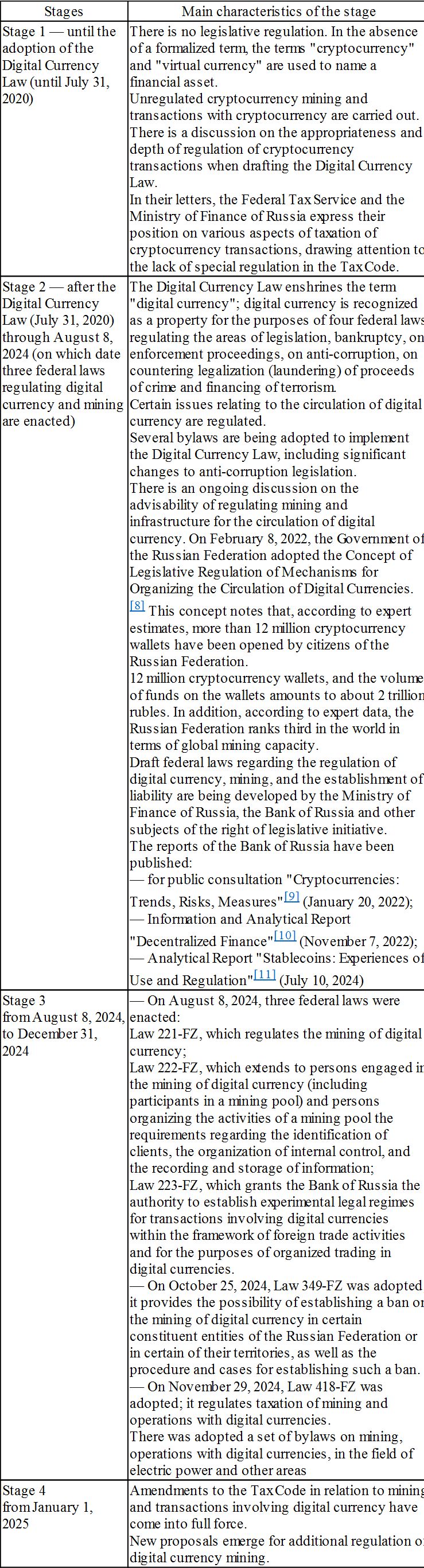
Let us look in more detail at the characterization of the stages, the main acts adopted during these periods, as well as the published reports of the Bank of Russia on this topic. Many issues discussed in the reports of the Bank of Russia are still relevant today.
Status before the adoption of the Digital Currency Law (stage 1)
As already mentioned, the term "digital currency" was introduced by the Digital Currency Law. Prior to that, the terms "cryptocurrency" and "virtual currency" were used. These terms were used by persons engaged in transactions with this digital asset, and these were also the terms used by the Bank of Russia and federal executive authorities in their documents.
Perhaps the period before the adoption of the Digital Currency Law can be most vividly characterized by information from three documents: the press release of the Bank of Russia, letters of the Ministry of Finance of the Russian Federation and the Federal Tax Service of Russia.
Let's look at the information from the Bank of Russia's press release of January 27, 2014, "On the use of ׳virtual currencies׳, in particular Bitcoin, in transactions":12
"The Bank of Russia notes that so-called 'virtual currencies', in particular Bitcoin, have recently become somewhat widespread in the world. Virtual currencies lack collateral and legally obliged entities. Transactions in virtual currencies are speculative in nature, are carried out on so-called 'virtual exchanges' and carry a high risk of loss of value.
The Bank of Russia warns citizens and legal entities, primarily credit organizations and non-credit financial organizations, against using 'virtual currencies' to exchange them for goods (work, services) or for money in rubles and foreign currency.
Article 27 of the Federal Law 'On the Central Bank of the Russian Federation (Bank of Russia)' prohibits the issuance of money surrogates on the territory of the Russian Federation.
Due to the anonymous nature of the activity of issuing 'virtual currencies' by an unlimited number of entities and their use for transactions, citizens and legal entities may be involved, unintentionally, in illegal activities, including legalization (laundering) of proceeds of crime and financing of terrorism.
The Bank of Russia warns that the provision by Russian legal entities of services involving the exchange of 'virtual currencies' for rubles and foreign currency and for goods (works, services) will be regarded as potential involvement in the conduct of dubious transactions in accordance with legislation on combating the legalization (laundering) of proceeds of crime and the financing of terrorism".
Let's see the position of the Ministry of Finance of Russia – Letter No. 03-11-11/63966 of the Department of Tax and Customs Policy of the Ministry of Finance of Russia, dated October 2, 2017, "On Regulation of the Issuance and Circulation of Cryptocurrencies":13
"<…> At the same time, we note that in accordance with Paragraph 1 of Article 75 of the Constitution of the Russian Federation, the monetary unit in the Russian Federation is ruble. Monetary emission is carried out exclusively by the Central Bank of the Russian Federation. In furtherance of these constitutional provisions, Article 27 of the Federal Law № 86-FZ, dated July 10, 2002, 'On the Central Bank of the Russian Federation (Bank of Russia)' establishes a ban on the introduction and circulation in the territory of the Russian Federation of monetary units other than the ruble and the issuance of monetary surrogates. In addition, Article 140 of the Civil Code of the Russian Federation determines that the ruble is a legal tender obligatory to be accepted at face value throughout the Russian Federation, and payments are made by cash and non-cash settlements.
It should be noted that virtual currencies (cryptocurrencies) do not have a centralized issuer, a single center of control over transactions and are characterized by anonymity of payments. The legal definition of cryptocurrencies, as well as their essence in the legislation of the Russian Federation is not defined <…>".
And I will conclude the review with information from Letter No. OA-18-17/1027 of the Federal Tax Service of Russia, dated October 3, 2016, "On Control over the Circulation of Cryptocurrencies (Virtual Currencies)",14 which shows in detail the position of the Federal Tax Service of Russia in many aspects at that time:
"<…> Article 27 of the Federal Law № 86-FZ, dated July 10, 2002, 'On the Central Bank of the Russian Federation (Bank of Russia)' establishes that the official monetary unit (currency) of the Russian Federation is ruble. The introduction in the territory of the Russian Federation of other monetary units and the issue of monetary surrogates are prohibited.
At the same time, the legislation of the Russian Federation does not enshrine such concepts as money surrogate, cryptocurrency, virtual currency.
In accordance with the Rosfinmonitoring information announcement posted on the official website www.fedsfm.ru, the use of cryptocurrencies during transactions is grounds for considering the question of classifying such transactions (operations) as transactions (operations) aimed at the legalization (laundering) of proceeds of crime and the financing of terrorism.
However, the legislation of the Russian Federation does not prohibit Russian citizens and organizations from conducting transactions using cryptocurrency.
The drafts of the federal laws, developed by the Ministry of Finance of the Russian Federation pursuant to the instruction of the President of the Russian Federation, V.V. Putin, dated March 25, 2014, No. Pr-604 'On Amendments to the Criminal Code of the Russian Federation and the Criminal Procedure Code of the Russian Federation' and 'On Amendments to Certain Legislative Acts of the Russian Federation' were recognized by the Government of the Russian Federation as requiring additional analysis of the risks of their possible use for unlawful (criminal) purposes, taking into account the results of monitoring the circulation of money surrogates (including cryptocurrencies), as well as additional analysis of the risks of their possible use for unlawful (criminal) purposes, taking into account foreign experience.
<…> Thus, in the opinion of the Federal Tax Service of Russia, transactions related to the acquisition or sale of cryptocurrencies using currency valuables (foreign currency and foreign securities) and (or) the currency of the Russian Federation are currency transactions, the procedure for which is established by the Law No. 173-FZ, and must be carried out through residents' accounts opened with authorized banks.
At the same time, we would like to inform you that the existing currency control system does not provide for the receipt by currency control authorities (the Bank of Russia, the Federal Tax Service of Russia, the Federal Customs Service of Russia) and currency control agents (authorized banks and professional securities market participants that are not authorized banks) from residents and non-residents of information on transactions involving the purchase and sale of cryptocurrencies.
At the same time, information on transactions involving the purchase and sale of cryptocurrencies for the purpose of controlling compliance with the requirements of currency legislation may be obtained by tax authorities from an authorized body in the field of combating the legalization (laundering) of proceeds of crime and the financing of terrorism.
In accordance with the Agreement on Cooperation and Organization of Information Interaction between the Federal Financial Monitoring Service and the Federal Tax Service, dated October 15, 2015, № 01-01-14/22440/MMV-23-2/77@ provides for the transfer by Rosfinmonitoring to the Federal Tax Service of Russia (including at the territorial level) of information on financial schemes being detected which have indications of tax evasion, illegal VAT refunds from the budget, premeditated bankruptcy and other unlawful acts related to bankruptcy, and violations of the currency legislation of the Russian Federation".
I draw attention to the conclusion of the Federal Tax Service of Russia that the legislation of the Russian Federation does not prohibit Russian citizens and organizations from carrying out transactions involving the use of cryptocurrency. I also draw attention to the fact that the existing currency control system did not provide the receipts by currency control authorities and agents from residents and non-residents of information on transactions involving the purchase and sale of cryptocurrencies.
Development of regulatory approaches (stage 2)
Undoubtedly, the key event of this period is the adoption of the Digital Currency Law, the analysis of the norms of which along various lines is offered in this book.
In addition to the Digital Currency Law, I will draw attention to several other documents in this section.
On January 20, 2022, the Bank of Russia published the Report for Public Consultation "Cryptocurrencies: Trends, Risks, Measures"15 (hereinafter – the "Cryptocurrencies Report").
Let's look at some of the findings that are outlined in the Cryptocurrencies Report Summary:
"1. The subject of the report is cryptocurrencies (unsecured cryptocurrencies and stablecoins) – digital currencies under Russian law, as well as digital financial assets that can be used in a foreign jurisdiction for payments (monetary surrogates).
2. Over the past year, the world has witnessed rapid growth in the cryptocurrency market. Their aggregate capitalization reached $2.3 trillion in December 2021. In December 2021, their total capitalization reached $2.3 trillion, which corresponds to approximately 1 % of global financial assets. The share of payment transactions attributable to cryptocurrencies is negligible compared to the figures for traditional payment systems, but due to their anonymity, monetary surrogates are actively used for settlements in illegal activities. The involvement of traditional financial intermediaries in the cryptocurrency market is still limited, but trading in derivatives and exchange-traded funds (ETFs) linked to cryptocurrencies is becoming more active, and decentralized finance ecosystems (DeFi) are developing.
3. The volume of transactions of Russian citizens with cryptocurrencies, according to some estimates, reaches $5 billion per year. The volume of transactions of Russian citizens with cryptocurrencies is estimated to be as high as $5 billion per year. Russian citizens are active users of Internet platforms trading cryptocurrencies. In addition, Russia is among the leaders in terms of global mining capacity.
<…> 9. To reduce the threats caused by the spread of cryptocurrencies, the Bank of Russia proposes the following amendments to the legislation:
• Establish liability for violation of the legislative prohibition on the use of cryptocurrencies as a means of payment for goods, work and services sold and purchased by legal entities and individuals who are residents of the Russian Federation.
• Introduce a ban on the organization of the issuance and (or) issue, organization of the circulation of cryptocurrency (including crypto exchanges, crypto exchanges, P2P platforms) in the territory of the Russian Federation and to establish liability for violation of this ban.
• Introduce a ban on investments by financial organizations in cryptocurrencies and related financial instruments, as well as on the use of Russian financial intermediaries and Russian financial infrastructure for transactions involving cryptocurrencies and establish liability for violation of this ban.
10. For some types of cryptocurrencies, mining involves, among other things, issuing cryptocurrency and/or receiving cryptocurrency as a reward for validating transactions.
It cannot be disregarded when considering the subject matter of the report, as this activity increases the involvement of the population and the economy in the cryptocurrency market. The Bank of Russia believes that the current scale and further spread of cryptocurrency mining in Russia poses significant risks to the economy and financial stability:
– creates unproductive electricity consumption, jeopardizing energy supply to residential buildings, social infrastructure buildings and enterprises, as well as the implementation of the environmental agenda of the Russian Federation;
– creates demand for infrastructure for cryptocurrency transactions, which amplifies the negative effects of cryptocurrency proliferation and creates incentives to circumvent regulation <…>.
Bepul matn qismi tugad.